 TrackMedia
 TrackRev

 Redocly
 Bump.sh
 APIMatic
 Theneo
 Archbee
 ClickHelp
 Heretto
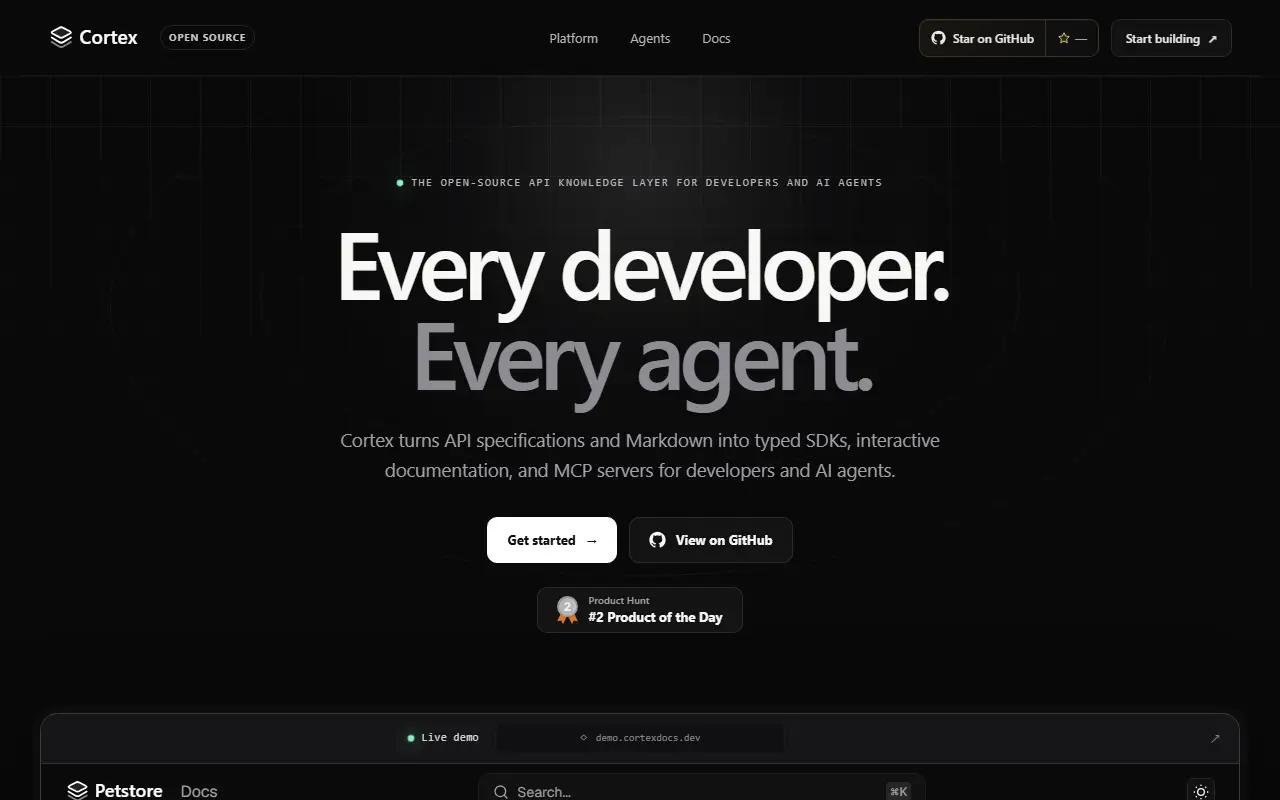
About Cortex Docs
Cortex turns API specifications and Markdown files into developer-facing outputs from a single project configuration. It reads sources such as OpenAPI, AsyncAPI, GraphQL, Protocol Buffers, OpenRPC, and plain Markdown, and produces interactive documentation for people, typed SDKs for applications, and an MCP server so AI agents can work with the same project context. It is released under the MIT license.
Generated SDKs cover many languages, including TypeScript, Python, Go, Java, Kotlin, Ruby, PHP, Rust, and C++, and can combine several specification files into one client. The tool supports HTTP, WebSocket, GraphQL, gRPC, and JSON-RPC clients, and builds static HTML documentation with interactive API reference pages. The MCP server includes typed tools, embedded specifications, and SDK guides.
You can try a local demo in about a minute, keep documentation in Git, and publish a free site for a public GitHub repository through the project's hosting flow. It suits API providers and developer-experience teams who want one source of truth for docs, client libraries, and agent access.
Key features
- Interactive API reference documentation
- Typed SDK generation for many languages
- MCP server generated from API specs
- Supports OpenAPI, AsyncAPI, GraphQL, gRPC, and OpenRPC
- Combines multiple spec files in one SDK
- Static HTML documentation output
- Markdown content kept in Git
Good fit for
- Publishing API docs and SDKs from one config
- Giving AI agents access to API documentation
Cortex Docs: questions and answers
- What is Cortex Docs used for?
- Cortex Docs generates interactive API documentation, typed SDKs, and MCP servers from OpenAPI, AsyncAPI, GraphQL, gRPC, OpenRPC, and Markdown sources. It is a good fit for publishing API docs and SDKs from one config, and giving AI agents access to API documentation.
- Is Cortex Docs open source?
- Yes. Cortex Docs is open source under the MIT licence. Its source code is on GitHub at cortex-docs/cortex and is written mainly in TypeScript.
- Is Cortex Docs free?
- Yes. Cortex Docs is open source, so the software itself is free to use. A managed cloud version is also available.
- What is Cortex Docs an alternative to?
- Cortex Docs is an open-source alternative to Mintlify, ReadMe, Speakeasy and SwaggerHub. Other open-source alternatives to Mintlify include Scalar, GitBook and Readthedocs.org.
- Is Cortex Docs actively maintained?
- Yes. The most recent commit to Cortex Docs was on 6 October 2026, and the latest release is v0.1.36, published on 28 September 2026. The project has 3.3k stars on GitHub, with 53 added in the last 30 days.
Open-source alternatives to Cortex Docs
See all
Scalar
API Tools
Scalar is an open-source API platform: 🌐 Modern RES
MITvs Postman★ 16k
OpenAPI Generator
API Tools
OpenAPI Generator allows generation of API client libraries (SDK generation), server stubs
Apache-2.0vs Stainless★ 27k
GitBook
Docs & Wikis
The open source frontend for GitBook doc sites
GPL-3.0vs GitBook★ 29k
Readthedocs.org
Docs & Wikis
The source code that powers readthedocs.org
MITvs GitBook★ 8.4k
Insomnia
API Tools
The open-source, cross-platform API client for GraphQL, REST, WebSockets, SSE and gRPC. Wi
Apache-2.0vs Postman★ 40k
Bruno
API Tools
Bruno is the Git-native API client for REST, GraphQL, gRPC and Websocket. A local and open
MITvs Postman★ 48k
SaaS alternatives to Cortex Docs
See all
Mintlify
Docs & Wikis
Developer documentation platform with API reference pages and AI search
SaaS
ReadMe
API Tools
Hosted API documentation and developer hub with usage analytics
SaaS
Speakeasy
API Tools
Generates SDKs, Terraform providers and docs from OpenAPI specs
SaaS
SwaggerHub
API Tools
Collaborative platform for designing and documenting OpenAPI-based APIs
SaaS
Stoplight
API Tools
API design, documentation and governance platform now owned by SmartBear
SaaS
Stainless
API Tools
Generates typed client SDKs and docs from OpenAPI specs
SaaS