10 open-source alternatives ranked by real activity

Open-source Spotify alternatives

A curated, ranked list of the 10 best open-source alternatives to Spotify.

The best open-source alternative to Spotify is Spotube. If that doesn't suit you, other good options are Navidrome, Feishin, Koel and Gonic.

Commercial alternatives to Spotify include Deezer, Amazon Music, Tidal and YouTube Music. See all 27.

Spotify alternatives are mainly media & streaming tools, but some are also developer tools. 9 of them shipped code in the last 30 days, 10 can be self-hosted, and 3 use a permissive licence.

Last updated November 12, 2026 · ranked by GitHub stars, growth and recent commits

Spotube

A cross-platform, plugin-based open-source music streaming app for desktop and mobile that avoids telemetry and keeps playback control local.

GitHub stars
51k
Last commit
yesterday
Latest release
v6.0.0
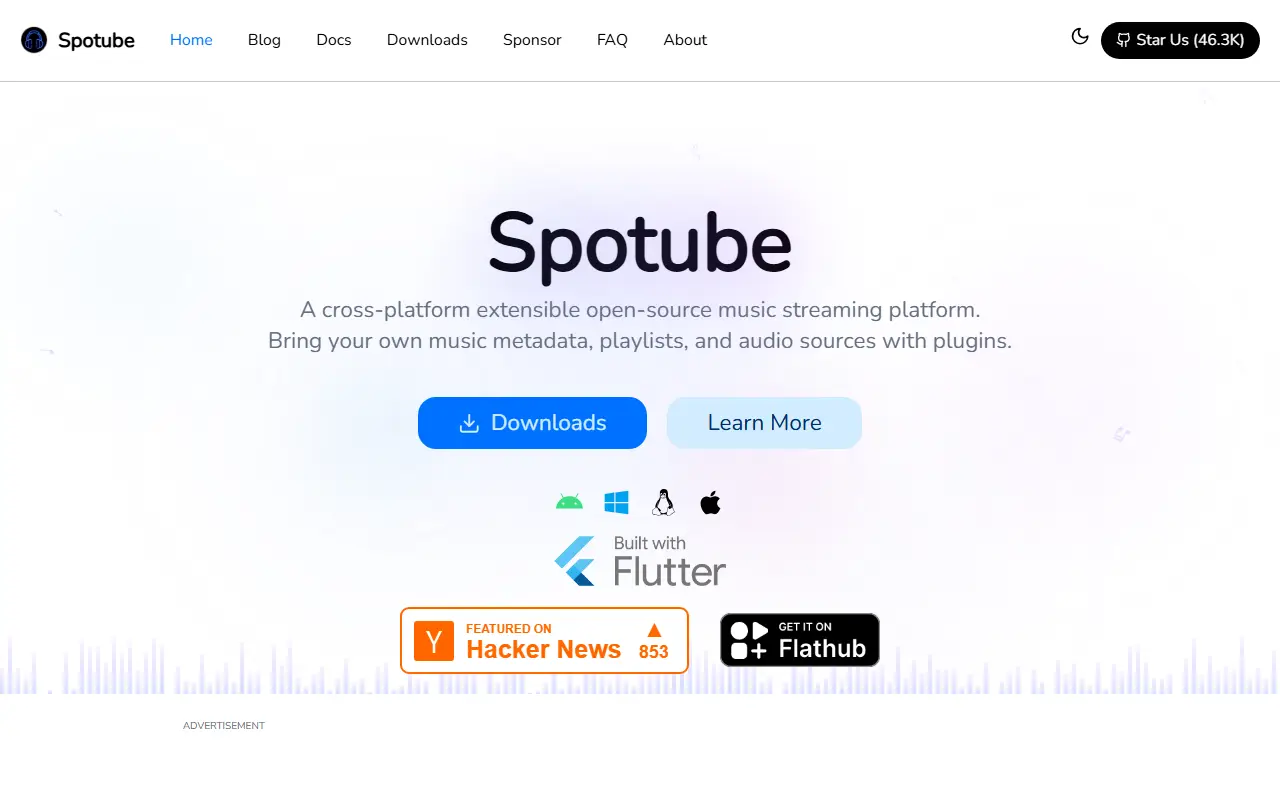
spotube.ccSpotube homepage screenshot

Spotube is an extensible, open-source music streaming app for desktop and mobile, written in Dart with Flutter. Rather than being tied to one service, it relies on plugins that supply music metadata, playlists and audio sources, so community-made or custom plugins can add support for different platforms. GitHub lists the license as 'Other'.

The README highlights freely downloadable tracks with tagged metadata, time-synced lyrics regardless of plugin support, a small installation size, low data usage and native performance. Playback control is done locally rather than on a server, and the project states it has no telemetry, diagnostics or user data collection.

Installers and packages cover Windows, macOS, Android, Linux through Flatpak, Debian, Arch, Fedora and openSUSE packages, and Homebrew, while iOS uses an IPA file that needs sideloading. New versions usually arrive every three to four months. It suits listeners who want a lightweight, privacy-minded music client they can extend with plugins.

Key features

  • Plugin-based music sources and metadata
  • Plugins built by the community
  • Downloadable tracks with tagged metadata
  • Time-synced lyrics for any plugin
  • No telemetry or user data collection
  • Desktop and mobile support

Pricing: Spotube is open source and free to use, with no premium subscription. The project is funded by community donations, sponsorships and website ads.

Feishin

A self-hosted music player client for Navidrome, Jellyfin and Subsonic-compatible servers, offered as a desktop app and a web app.

GitHub stars
10k
Last commit
2 days ago
Latest release
v1.17.0
Licence
GPL-3.0
Self-hosted
Yes
Hosted version
Available
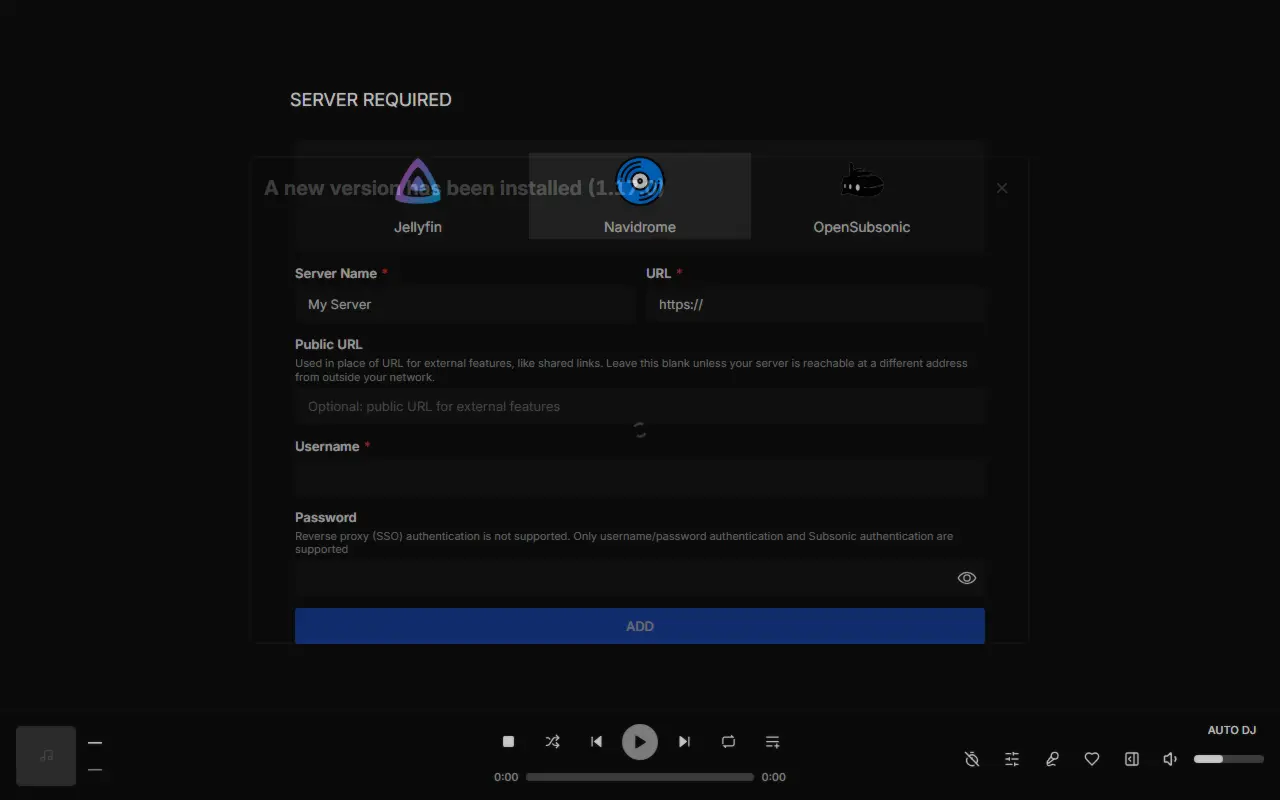
feishin.vercel.appFeishin homepage screenshot

Feishin is a modern music player built for self-hosted music servers. It acts as a client for Navidrome, Jellyfin and other Subsonic-compatible servers, and is a rewrite of the earlier Sonixd player. You keep your library on your own server and use Feishin to browse and play it.

Features include an MPV player backend for the desktop app and a web player backend, a modern interface, scrobbling of playback to your server, a smart playlist editor for Navidrome, and synchronized and unsynchronized lyrics, with built-in lyric fetching in the desktop app. The project recommends the desktop app as the main way to use it, with macOS notes about quarantine and accessibility permissions, a Flathub package and an AppImage install script for Linux, including an experimental Wayland option.

A hosted web instance is available at feishin.vercel.app, and the web app can also be run with Docker. Feishin is written in TypeScript, uses Electron for the desktop build and is licensed under GPL-3.0. It suits people who run Navidrome or Jellyfin at home and want a polished player.

Key features

  • Client for Navidrome, Jellyfin and Subsonic
  • MPV player backend on desktop
  • Web player backend
  • Scrobbling playback to your server
  • Smart playlist editor for Navidrome
  • Synchronized lyrics support
  • Desktop app, web app and Docker

Pricing: Free and open source under the GPL-3.0 licence.

Koel

Koel is a self-hosted, web-based music streaming server built with Laravel and Vue that serves your personal music collection in any browser.

GitHub stars
17k
Last commit
yesterday
Latest release
v9.15.0
Licence
MIT
Self-hosted
Yes
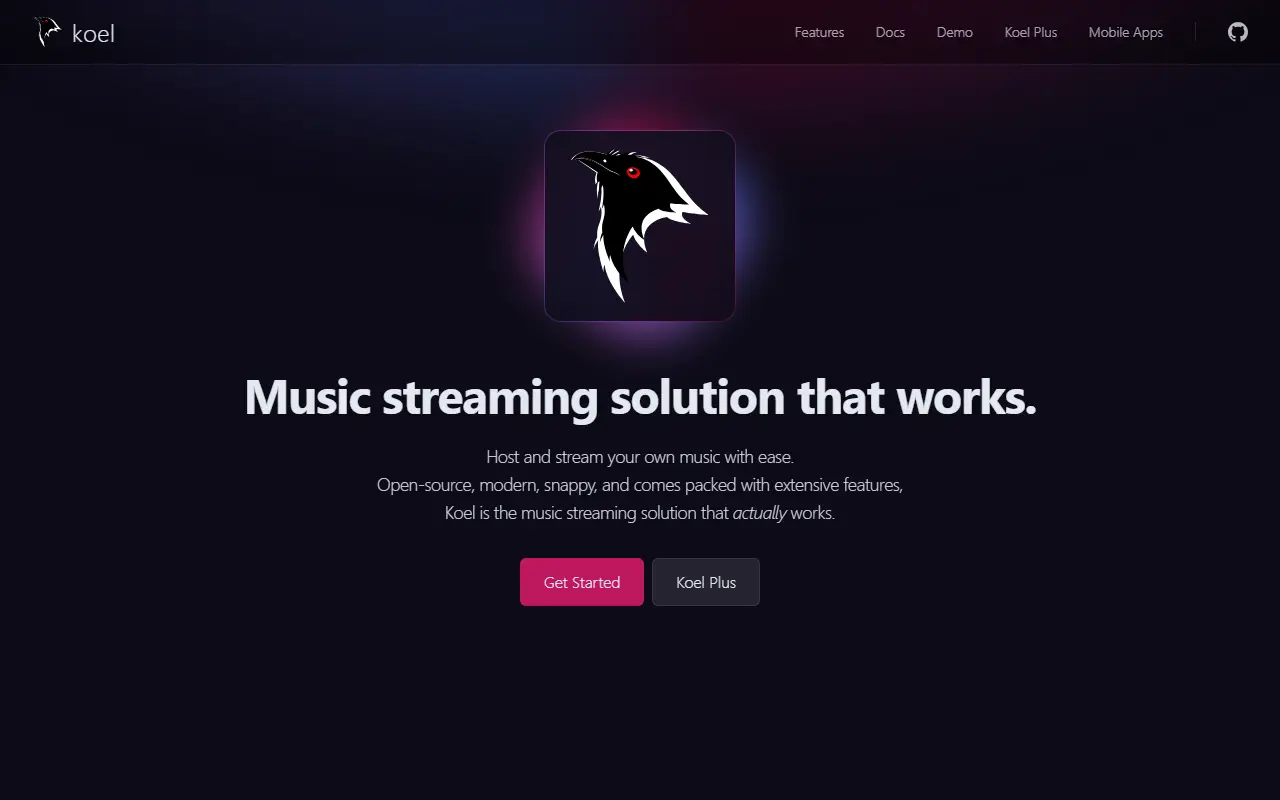
koel.devKoel homepage screenshot

Koel is a free, open-source music streaming server that turns a personal music collection into a web-based player. It is built on Laravel and Vue, scans a music library and serves it back through a modern interface that works in any browser.

Beyond playback, Koel supports playlists and smart playlists, scrobbling, podcasts and radio, integrations with Last.fm, Spotify and MusicBrainz, and an AI assistant that responds to natural-language commands. Koel Player is the official mobile app for iOS and Android, which avoids the limits of the mobile web version.

The core is MIT licensed and designed to be self-hosted, with install and upgrade guides in the official documentation. A premium edition, Koel Plus, adds multi-user libraries, collaboration, SSO, cloud storage drivers, custom themes and white-labeling for organizations that want to run their own streaming service. The author is supported through sponsors on OpenCollective and GitHub.

Key features

  • Web-based streaming of a personal music library
  • Playlists and smart playlists
  • Scrobbling with Last.fm, Spotify and MusicBrainz links
  • Podcast and radio support
  • AI assistant for natural-language commands
  • Official iOS and Android app

Pricing: The core is free and open source under MIT; the premium Koel Plus edition adds multi-user and SSO features.

Read more about KoelWebsiteGitHub#4 Spotify alternative

Gonic

Gonic is a lightweight, self-hosted music streaming server written in Go that implements the Subsonic API for many existing clients.

GitHub stars
2.7k
Last commit
2 days ago
Latest release
v0.23.0
Licence
GPL-3.0
Self-hosted
Yes
web.libera.chatGonic homepage screenshot

Gonic is a free-software music streaming server that implements the Subsonic server API, so it works with the many apps that speak that protocol. It is written in Go, which keeps it lightweight enough for devices such as a Raspberry Pi, and ARM images are provided. It is licensed under GPL-3.0.

You can browse your collection by folder, which keeps your directory tree intact, or by tags read with taglib for formats including mp3, opus, flac, ape, m4a and wav. It supports on-the-fly audio transcoding with caching through ffmpeg, the Subsonic jukebox mode for gapless server-side playback, podcasts, multiple users with their own playlists and preferences, and scrobbling to last.fm and ListenBrainz. Artist biographies and similar artists come from the last.fm API.

A web interface handles configuration, such as connecting last.fm, managing users and starting library scans. The project lists tested clients including DSub, Symfonium, Amperfy, Tempus, Strawberry and Ultrasonic. Installation is possible from source, with Docker or with systemd, and the default login is admin, which you should change after the first sign-in.

Key features

  • Subsonic API implementation for many clients
  • Browse by folder or by tags
  • On-the-fly transcoding with caching
  • Multiple users with separate playlists
  • last.fm and ListenBrainz scrobbling
  • Podcast support and jukebox mode
  • Web interface for configuration

Pricing: Free and open source under the GPL-3.0 license.

Tempus

Tempus is a native Android music client for Subsonic servers, built around listening history and randomness rather than recommendation algorithms.

GitHub stars
1.4k
Last commit
yesterday
Latest release
v4.32.0
Licence
GPL-3.0
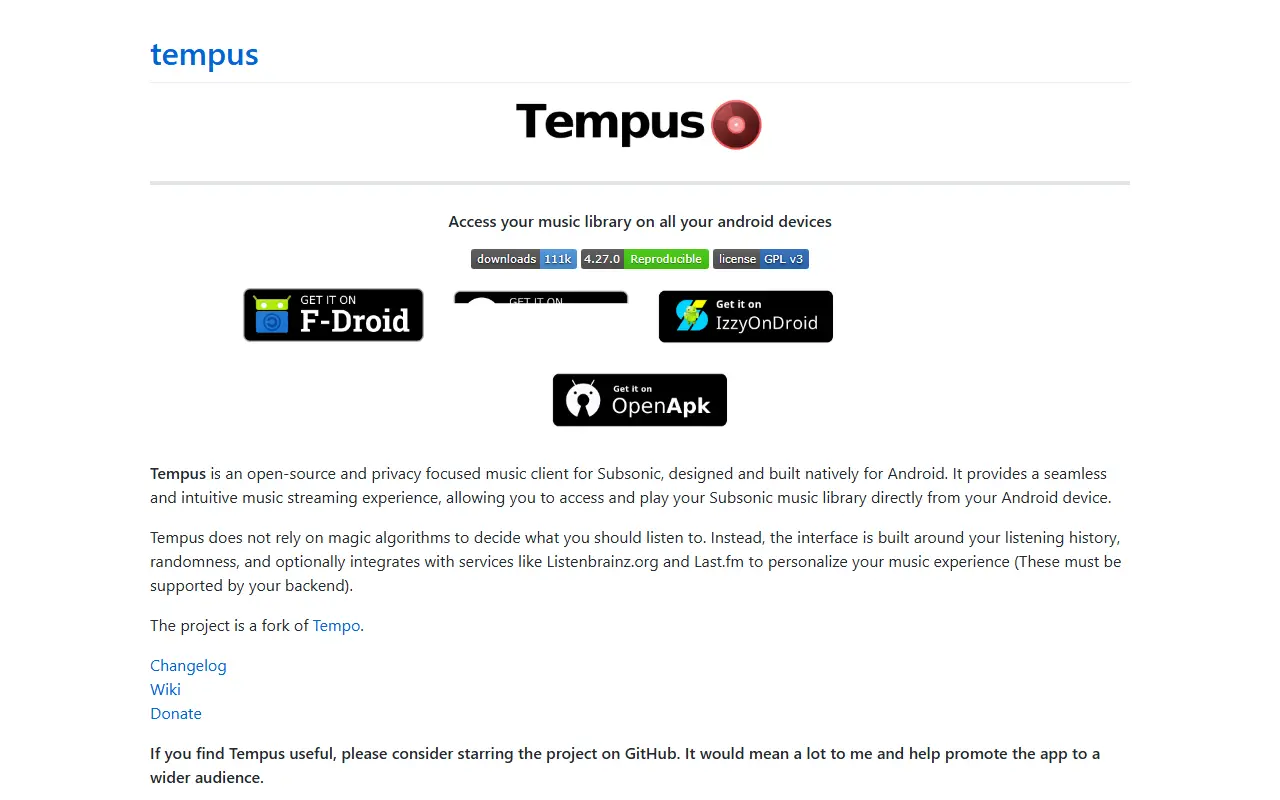
eddyizm.github.ioTempus homepage screenshot

Tempus is an open-source Android app that connects to a Subsonic server and plays the music library stored there. The interface is organised around your own listening history and randomness instead of an algorithm that picks tracks for you. It is a fork of the Tempo project and is released under GPL-3.0.

Beyond streaming, the app offers library browsing, playlist management, gapless playback and ReplayGain volume handling. It can scrobble to Last.fm or Listenbrainz.org when the backend supports it, play podcasts if the server provides them, and save Internet radio stations on the device itself.

Two release flavours exist. The GitHub build carries the Android Auto and Chromecast features, while the degoogled build published through F-Droid and IzzyOnDroid leaves out the Google components. Both 32-bit and 64-bit APKs are published on GitHub.

Key features

  • Browse by artist, album, genre, playlist or decade
  • Gapless playback between tracks
  • ReplayGain volume normalization with preamp offset
  • Optional Last.fm and Listenbrainz.org scrobbling
  • Podcast playback when the server supports it
  • Save Internet radio stations locally
  • Set a transcoding profile for streaming

Mopidy

Mopidy is a Python-based, extensible music server that plays local files and streaming sources and can be controlled from MPD or web clients.

GitHub stars
8.6k
Last commit
10 days ago
Latest release
v4.0.5
Licence
Apache-2.0
Self-hosted
Yes
mopidy.comMopidy homepage screenshot

Mopidy is a music server written in Python and designed to be extended. It runs on a computer or small device and plays music that you control remotely from a phone, tablet or another computer, using any MPD client or web client.

Music can come from local disk, Spotify, SoundCloud, internet radio and other sources, with additional sources added through extensions listed on the project website. This design lets one server and one set of clients cover many services. Packages and installation instructions exist for Debian, Ubuntu, Raspberry Pi OS, Arch Linux and macOS, as well as manual installation.

Mopidy is licensed under Apache-2.0. The project provides documentation for installing, configuring and developing extensions, a Discourse forum for help and a Zulip chat for development discussion. Contributions such as bug fixes, testing, documentation and user support are welcome.

Key features

  • Plays local music files
  • Streaming sources through extensions
  • Control from any MPD client
  • Web client support
  • Packages for Debian, Raspberry Pi OS and macOS
  • Extension system written in Python

Pricing: Free and open source under the Apache-2.0 licence.

GNU Emacs

GNU Emacs, an extensible and customizable free text editor built around an Emacs Lisp interpreter, with features reaching well beyond editing.

GitHub stars
5.2k
Last commit
yesterday
Licence
GPL-3.0
Self-hosted
Yes
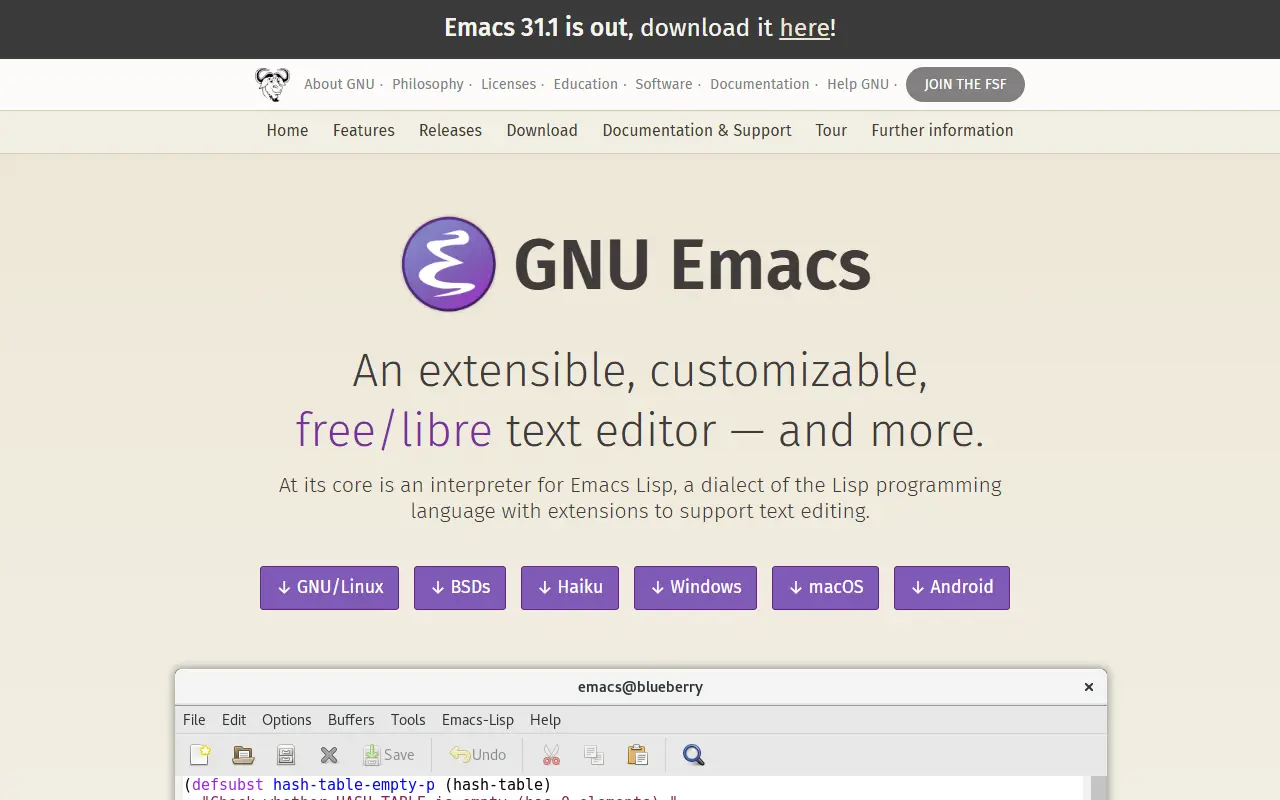
gnu.orgGNU Emacs homepage screenshot

GNU Emacs is an extensible, customizable, free text editor. The editor is built around an Emacs Lisp interpreter, a Lisp variant extended for editing text, and that same language is used to customize and extend it, which makes nearly every behavior of the editor programmable by its users.

Emacs offers content-aware editing modes with syntax coloring for many file types, built-in documentation with a tutorial for new users, and full Unicode support. It doubles as a calendar, an IRC client, a news and mail reader, a project planner and a front end for debuggers, and a packaging system downloads and installs extensions.

Emacs runs on GNU/Linux, the BSDs, Haiku, Windows, macOS and Android, and is licensed under GPL-3.0. Customization is done with Emacs Lisp code or a graphical interface. The GitHub repository is a mirror of the GNU project's source, and the official site offers downloads, a guided tour and documentation.

Key features

  • Emacs Lisp scripting and customization
  • Content-aware editing modes with syntax coloring
  • Built-in documentation and tutorial
  • Full Unicode support
  • Package system for extensions
  • Mail, news and IRC clients
  • Debugger interface and calendar

Pricing: Free software under the GPL-3.0 licence.

Ampache

A web-based audio and video streaming application and file manager for accessing your music and videos from nearly any internet-enabled device.

GitHub stars
3.8k
Last commit
2 days ago
Latest release
8.4.0
Licence
AGPL-3.0
Self-hosted
Yes
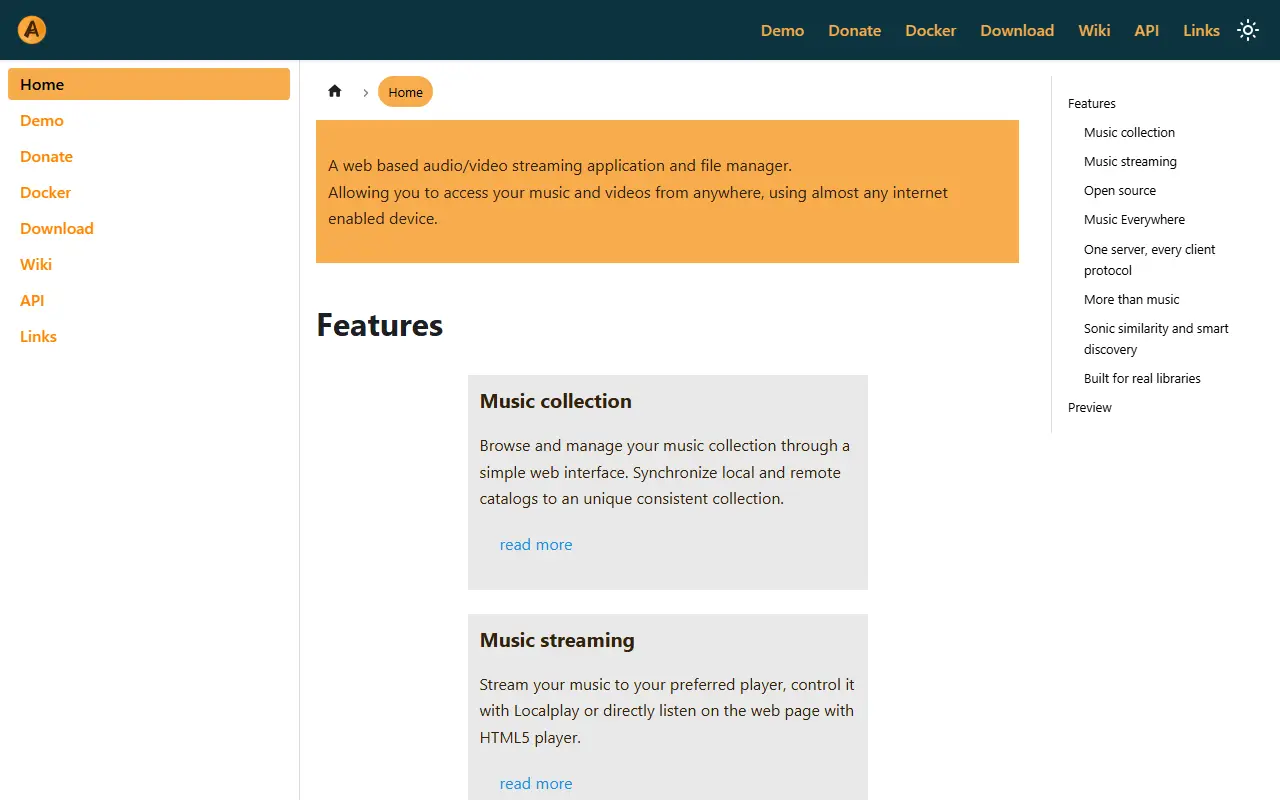
ampache.orgAmpache homepage screenshot

Ampache is a web-based audio and video streaming application and file manager that lets you reach your music and videos from almost any internet-enabled device. It presents an already organized collection in a useful way rather than reorganizing your files.

Its usefulness depends on extracting correct metadata from embedded tags or file names, and it assumes you manage your files yourself. It runs on web servers including Apache, lighttpd, nginx and IIS, with most testing on Apache, and a documented API supports clients. The development branch, Ampache 8, adds an opt-in Jellyfin-compatible API so third-party clients such as Finamp and Symfonium can browse and stream a library.

The project recommends the stable release 7 branch for most users, notes that the develop branch can be unstable and needs PHP 8.5 or later, and provides a Docker image, wiki and admin and user guides. Ampache is written in PHP and licensed under AGPL-3.0.

Key features

  • Web-based audio and video streaming
  • File manager for media collections
  • Metadata from embedded tags and filenames
  • Documented API for third-party clients
  • Opt-in Jellyfin-compatible API
  • Runs on Apache, nginx, lighttpd and IIS
  • Docker image available

Pricing: Free and open source under the AGPL-3.0 licence.

Jukebox

Open-source collaborative playlist app where friends join a shared box through a link and queue YouTube songs without accounts.

GitHub stars
313
Last commit
1 yr ago
Licence
MIT
Self-hosted
Yes
Hosted version
Available

Jukebox is an open-source alternative to Spotify collaborative playlists. Someone creates a box, shares the invite link, and everyone who opens it can add songs in real time. No app download, sign-up or email is needed, and it runs in the browser on phones, tablets and desktops.

Songs come from YouTube: users search for a track or add one manually, and a built-in player streams the queue. Fair queueing sorts the songs automatically so each person gets a turn, which targets the argument over who controls the music.

The code is TypeScript under the MIT licence, with an Express server, a worker and a React frontend. Self-hosting needs Node.js 16 or newer, a free YouTube Data API v3 key and database migrations, and Docker Compose files are provided for deployment.

Key features

  • Shared playlist created with a link
  • Anonymous use with no account
  • YouTube search and playback
  • Fair queueing so everyone gets a turn
  • Mobile-first, responsive interface
  • Docker Compose deployment with zero-downtime redeploy

Commercial Spotify alternatives

Hosted, closed-source products that compete with Spotify. Showing 12 of 27.

See every Spotify alternative on its tool page

Spotify alternatives: questions

What is the best open-source alternative to Spotify?
Spotube is the top-ranked open-source alternative to Spotify on Enlisted: A cross-platform, plugin-based open-source music streaming app for desktop and mobile that avoids telemetry and keeps playback control local. Other strong options are Navidrome, Feishin, Koel and Gonic.
What are the best commercial alternatives to Spotify?
Deezer, Amazon Music, Tidal, YouTube Music and Pandora are among the hosted, closed-source alternatives to Spotify listed on Enlisted, which lists 27 in total. Compare their pricing and features on each tool page.
Are these Spotify alternatives free?
All 10 are open source, so the code is free to use under its licence, and all of them can be self-hosted on your own server or computer. 3 also offer a paid or managed cloud version if you'd rather not host it yourself.
How is this list of Spotify alternatives ranked?
By a score built from GitHub stars, star growth over the last 30 days and how recently the code changed. 9 of these projects shipped code in the last 30 days. Data is refreshed daily, and nobody can pay to move up.

People also look for alternatives to…

View all