
About Vim
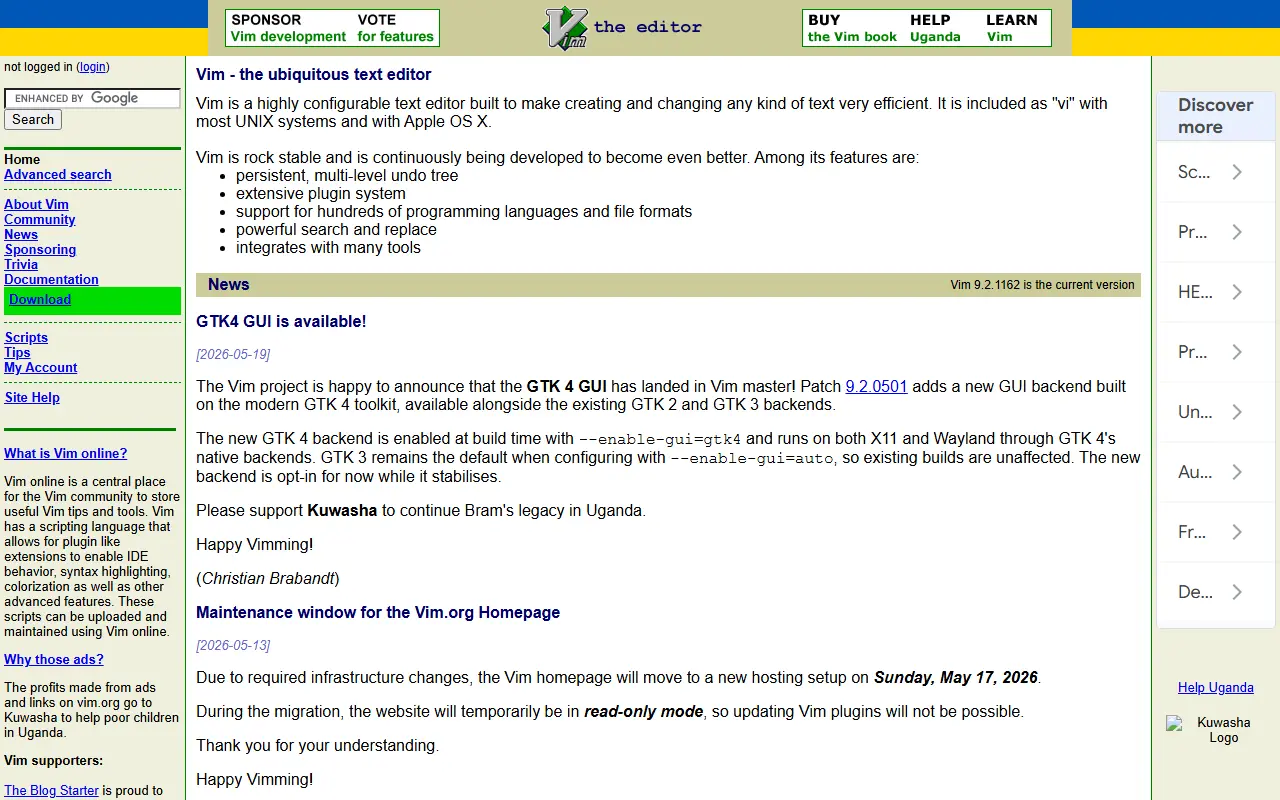
Vim is an enhanced descendant of the classic UNIX editor Vi. It adds spell checking, syntax highlighting, filename completion, block operations, a command history, online help, a scripting language and multi-level undo, and a graphical interface is also available. Vi compatibility is maintained, so people who learned Vi feel at home. This is the official repository, and the license is Vim's own.
It works well for source code and other plain text. Commands are typed with ordinary keyboard characters, which lets fast typists work quickly, while function keys can be mapped to commands and the mouse can be used. It can also be built with a minimal feature set, usually called vim.tiny, to act as a largely POSIX-compatible vi, which many Linux distributions ship as their default vi.
Vim runs on Windows, macOS, Haiku, VMS and almost all flavors of UNIX, and older versions ran on systems such as MS-DOS and Amiga that are no longer maintained. Vim9 script is documented separately. On Mac and Linux a small version is often preinstalled, and package managers provide fuller builds. It suits developers, system administrators and writers who edit text from the keyboard.
Key features
- Multi-level undo and syntax highlighting
- Built-in spell checking and filename completion
- Scripting language including Vim9 script
- Optional graphical user interface
- Vi compatibility and minimal vim.tiny build
- Runs on Unix-like systems, Windows and macOS
Good fit for
- →Programming and configuration editing
- →Editing files on remote servers
- →Keyboard-driven text editing
- Built with
- Vim Script
- Tags
- text-editor
- vim
- vi
- terminal
- cross-platform
- editor
- scripting
- command-line
Vim: questions and answers
- What is Vim used for?
- Vim: The official repository of Vim, a highly configurable modal text editor derived from Vi that runs on Unix, Windows, macOS and other systems. It is a good fit for programming and configuration editing, editing files on remote servers, and keyboard-driven text editing.
- Is Vim open source?
- Yes. Vim is open source under the Vim licence. Its source code is on GitHub at vim/vim and is written mainly in Vim Script.
- Is Vim free?
- Yes. Vim is open source, so the software itself is free to use.
- What is Vim an alternative to?
- Vim is an open-source alternative to Sublime Text and BBEdit. Other open-source alternatives to Sublime Text include Neovim, Helix and GNU Emacs.
- Is Vim actively maintained?
- Yes. The most recent commit to Vim was on 1 October 2026. The project has 41k stars on GitHub.
Open-source alternatives to Vim
See all
Neovim
Developer Tools
Vim-fork focused on extensibility and usability
OSSvs Sublime Text★ 103k
Helix
Developer Tools
A post-modern modal text editor.
MPL-2.0vs Sublime Text★ 46k
GNU Emacs
Developer Tools
Mirror of GNU Emacs
GPL-3.0vs Sublime Text★ 5.2k
Zed
Developer Tools
Code at the speed of thought – Zed is a high-performance, multiplayer code editor from the
OSSvs Sublime Text★ 91k
VSCodium
Developer Tools
binary releases of VS Code without MS branding/telemetry/licensing
MITvs Sublime Text★ 33k
Visual Studio Code
Developer Tools
Visual Studio Code
MITvs Sublime Text★ 193k
SaaS alternatives to Vim
See all
Sublime Text
Developer Tools
Fast cross-platform text and code editor with multi-select and a Python plugin API
SaaS
BBEdit
Developer Tools
Text, code and markup editor for macOS
SaaS
Nova
Developer Tools
macOS code editor from Panic with built-in terminal, Git and extensions
SaaS
CLion
Developer Tools
Cross-platform IDE for C and C++ development from JetBrains
SaaS
RubyMine
Developer Tools
JetBrains IDE for Ruby and Rails development
SaaS
RustRover
Developer Tools
JetBrains IDE for Rust development
SaaS