5 open-source alternatives ranked by real activity

Open-source Upscope alternatives

A curated, ranked list of the 5 best open-source alternatives to Upscope.

The best open-source alternative to Upscope is RustDesk. If that doesn't suit you, other good options are Jitsi Meet, OpenReplay, Apache Guacamole and OpenVidu.

Commercial alternatives to Upscope include Surfly, Fullview, Zoho Assist and Chrome Remote Desktop. See all 14.

Upscope alternatives are mainly networking & VPN tools, but some are also video conferencing tools and session replay tools. 5 of them shipped code in the last 30 days, 5 can be self-hosted, and 3 use a permissive licence.

Last updated November 12, 2026 · ranked by GitHub stars, growth and recent commits

RustDesk

An open-source remote desktop application written in Rust, designed for self-hosting and positioned as an alternative to TeamViewer.

GitHub stars
129k
Last commit
yesterday
Latest release
1.5.3
Licence
AGPL-3.0
Self-hosted
Yes
Hosted version
Available
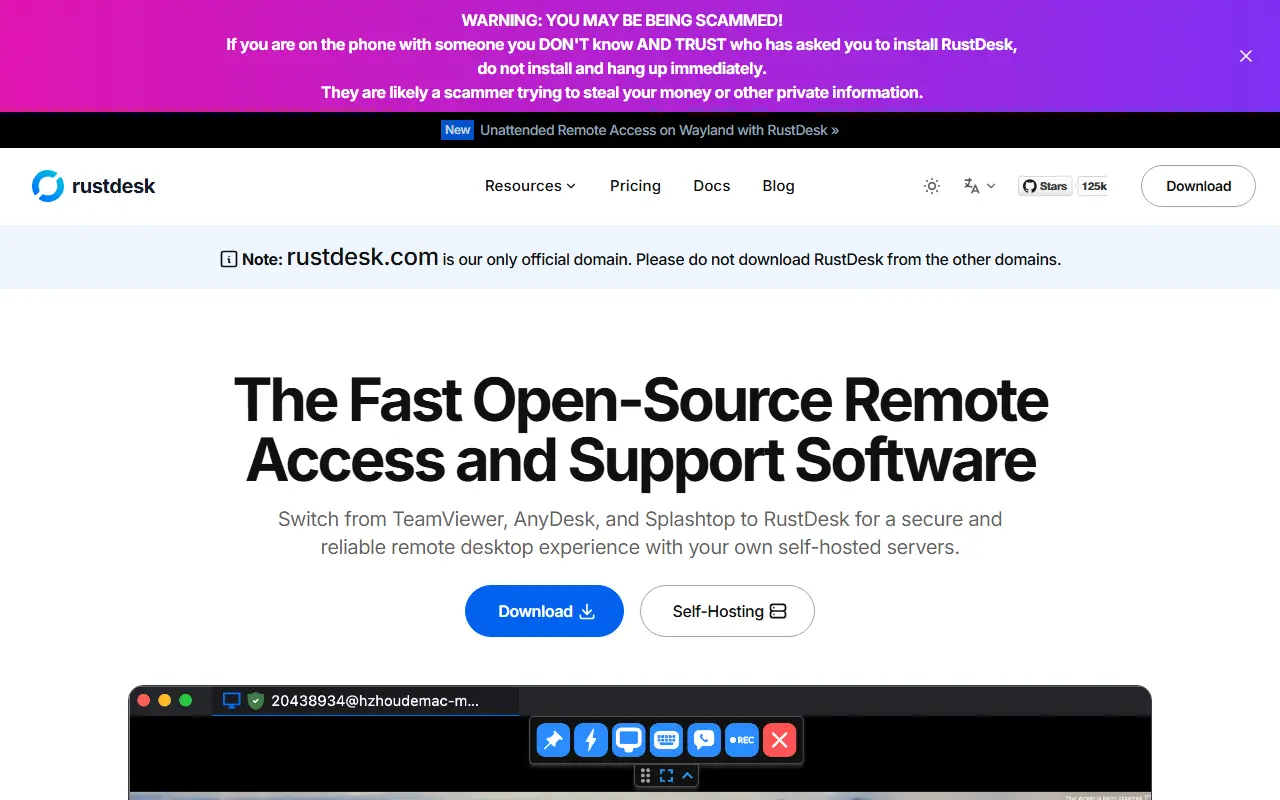
rustdesk.comRustDesk homepage screenshot

RustDesk is a remote desktop application that lets you view and control another computer over the network. It is written in Rust with a Flutter interface, released under AGPL-3.0, and designed for self-hosting, making it an open-source alternative to TeamViewer. The project says no setup is needed to get started.

You decide where connection brokering happens: use the project's rendezvous and relay servers, run your own, or write a custom one. Clients exist for Windows, macOS, Linux, Android and iOS, with Wayland support on Linux, and the codebase includes peer-to-peer connection support. Because you can host the servers yourself, you keep control of your data.

Desktop builds use Flutter for the interface, while the older Sciter interface is deprecated. The README includes a misuse disclaimer stating that the developers do not support unauthorized access or privacy invasion. It suits IT teams, support staff and individuals who want remote access without relying entirely on a third-party service.

Key features

  • Remote desktop viewing and control
  • Self-hostable rendezvous and relay servers
  • Clients for desktop and mobile platforms
  • Peer-to-peer connection mode
  • Flutter-based cross-platform interface
  • Usable immediately with no setup

Pricing: Free self-hosting plan. Paid self-hosted Pro plans cost $11.88 (Individual) and $23.88 (Basic and Customized) per month billed annually; only annual payment is offered. This is not a SaaS subscription.

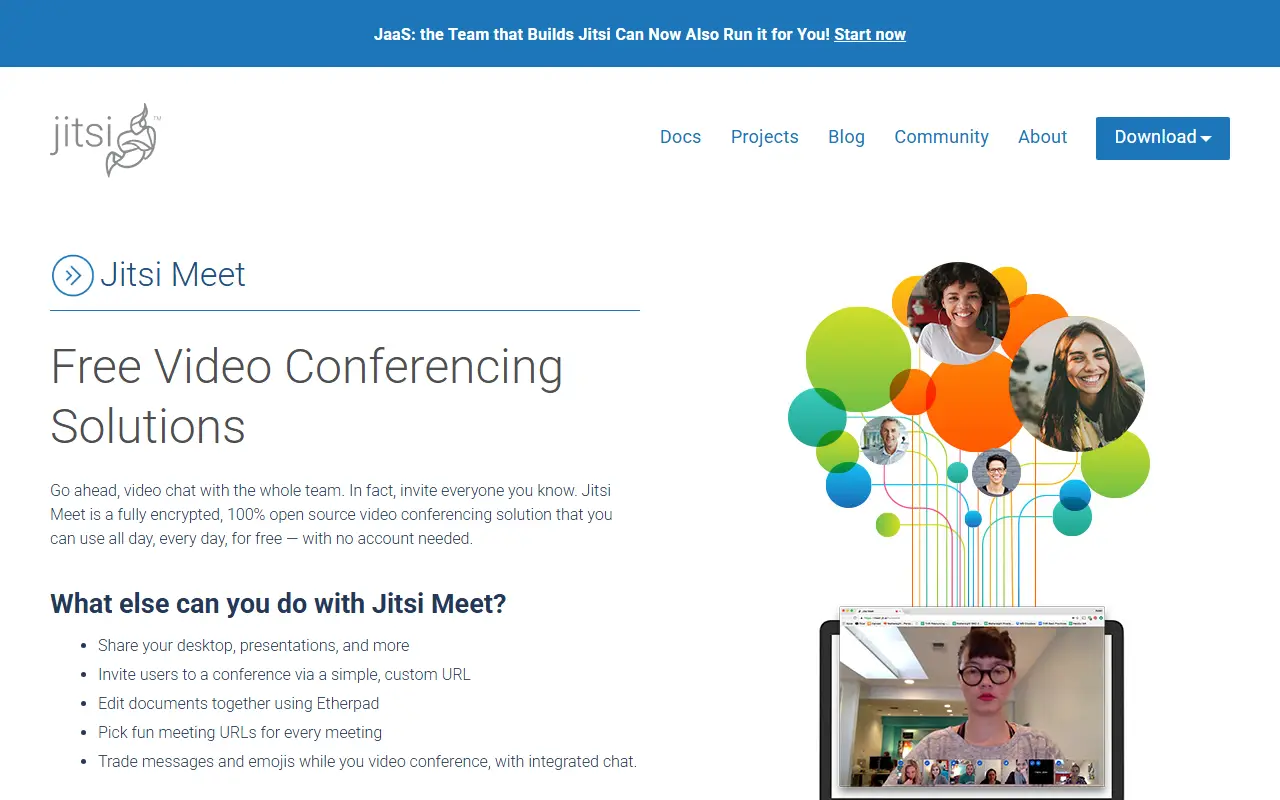
Jitsi Meet

An open-source video conferencing platform that runs in the browser and mobile apps, usable as a standalone service or embedded in your own web application.

GitHub stars
30k
Last commit
today
Latest release
stable/jitsi-meet_11248
Licence
Apache-2.0
Self-hosted
Yes
Hosted version
Available
jitsi.orgJitsi Meet homepage screenshot

Jitsi Meet is a collection of open-source projects for hosting video conferences. It works in all current browsers and has Android and iOS apps, and it can be used as a ready-made service or embedded into other web applications through web and native SDKs. It is built on WebRTC with a selective forwarding unit to scale to larger meetings.

Meetings offer HD audio and video, content sharing, raised hands and reactions, chat with private conversations, polls and virtual backgrounds. The hosted service at meet.jit.si is free to use, and the README says you can start a meeting after signing in with an account from a major provider. Mobile users can use the browser or the full-featured apps, which are also available from F-Droid, and open beta programs let early adopters test features.

If you prefer control over your data, Jitsi can be deployed on your own infrastructure, with documentation for running your own instance. Jitsi Meet is Apache-2.0 licensed and written in TypeScript. It suits organizations, schools and communities that want an alternative to proprietary meeting software.

Key features

  • Browser-based meetings with no install
  • Android and iOS apps
  • Screen and content sharing
  • Chat, polls, reactions and raised hands
  • Virtual background support
  • Web and native SDKs for embedding

Pricing: Free and open source under Apache-2.0; the public meet.jit.si service is free to use.

OpenReplay

A self-hosted session replay, cobrowsing and product analytics platform that keeps user session data inside your own infrastructure.

GitHub stars
13k
Last commit
yesterday
Latest release
v1.28.0
Self-hosted
Yes
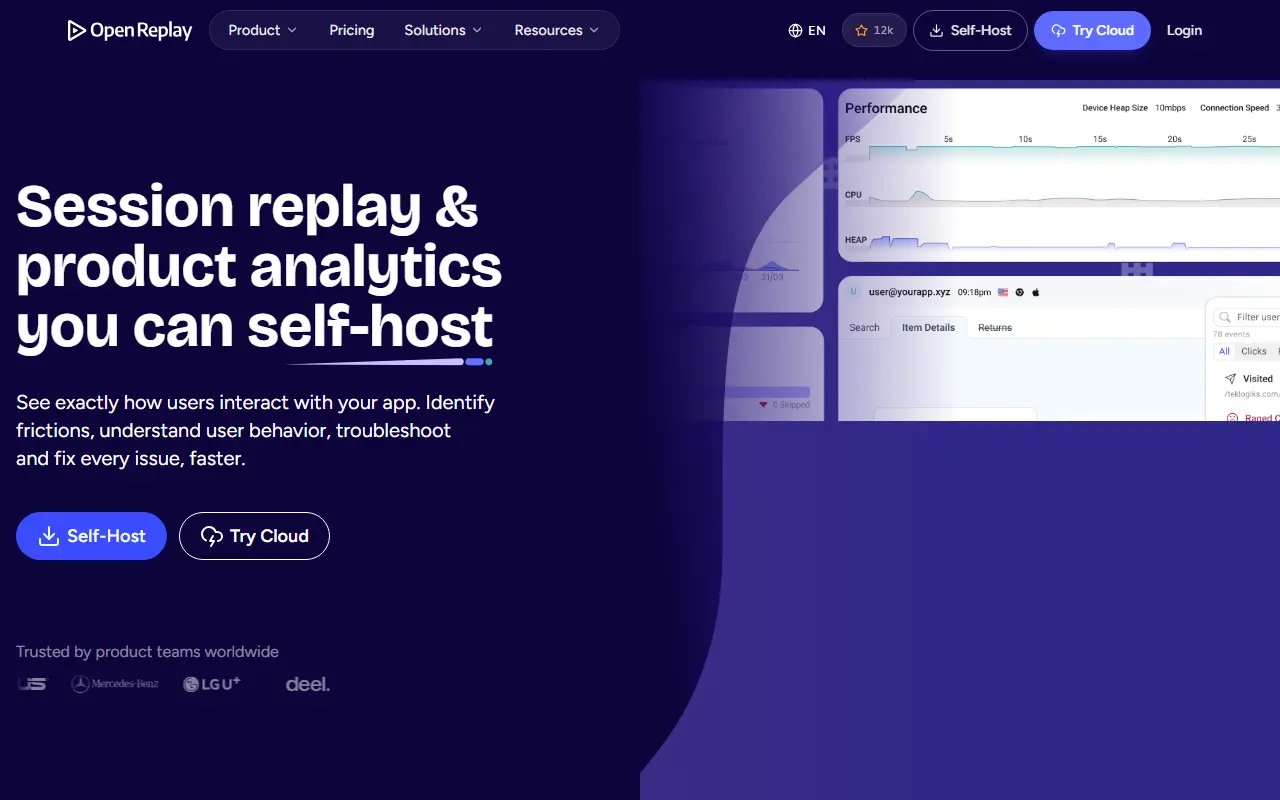
openreplay.comOpenReplay homepage screenshot

OpenReplay is an open-source experience platform that you host on your own infrastructure. It combines session replay, DevTools-level debugging context, product analytics and live cobrowsing, so teams can see how real users navigate, where they struggle and what errors they hit without sending sessions to a third party.

Because everything stays in your own cloud, it is pitched at teams that cannot hand customer data to an external vendor. Data can be masked, obscured or skipped at capture time before it reaches your servers, and a private mode redacts everything by default. A lightweight tracker sends data asynchronously to limit the impact on page performance, and SDKs cover frameworks such as React, Angular, Vue, Svelte, Next.js and React Native.

The README states it can be self-hosted for free on AWS, GCP, Azure and other platforms. The repository lists its licence as Other and its topics also reference feature flags, web vitals and real-user monitoring, so it spans debugging, product and support use cases.

Key features

  • Session replay with search and filtering
  • DevTools context for debugging sessions
  • Product analytics for usage insights
  • Live cobrowsing with users
  • Masking and private mode at capture time
  • Lightweight asynchronous tracker
  • Web and mobile framework SDKs

Pricing: Self-hosting is free. Managed Dedicated instances start from $199 a month (billed hourly) with a 7-day trial; Serverless is usage-based and Enterprise is custom.

Apache Guacamole

The server-side components of Apache Guacamole, a clientless remote desktop gateway that provides VNC, RDP and SSH access through a web browser.

GitHub stars
4k
Last commit
10 days ago
Licence
Apache-2.0
Self-hosted
Yes
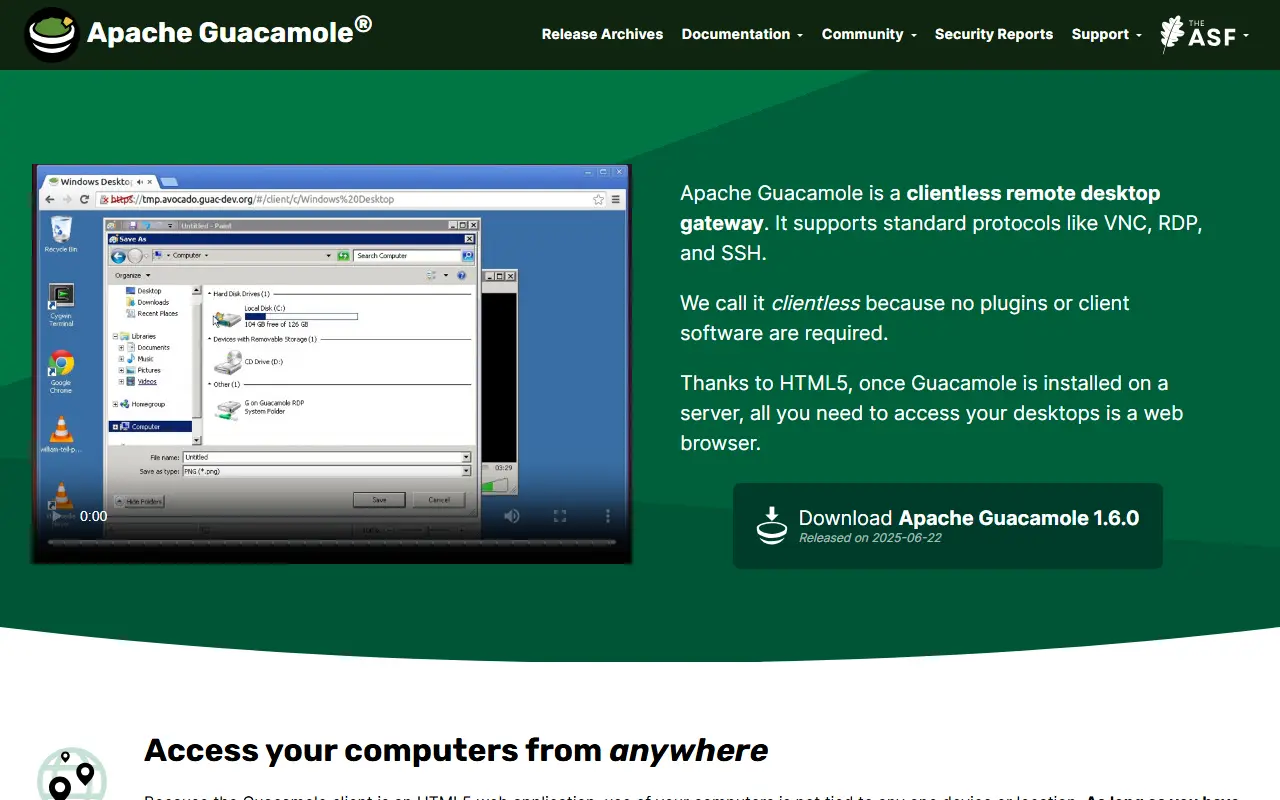
guacamole.apache.orgApache Guacamole homepage screenshot

This repository holds the server-side parts of Apache Guacamole: the guacd proxy daemon, the libguac C API and protocol support. Guacamole itself is a clientless remote desktop gateway that supports standard protocols such as VNC, RDP and SSH.

It is called clientless because no plugins or client software are needed. Once Guacamole is installed on a server, a web browser is all that is required to reach your desktops, since the client is an HTML5 web application. That frees access from any one device or location, and the desktops can even be virtual machines hosted in the cloud.

Guacamole is built on its own documented stack of core APIs, with tutorials and conceptual overviews in the online manual. It is a project of the Apache Software Foundation, licensed under Apache-2.0, and the codebase combines C, Java and JavaScript. The project provides release archives, mailing lists, an issue tracker and commercial support options.

Key features

  • Clientless remote desktop gateway
  • VNC, RDP and SSH protocol support
  • HTML5 browser client
  • guacd proxy daemon
  • libguac C API
  • Documented core APIs

Pricing: Free and open source under the Apache-2.0 licence.

OpenVidu

Self-hosted real-time video stack built on LiveKit and mediasoup, offering a ready-made conferencing app and SDKs for building custom WebRTC applications.

GitHub stars
2.1k
Last commit
today
Latest release
v3.9.0
Licence
Apache-2.0
Self-hosted
Yes
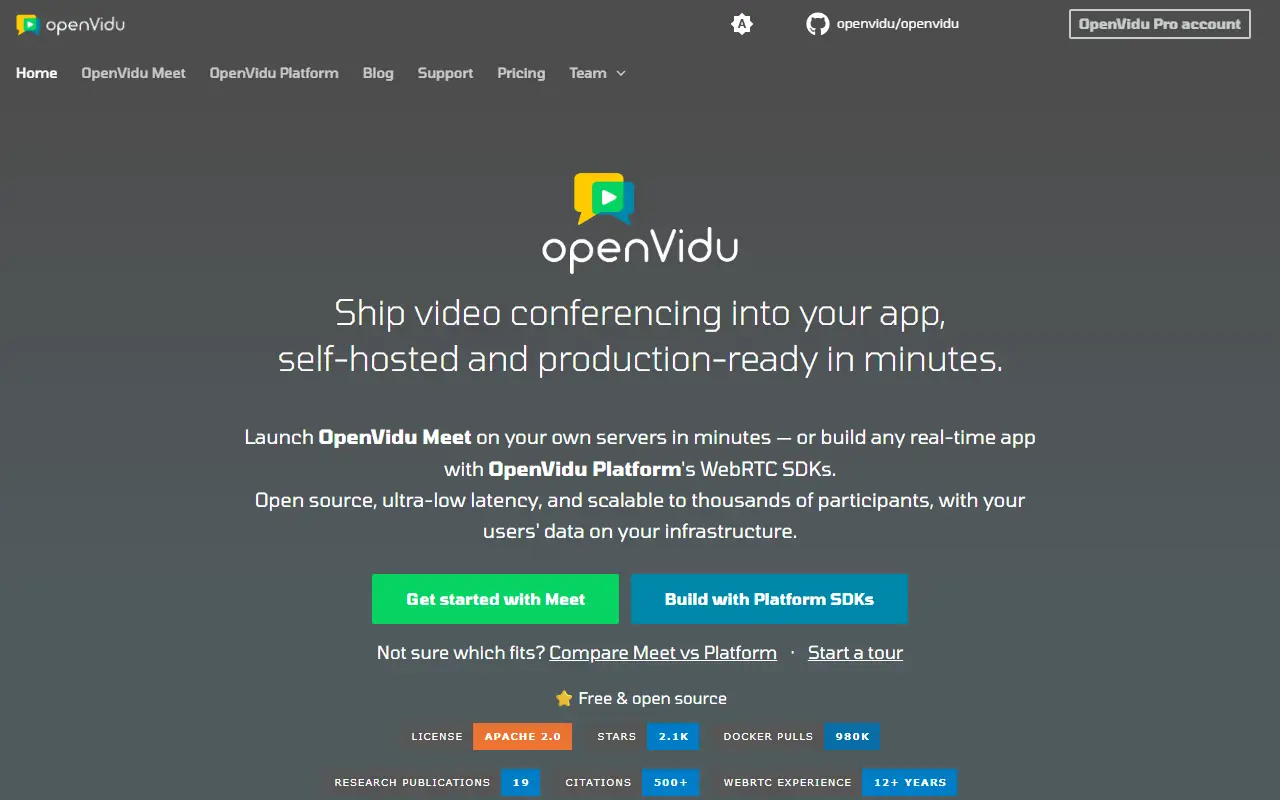
openvidu.ioOpenVidu homepage screenshot

OpenVidu is a self-hosted real-time video and audio stack built on LiveKit and mediasoup by a team with long experience in WebRTC. It ships as two products. OpenVidu Meet is a ready-to-use video conferencing application and an open-source alternative to Zoom, Google Meet, and Jitsi Meet, with rooms, recordings, chat, screen sharing, and moderation. The code is released under the Apache-2.0 license.

OpenVidu Meet can be branded with your own name, logo, and colors, with per-participant feature choices, and embedded into your own application through a web component, driven from your backend with a REST API and webhooks. OpenVidu Platform provides programmable client and server SDKs for custom WebRTC apps with low-level media control, and it is API-compatible with LiveKit, so LiveKit SDKs work unchanged.

Both products are self-hosted only, deployable on AWS, GCP, Azure, Oracle, DigitalOcean, or on-premises, with no hosted SaaS tier. OpenVidu PRO is a paid self-hosted edition, and the team offers support and consultancy. Advanced features include recording, RTMP streaming egress, AI agents for transcription and translation, and virtual backgrounds.

Key features

  • Ready-made video conferencing app (OpenVidu Meet)
  • Rooms, recordings, chat, and moderation
  • Embeddable web component and REST API
  • SDKs compatible with LiveKit
  • RTMP egress and AI agent support
  • Branding and per-participant feature control

Pricing: OpenVidu Community is free and open source. Pro is self-hosted and billed per core per minute of cluster running time, with a 15-day free trial.

Commercial Upscope alternatives

Hosted, closed-source products that compete with Upscope. Showing 12 of 14.

See every Upscope alternative on its tool page

Upscope alternatives: questions

What is the best open-source alternative to Upscope?
RustDesk is the top-ranked open-source alternative to Upscope on Enlisted: An open-source remote desktop application written in Rust, designed for self-hosting and positioned as an alternative to TeamViewer. Other strong options are Jitsi Meet, OpenReplay, Apache Guacamole and OpenVidu.
What are the best commercial alternatives to Upscope?
Surfly, Fullview, Zoho Assist, Chrome Remote Desktop and Helpshift are among the hosted, closed-source alternatives to Upscope listed on Enlisted, which lists 14 in total. Compare their pricing and features on each tool page.
Are these Upscope alternatives free?
All 5 are open source, so the code is free to use under its licence, and all of them can be self-hosted on your own server or computer. 2 also offer a paid or managed cloud version if you'd rather not host it yourself.
How is this list of Upscope alternatives ranked?
By a score built from GitHub stars, star growth over the last 30 days and how recently the code changed. 5 of these projects shipped code in the last 30 days. Data is refreshed daily, and nobody can pay to move up.

People also look for alternatives to…

View all