
 100ms
100ms ZEGOCLOUD
 MirrorFly
 Azure Communication Services
 Digital Samba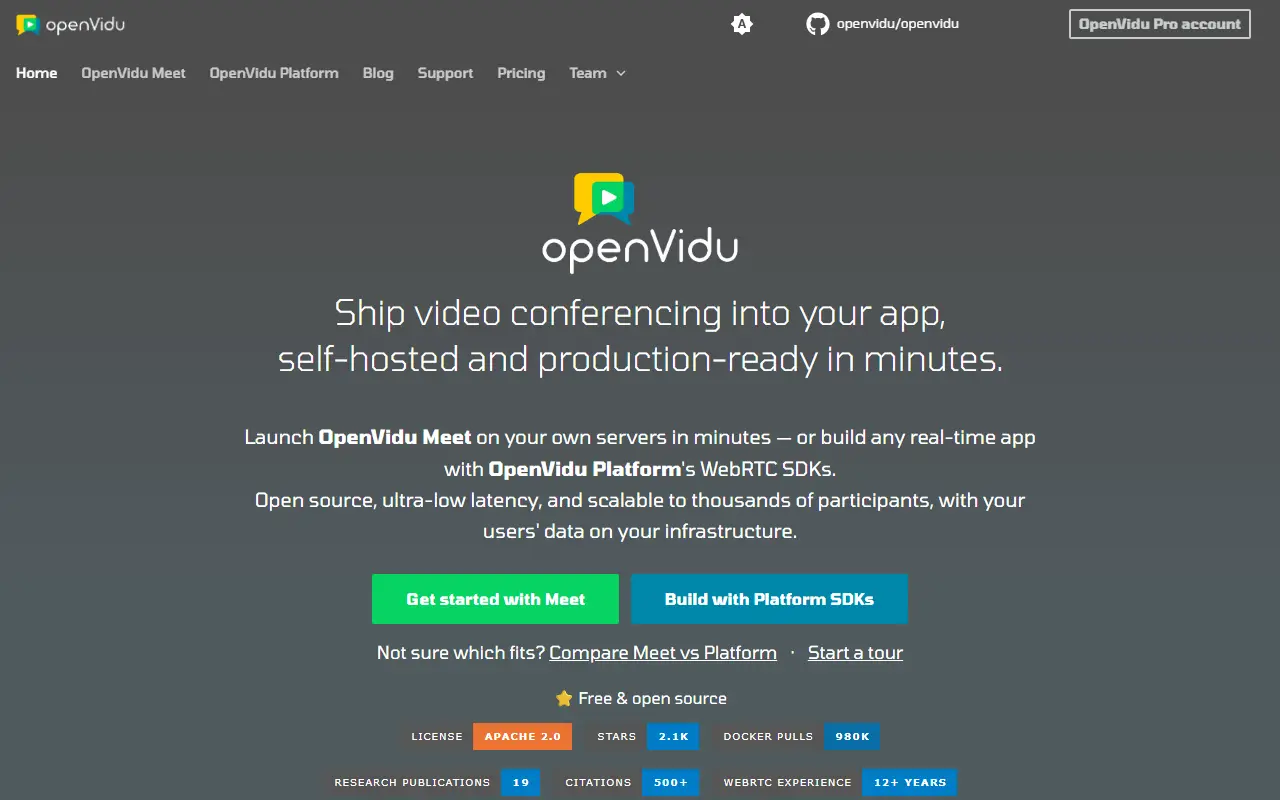
About OpenVidu
OpenVidu is a self-hosted real-time video and audio stack built on LiveKit and mediasoup by a team with long experience in WebRTC. It ships as two products. OpenVidu Meet is a ready-to-use video conferencing application and an open-source alternative to Zoom, Google Meet, and Jitsi Meet, with rooms, recordings, chat, screen sharing, and moderation. The code is released under the Apache-2.0 license.
OpenVidu Meet can be branded with your own name, logo, and colors, with per-participant feature choices, and embedded into your own application through a web component, driven from your backend with a REST API and webhooks. OpenVidu Platform provides programmable client and server SDKs for custom WebRTC apps with low-level media control, and it is API-compatible with LiveKit, so LiveKit SDKs work unchanged.
Both products are self-hosted only, deployable on AWS, GCP, Azure, Oracle, DigitalOcean, or on-premises, with no hosted SaaS tier. OpenVidu PRO is a paid self-hosted edition, and the team offers support and consultancy. Advanced features include recording, RTMP streaming egress, AI agents for transcription and translation, and virtual backgrounds.
Key features
- Ready-made video conferencing app (OpenVidu Meet)
- Rooms, recordings, chat, and moderation
- Embeddable web component and REST API
- SDKs compatible with LiveKit
- RTMP egress and AI agent support
- Branding and per-participant feature control
Good fit for
- →Embedding video calls in a product
- →Self-hosted alternative to Zoom for an organization
- Built with
- TypeScript
- Tags
- webrtc
- video-conferencing
- livekit
- mediasoup
- self-hosted
- sfu
- embeddable
- e-learning
OpenVidu: questions and answers
- What is OpenVidu used for?
- OpenVidu is a self-hosted real-time video stack built on LiveKit and mediasoup, offering a ready-made conferencing app and SDKs for building custom WebRTC applications. It is a good fit for embedding video calls in a product.
- Is OpenVidu open source?
- Yes. OpenVidu is open source under the Apache-2.0 licence. Its source code is on GitHub at OpenVidu/openvidu and is written mainly in TypeScript.
- Is OpenVidu free?
- Yes. OpenVidu is open source, so the software itself is free to use.
- Can I self-host OpenVidu?
- Yes. OpenVidu can be self-hosted on your own server or infrastructure; there is no official hosted version.
- What is OpenVidu an alternative to?
- OpenVidu is an open-source alternative to Daily, Agora, Zoom and CometChat. Other open-source alternatives to Daily include LiveKit.
- Is OpenVidu actively maintained?
- Yes. The most recent commit to OpenVidu was on 2 October 2026, and the latest release is v3.9.0, published on 29 September 2026. The project has 2.1k stars on GitHub.
Open-source alternatives to OpenVidu
See all
LiveKit
Backend as a Service
End-to-end realtime stack for connecting humans and AI
Apache-2.0vs Daily★ 21k
OpenIM
Backend as a Service
IM Chat OpenClaw
Apache-2.0vs Sendbird★ 17k
WuKongIM
Backend as a Service
More than just IM 不只是即时通讯(IM)
Apache-2.0vs Sendbird★ 5k
Jitsi Meet
Video Conferencing
Jitsi Meet - Secure, Simple and Scalable Video Conferences that you use as a standalone ap
Apache-2.0vs Zoom★ 30k
BigBlueButton
Video Conferencing
A complete web conferencing system for virtual classes and more!
LGPL-3.0vs Zoom★ 9.2k
La Suite Meet
Video Conferencing
Open source video conferencing app powered by LiveKit. Built with Django and React.
MITvs Zoom★ 2.4k
SaaS alternatives to OpenVidu
See all
Daily
Backend as a Service
Video and audio calling APIs with prebuilt embeddable call UI
SaaS
Agora
Backend as a Service
Real-time voice, video and streaming SDKs for apps
SaaS
Zoom
Video Conferencing
Zoom is a communications platform for video meetings, team chat, phone, webinars, whiteboards and events, with apps for desktop and mobile.
SaaS
CometChat
Backend as a Service
Chat and calling SDKs and APIs for adding messaging to apps
SaaSQuickBlox
Backend as a Service
Chat and video communication backend with SDKs for mobile and web apps
SaaS
Vonage API
Backend as a Service
Communications APIs for messaging, voice, video and verification
SaaS