7,363 open-source and SaaS tools, with GitHub stats refreshed every day.

4 alternatives ranked by real activity

Open-source Agora alternatives

A curated, ranked list of the 4 best open-source alternatives to Agora.

The best open-source alternative to Agora is LiveKit. If that doesn't suit you, other good options are Janus Gateway, Ant Media Server and OpenVidu.

Agora alternatives are mainly video conferencing tools, but some are also backend-as-a-service tools and media & streaming tools. 4 of them shipped code in the last 30 days, 4 can be self-hosted, and 2 use a permissive licence.

Last updated October 2, 2026 · ranked by GitHub stars, growth and recent commits

LiveKit

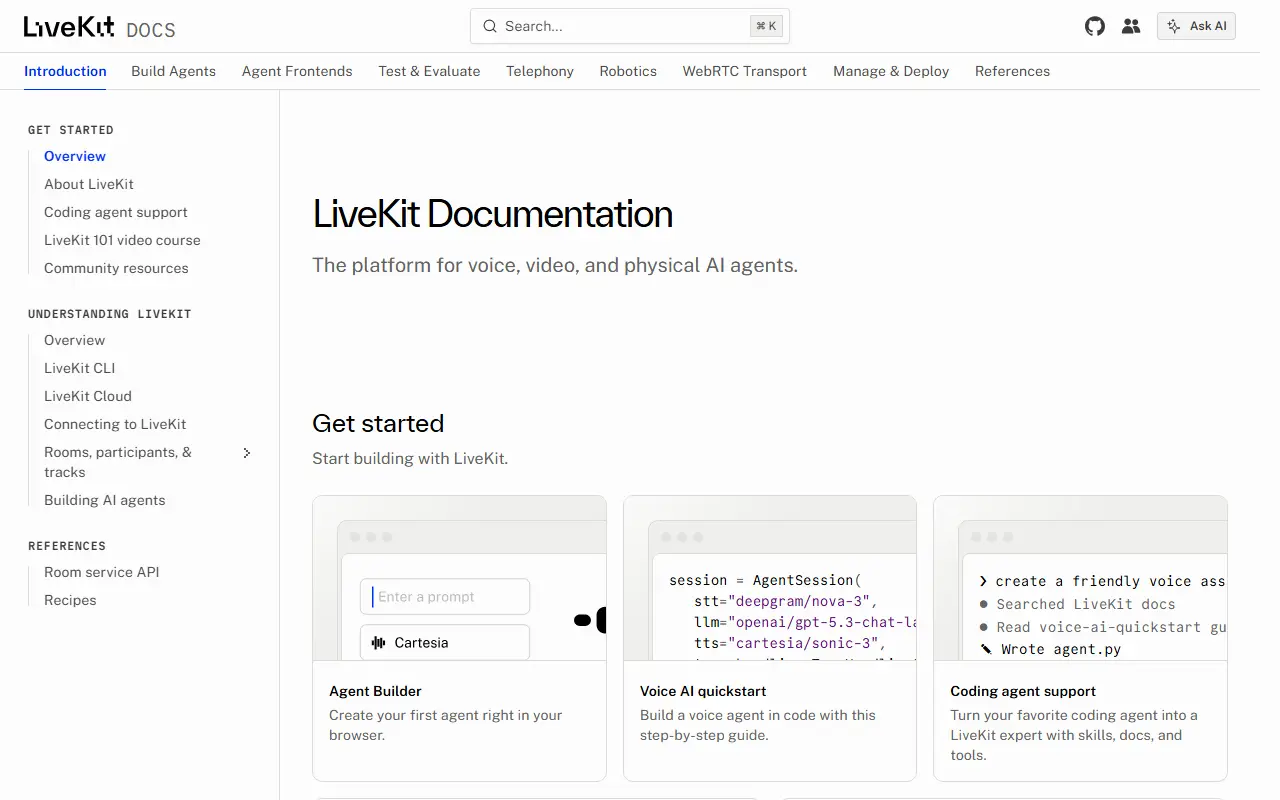
LiveKit is an open-source realtime server and SDK platform for building voice, video and AI-agent applications on WebRTC.

GitHub stars
21k
Last commit
yesterday
Latest release
v1.13.7
Licence
Apache-2.0
Self-hosted
Yes
Hosted version
Available
docs.livekit.ioLiveKit homepage screenshot

LiveKit is an open-source platform for realtime audio, video and data, aimed at developers building voice, video and AI agent applications. This repository holds the LiveKit server, a distributed WebRTC selective forwarding unit (SFU) written in Go on top of the Pion WebRTC implementation.

People, devices and AI agents join the same room as participants, and agents can be dispatched into rooms automatically or on demand. The server offers speaker detection, simulcast and selective subscription, uses JWT for authentication, and handles UDP, TCP and TURN connectivity. SDKs cover web, mobile, desktop, embedded and server environments, and a separate Agents framework in Python and Node.js supports code-first voice agents.

The server ships as a single binary and can be deployed with Docker or Kubernetes on your own infrastructure under the Apache 2.0 license. The vendor also runs LiveKit Cloud, a managed service that handles deployment and observability.

Key features

  • Distributed WebRTC SFU server written in Go
  • Rooms where people and AI agents meet
  • Simulcast and speaker detection
  • JWT authentication for participants
  • SDKs for web, mobile, desktop and server
  • Single binary, Docker or Kubernetes deployment

Pricing: The server is free and open source under Apache 2.0; LiveKit Cloud is offered as a managed option by the vendor.

Janus Gateway

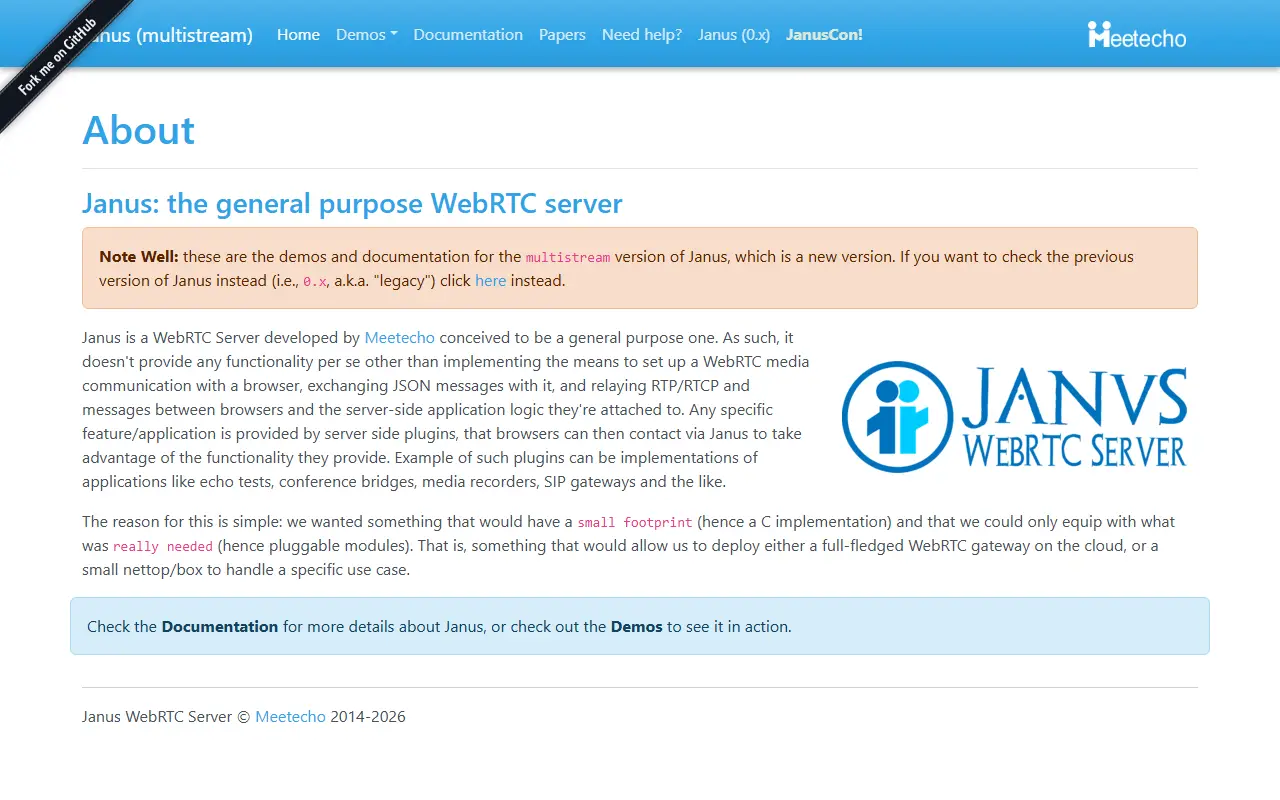
Janus is a general-purpose WebRTC server from Meetecho, published as open source and written in C, for developers building real-time audio, video and data services.

GitHub stars
9.2k
Last commit
2 days ago
Licence
GPL-3.0
Self-hosted
Yes
janus.conf.meetecho.comJanus Gateway homepage screenshot

Janus is a general purpose WebRTC server developed by Meetecho and published as open source. It is aimed at developers who need server-side support for real-time audio, video and data applications such as video conferencing, rather than at end users looking for a finished meeting product.

The server is written in C and exposes its API over several optional transports, including REST through libmicrohttpd, WebSockets through libwebsockets and RabbitMQ messaging. WebRTC data channels are available through the usrsctp library, and optional BoringSSL support is built with cmake. The main branch holds the multistream version of Janus, while the older 0.x line is kept as a separate legacy version.

Janus targets Linux and can also be compiled for macOS. Windows is not supported natively, although it is reported to work under the Windows Subsystem for Linux, and the maintainers warn against unofficial executable builds. It is released under GPL-3.0 and must be built from source with dependencies such as GLib, libnice, OpenSSL and libsrtp.

Key features

  • General purpose WebRTC server written in C
  • WebRTC data channel support
  • REST and WebSocket API transports
  • RabbitMQ transport option
  • Multistream version on the main branch
  • Runs on Linux and macOS

Pricing: Free and open source under the GPL-3.0 licence.

Ant Media Server

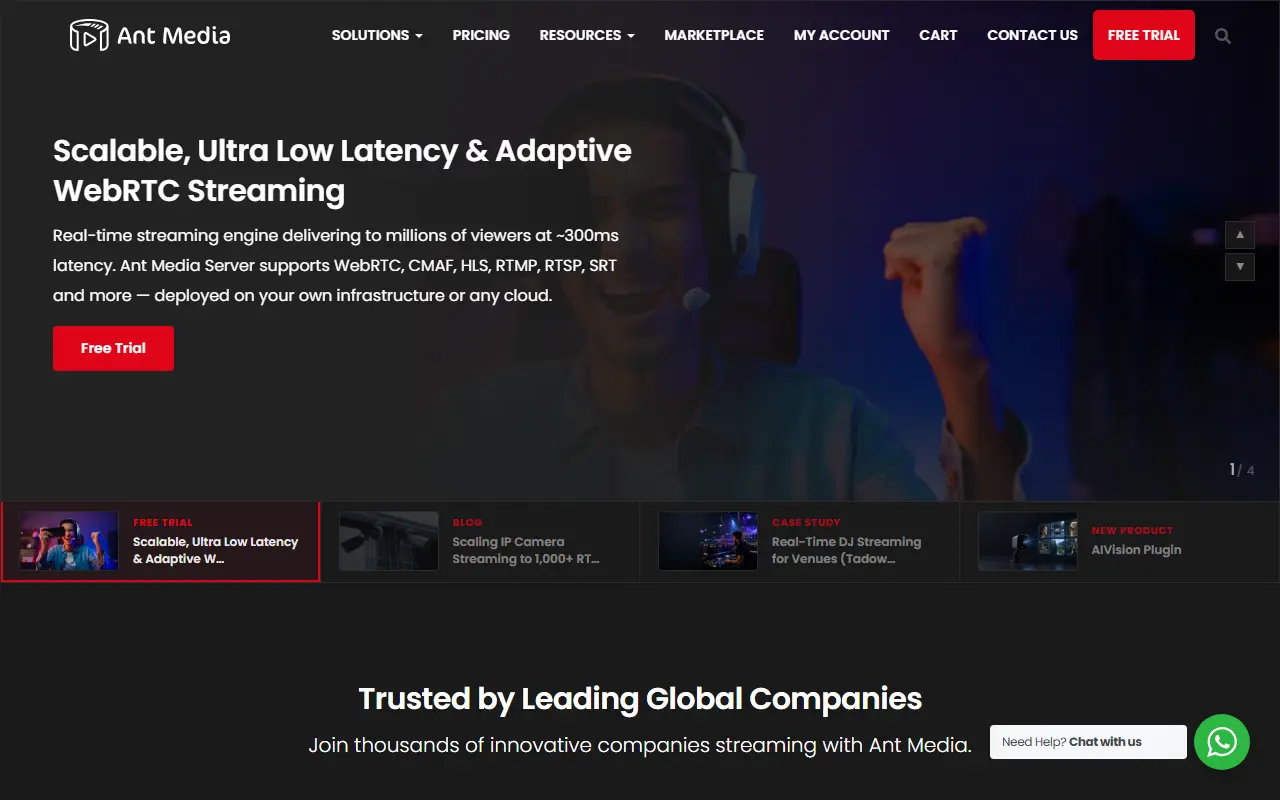
A scalable media server for live streaming with WebRTC, SRT, RTMP, HLS and CMAF, with SDKs for mobile and web and Community and Enterprise editions.

GitHub stars
4.7k
Last commit
yesterday
Latest release
ams-v3.1.0
Self-hosted
Yes
antmedia.ioAnt Media Server homepage screenshot

Ant Media Server is a scalable media server for low-latency live streaming. It supports WebRTC with a claimed latency of about half a second, along with SRT, RTMP, RTSP, HLS and CMAF low-latency HLS, and also handles H.265/HEVC. Developers use it to build real-time video applications and live broadcasting.

Capabilities include adaptive bitrate workflows, transcoding, recording and cloud auto-scaling. SDKs are provided for iOS, Android, React Native, Flutter, Unity and JavaScript, and security features include SSL/TLS, token authentication, IP filtering and watermarking. The README lists use cases such as telehealth, e-learning, sports streaming, auctions and interactive applications.

The project is split into a Community edition with the essentials and an Enterprise edition that adds advanced features and support, and a free trial of the Enterprise edition is offered. It is written in Java, and documentation covers installation, API references and tutorials.

Key features

  • Low-latency WebRTC streaming
  • SRT, RTMP, RTSP and HLS support
  • CMAF and low-latency HLS
  • Adaptive bitrate and transcoding
  • Recording and cloud auto-scaling
  • SDKs for iOS, Android, Flutter and JavaScript
  • Token authentication and IP filtering

Pricing: Self-hosted Enterprise licenses cost $109 per instance per month, $89 on an annual subscription, $0.24 per instance-hour, or $2799 perpetual. Cloud marketplace listings start at $0.33 per hour, with trials.

OpenVidu

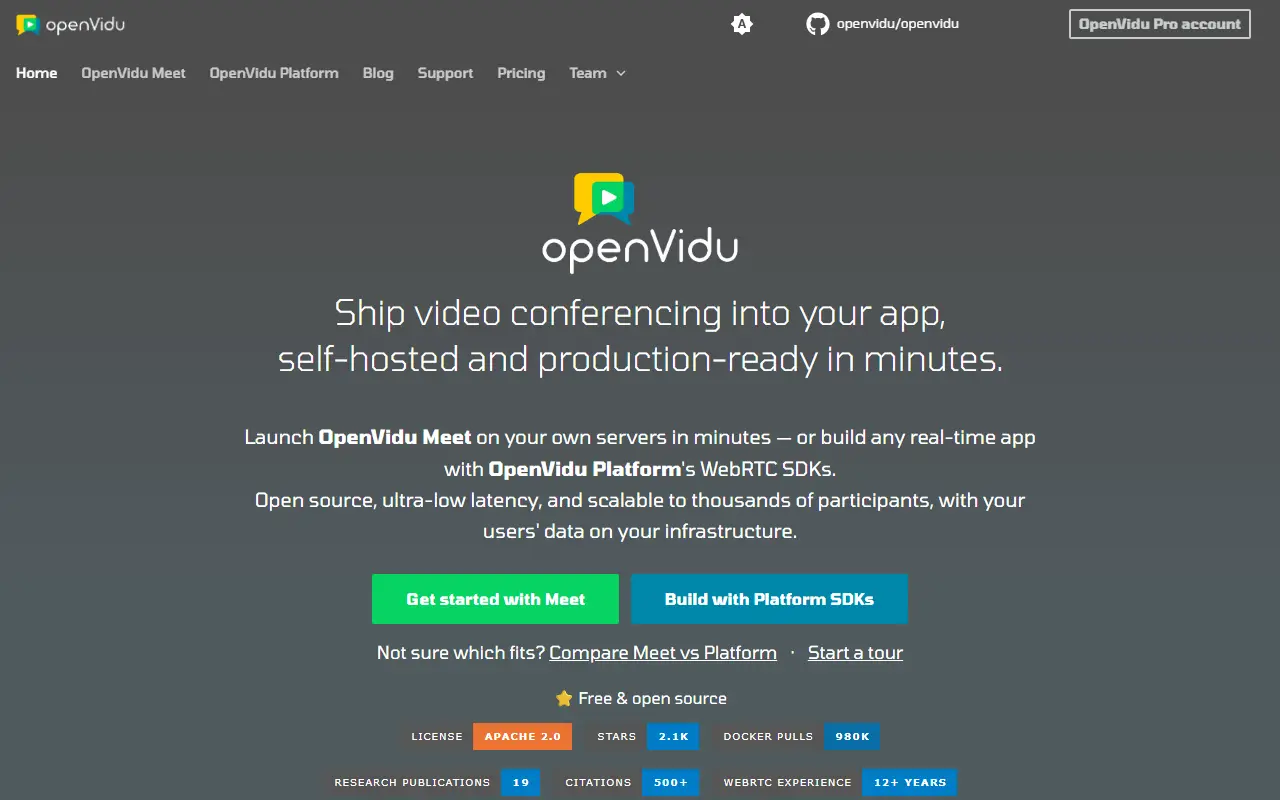
Self-hosted real-time video stack built on LiveKit and mediasoup, offering a ready-made conferencing app and SDKs for building custom WebRTC applications.

GitHub stars
2.1k
Last commit
yesterday
Latest release
v3.9.0
Licence
Apache-2.0
Self-hosted
Yes
openvidu.ioOpenVidu homepage screenshot

OpenVidu is a self-hosted real-time video and audio stack built on LiveKit and mediasoup by a team with long experience in WebRTC. It ships as two products. OpenVidu Meet is a ready-to-use video conferencing application and an open-source alternative to Zoom, Google Meet, and Jitsi Meet, with rooms, recordings, chat, screen sharing, and moderation. The code is released under the Apache-2.0 license.

OpenVidu Meet can be branded with your own name, logo, and colors, with per-participant feature choices, and embedded into your own application through a web component, driven from your backend with a REST API and webhooks. OpenVidu Platform provides programmable client and server SDKs for custom WebRTC apps with low-level media control, and it is API-compatible with LiveKit, so LiveKit SDKs work unchanged.

Both products are self-hosted only, deployable on AWS, GCP, Azure, Oracle, DigitalOcean, or on-premises, with no hosted SaaS tier. OpenVidu PRO is a paid self-hosted edition, and the team offers support and consultancy. Advanced features include recording, RTMP streaming egress, AI agents for transcription and translation, and virtual backgrounds.

Key features

  • Ready-made video conferencing app (OpenVidu Meet)
  • Rooms, recordings, chat, and moderation
  • Embeddable web component and REST API
  • SDKs compatible with LiveKit
  • RTMP egress and AI agent support
  • Branding and per-participant feature control

Pricing: OpenVidu Community is free and open source. Pro is self-hosted and billed per core per minute of cluster running time, with a 15-day free trial.

Agora alternatives: questions

What is the best open-source alternative to Agora?
LiveKit is the top-ranked open-source alternative to Agora on Enlisted: LiveKit is an open-source realtime server and SDK platform for building voice, video and AI-agent applications on WebRTC. Other strong options are Janus Gateway, Ant Media Server and OpenVidu.
Are these Agora alternatives free?
All 4 are open source, so the code is free to use under its licence, and all of them can be self-hosted on your own server or computer. 1 also offers a paid or managed cloud version if you'd rather not host it yourself.
How is this list of Agora alternatives ranked?
By a score built from GitHub stars, star growth over the last 30 days and how recently the code changed. 4 of these projects shipped code in the last 30 days. Data is refreshed daily, and nobody can pay to move up.

People also look for alternatives to…

View all