
 CometChat
 100ms
100ms ZEGOCLOUD
 MirrorFly
 Azure Communication Services
 Digital Samba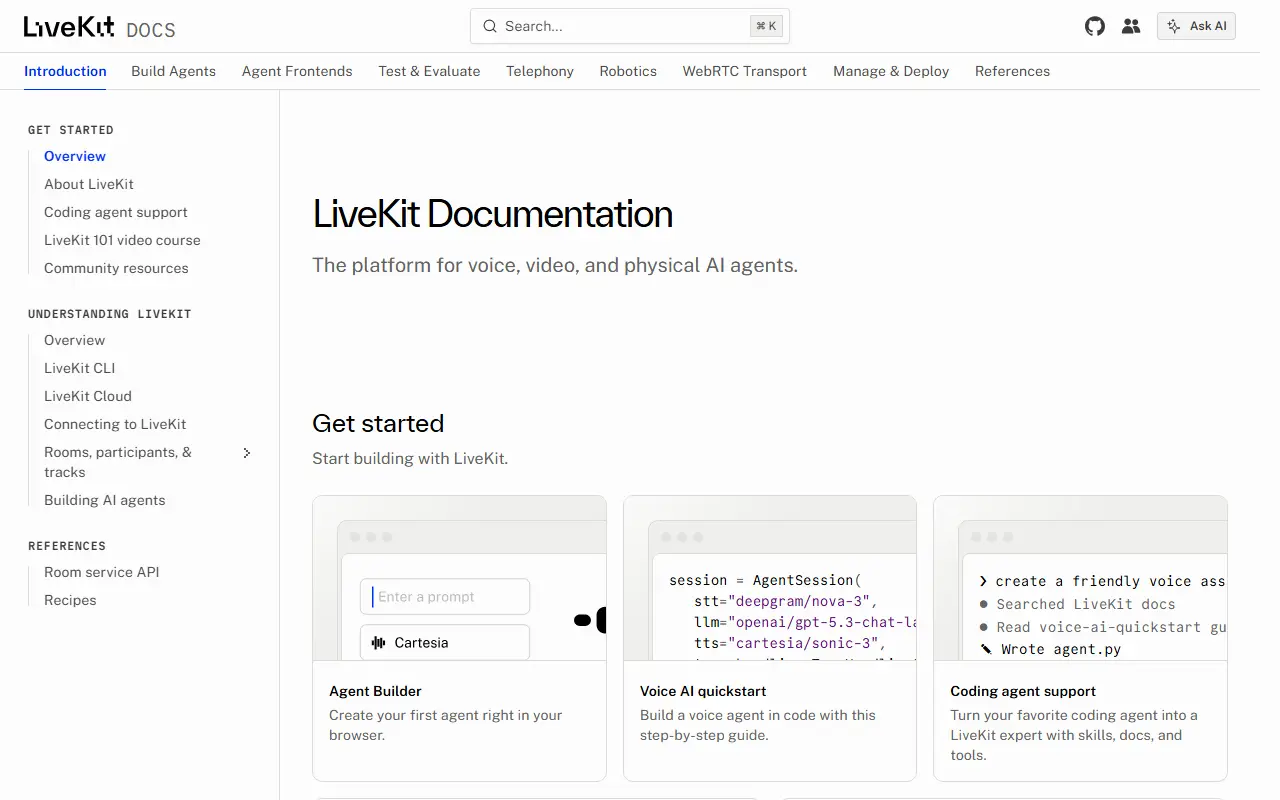
About LiveKit
LiveKit is an open-source platform for realtime audio, video and data, aimed at developers building voice, video and AI agent applications. This repository holds the LiveKit server, a distributed WebRTC selective forwarding unit (SFU) written in Go on top of the Pion WebRTC implementation.
People, devices and AI agents join the same room as participants, and agents can be dispatched into rooms automatically or on demand. The server offers speaker detection, simulcast and selective subscription, uses JWT for authentication, and handles UDP, TCP and TURN connectivity. SDKs cover web, mobile, desktop, embedded and server environments, and a separate Agents framework in Python and Node.js supports code-first voice agents.
The server ships as a single binary and can be deployed with Docker or Kubernetes on your own infrastructure under the Apache 2.0 license. The vendor also runs LiveKit Cloud, a managed service that handles deployment and observability.
Key features
- Distributed WebRTC SFU server written in Go
- Rooms where people and AI agents meet
- Simulcast and speaker detection
- JWT authentication for participants
- SDKs for web, mobile, desktop and server
- Single binary, Docker or Kubernetes deployment
Good fit for
- →Building video conferencing features
- →Voice AI agents with realtime audio
- →Live streaming and interactive rooms
- Built with
- Go
- Tags
- webrtc
- sfu
- video
- voice-ai
- realtime
- media-server
- ai-agents
- golang
LiveKit: questions and answers
- What is LiveKit used for?
- LiveKit is an open-source realtime server and SDK platform for building voice, video and AI-agent applications on WebRTC. It is a good fit for building video conferencing features, voice AI agents with realtime audio, and live streaming and interactive rooms.
- Is LiveKit open source?
- Yes. LiveKit is open source under the Apache-2.0 licence. Its source code is on GitHub at livekit/livekit and is written mainly in Go.
- Is LiveKit free?
- Yes. LiveKit is open source, so the software itself is free to use. A managed cloud version is also available.
- Can I self-host LiveKit?
- Yes. LiveKit can be self-hosted on your own server or infrastructure.
- What is LiveKit an alternative to?
- LiveKit is an open-source alternative to Daily, Agora, Twilio and Vonage API. Other open-source alternatives to Daily include OpenVidu and Janus Gateway.
- Is LiveKit actively maintained?
- Yes. The most recent commit to LiveKit was on 1 October 2026, and the latest release is v1.13.7, published on 14 September 2026. The project has 21k stars on GitHub.
Open-source alternatives to LiveKit
See all
OpenVidu
Video Conferencing
OpenVidu Platform: self-hosted real-time video and audio for your apps, built on LiveKit a
Apache-2.0vs Daily★ 2.1k
OpenIM
Backend as a Service
IM Chat OpenClaw
Apache-2.0vs Sendbird★ 17k
WuKongIM
Backend as a Service
More than just IM 不只是即时通讯(IM)
Apache-2.0vs Sendbird★ 5k
JuggleIM
Backend as a Service
IM Chat, High-performance, scalable, self-hosted instant messaging server in Go — private
Apache-2.0vs Sendbird★ 3.5k
Fonoster
Backend as a Service
🚀 The open-source alternative to Twilio.
MITvs Twilio★ 8.1k
Janus Gateway
Video Conferencing
Janus WebRTC Server
GPL-3.0vs Agora★ 9.2k
SaaS alternatives to LiveKit
See all
Daily
Backend as a Service
Video and audio calling APIs with prebuilt embeddable call UI
SaaS
Agora
Backend as a Service
Real-time voice, video and streaming SDKs for apps
SaaS
Twilio
Backend as a Service
Communications APIs for SMS, voice, video, email and verification
SaaS
Vonage API
Backend as a Service
Communications APIs for messaging, voice, video and verification
SaaS
Stream
Backend as a Service
Chat, activity feeds, video and moderation APIs for in-app social features
SaaS
Sendbird
Backend as a Service
Chat, voice and video APIs and SDKs for in-app messaging
SaaS