 TrackMedia
 TrackRev

 MirrorFly
 Azure Communication Services
About OpenIM
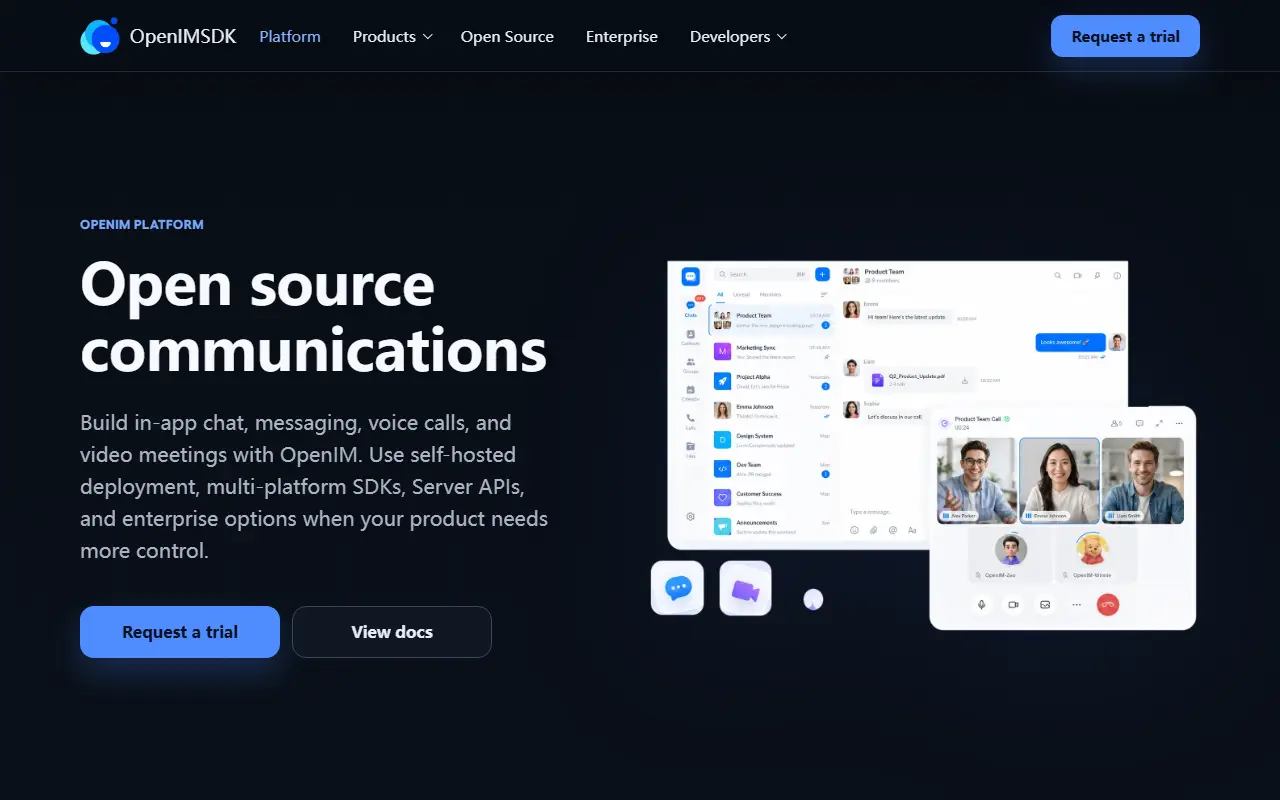
OpenIM is an open-source instant messaging solution aimed at developers rather than end users. The project contrasts itself with standalone chat apps such as Telegram, Signal and Rocket.Chat, saying it is a set of building blocks for adding messaging to your own application instead of an installable chat product.
It consists of the OpenIM SDK, a client-side library, and the OpenIM Server, written in Go. Together they handle sending and receiving messages, managing users and managing groups, so teams can embed chat into social, marketplace, enterprise or other apps without building the infrastructure themselves. The README is translated into many languages and links to community channels on Twitter, Slack and WeChat, and topics mention IM, chat and messaging.
OpenIM is Apache-2.0 licensed and runs on your own servers. It suits product teams and agencies who need to own their messaging stack, for example for data-residency or customization reasons, and who are comfortable operating a Go back end.
Key features
- Instant messaging server in Go
- Client SDK for embedding chat
- Message sending and receiving
- User account management
- Group chat management
- Deploy on your own servers
Good fit for
- Adding chat to a mobile or web app
- Enterprise messaging inside a product
- Owning your messaging infrastructure
OpenIM: questions and answers
- What is OpenIM used for?
- OpenIM is an open-source instant messaging SDK and server for developers who want to build chat, user management and group messaging into their own apps. It is a good fit for adding chat to a mobile or web app, enterprise messaging inside a product and owning your messaging infrastructure.
- Is OpenIM open source?
- Yes. OpenIM is open source under the Apache-2.0 licence. Its source code is on GitHub at openimsdk/open-im-server and is written mainly in Go.
- Is OpenIM free?
- Yes. OpenIM is open source, so the software itself is free to use.
- Can I self-host OpenIM?
- Yes. OpenIM can be self-hosted on your own server or infrastructure.
- What is OpenIM an alternative to?
- OpenIM is an open-source alternative to Sendbird, Stream, QuickBlox and PubNub. Other open-source alternatives to Sendbird include WuKongIM, LiveKit and JuggleIM.
- Is OpenIM actively maintained?
- Yes. The most recent commit to OpenIM was on 10 November 2026, and the latest release is v3.8.3-patch.18, published on 13 October 2026. The project has 17k stars on GitHub, with 87 added in the last 30 days.
Open-source alternatives to OpenIM
See all
WuKongIM
Backend as a Service
More than just IM 不只是即时通讯(IM)
Apache-2.0vs Sendbird★ 5k
LiveKit
Backend as a Service
End-to-end realtime stack for connecting humans and AI
Apache-2.0vs Daily★ 22k
JuggleIM
Backend as a Service
IM Chat, High-performance, scalable, self-hosted instant messaging server in Go — private
Apache-2.0vs Sendbird★ 3.5k
Mattermost
Team Chat
Mattermost is an open source platform for secure collaboration across the entire software
OSSvs Slack★ 40k
Rocket.Chat
Team Chat
The Secure CommsOS™ for mission-critical operations
OSSvs Slack★ 46k
OpenVidu
Video Conferencing
OpenVidu Platform: self-hosted real-time video and audio for your apps, built on LiveKit a
Apache-2.0vs Daily★ 2.1k
SaaS alternatives to OpenIM
See all
Sendbird
Backend as a Service
Chat, voice and video APIs and SDKs for in-app messaging
SaaS
Stream
Backend as a Service
Chat, activity feeds, video and moderation APIs for in-app social features
SaaSQuickBlox
Backend as a Service
Chat and video communication backend with SDKs for mobile and web apps
SaaS
PubNub
Backend as a Service
Realtime messaging and presence APIs for chat, IoT and live apps
SaaS
CometChat
Backend as a Service
Chat and calling SDKs and APIs for adding messaging to apps
SaaS
ZEGOCLOUD
Backend as a Service
Real-time video, voice, chat and live streaming SDKs for apps
SaaS