#1
An open-source Postgres development platform bundling a database, auth, auto-generated APIs, realtime, storage and vector tools, often chosen as a Firebase alternative.
- GitHub stars
- 115k
- Last commit
- today
- Latest release
- v1.26.08
- Licence
- Apache-2.0
- Self-hosted
- Yes
- Hosted version
- Available
supabase.com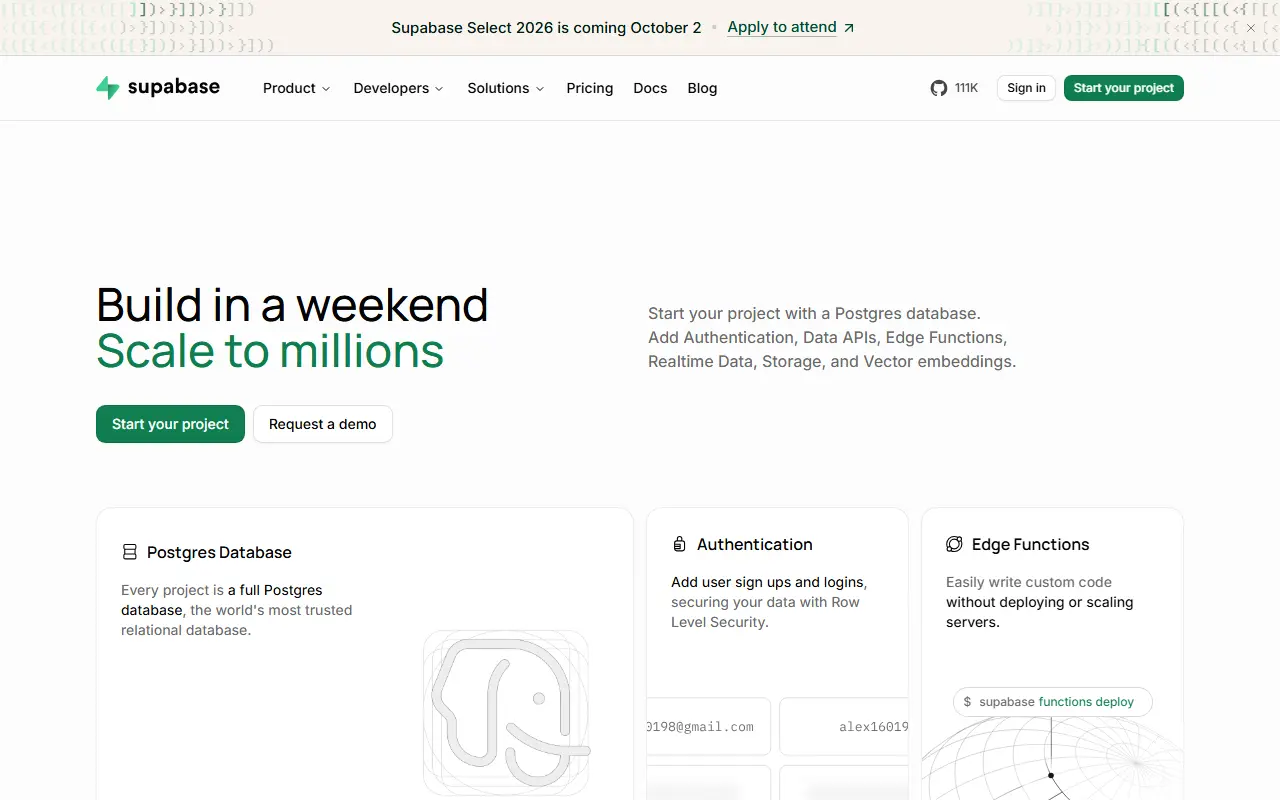
Supabase is a backend platform built around a dedicated Postgres database. It packages the pieces most web, mobile and AI apps need, including authentication and authorization, auto-generated APIs, file storage, serverless functions and a dashboard, so developers can start without assembling separate services. Its stated aim is a developer experience similar to Firebase, built from open-source components.
APIs are generated from your schema as REST and GraphQL, with realtime subscriptions over websockets. Logic can live in database functions or in Edge Functions that run on Deno. For AI work there is a toolkit for vectors and embeddings built on pgvector, and Postgres extensions such as PostGIS are available. Supabase combines existing open tools with ones it builds itself when nothing suitable exists.
The code is Apache-2.0 licensed. Supabase is offered as a hosted platform you can sign up for without installing anything, and the same stack can be self-hosted or run locally for development. It suits teams that want Postgres at the core of their app but prefer not to build the surrounding backend themselves.
Key features
- Hosted Postgres database with a dashboard
- Authentication and authorization
- Auto-generated REST and GraphQL APIs
- Realtime subscriptions over websockets
- Edge Functions and database functions
- File storage for user uploads
- Vector and embeddings toolkit with pgvector
Pricing: Free plan with 50,000 monthly active users. Pro starts at $25 and Team at $599 per month, with usage and extra compute billed on top; Enterprise is custom.
#2
LiveKit is an open-source realtime server and SDK platform for building voice, video and AI-agent applications on WebRTC.
- GitHub stars
- 22k
- Last commit
- yesterday
- Latest release
- v1.13.11
- Licence
- Apache-2.0
- Self-hosted
- Yes
- Hosted version
- Available
docs.livekit.io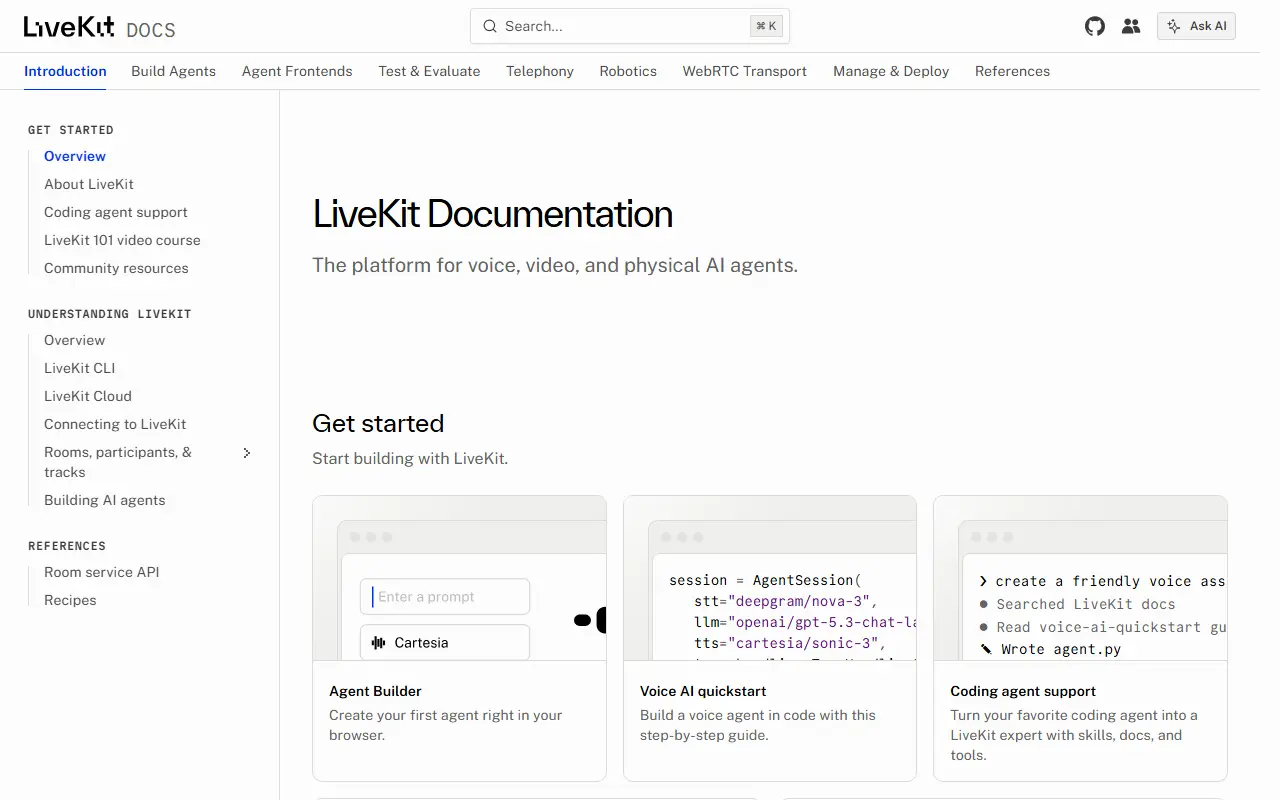
LiveKit is an open-source platform for realtime audio, video and data, aimed at developers building voice, video and AI agent applications. This repository holds the LiveKit server, a distributed WebRTC selective forwarding unit (SFU) written in Go on top of the Pion WebRTC implementation.
People, devices and AI agents join the same room as participants, and agents can be dispatched into rooms automatically or on demand. The server offers speaker detection, simulcast and selective subscription, uses JWT for authentication, and handles UDP, TCP and TURN connectivity. SDKs cover web, mobile, desktop, embedded and server environments, and a separate Agents framework in Python and Node.js supports code-first voice agents.
The server ships as a single binary and can be deployed with Docker or Kubernetes on your own infrastructure under the Apache 2.0 license. The vendor also runs LiveKit Cloud, a managed service that handles deployment and observability.
Key features
- Distributed WebRTC SFU server written in Go
- Rooms where people and AI agents meet
- Simulcast and speaker detection
- JWT authentication for participants
- SDKs for web, mobile, desktop and server
- Single binary, Docker or Kubernetes deployment
Pricing: The server is free and open source under Apache 2.0; LiveKit Cloud is offered as a managed option by the vendor.
#3
An open-source backend platform offering auth, databases, storage, functions, messaging, realtime and hosting, available as a managed cloud or self-hosted with Docker.
- GitHub stars
- 58k
- Last commit
- today
- Latest release
- 2.7.2
- Licence
- BSD-3-Clause
- Self-hosted
- Yes
- Hosted version
- Available
appwrite.io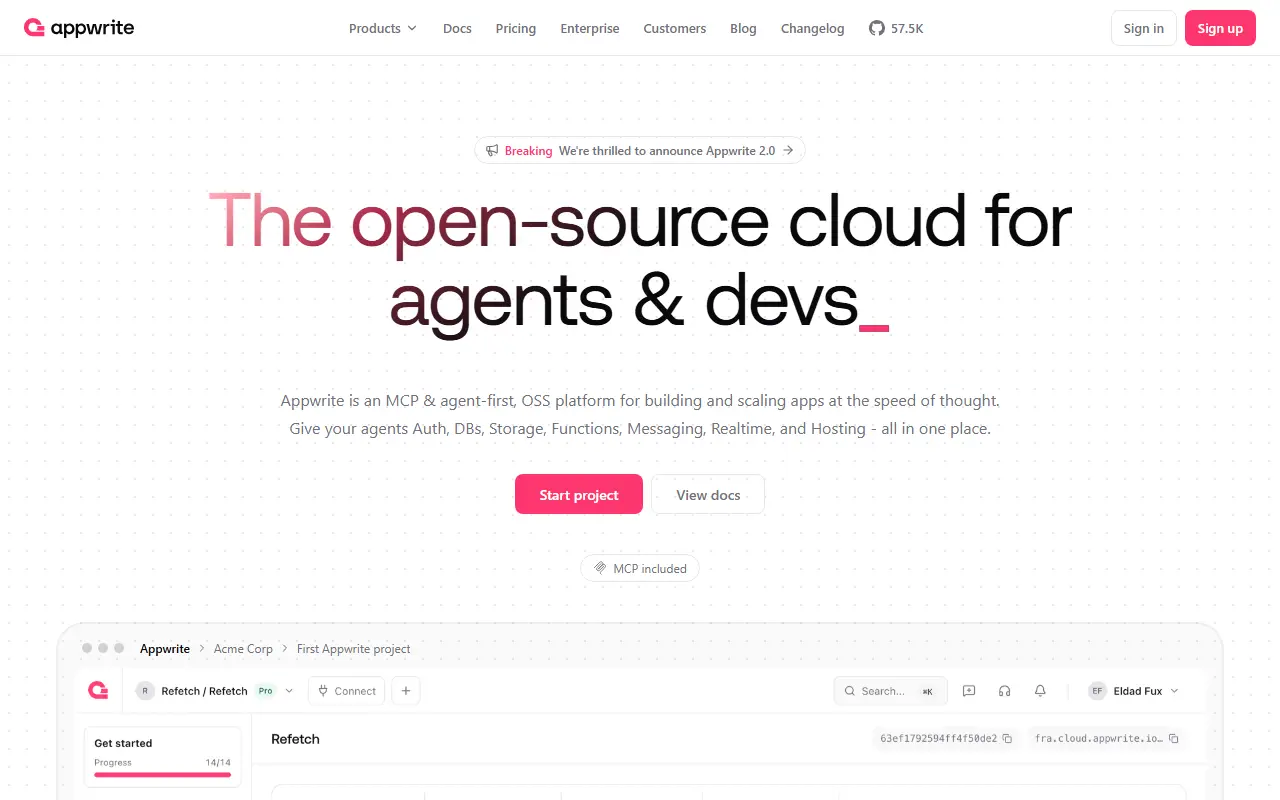
Appwrite is an open-source platform for building and scaling web, mobile and AI apps. It bundles the backend services most apps need, namely auth, databases, storage, functions, messaging, realtime and hosting, and presents them as an agent-friendly cloud with MCP support. It can run as a managed cloud platform or be self-hosted on infrastructure you control.
Auth supports email, SMS, OAuth, anonymous sessions and magic URLs. Databases can be modeled and queried through Appwrite itself or backed by managed PostgreSQL and MySQL. Storage keeps files with compression, encryption, image transformations and permission controls, and Functions run serverless code in isolated runtimes triggered by events. Sites deploys static, SSR and CSR frontends from Git with previews, and Messaging sends email, SMS and push notifications.
Developers integrate through client and server SDKs, including Flutter, Swift, React Native and JavaScript, or let coding agents such as Cursor, Claude Code and Codex operate a live project through a hosted MCP server. Appwrite is BSD-3-Clause licensed and written mainly in PHP, with Docker-based self-hosting for Unix and Windows.
Key features
- Auth with email, SMS, OAuth and magic URLs
- Databases including managed PostgreSQL and MySQL
- File storage with encryption and image transformations
- Serverless functions in isolated runtimes
- Messaging via email, SMS and push
- Realtime updates and static or SSR site hosting
- Hosted MCP server and client and server SDKs
Pricing: A free plan and a Pro plan exist, but the captured page does not show their prices. Dedicated databases start at $10 a month each and go up to $960 a month; serverless databases have no fixed fee.
#4
A customizable team communications platform with real-time chat and video, aimed at organizations with strict data protection needs and offered self-hosted, cloud or air-gapped.
- GitHub stars
- 46k
- Last commit
- today
- Latest release
- 9.0.0
- Self-hosted
- Yes
- Hosted version
- Available
rocket.chat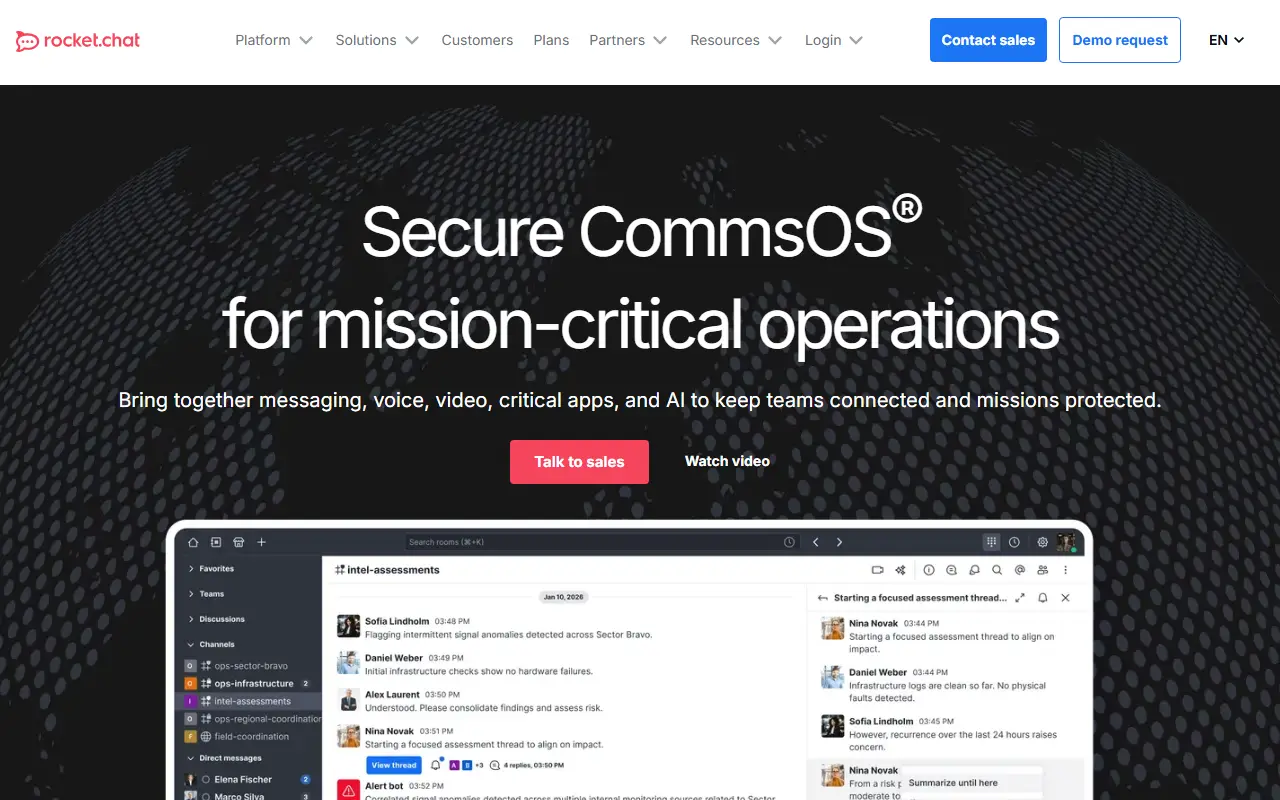
Rocket.Chat is a communications platform written in TypeScript for teams and organizations that care about data protection. It supports real-time conversations between colleagues, with partner companies, and with customers or citizens, and its topics place it in the same space as Slack, with WebRTC for calls and meetings.
The product emphasizes control over where and how it runs. Deployment options include self-hosted servers, a managed cloud and fully air-gapped environments, with a scalable architecture and performance monitoring for workspace administration. Security and sovereignty features, including identity management, are a core part of the pitch, and the platform is built to be highly customizable, so organizations can adapt it to their own workflows and integrations.
The repository's license is listed as 'Other' on GitHub, although the topics reference an MIT-licensed community core, so confirm which components fall under which terms before relying on it commercially. It suits government bodies, enterprises and regulated industries that want a Slack-style tool they can host themselves.
Key features
- Real-time team messaging and channels
- Video conferencing built on WebRTC
- Self-hosted, cloud and air-gapped deployment
- Scalable architecture with performance monitoring
- Identity and security controls for data sovereignty
- Highly customizable platform
Pricing: Rocket.Chat does not publish prices. Commercial, Government and Defense plans are quoted through its sales team, with on-premise and air-gapped deployment options.
#5
A self-hosted, open-core collaboration platform combining team chat, automated workflows, voice calls, screen sharing and AI integrations.
- GitHub stars
- 40k
- Last commit
- yesterday
- Latest release
- v12.0.2
- Self-hosted
- Yes
- Hosted version
- Available
mattermost.com
Mattermost is an open-core collaboration platform you host yourself, covering team chat, workflow automation, voice calls, screen sharing and AI integrations. This repository is the primary source for core development of the platform. The server is built with Go and React, ships as one Linux binary and depends on PostgreSQL. GitHub lists the license as 'Other'.
Each month, on the 16th, a newly compiled release is published under the MIT license. You can deploy Mattermost on-premises or try it in the cloud. The project highlights use cases such as DevSecOps, incident resolution and IT service desk, and it offers native clients for Android, iOS, Windows, macOS and Linux in addition to the web interface.
Installation options include Docker, Ubuntu, a tar archive, Kubernetes, Helm and an Omnibus package. Developers can build integrations through APIs, webhooks, slash commands, Apps and plugins, and the repository links product and developer documentation, security bulletins and contribution guides. It suits engineering, security and operations teams that want controlled, self-managed team messaging.
Key features
- Team chat with channels and threads
- Built-in workflow automation
- Voice calling and screen sharing
- Integration with AI tools
- Single Linux binary with PostgreSQL
- Native mobile and desktop apps
- APIs, webhooks, slash commands and plugins
Pricing: Mattermost does not publish prices. Professional, Enterprise and Enterprise Advanced are quoted through sales; a limited-use edition and a 1-hour trial environment are offered for evaluation.
#6
An open-source team chat app that organizes conversations into topic-based threads, designed for both live and asynchronous discussion, available hosted or self-hosted.
- GitHub stars
- 26k
- Last commit
- today
- Latest release
- 13.0
- Licence
- Apache-2.0
- Self-hosted
- Yes
- Hosted version
- Available
zulip.com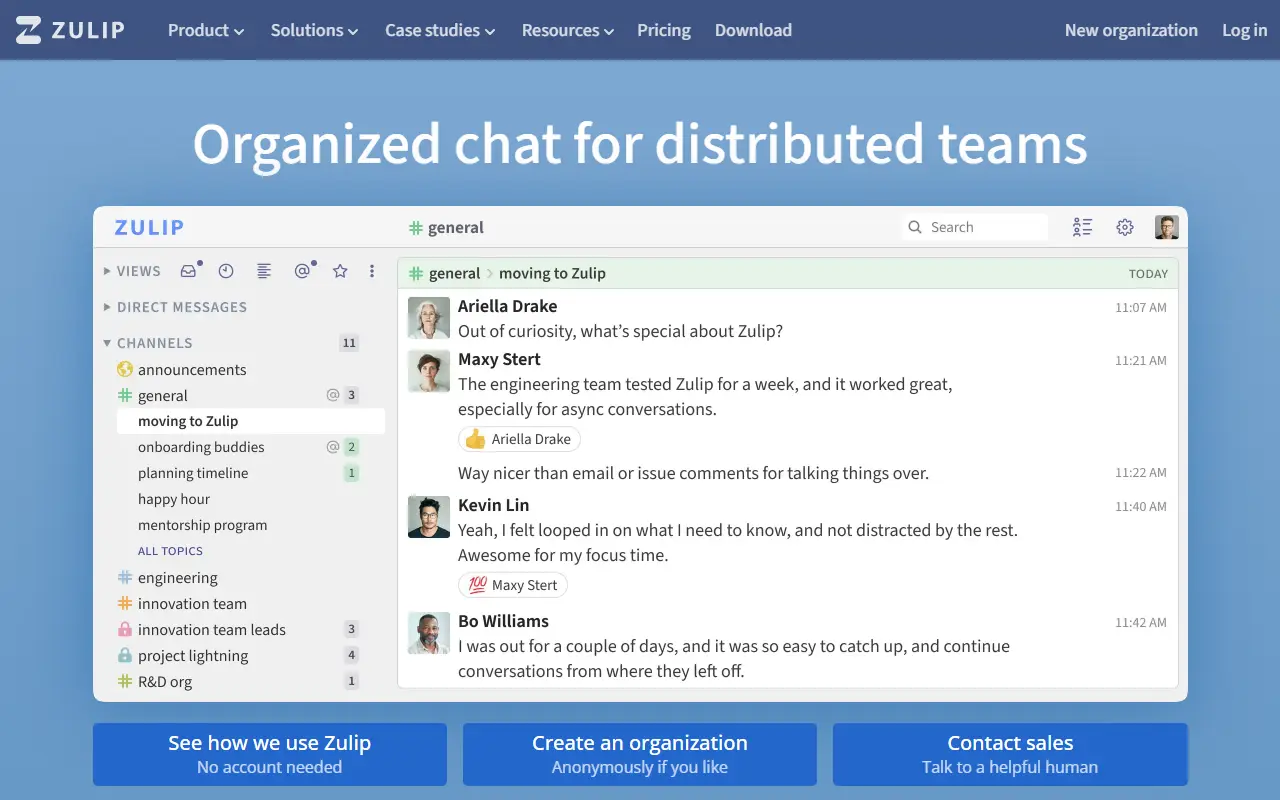
Zulip is an open-source team chat application whose defining feature is topic-based threading within channels. The idea is to blend the strengths of email and chat, so that remote and distributed teams can follow several conversations at once and catch up later without losing context. Its topics tag it as a Slack alternative.
The project is developed by a distributed community, with more than a thousand contributors and a steady flow of commits each month, and it says it has put effort into readable, tested code and extensive contributor documentation. The server is a Python web application, and there are web, desktop, built on Electron, and mobile clients, built with React Native. Zulip is used by companies and open-source projects alike, and the README says it is designed for both live and asynchronous communication.
Zulip is licensed under Apache-2.0. You can run the server on your own infrastructure, which gives full control over data, or use the hosted service operated by the project's company. It suits teams that find flat channel-based chat chaotic and want a more structured way to keep discussions organized.
Key features
- Topic-based threading in channels
- Live and asynchronous conversations
- Web, desktop and mobile clients
- Self-hosted server or hosted service
- Extensive contributor documentation
- Python and JavaScript codebase
Pricing: Cloud has a free plan, with Standard at $8 and Plus at $12 per user per month ($6.67 and $10 billed annually). Self-hosted is free, with Basic at $3.50 and Business at $8 per user per month; Enterprise is by contact.
#7
An open-source instant messaging SDK and server for developers who want to build chat, user management and group messaging into their own apps.
- GitHub stars
- 17k
- Last commit
- 3 days ago
- Latest release
- v3.8.3-patch.18
- Licence
- Apache-2.0
- Self-hosted
- Yes
openim.io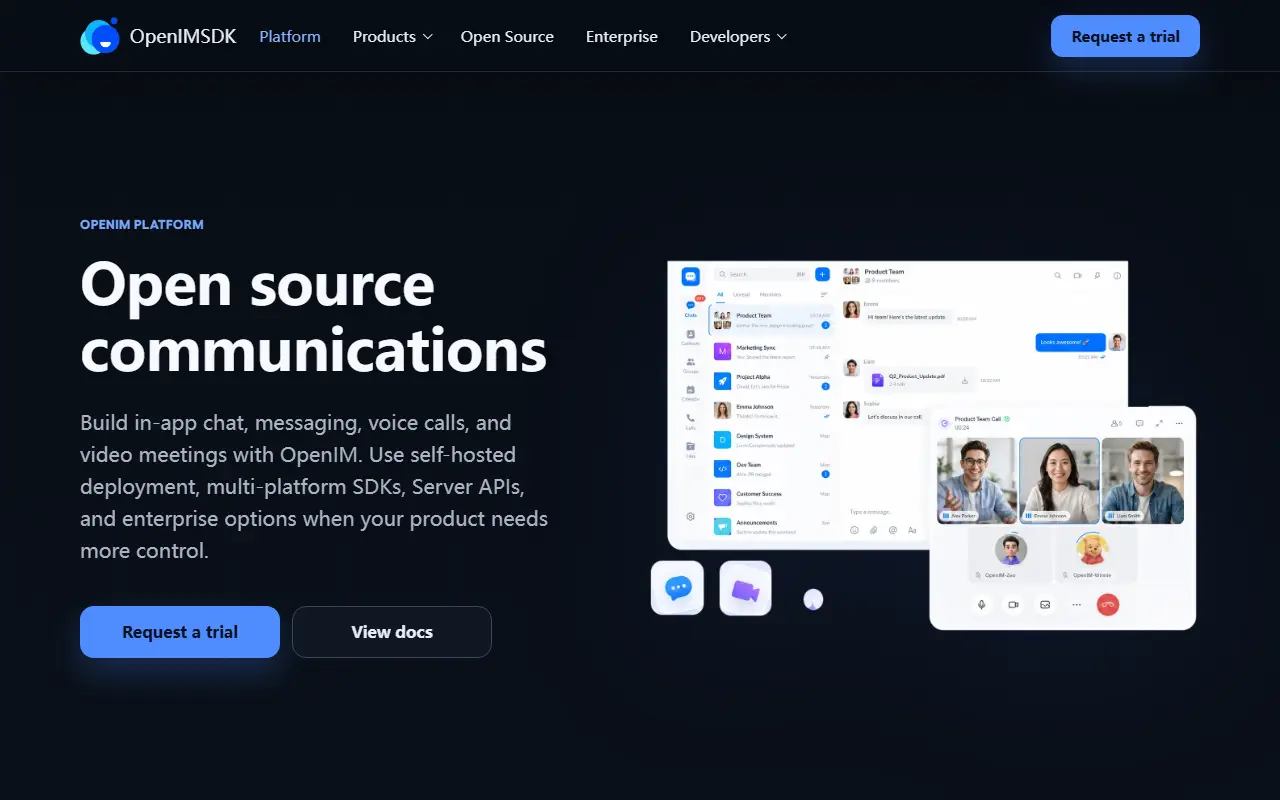
OpenIM is an open-source instant messaging solution aimed at developers rather than end users. The project contrasts itself with standalone chat apps such as Telegram, Signal and Rocket.Chat, saying it is a set of building blocks for adding messaging to your own application instead of an installable chat product.
It consists of the OpenIM SDK, a client-side library, and the OpenIM Server, written in Go. Together they handle sending and receiving messages, managing users and managing groups, so teams can embed chat into social, marketplace, enterprise or other apps without building the infrastructure themselves. The README is translated into many languages and links to community channels on Twitter, Slack and WeChat, and topics mention IM, chat and messaging.
OpenIM is Apache-2.0 licensed and runs on your own servers. It suits product teams and agencies who need to own their messaging stack, for example for data-residency or customization reasons, and who are comfortable operating a Go back end.
Key features
- Instant messaging server in Go
- Client SDK for embedding chat
- Message sending and receiving
- User account management
- Group chat management
- Deploy on your own servers
Pricing: Free and open source under the Apache-2.0 license.
#8
WuKongIM is an open-source real-time messaging service in Go for chat, notifications and streaming AI replies, with built-in storage and clustering.
- GitHub stars
- 5k
- Last commit
- 2 days ago
- Latest release
- v2.2.5-20260422
- Licence
- Apache-2.0
- Self-hosted
- Yes
docs.githubim.com
WuKongIM is open-source messaging infrastructure that you build your own product on. It takes care of client connections, storing and syncing messages, presence and delivery to online users, while your application keeps ownership of the user interface, accounts and business rules.
The project suits personal and group chat, customer support, application notifications and streaming AI replies. A key design point is a self-contained messaging core with built-in storage and clustering, so no external database, cache or message queue is required. The repository offers a quick start, a live demo, a showcase and documentation, and the README is available in Chinese as well as English. It is written in Go.
WuKongIM is licensed under Apache-2.0 and runs on your own servers, which suits teams that want to embed chat in their apps without depending on a third-party messaging service or running extra infrastructure.
Key features
- Real-time message delivery and presence
- Built-in storage and clustering
- No external database or queue required
- Personal and group chat support
- Streaming AI conversation delivery
- Application notification messaging
Pricing: Free and open source under the Apache-2.0 license.
#9
JuggleIM is a self-hosted instant messaging server written in Go, offering private chat, groups and chatrooms over WebSocket and REST APIs.
- GitHub stars
- 3.5k
- Last commit
- yesterday
- Latest release
- v1.8.16
- Licence
- Apache-2.0
- Self-hosted
- Yes
juggle.im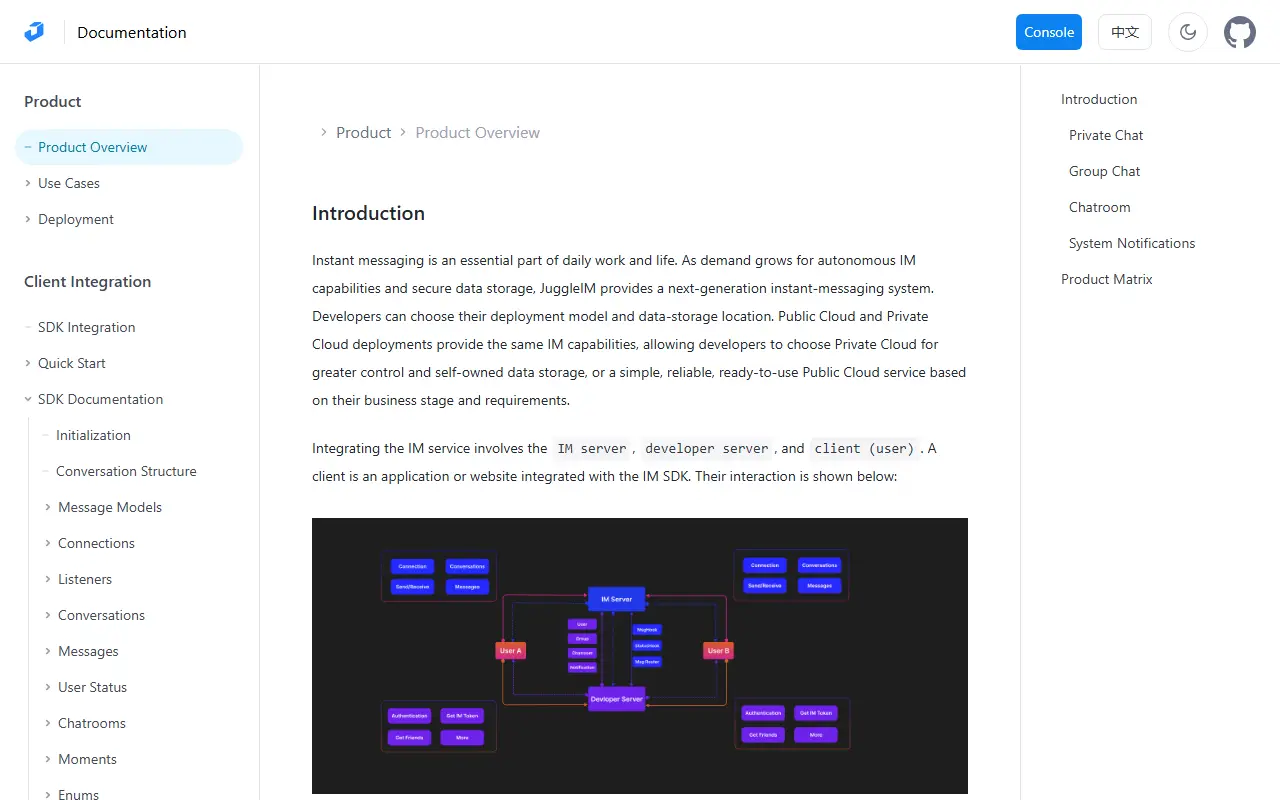
JuggleIM is a high-performance, scalable instant messaging backend that you host yourself. It is built on a Protobuf and WebSocket long-connection protocol and focuses on efficient message delivery and reliable storage, so teams can add chat to an app, website or business system quickly.
The server supports private chat, group chat and chatrooms, exposes WebSocket and REST APIs, and offers multi-tenant operation, with SDKs for client platforms. It is positioned for social products, customer-service systems and similar use cases. Documentation includes a quick deploy guide, an API reference and an introduction, and the code is written in Go.
JuggleIM is licensed under Apache-2.0 and deployed on your own servers, which keeps message data in your control. It suits product teams that need to embed real-time messaging without relying on a third-party chat service.
Key features
- Private chat, groups and chatrooms
- WebSocket and REST APIs
- Protobuf-based long-connection protocol
- Support for multiple tenants
- Reliable message storage
- Quick deploy guide
Pricing: Free and open source under the Apache-2.0 license.
#10
Self-hosted real-time video stack built on LiveKit and mediasoup, offering a ready-made conferencing app and SDKs for building custom WebRTC applications.
- GitHub stars
- 2.1k
- Last commit
- today
- Latest release
- v3.9.0
- Licence
- Apache-2.0
- Self-hosted
- Yes
openvidu.io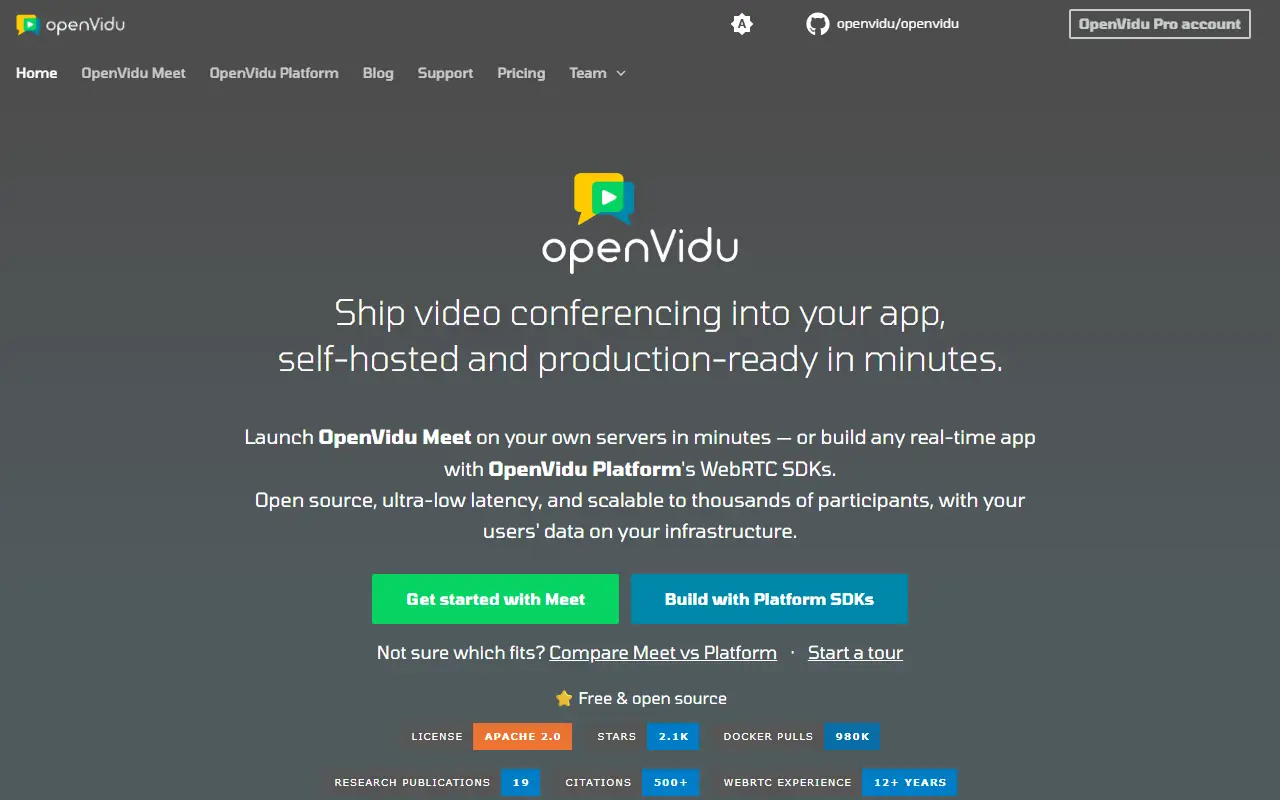
OpenVidu is a self-hosted real-time video and audio stack built on LiveKit and mediasoup by a team with long experience in WebRTC. It ships as two products. OpenVidu Meet is a ready-to-use video conferencing application and an open-source alternative to Zoom, Google Meet, and Jitsi Meet, with rooms, recordings, chat, screen sharing, and moderation. The code is released under the Apache-2.0 license.
OpenVidu Meet can be branded with your own name, logo, and colors, with per-participant feature choices, and embedded into your own application through a web component, driven from your backend with a REST API and webhooks. OpenVidu Platform provides programmable client and server SDKs for custom WebRTC apps with low-level media control, and it is API-compatible with LiveKit, so LiveKit SDKs work unchanged.
Both products are self-hosted only, deployable on AWS, GCP, Azure, Oracle, DigitalOcean, or on-premises, with no hosted SaaS tier. OpenVidu PRO is a paid self-hosted edition, and the team offers support and consultancy. Advanced features include recording, RTMP streaming egress, AI agents for transcription and translation, and virtual backgrounds.
Key features
- Ready-made video conferencing app (OpenVidu Meet)
- Rooms, recordings, chat, and moderation
- Embeddable web component and REST API
- SDKs compatible with LiveKit
- RTMP egress and AI agent support
- Branding and per-participant feature control
Pricing: OpenVidu Community is free and open source. Pro is self-hosted and billed per core per minute of cluster running time, with a 15-day free trial.
Commercial QuickBlox alternatives
Hosted, closed-source products that compete with QuickBlox.
- View tool

Stream
Backend as a Service
Chat, activity feeds, video and moderation APIs for in-app social features
SaaS
- View tool

Sendbird
Backend as a Service
Chat, voice and video APIs and SDKs for in-app messaging
SaaS
- View tool

Azure Communication Services
Backend as a Service
Microsoft cloud APIs for adding chat, voice, video and SMS to applications
SaaS
- View tool

MirrorFly
Backend as a Service
In-app chat, voice and video calling SDKs and white-label messaging solutions
SaaS
- View tool

ZEGOCLOUD
Backend as a Service
Real-time video, voice, chat and live streaming SDKs for apps
SaaS
- View tool

100ms
Backend as a Service
Video and audio SDK platform for adding live calls and streaming to apps
SaaS
- View tool

CometChat
Backend as a Service
Chat and calling SDKs and APIs for adding messaging to apps
SaaS
- View tool

PubNub
Backend as a Service
Realtime messaging and presence APIs for chat, IoT and live apps
SaaS
- View tool

Agora
Backend as a Service
Real-time voice, video and streaming SDKs for apps
SaaS
- View tool

Daily
Backend as a Service
Video and audio calling APIs with prebuilt embeddable call UI
SaaS
- View tool
Twilio
Backend as a Service
Communications APIs for SMS, voice, video, email and verification
SaaS
- View tool

Firebase
Backend as a Service
Firebase is Google's mobile and web app development platform, bundling authentication, databases, hosting, messaging and analytics as a managed backend.
SaaS
QuickBlox alternatives: questions
- What is the best open-source alternative to QuickBlox?
- Supabase is the top-ranked open-source alternative to QuickBlox on Enlisted: An open-source Postgres development platform bundling a database, auth, auto-generated APIs, realtime, storage and vector tools, often chosen as a Firebase alternative. Other strong options are LiveKit, Appwrite, Rocket.Chat and Mattermost.
- What are the best commercial alternatives to QuickBlox?
- Stream, Sendbird, Azure Communication Services, MirrorFly and ZEGOCLOUD are among the hosted, closed-source alternatives to QuickBlox listed on Enlisted, which lists 12 in total. Compare their pricing and features on each tool page.
- Are these QuickBlox alternatives free?
- All 10 are open source, so the code is free to use under its licence, and all of them can be self-hosted on your own server or computer. 6 also offer a paid or managed cloud version if you'd rather not host it yourself.
- How is this list of QuickBlox alternatives ranked?
- By a score built from GitHub stars, star growth over the last 30 days and how recently the code changed. 10 of these projects shipped code in the last 30 days. Data is refreshed daily, and nobody can pay to move up.
 TrackMedia
 TrackRev





