7,363 open-source and SaaS tools, with GitHub stats refreshed every day.

4 alternatives ranked by real activity

Open-source Azure Communication Services alternatives

A curated, ranked list of the 4 best open-source alternatives to Azure Communication Services.

The best open-source alternative to Azure Communication Services is LiveKit. If that doesn't suit you, other good options are OpenIM, Fonoster and OpenVidu.

Azure Communication Services alternatives are mainly backend-as-a-service tools, but some are also video conferencing tools. 4 of them shipped code in the last 30 days, 4 can be self-hosted, and 4 use a permissive licence.

Last updated October 3, 2026 · ranked by GitHub stars, growth and recent commits

LiveKit

LiveKit is an open-source realtime server and SDK platform for building voice, video and AI-agent applications on WebRTC.

GitHub stars
21k
Last commit
yesterday
Latest release
v1.13.7
Licence
Apache-2.0
Self-hosted
Yes
Hosted version
Available
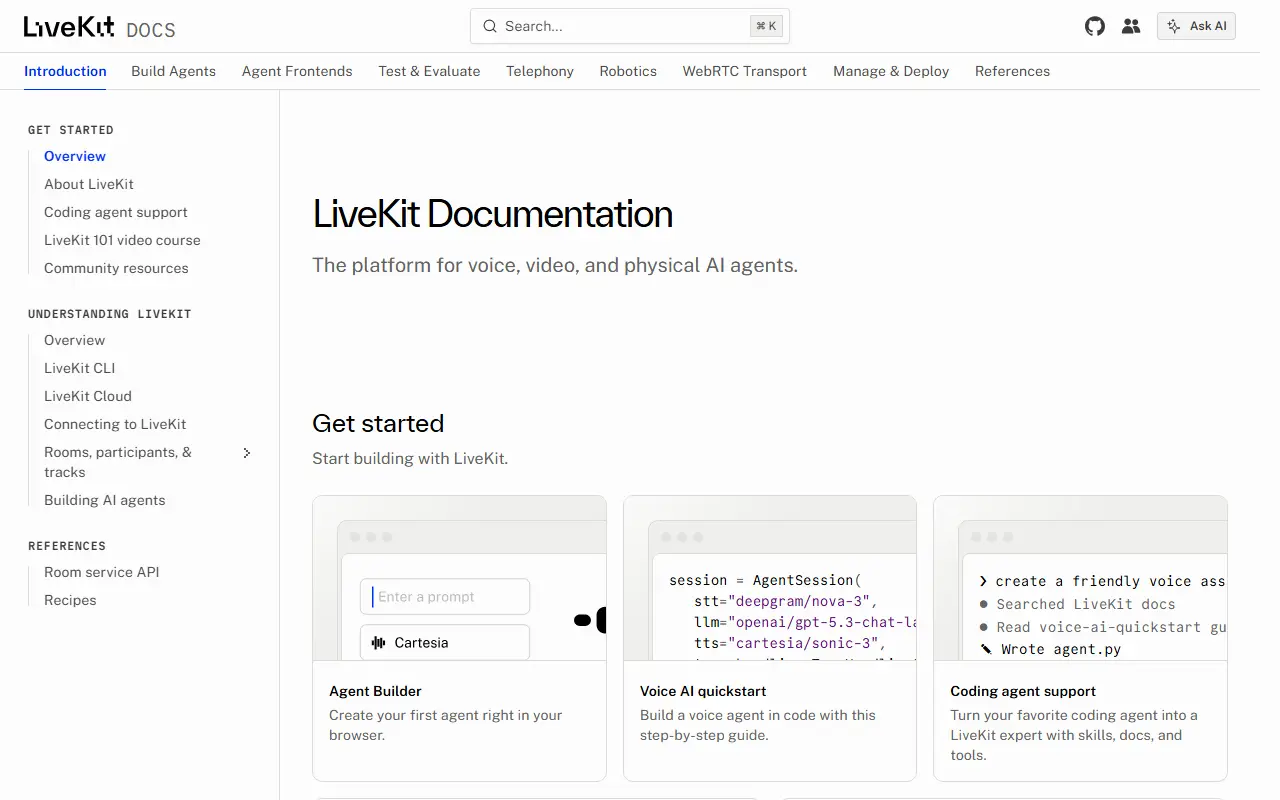
docs.livekit.ioLiveKit homepage screenshot

LiveKit is an open-source platform for realtime audio, video and data, aimed at developers building voice, video and AI agent applications. This repository holds the LiveKit server, a distributed WebRTC selective forwarding unit (SFU) written in Go on top of the Pion WebRTC implementation.

People, devices and AI agents join the same room as participants, and agents can be dispatched into rooms automatically or on demand. The server offers speaker detection, simulcast and selective subscription, uses JWT for authentication, and handles UDP, TCP and TURN connectivity. SDKs cover web, mobile, desktop, embedded and server environments, and a separate Agents framework in Python and Node.js supports code-first voice agents.

The server ships as a single binary and can be deployed with Docker or Kubernetes on your own infrastructure under the Apache 2.0 license. The vendor also runs LiveKit Cloud, a managed service that handles deployment and observability.

Key features

  • Distributed WebRTC SFU server written in Go
  • Rooms where people and AI agents meet
  • Simulcast and speaker detection
  • JWT authentication for participants
  • SDKs for web, mobile, desktop and server
  • Single binary, Docker or Kubernetes deployment

Pricing: The server is free and open source under Apache 2.0; LiveKit Cloud is offered as a managed option by the vendor.

Read more about LiveKitWebsite GitHub

OpenIM

An open-source instant messaging SDK and server for developers who want to build chat, user management and group messaging into their own apps.

GitHub stars
17k
Last commit
15 days ago
Latest release
v3.8.3-patch.16
Licence
Apache-2.0
Self-hosted
Yes
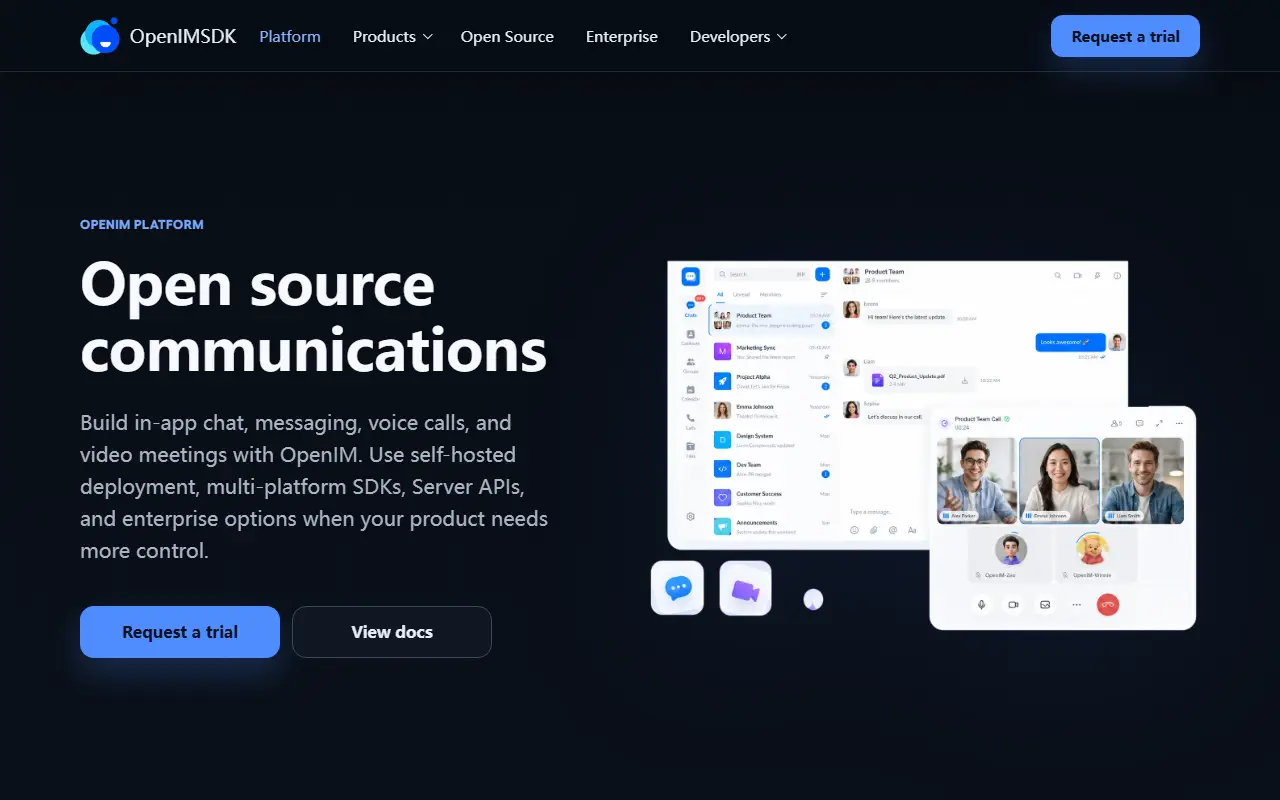
openim.ioOpenIM homepage screenshot

OpenIM is an open-source instant messaging solution aimed at developers rather than end users. The project contrasts itself with standalone chat apps such as Telegram, Signal and Rocket.Chat, saying it is a set of building blocks for adding messaging to your own application instead of an installable chat product.

It consists of the OpenIM SDK, a client-side library, and the OpenIM Server, written in Go. Together they handle sending and receiving messages, managing users and managing groups, so teams can embed chat into social, marketplace, enterprise or other apps without building the infrastructure themselves. The README is translated into many languages and links to community channels on Twitter, Slack and WeChat, and topics mention IM, chat and messaging.

OpenIM is Apache-2.0 licensed and runs on your own servers. It suits product teams and agencies who need to own their messaging stack, for example for data-residency or customization reasons, and who are comfortable operating a Go back end.

Key features

  • Instant messaging server in Go
  • Client SDK for embedding chat
  • Message sending and receiving
  • User account management
  • Group chat management
  • Deploy on your own servers

Pricing: Free and open source under the Apache-2.0 license.

Read more about OpenIMWebsite GitHub

Fonoster

An open-source programmable telecommunications stack, positioned as an alternative to Twilio, for building voice applications, PBX features and cloud telephony.

GitHub stars
8.1k
Last commit
15 days ago
Latest release
v0.22.14
Licence
MIT
Self-hosted
Yes
fonoster.comFonoster homepage screenshot

Fonoster is an open-source cloud communications platform presented as an alternative to Twilio. Its stated aim is a programmable telecommunications stack that lets businesses connect telephony services with the internet through a cloud-based utility, and the topics mention VoIP, WebRTC, UCaaS and CPaaS.

Main features include multitenancy, easy deployment of PBX functionality, programmable voice applications, a Node.js SDK, support for Amazon S3, secured API endpoints with Let's Encrypt, OAuth2 and JWT authentication, role-based access control, a plugin-based CLI and Google speech APIs. A voice application is a server process that drives a call using verbs such as Answer, Hangup, Play, Say, Gather, Stream, Dial, Record, Mute and Unmute, and everything in Fonoster is API first, including starting a call with the SDK.

Fonoster is written in TypeScript on Node.js and designed for Kubernetes deployments. It is licensed under MIT and aimed at developers and companies building voice bots, IVR systems and cloud phone features that they can run on their own infrastructure.

Key features

  • Programmable voice applications
  • PBX functionality deployment
  • SDK for Node.js developers
  • Multitenancy with role-based access control
  • OAuth2 and JWT authentication
  • Speech recognition and synthesis hooks
  • Plugin-based command-line tool

Pricing: Free and open source under the MIT licence.

Read more about FonosterWebsite GitHub

OpenVidu

Self-hosted real-time video stack built on LiveKit and mediasoup, offering a ready-made conferencing app and SDKs for building custom WebRTC applications.

GitHub stars
2.1k
Last commit
today
Latest release
v3.9.0
Licence
Apache-2.0
Self-hosted
Yes
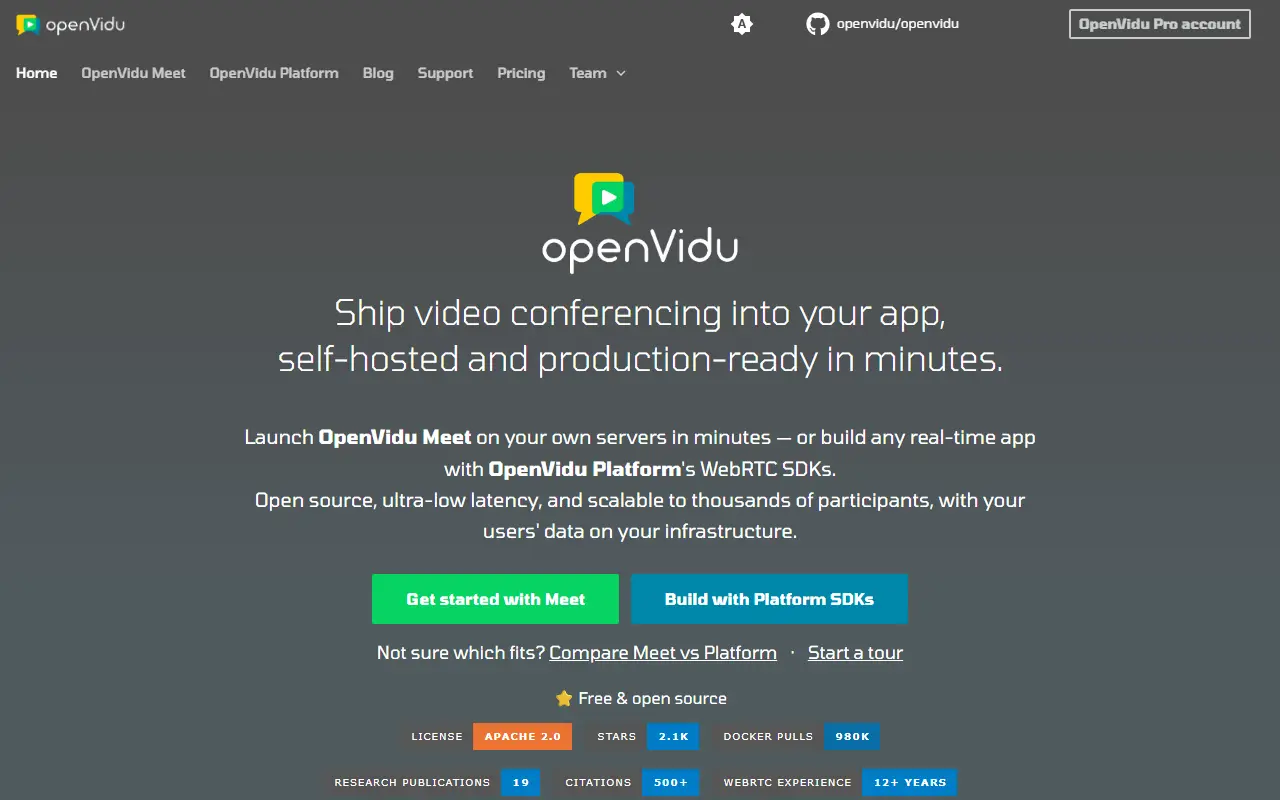
openvidu.ioOpenVidu homepage screenshot

OpenVidu is a self-hosted real-time video and audio stack built on LiveKit and mediasoup by a team with long experience in WebRTC. It ships as two products. OpenVidu Meet is a ready-to-use video conferencing application and an open-source alternative to Zoom, Google Meet, and Jitsi Meet, with rooms, recordings, chat, screen sharing, and moderation. The code is released under the Apache-2.0 license.

OpenVidu Meet can be branded with your own name, logo, and colors, with per-participant feature choices, and embedded into your own application through a web component, driven from your backend with a REST API and webhooks. OpenVidu Platform provides programmable client and server SDKs for custom WebRTC apps with low-level media control, and it is API-compatible with LiveKit, so LiveKit SDKs work unchanged.

Both products are self-hosted only, deployable on AWS, GCP, Azure, Oracle, DigitalOcean, or on-premises, with no hosted SaaS tier. OpenVidu PRO is a paid self-hosted edition, and the team offers support and consultancy. Advanced features include recording, RTMP streaming egress, AI agents for transcription and translation, and virtual backgrounds.

Key features

  • Ready-made video conferencing app (OpenVidu Meet)
  • Rooms, recordings, chat, and moderation
  • Embeddable web component and REST API
  • SDKs compatible with LiveKit
  • RTMP egress and AI agent support
  • Branding and per-participant feature control

Pricing: OpenVidu Community is free and open source. Pro is self-hosted and billed per core per minute of cluster running time, with a 15-day free trial.

Read more about OpenViduWebsite GitHub

Azure Communication Services alternatives: questions

What is the best open-source alternative to Azure Communication Services?
LiveKit is the top-ranked open-source alternative to Azure Communication Services on Enlisted: LiveKit is an open-source realtime server and SDK platform for building voice, video and AI-agent applications on WebRTC. Other strong options are OpenIM, Fonoster and OpenVidu.
Are these Azure Communication Services alternatives free?
All 4 are open source, so the code is free to use under its licence, and all of them can be self-hosted on your own server or computer. 1 also offers a paid or managed cloud version if you'd rather not host it yourself.
How is this list of Azure Communication Services alternatives ranked?
By a score built from GitHub stars, star growth over the last 30 days and how recently the code changed. 4 of these projects shipped code in the last 30 days. Data is refreshed daily, and nobody can pay to move up.

People also look for alternatives to…

View all