
About Bandwidth
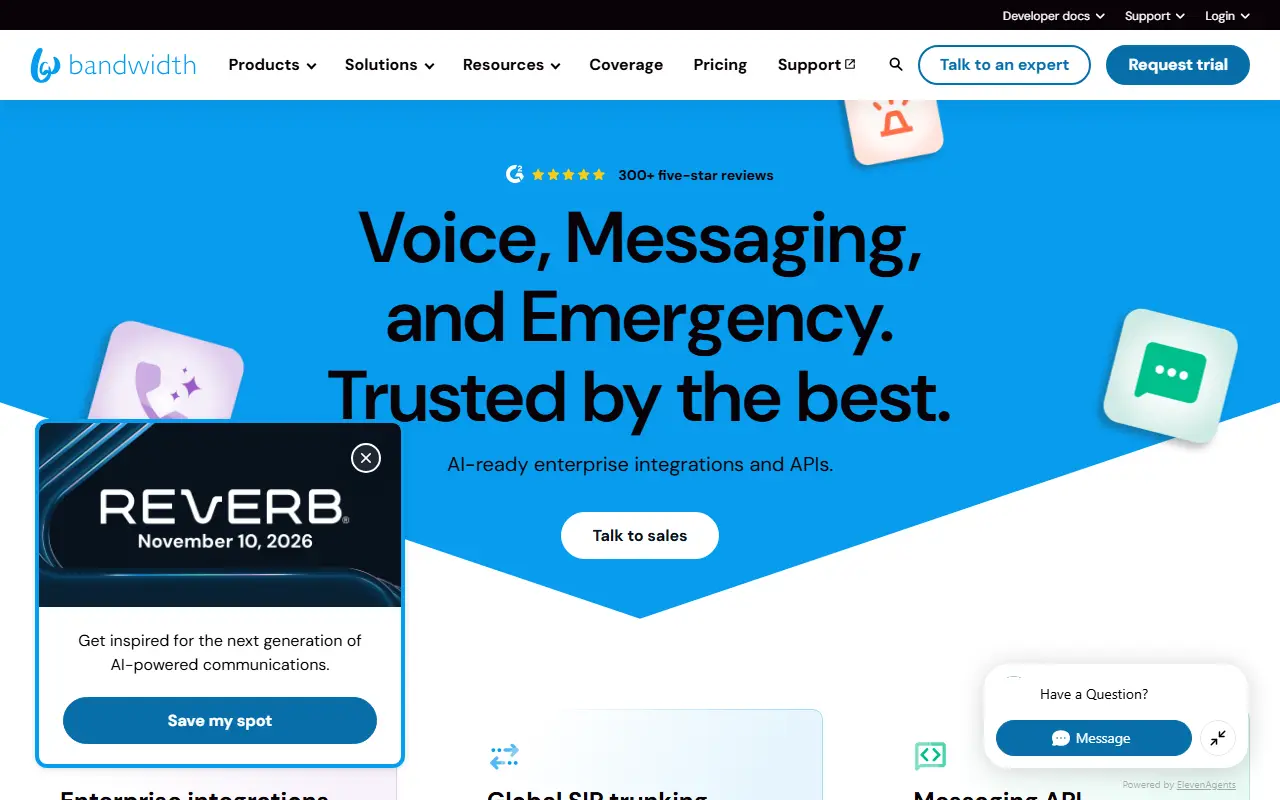
Bandwidth is a communications platform that exposes voice, messaging and emergency calling capabilities as APIs. Developers and enterprises use it to add calling and texting to applications, and the vendor says these services run on its own carrier network.
The product catalog includes a Voice API, media streaming, a messaging API covering SMS, MMS and RCS, an Emergency Calling API, WebRTC and authentication APIs. Integrations cover Microsoft Teams through Direct Routing and Operator Connect, Zoom Phone, Webex Calling, Genesys Cloud CX, Five9 and Salesforce Contact Center. Wholesale offerings include global SIP trunking and VoIP origination and termination, and tooling covers phone number management, porting, caller ID, number reputation and branded calling.
Bandwidth uses volume-based pricing and offers support plans, developer documentation and code samples. Business types it addresses include large enterprises, SaaS product builders, voice AI startups and communications providers.
Key features
- Voice API and media streaming
- Messaging API for SMS, MMS and RCS
- Emergency calling API
- Microsoft Teams and Zoom Phone integrations
- Global SIP trunking and VoIP
- Phone number management and porting
Good fit for
- →Adding calling to Microsoft Teams with Direct Routing
- →Providing emergency calling in a voice application
- Tags
- cpaas
- voice-api
- messaging-api
- emergency-calling
- sip-trunking
- telecom
- enterprise
Bandwidth: questions and answers
- What is Bandwidth used for?
- Bandwidth is a commercial enterprise communications platform with voice, messaging and emergency calling APIs delivered over its own carrier network. It is a good fit for adding calling to Microsoft Teams with Direct Routing and providing emergency calling in a voice application.
- How much does Bandwidth cost?
- Bandwidth is a paid product with no free plan. US list rates are usage-based: SMS from $0.004 per message, outbound voice $0.01 per minute and two-factor authentication $0.05 per attempt. Volume discounts and SIP trunking are quoted.
- Is Bandwidth open source?
- No. Bandwidth is proprietary (closed-source) software and can't be self-hosted. Open-source alternatives to Bandwidth include Fonoster.
- What are some alternatives to Bandwidth?
- Bandwidth competes with Twilio, Telnyx and Vonage API. For open-source options, see Enlisted's ranked list of open-source Bandwidth alternatives.
Open-source alternatives to Bandwidth
See all
Fonoster
Backend as a Service
🚀 The open-source alternative to Twilio.
MITvs Twilio★ 8.1k
Supabase
Backend as a Service
The Postgres development platform. Supabase gives you a dedicated Postgres database to bui
Apache-2.0vs Firebase★ 111k
PocketBase
Backend as a Service
Open Source realtime backend in 1 file
MITvs Firebase★ 61k
Appwrite
Backend as a Service
Appwrite is an open-source developer platform with Auth, Databases, Storage, Functions, Me
BSD-3-Clausevs Firebase★ 58k
Novu
Backend as a Service
The open-source communication infrastructure for agents and products
OSSvs Knock★ 40k
Hasura
Backend as a Service
Blazing fast, instant realtime GraphQL APIs on all your data with fine grained access cont
Apache-2.0vs AWS AppSync★ 32k
SaaS alternatives to Bandwidth
See all
Twilio
Backend as a Service
Communications APIs for SMS, voice, video, email and verification
SaaS
Telnyx
Backend as a Service
Communications platform with voice, messaging, SIP trunking and IoT connectivity APIs
SaaS
Vonage API
Backend as a Service
Communications APIs for messaging, voice, video and verification
SaaS
Plivo
Backend as a Service
Cloud communications API platform for SMS, voice and WhatsApp messaging
SaaS
Sinch
Backend as a Service
Messaging, voice and verification APIs for customer communication
SaaS
Infobip
Backend as a Service
Omnichannel cloud communications platform for SMS, chat apps, email and voice
SaaS