4 open-source alternatives ranked by real activity

Open-source Bandwidth alternatives

A curated, ranked list of the 4 best open-source alternatives to Bandwidth.

The best open-source alternative to Bandwidth is FreeSWITCH. If that doesn't suit you, other good options are Fonoster, Asterisk and Kamailio.

Commercial alternatives to Bandwidth include Telnyx, Plivo, Vonage Business and Google Voice. See all 20.

Bandwidth alternatives are mainly video conferencing tools, but some are also backend-as-a-service tools and team chat tools. 4 of them shipped code in the last 30 days, 4 can be self-hosted, and 1 uses a permissive licence.

Last updated November 12, 2026 · ranked by GitHub stars, growth and recent commits

FreeSWITCH

An open-source software-defined telecom stack that turns commodity hardware into a telephony platform for VoIP, SIP and WebRTC applications.

GitHub stars
5.3k
Last commit
3 days ago
Latest release
v1.11.3
Self-hosted
Yes
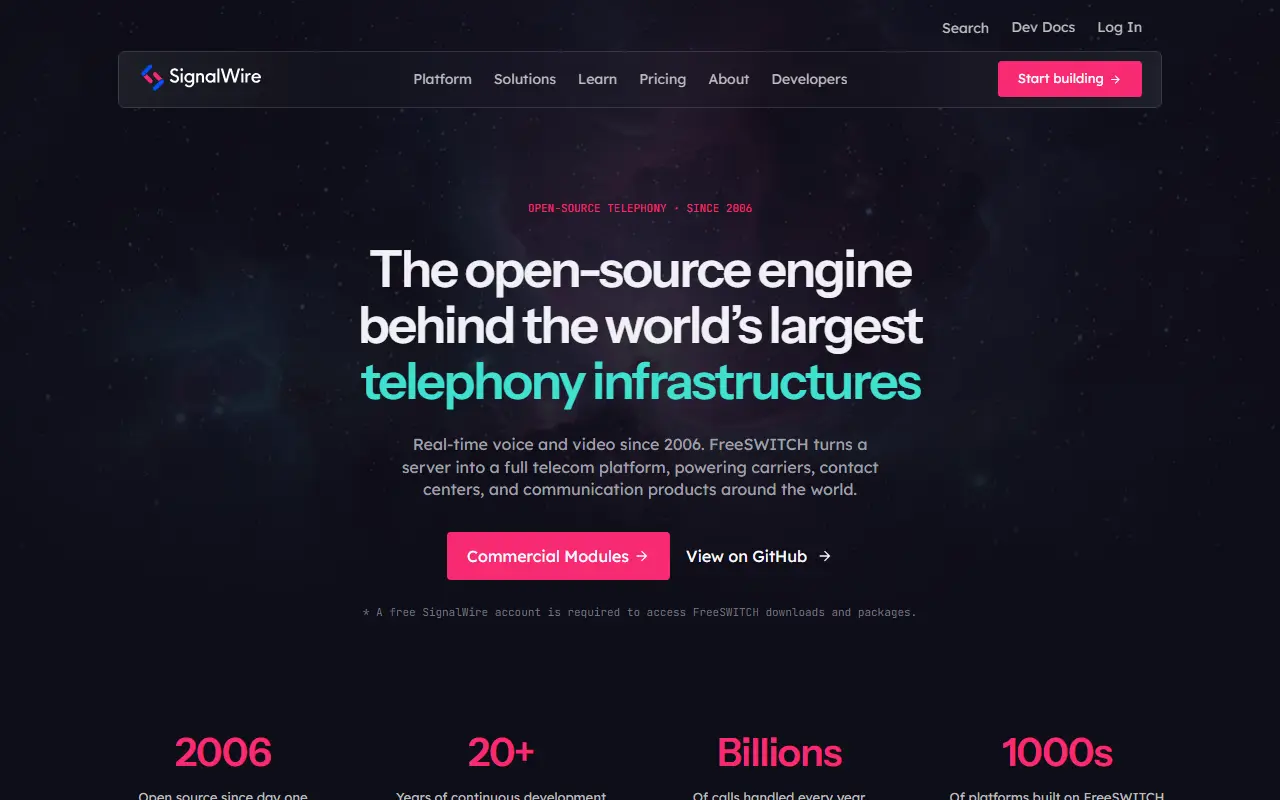
freeswitch.comFreeSWITCH homepage screenshot

FreeSWITCH is a software-defined telecom stack that replaces proprietary telecom switches with software running on ordinary hardware, from a Raspberry Pi to a multi-core server. It is used to build voice and communications systems around standards such as SIP, WebRTC and VoIP.

The source code is available on GitHub and can be built for Linux, Windows, macOS and BSD, with an issue tracker and pull request workflow in the repository. Documentation, release notes and step-by-step installation tutorials from packages are published online. A mod_signalwire module included in the codebase links a FreeSWITCH instance to the SignalWire cloud platform.

SignalWire, founded by FreeSWITCH's original developers, is the primary sponsor and offers services such as SMS, SIP and programmable telecom that can extend a deployment. Teams that need commercially supported builds can contact the core team about professional services. The project is written in C.

Key features

  • SIP and VoIP call handling
  • WebRTC support
  • Builds for Linux, Windows, macOS and BSD
  • Scales from Raspberry Pi to multi-core servers
  • mod_signalwire cloud integration
  • Professional support available

Fonoster

An open-source programmable telecommunications stack, positioned as an alternative to Twilio, for building voice applications, PBX features and cloud telephony.

GitHub stars
8.2k
Last commit
today
Latest release
v0.57.0
Licence
MIT
Self-hosted
Yes
fonoster.comFonoster homepage screenshot

Fonoster is an open-source cloud communications platform presented as an alternative to Twilio. Its stated aim is a programmable telecommunications stack that lets businesses connect telephony services with the internet through a cloud-based utility, and the topics mention VoIP, WebRTC, UCaaS and CPaaS.

Main features include multitenancy, easy deployment of PBX functionality, programmable voice applications, a Node.js SDK, support for Amazon S3, secured API endpoints with Let's Encrypt, OAuth2 and JWT authentication, role-based access control, a plugin-based CLI and Google speech APIs. A voice application is a server process that drives a call using verbs such as Answer, Hangup, Play, Say, Gather, Stream, Dial, Record, Mute and Unmute, and everything in Fonoster is API first, including starting a call with the SDK.

Fonoster is written in TypeScript on Node.js and designed for Kubernetes deployments. It is licensed under MIT and aimed at developers and companies building voice bots, IVR systems and cloud phone features that they can run on their own infrastructure.

Key features

  • Programmable voice applications
  • PBX functionality deployment
  • SDK for Node.js developers
  • Multitenancy with role-based access control
  • OAuth2 and JWT authentication
  • Speech recognition and synthesis hooks
  • Plugin-based command-line tool

Pricing: Free and open source under the MIT licence.

Asterisk

Asterisk is an open-source PBX and telephony toolkit that connects SIP and Internet telephony with traditional PSTN interfaces.

GitHub stars
3.7k
Last commit
8 days ago
Latest release
24.0.0
Self-hosted
Yes

Asterisk is an open-source PBX and telephony toolkit. The README describes it as middleware between Internet and telephony channels at the bottom and Internet and telephony applications at the top, with support for more telephony interfaces than Internet telephony alone and a large amount of support for traditional PSTN telephony. The code is C, credited to Mark Spencer and the Asterisk.org developer community, with copyright held by Sangoma Technologies.

It is developed and tested mainly on GNU/Linux and is supported on every major Linux distribution; it also reportedly runs on Mac OS X and the BSD variants. Most users now run VoIP/SIP only, but TDM or analog services need supported hardware: Sangoma analog and digital interface cards, full-duplex sound cards supported by PortAudio, and the Xorcom Astribank channel bank.

Installation is from source. The README asks for GCC 4.1 or newer, or a C99 compiler, plus ncurses and other development libraries. The steps are ./configure, make menuselect to choose modules, make, make install and optionally make samples for a demonstration PBX. Running asterisk -vvvc starts it in the foreground with a command-line console where core show help lists commands.

Key features

  • Open-source PBX and telephony toolkit
  • Supports many telephony interfaces beyond Internet telephony
  • Works with Sangoma cards, PortAudio sound cards and Astribank
  • Modules are chosen at build time with menuselect
  • Console with built-in command help
  • Sample PBX with demonstration extensions
  • Configuration files share one common format

Kamailio

Kamailio is an open-source SIP signaling server built for large VoIP and real-time communication platforms, with a focus on scalability and security.

GitHub stars
3k
Last commit
2 days ago
Latest release
6.1.5
Self-hosted
Yes
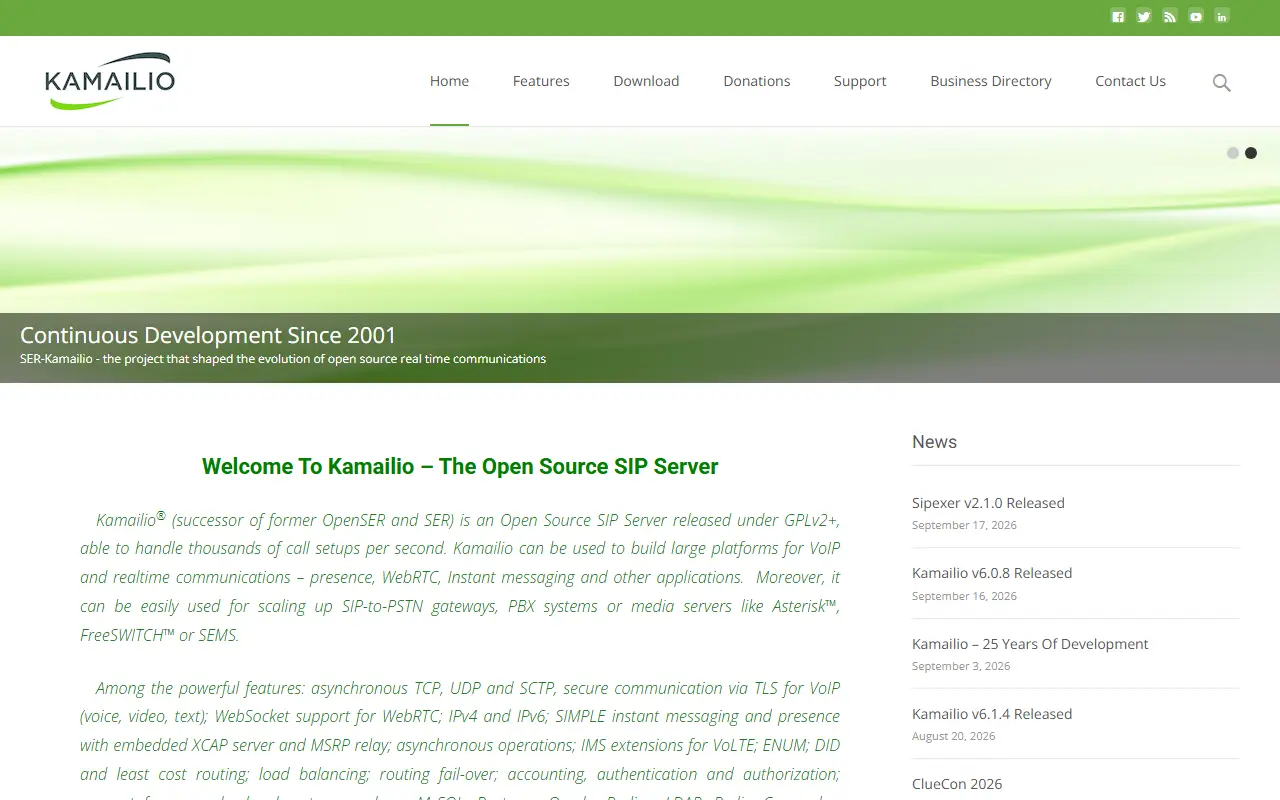
kamailio.orgKamailio homepage screenshot

Kamailio is an open-source implementation of a SIP signaling server. SIP is an open IETF standard, specified in RFC 3261, used to set up voice and other real-time communication sessions. The server is written in C and is aimed at flexibility, security and scalability, with topics that include VoIP, WebRTC, VoLTE and telephony.

It is designed for large deployments, such as IP telephony operators and carriers with big subscriber bases or high call volumes. Enterprises and individuals can also use it to provide VoIP, instant messaging and presence. The project is known for its flexibility, robustness and extensive module list, which the website describes in more detail.

The project began in 2001 at the Fraunhofer Fokus research institute in Berlin as SIP Express Router. A fork called OpenSER appeared in 2005 and was renamed Kamailio in 2008, after which the two projects merged. Fokus is no longer actively involved, and a worldwide community now develops the server, with events such as developer meetings and the Kamailio World Conference.

Key features

  • SIP signaling server
  • Scales to large subscriber bases and call volumes
  • VoIP, instant messaging and presence
  • WebRTC and VoLTE related support
  • Extensible module architecture

Commercial Bandwidth alternatives

Hosted, closed-source products that compete with Bandwidth. Showing 12 of 20.

See every Bandwidth alternative on its tool page

Bandwidth alternatives: questions

What is the best open-source alternative to Bandwidth?
FreeSWITCH is the top-ranked open-source alternative to Bandwidth on Enlisted: An open-source software-defined telecom stack that turns commodity hardware into a telephony platform for VoIP, SIP and WebRTC applications. Other strong options are Fonoster, Asterisk and Kamailio.
What are the best commercial alternatives to Bandwidth?
Telnyx, Plivo, Vonage Business, Google Voice and Infobip are among the hosted, closed-source alternatives to Bandwidth listed on Enlisted, which lists 20 in total. Compare their pricing and features on each tool page.
Are these Bandwidth alternatives free?
All 4 are open source, so the code is free to use under its licence, and all of them can be self-hosted on your own server or computer.
How is this list of Bandwidth alternatives ranked?
By a score built from GitHub stars, star growth over the last 30 days and how recently the code changed. 4 of these projects shipped code in the last 30 days. Data is refreshed daily, and nobody can pay to move up.

People also look for alternatives to…

View all