
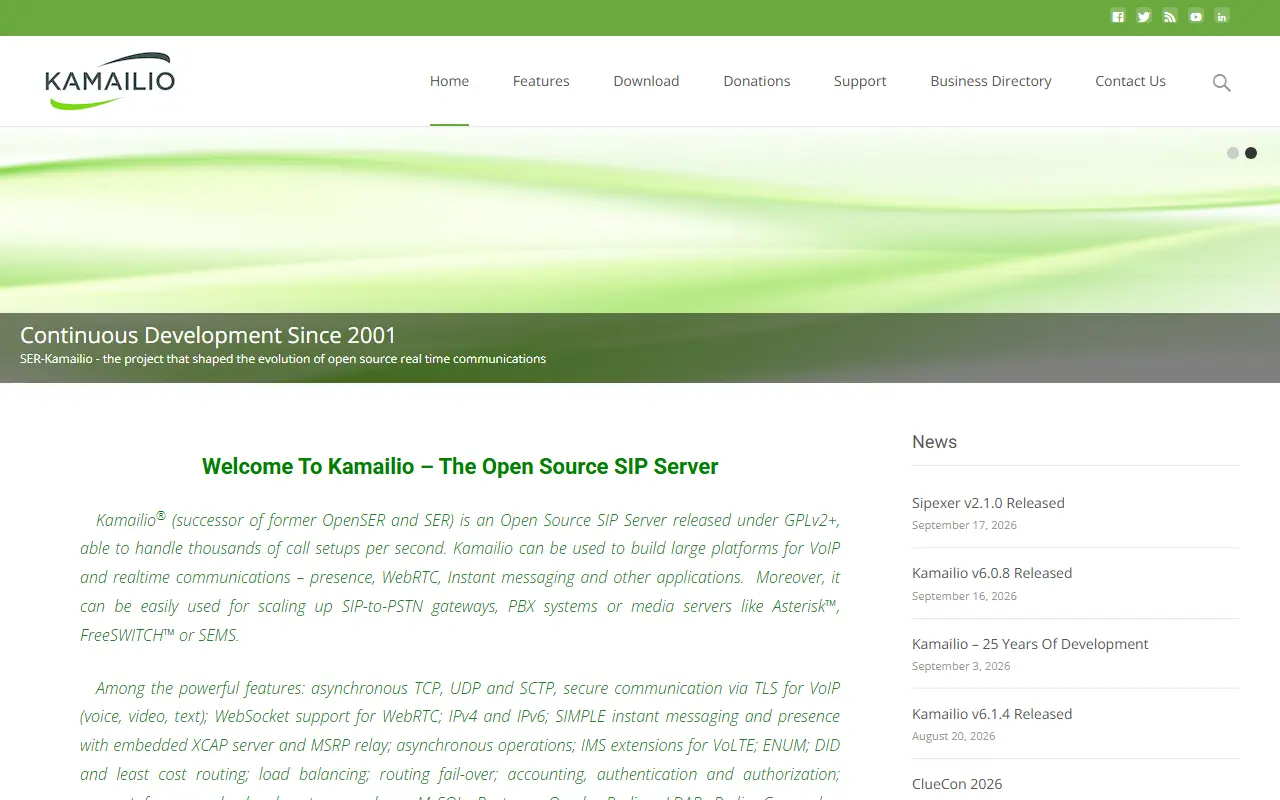
About Kamailio
Kamailio is an open-source implementation of a SIP signaling server. SIP is an open IETF standard, specified in RFC 3261, used to set up voice and other real-time communication sessions. The server is written in C and is aimed at flexibility, security and scalability, with topics that include VoIP, WebRTC, VoLTE and telephony.
It is designed for large deployments, such as IP telephony operators and carriers with big subscriber bases or high call volumes. Enterprises and individuals can also use it to provide VoIP, instant messaging and presence. The project is known for its flexibility, robustness and extensive module list, which the website describes in more detail.
The project began in 2001 at the Fraunhofer Fokus research institute in Berlin as SIP Express Router. A fork called OpenSER appeared in 2005 and was renamed Kamailio in 2008, after which the two projects merged. Fokus is no longer actively involved, and a worldwide community now develops the server, with events such as developer meetings and the Kamailio World Conference.
Key features
- SIP signaling server
- Scales to large subscriber bases and call volumes
- VoIP, instant messaging and presence
- WebRTC and VoLTE related support
- Extensible module architecture
Good fit for
- →Carrier and operator VoIP platforms
- →Load balancing and routing SIP traffic
- →Enterprise telephony infrastructure
- Built with
- C
- Tags
- sip
- voip
- telephony
- webrtc
- volte
- sip-server
- real-time-communication
- self-hosted
Kamailio: questions and answers
- What is Kamailio used for?
- Kamailio is an open-source SIP signaling server built for large VoIP and real-time communication platforms, with a focus on scalability and security. It is a good fit for carrier and operator VoIP platforms, load balancing and routing SIP traffic, and enterprise telephony infrastructure.
- Is Kamailio open source?
- Yes. Kamailio is open source under a custom licence. Its source code is on GitHub at kamailio/kamailio and is written mainly in C.
- Is Kamailio free?
- Yes. Kamailio is open source, so the software itself is free to use under the terms of its own licence.
- Can I self-host Kamailio?
- Yes. Kamailio can be self-hosted on your own server or infrastructure.
- What are some alternatives to Kamailio?
- Similar open-source tools in the Networking & VPN category include frp, Caddy and Pi-hole. SaaS products in the same category include Akamai, Amazon CloudFront and Amazon Route 53.
- Is Kamailio actively maintained?
- Yes. The most recent commit to Kamailio was on 2 October 2026, and the latest release is 6.0.8, published on 16 September 2026. The project has 3k stars on GitHub.
Open-source alternatives to Kamailio
See allfrp
Networking & VPN
A fast reverse proxy to help you expose a local server behind a NAT or firewall to the int
Apache-2.0vs ngrok★ 110k
Caddy
Networking & VPN
Fast and extensible multi-platform HTTP/1-2-3 web server with automatic HTTPS
Apache-2.0★ 76k
Pi-hole
Networking & VPN
A black hole for Internet advertisements
OSSvs Cisco Umbrella★ 61kHeadscale
Networking & VPN
An open source, self-hosted implementation of the Tailscale control server
BSD-3-Clausevs Tailscale★ 44k
AdGuard Home
Networking & VPN
Network-wide ads & trackers blocking DNS server
GPL-3.0vs Cisco Umbrella★ 37k
NetBird
Networking & VPN
Connect your devices, users, and agents into a secure WireGuard®-based overlay network wit
OSSvs Tailscale★ 30k
SaaS alternatives to Kamailio
See all
Akamai
Networking & VPN
CDN, security and edge compute platform for enterprise web delivery
SaaS
Amazon CloudFront
Networking & VPN
AWS content delivery network for caching and accelerating web content and APIs
SaaS
Amazon Route 53
Networking & VPN
Scalable DNS, domain registration and health-check routing service on AWS
SaaS
AnyDesk
Networking & VPN
Remote desktop software for support, administration and file transfer
SaaS
Aruba Central
Networking & VPN
Cloud-based network management platform from HPE Aruba
SaaS
Azure Front Door
Networking & VPN
Global CDN and application delivery network on Azure
SaaS