9 open-source alternatives ranked by real activity

Open-source Mitel alternatives

A curated, ranked list of the 9 best open-source alternatives to Mitel.

The best open-source alternative to Mitel is Rocket.Chat. If that doesn't suit you, other good options are Mattermost, Jitsi Meet, Mumble and BigBlueButton.

Commercial alternatives to Mitel include Nextiva, GoTo Connect, RingCentral and Intermedia. See all 22.

Mitel alternatives are mainly team chat tools, but some are also video conferencing tools and networking & VPN tools. 9 of them shipped code in the last 30 days, 9 can be self-hosted, and 1 uses a permissive licence.

Last updated November 13, 2026 · ranked by GitHub stars, growth and recent commits

Rocket.Chat

A customizable team communications platform with real-time chat and video, aimed at organizations with strict data protection needs and offered self-hosted, cloud or air-gapped.

GitHub stars
46k
Last commit
today
Latest release
9.0.0
Self-hosted
Yes
Hosted version
Available
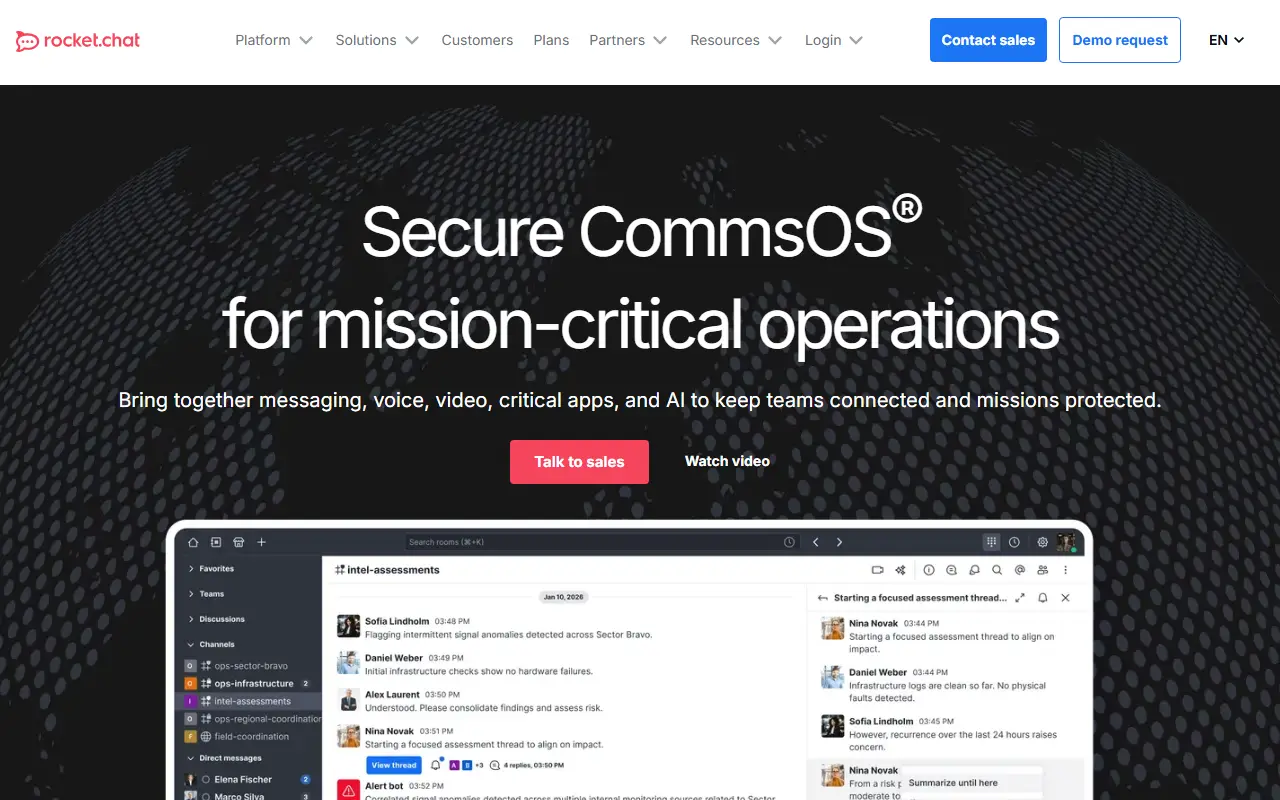
rocket.chatRocket.Chat homepage screenshot

Rocket.Chat is a communications platform written in TypeScript for teams and organizations that care about data protection. It supports real-time conversations between colleagues, with partner companies, and with customers or citizens, and its topics place it in the same space as Slack, with WebRTC for calls and meetings.

The product emphasizes control over where and how it runs. Deployment options include self-hosted servers, a managed cloud and fully air-gapped environments, with a scalable architecture and performance monitoring for workspace administration. Security and sovereignty features, including identity management, are a core part of the pitch, and the platform is built to be highly customizable, so organizations can adapt it to their own workflows and integrations.

The repository's license is listed as 'Other' on GitHub, although the topics reference an MIT-licensed community core, so confirm which components fall under which terms before relying on it commercially. It suits government bodies, enterprises and regulated industries that want a Slack-style tool they can host themselves.

Key features

  • Real-time team messaging and channels
  • Video conferencing built on WebRTC
  • Self-hosted, cloud and air-gapped deployment
  • Scalable architecture with performance monitoring
  • Identity and security controls for data sovereignty
  • Highly customizable platform

Pricing: Rocket.Chat does not publish prices. Commercial, Government and Defense plans are quoted through its sales team, with on-premise and air-gapped deployment options.

Mattermost

A self-hosted, open-core collaboration platform combining team chat, automated workflows, voice calls, screen sharing and AI integrations.

GitHub stars
40k
Last commit
yesterday
Latest release
v12.0.2
Self-hosted
Yes
Hosted version
Available
mattermost.comMattermost homepage screenshot

Mattermost is an open-core collaboration platform you host yourself, covering team chat, workflow automation, voice calls, screen sharing and AI integrations. This repository is the primary source for core development of the platform. The server is built with Go and React, ships as one Linux binary and depends on PostgreSQL. GitHub lists the license as 'Other'.

Each month, on the 16th, a newly compiled release is published under the MIT license. You can deploy Mattermost on-premises or try it in the cloud. The project highlights use cases such as DevSecOps, incident resolution and IT service desk, and it offers native clients for Android, iOS, Windows, macOS and Linux in addition to the web interface.

Installation options include Docker, Ubuntu, a tar archive, Kubernetes, Helm and an Omnibus package. Developers can build integrations through APIs, webhooks, slash commands, Apps and plugins, and the repository links product and developer documentation, security bulletins and contribution guides. It suits engineering, security and operations teams that want controlled, self-managed team messaging.

Key features

  • Team chat with channels and threads
  • Built-in workflow automation
  • Voice calling and screen sharing
  • Integration with AI tools
  • Single Linux binary with PostgreSQL
  • Native mobile and desktop apps
  • APIs, webhooks, slash commands and plugins

Pricing: Mattermost does not publish prices. Professional, Enterprise and Enterprise Advanced are quoted through sales; a limited-use edition and a 1-hour trial environment are offered for evaluation.

Jitsi Meet

An open-source video conferencing platform that runs in the browser and mobile apps, usable as a standalone service or embedded in your own web application.

GitHub stars
30k
Last commit
today
Latest release
stable/jitsi-meet_11248
Licence
Apache-2.0
Self-hosted
Yes
Hosted version
Available
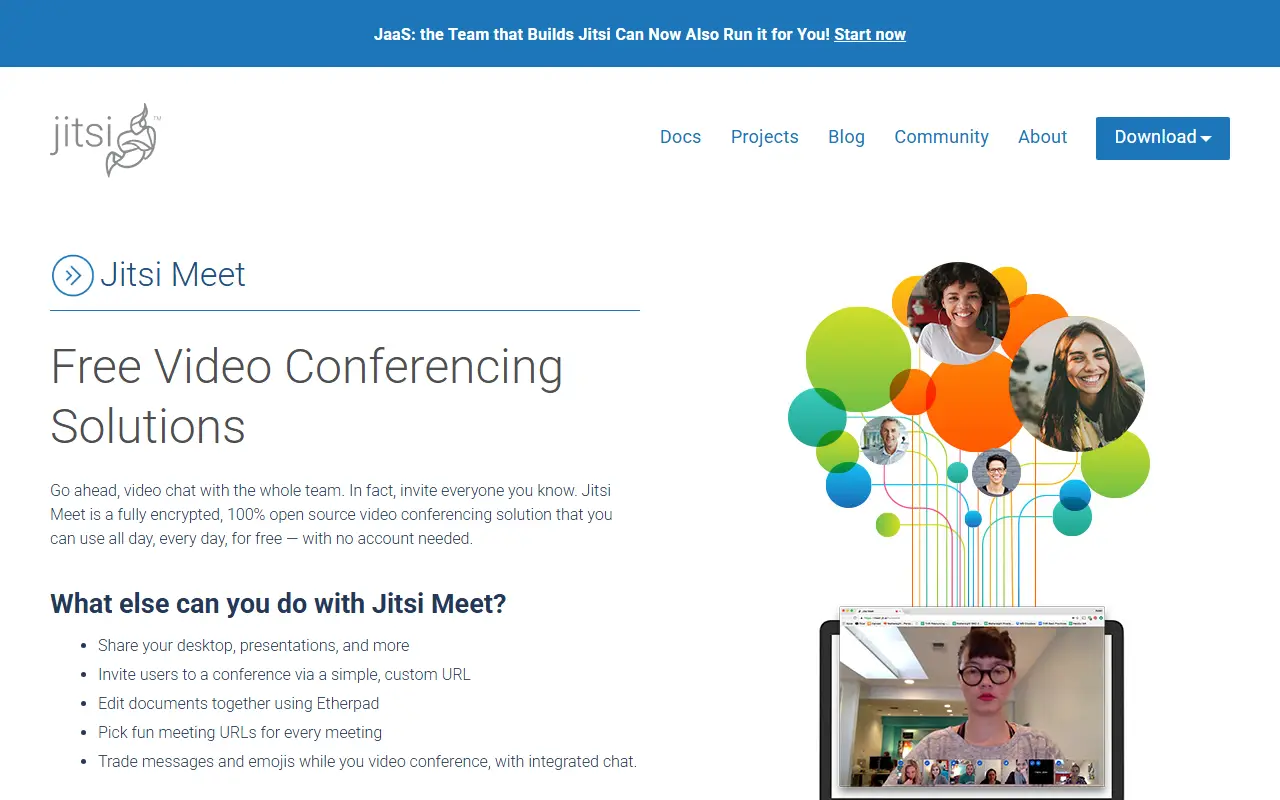
jitsi.orgJitsi Meet homepage screenshot

Jitsi Meet is a collection of open-source projects for hosting video conferences. It works in all current browsers and has Android and iOS apps, and it can be used as a ready-made service or embedded into other web applications through web and native SDKs. It is built on WebRTC with a selective forwarding unit to scale to larger meetings.

Meetings offer HD audio and video, content sharing, raised hands and reactions, chat with private conversations, polls and virtual backgrounds. The hosted service at meet.jit.si is free to use, and the README says you can start a meeting after signing in with an account from a major provider. Mobile users can use the browser or the full-featured apps, which are also available from F-Droid, and open beta programs let early adopters test features.

If you prefer control over your data, Jitsi can be deployed on your own infrastructure, with documentation for running your own instance. Jitsi Meet is Apache-2.0 licensed and written in TypeScript. It suits organizations, schools and communities that want an alternative to proprietary meeting software.

Key features

  • Browser-based meetings with no install
  • Android and iOS apps
  • Screen and content sharing
  • Chat, polls, reactions and raised hands
  • Virtual background support
  • Web and native SDKs for embedding

Pricing: Free and open source under Apache-2.0; the public meet.jit.si service is free to use.

Mumble

Mumble is an open-source, low-latency voice chat program with a client and server built on Qt and Opus, popular with gaming groups and communities.

GitHub stars
8.4k
Last commit
2 days ago
Latest release
v1.5.939
Self-hosted
Yes
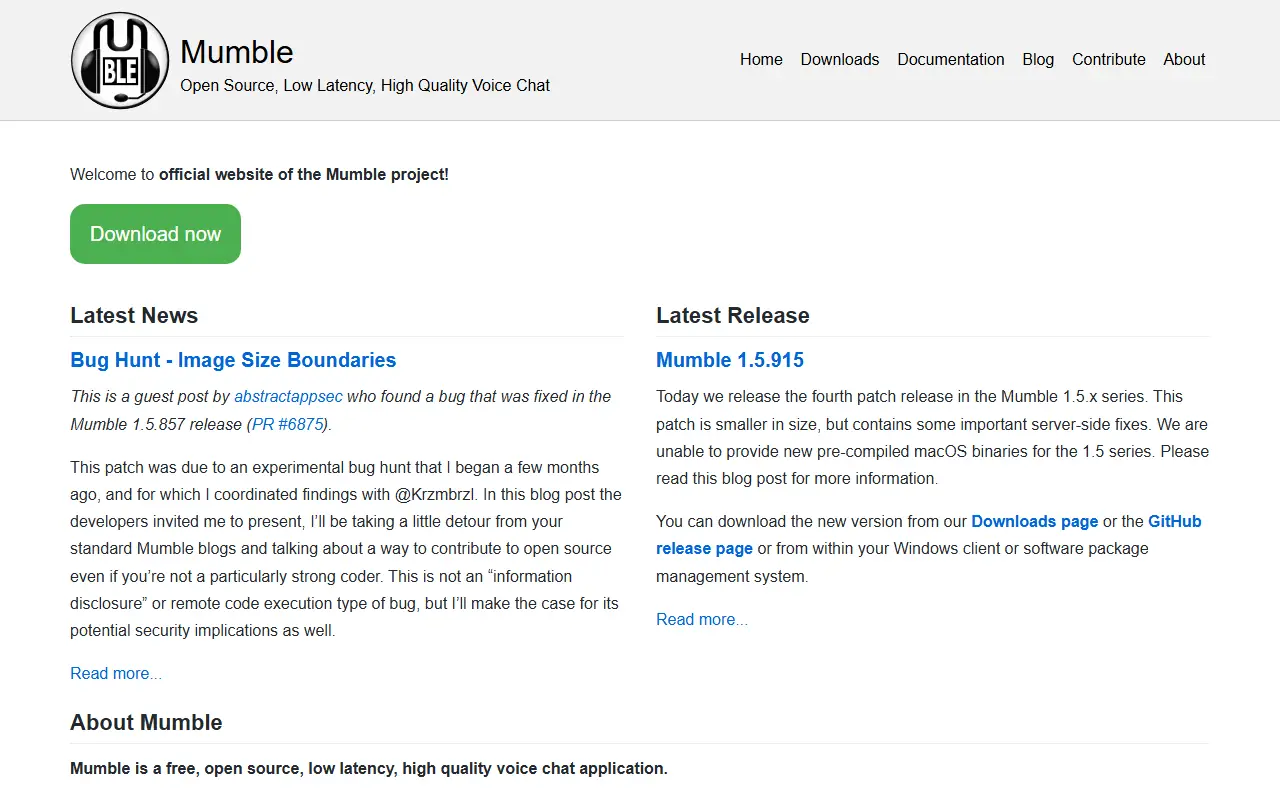
mumble.infoMumble homepage screenshot

Mumble is an open-source voice chat program designed for low latency and high audio quality. It is written on top of Qt and Opus and is used by groups, including gaming communities, that want to talk in real time on a server they control.

The software has two parts: the client, called mumble, and the server, called mumble-server, which was formerly known as murmur. The client is available for Windows, Linux, FreeBSD, OpenBSD and macOS, and the server is expected to run anywhere Qt can be installed. General-purpose plugins can add functionality that is not built into the main application, and the interface is translated through the Weblate platform.

Mumble is written in C++, and its licence is listed as non-standard on GitHub, so check the repository for details. Documentation lives on the project website, and the README gives build instructions that vary by branch, with the master branch holding unstable code for a future release.

Key features

  • Low-latency voice chat
  • Opus audio codec
  • Separate client and server programs
  • Clients for Windows, Linux, macOS and BSD
  • Plugin support
  • Community translations via Weblate

BigBlueButton

An open-source virtual classroom and web conferencing system with real-time audio, video, slides, whiteboard, chat, polling and breakout rooms for online teaching.

GitHub stars
9.3k
Last commit
today
Latest release
v4.0.2
Licence
LGPL-3.0
Self-hosted
Yes
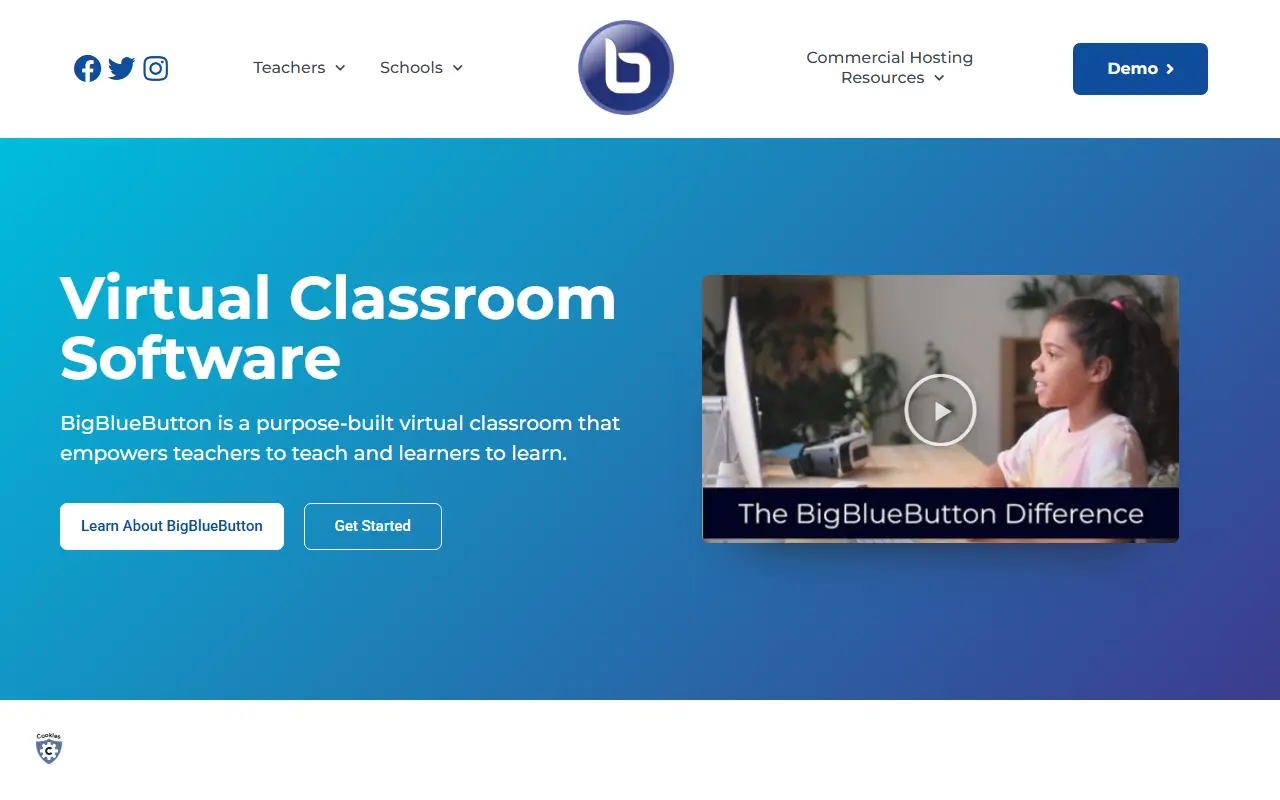
bigbluebutton.orgBigBlueButton homepage screenshot

BigBlueButton is an open-source web conferencing system designed for online learning, intended to help teachers teach and learners learn. Participants can share audio, video, slides (with whiteboard annotations), chat messages and their screen in real time, and can also be used for many other meeting types beyond education.

To keep remote students involved, instructors can use polls, emoji reactions, whiteboards that several people can draw on, shared notes and breakout rooms. During a session it generates analytics shown to moderators on a Learning Analytics Dashboard, and presenters can record sessions for later playback and sharing. The README lists online tutoring, flipped classrooms, group collaboration and online classes as the educational scenarios it was built for. Its topics reference WebRTC.

The current major release is BigBlueButton 3.0, which can be installed on Ubuntu 22.04 with the bbb-install.sh script, and full documentation covers architecture, features, the API and GreenLight, the default front end. The software is licensed under LGPL-3.0, while the name and logo are trademarks of BigBlueButton Inc. It suits schools, universities and training providers that want to host their own conferencing.

Key features

  • Real-time audio, video and screen sharing
  • Slides with whiteboard annotations
  • Polling, emojis and breakout rooms
  • Multi-user whiteboard and shared notes
  • Learning Analytics Dashboard
  • Session recording and playback
  • GreenLight default front end

Pricing: Free and open source under the LGPL-3.0 licence.

Asterisk

Asterisk is an open-source PBX and telephony toolkit that connects SIP and Internet telephony with traditional PSTN interfaces.

GitHub stars
3.7k
Last commit
8 days ago
Latest release
24.0.0
Self-hosted
Yes

Asterisk is an open-source PBX and telephony toolkit. The README describes it as middleware between Internet and telephony channels at the bottom and Internet and telephony applications at the top, with support for more telephony interfaces than Internet telephony alone and a large amount of support for traditional PSTN telephony. The code is C, credited to Mark Spencer and the Asterisk.org developer community, with copyright held by Sangoma Technologies.

It is developed and tested mainly on GNU/Linux and is supported on every major Linux distribution; it also reportedly runs on Mac OS X and the BSD variants. Most users now run VoIP/SIP only, but TDM or analog services need supported hardware: Sangoma analog and digital interface cards, full-duplex sound cards supported by PortAudio, and the Xorcom Astribank channel bank.

Installation is from source. The README asks for GCC 4.1 or newer, or a C99 compiler, plus ncurses and other development libraries. The steps are ./configure, make menuselect to choose modules, make, make install and optionally make samples for a demonstration PBX. Running asterisk -vvvc starts it in the foreground with a command-line console where core show help lists commands.

Key features

  • Open-source PBX and telephony toolkit
  • Supports many telephony interfaces beyond Internet telephony
  • Works with Sangoma cards, PortAudio sound cards and Astribank
  • Modules are chosen at build time with menuselect
  • Console with built-in command help
  • Sample PBX with demonstration extensions
  • Configuration files share one common format

Kamailio

Kamailio is an open-source SIP signaling server built for large VoIP and real-time communication platforms, with a focus on scalability and security.

GitHub stars
3k
Last commit
2 days ago
Latest release
6.1.5
Self-hosted
Yes
kamailio.orgKamailio homepage screenshot

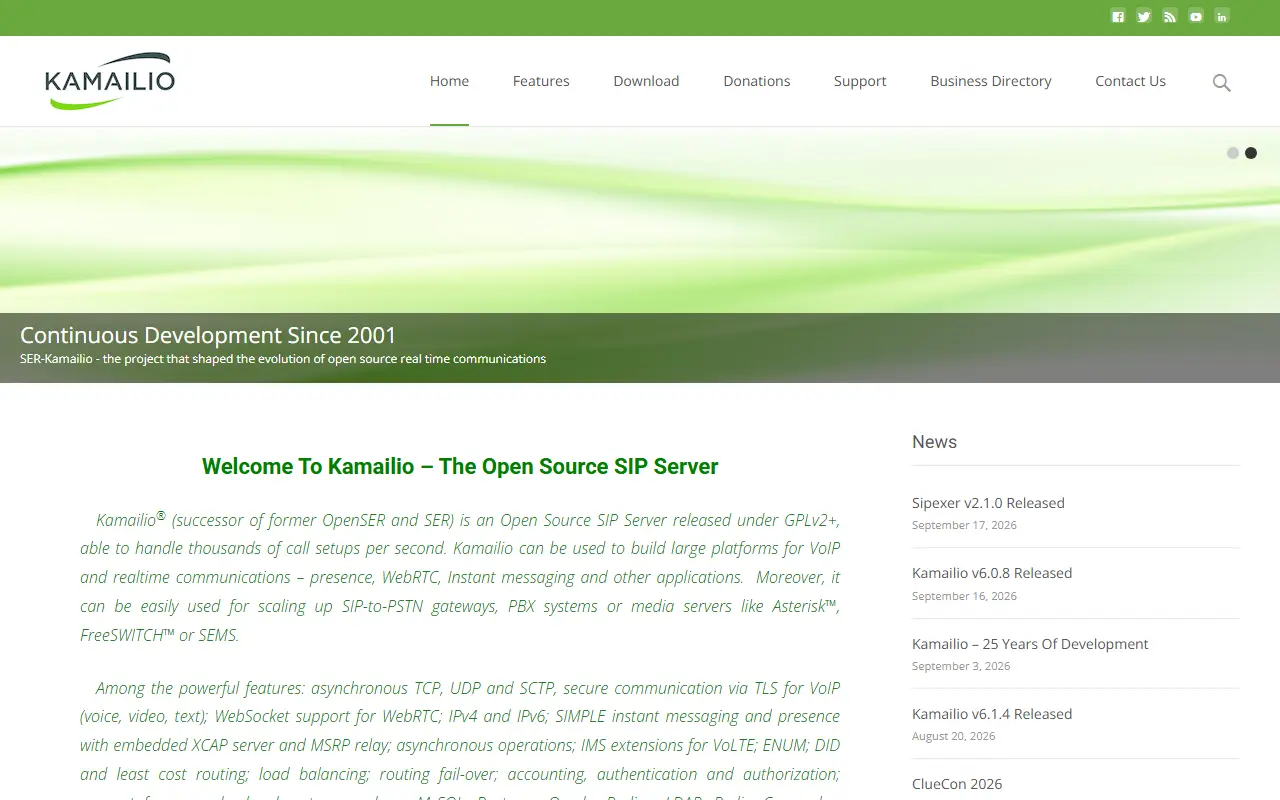
Kamailio is an open-source implementation of a SIP signaling server. SIP is an open IETF standard, specified in RFC 3261, used to set up voice and other real-time communication sessions. The server is written in C and is aimed at flexibility, security and scalability, with topics that include VoIP, WebRTC, VoLTE and telephony.

It is designed for large deployments, such as IP telephony operators and carriers with big subscriber bases or high call volumes. Enterprises and individuals can also use it to provide VoIP, instant messaging and presence. The project is known for its flexibility, robustness and extensive module list, which the website describes in more detail.

The project began in 2001 at the Fraunhofer Fokus research institute in Berlin as SIP Express Router. A fork called OpenSER appeared in 2005 and was renamed Kamailio in 2008, after which the two projects merged. Fokus is no longer actively involved, and a worldwide community now develops the server, with events such as developer meetings and the Kamailio World Conference.

Key features

  • SIP signaling server
  • Scales to large subscriber bases and call volumes
  • VoIP, instant messaging and presence
  • WebRTC and VoLTE related support
  • Extensible module architecture

FusionPBX

Web-based PBX and voice switch built on FreeSWITCH, offering multi-tenant telephony features for businesses and hosting providers.

GitHub stars
1.1k
Last commit
yesterday
Latest release
5.6.5
Self-hosted
Yes
fusionpbx.comFusionPBX homepage screenshot

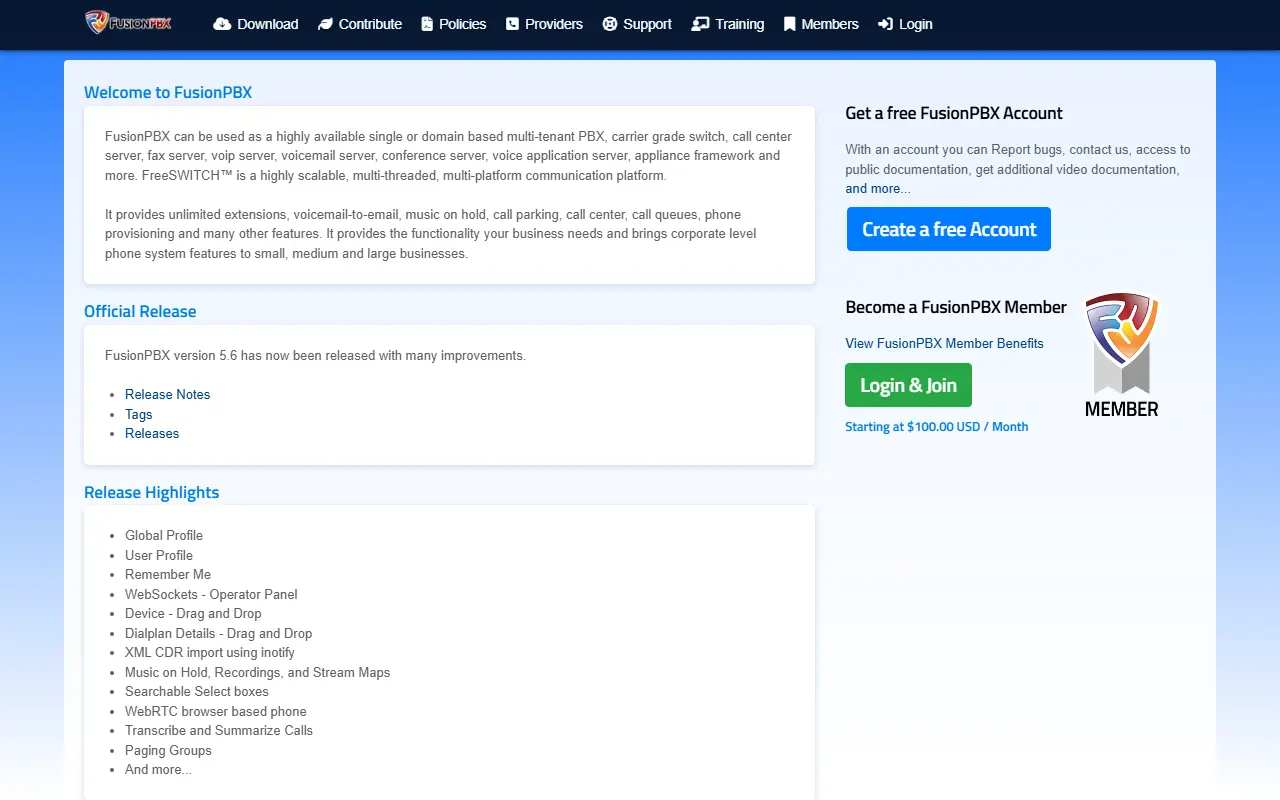
FusionPBX is an open-source web interface and management layer for FreeSWITCH, the telephony platform that handles call routing. It turns a FreeSWITCH installation into a domain-based, multi-tenant PBX and voice switch, so one server can serve several separate organizations, each with its own extensions and settings.

Beyond ordinary office phone features, the project says it can act as a call center server, fax server, voicemail server, conference server and voice application server. Configurable features include unlimited extensions, voicemail-to-email, device provisioning, music on hold, call parking, automatic call distribution, interactive voice response, ring groups, find me and follow me rules, and hot desking. A flexible dialplan system allows custom call logic.

FusionPBX is written in PHP and installs on Debian, Ubuntu LTS, FreeBSD and CentOS using a scripted installer. The installer sets up FusionPBX, FreeSWITCH and its dependencies, along with Nginx, PHP-FPM, PostgreSQL, Fail2ban and IPTables. High availability and redundancy are listed among its capabilities.

Key features

  • Domain-based multi-tenant PBX on FreeSWITCH
  • Unlimited extensions with voicemail-to-email
  • Device provisioning for desk phones
  • Interactive voice response and ring groups
  • Automatic call distribution for call centers
  • Find me / follow me and hot desking
  • Programmable dialplan for custom call logic
  • High availability and redundancy support

Linphone

Open-source SIP softphone for voice calls, video calls and instant messaging on Windows, macOS and Linux desktops.

GitHub stars
516
Last commit
7 days ago
Licence
GPL-3.0
linphone.orgLinphone homepage screenshot

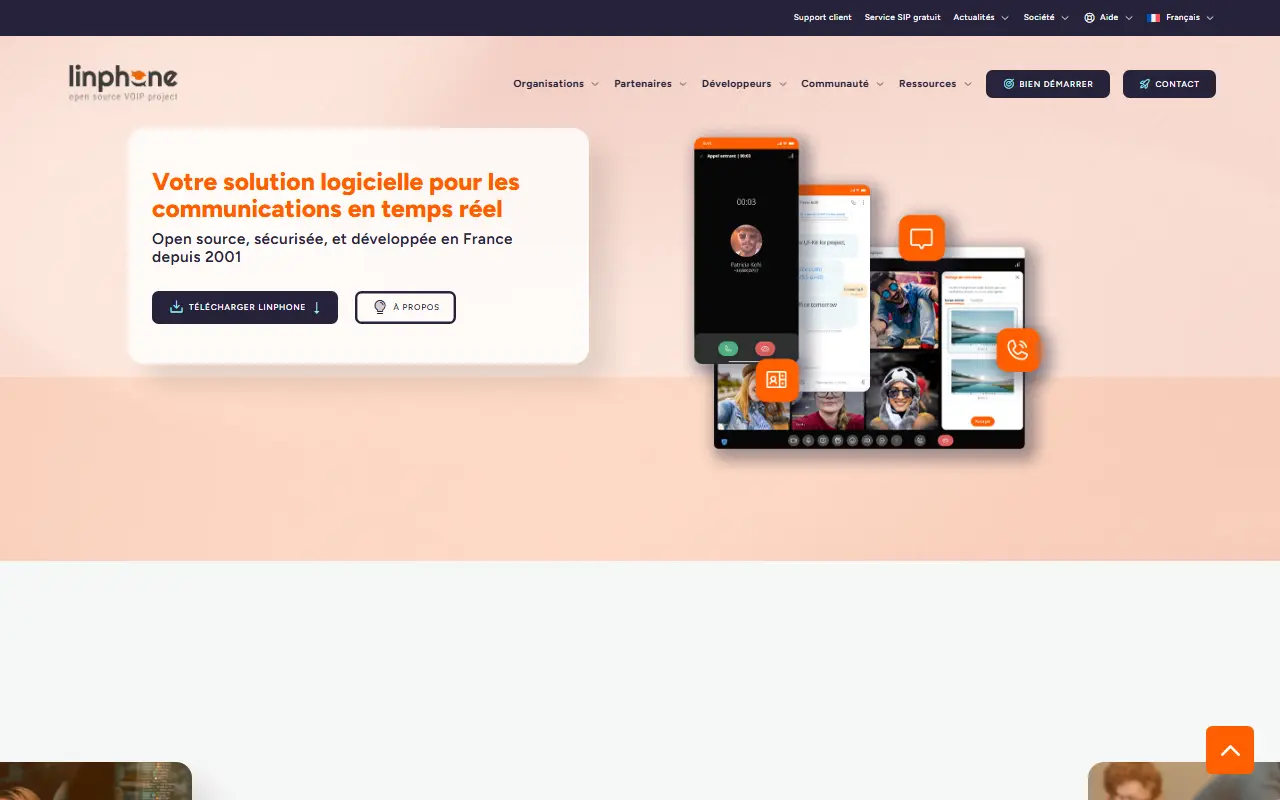
Linphone Desktop is an open-source softphone for voice and video calling and instant messaging over IP. It is based entirely on the SIP protocol and handles calling, presence and messaging features. The project is developed by Belledonne Communications, and this GitHub repository mirrors the official git repository.

Topics on the repository include conferencing, chat and messaging. The app is built with Qt 6, requires a C++17 compiler, and depends on the Linphone SDK, so building from source means installing the SDK dependencies and setting up the Qt environment. Supported features and RFCs are listed in the project documentation and wiki.

Linphone is dual licensed. It is free under GPL-3.0 for open-source use, and Belledonne Communications also sells a proprietary license for a fee to companies that want to use it in closed-source applications.

Key features

  • Voice and video calls over SIP
  • Instant messaging and presence
  • Conference calls
  • Built with Qt 6 for desktop
  • Based on the Linphone SDK

Pricing: Free under GPL-3.0; a paid proprietary license is available for closed-source applications.

Commercial Mitel alternatives

Hosted, closed-source products that compete with Mitel. Showing 12 of 22.

See every Mitel alternative on its tool page

Mitel alternatives: questions

What is the best open-source alternative to Mitel?
Rocket.Chat is the top-ranked open-source alternative to Mitel on Enlisted: A customizable team communications platform with real-time chat and video, aimed at organizations with strict data protection needs and offered self-hosted, cloud or air-gapped. Other strong options are Mattermost, Jitsi Meet, Mumble and BigBlueButton.
What are the best commercial alternatives to Mitel?
Nextiva, GoTo Connect, RingCentral, Intermedia and 8x8 are among the hosted, closed-source alternatives to Mitel listed on Enlisted, which lists 22 in total. Compare their pricing and features on each tool page.
Are these Mitel alternatives free?
All 9 are open source, so the code is free to use under its licence, and all of them can be self-hosted on your own server or computer. 3 also offer a paid or managed cloud version if you'd rather not host it yourself.
How is this list of Mitel alternatives ranked?
By a score built from GitHub stars, star growth over the last 30 days and how recently the code changed. 9 of these projects shipped code in the last 30 days. Data is refreshed daily, and nobody can pay to move up.

People also look for alternatives to…

View all