#1
An open-source omnichannel customer support desk with live chat, email and social inbox, an AI agent and a help center, positioned against Intercom and Zendesk.
- GitHub stars
- 40k
- Last commit
- yesterday
- Latest release
- v4.19.1
- Self-hosted
- Yes
- Hosted version
- Available
chatwoot.com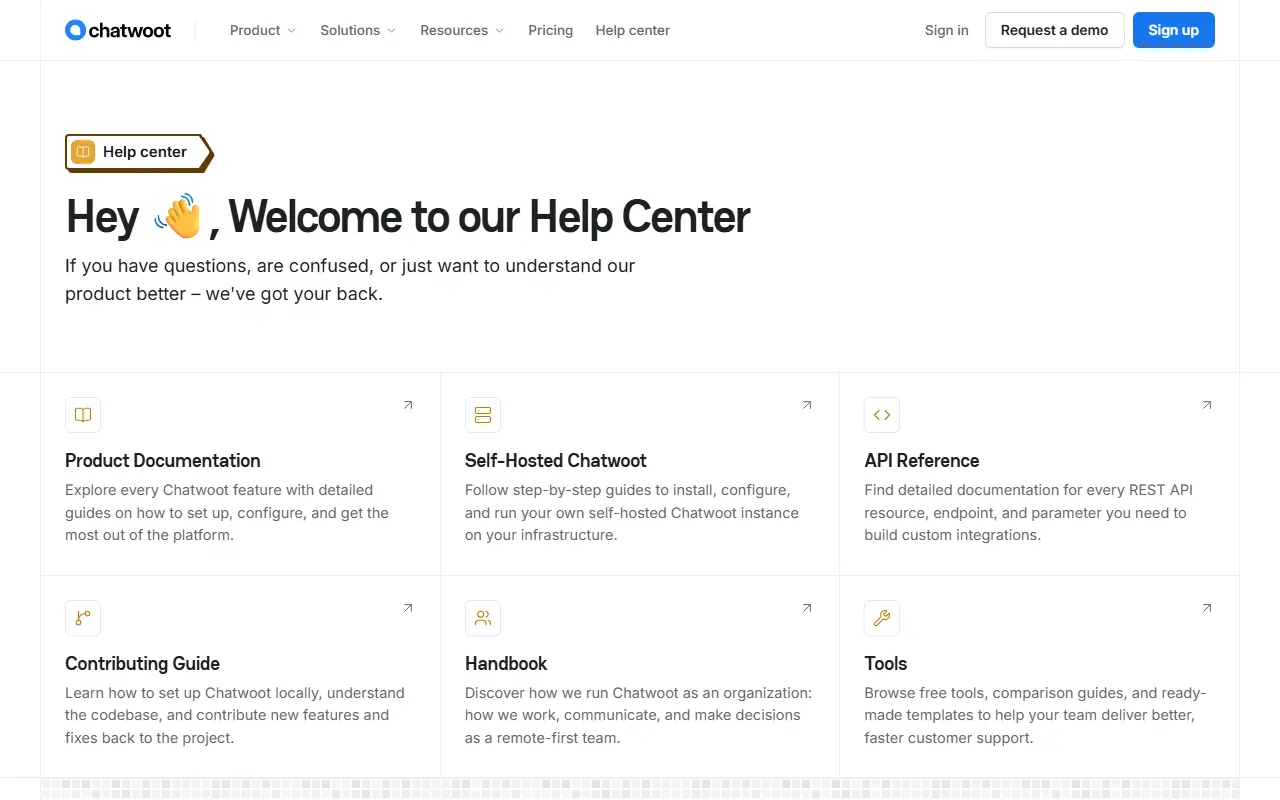
Chatwoot is an open-source, self-hostable customer support platform that gathers all customer conversations into one inbox. It is presented as an alternative to Intercom, Zendesk and Salesforce Service Cloud, and aims to give businesses control over their customer data while managing conversations across channels.
The shared inbox takes in website live chat, email, SMS and messaging channels such as Facebook, Instagram, Twitter, WhatsApp, Telegram and Line. An AI agent called Captain automates replies to common questions to reduce agent workload, and a built-in Help Center portal lets you publish articles and FAQs so customers can find answers themselves. Collaboration tools include private notes with mentions, labels, canned responses, auto-assignment based on availability, custom views and filters, a command bar and multi-language support.
Chatwoot is built with Ruby on Rails and Vue and can be run with Docker, with deployment guides on its help center. The repository license is listed as 'Other', so confirm which parts are open source. A hosted cloud version is also available for teams that prefer not to maintain their own server.
Key features
- Shared inbox across chat, email and social channels
- Captain AI agent for automated replies
- Built-in Help Center portal
- Private notes and @mentions
- Canned responses and auto-assignment
- Custom views and filters
- Support for multiple languages
Pricing: Hacker is free for up to 2 agents. Startups costs $19, Business $39 and Enterprise $99 per agent per month, with a 15-day free trial; extra Captain AI credits are $20 per 1,000.
#2
A collaborative team knowledge base and wiki with realtime editing and Markdown compatibility, built with React and Node.js and available hosted or self-run.
- GitHub stars
- 41k
- Last commit
- today
- Latest release
- v1.12.0
- Self-hosted
- Yes
- Hosted version
- Available
getoutline.com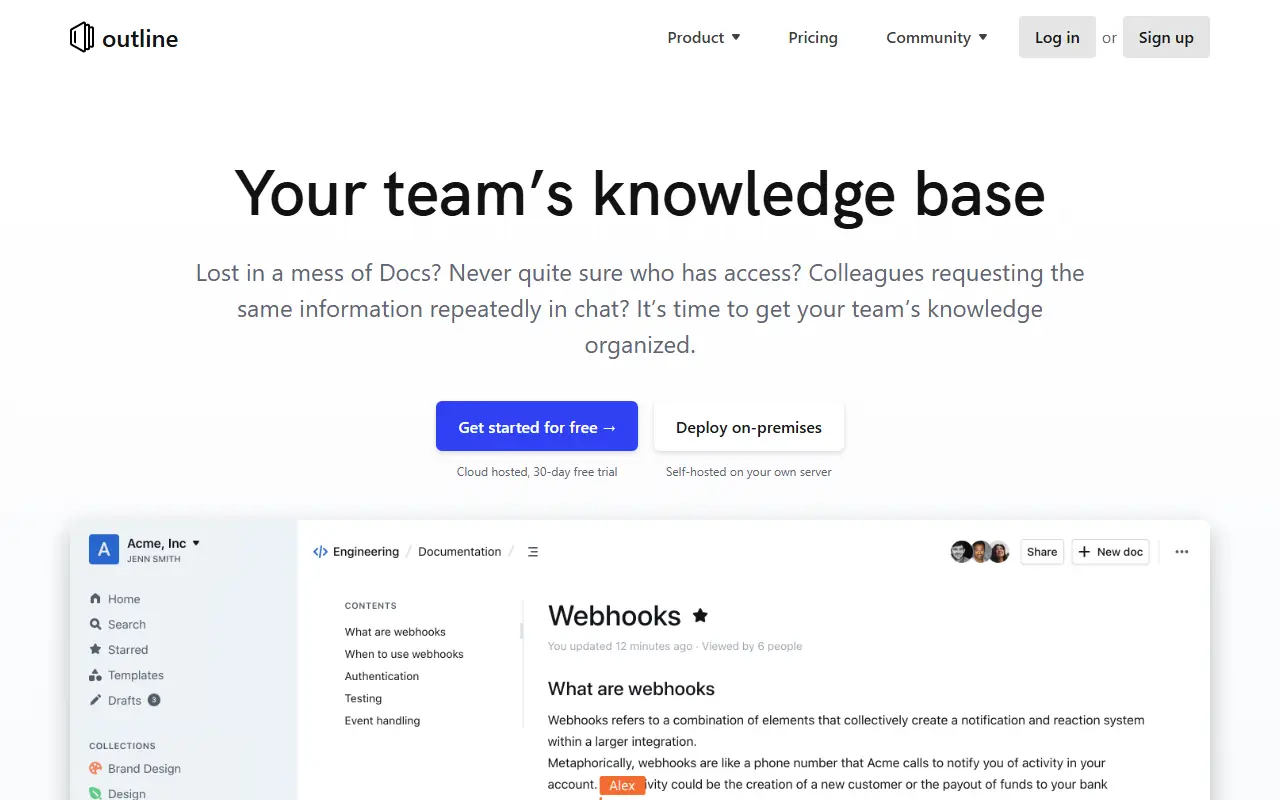
Outline is a knowledge base for teams, built with React and Node.js. It focuses on fast, collaborative writing: documents are edited together in realtime, stay compatible with Markdown, and are organized into collections so a growing team can find what it has written down.
The maintainers offer a hosted version at getoutline.com, and the repository contains the source that runs Outline and its associated services. If you only want to use Outline you do not need to run the code yourself, while teams that want their own copy can follow the documentation for a production configuration and use the published container images. Topics also mention a Slack integration.
The repository license is listed as 'Other', so review it before commercial redistribution. Outline suits teams looking for a wiki or internal documentation tool with a clean editor, as an alternative to products such as Confluence or Notion for company knowledge. The project does not accept AI-generated pull requests.
Key features
- Realtime collaborative editing
- Markdown-compatible document editing
- Collections for organizing a wiki
- Integration with Slack workspaces
- Hosted service at getoutline.com
- Container images for self-running
Pricing: Cloud pricing is by team size: $10 per month for 1-10 members, $79 for 11-100 and $249 for 101-200. The first 30 days are free; larger teams are quoted.
#3
An open-source collaborative wiki and documentation tool, positioned as an alternative to Confluence and Notion, with real-time editing, diagrams and permissions.
- GitHub stars
- 22k
- Last commit
- today
- Latest release
- v0.97.0
- Licence
- AGPL-3.0
- Self-hosted
- Yes
- Hosted version
- Available
docmost.com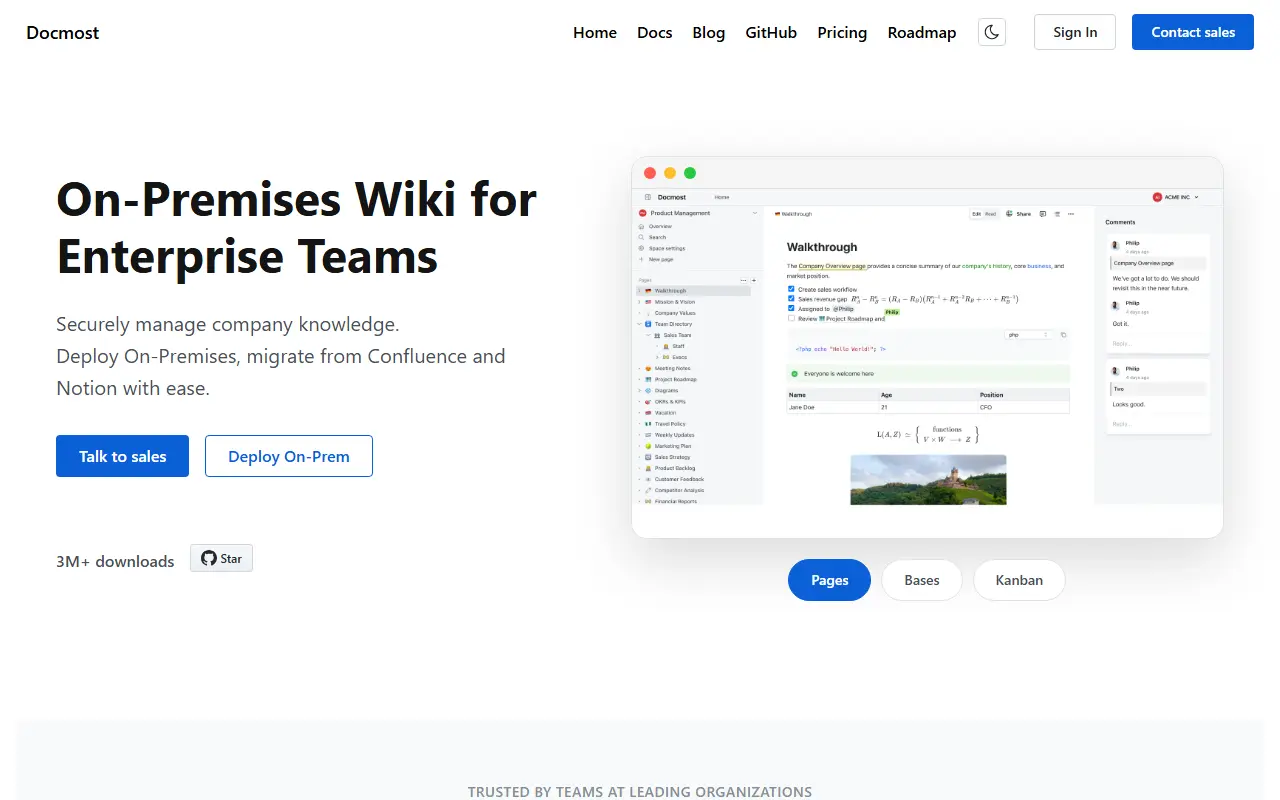
Docmost is a collaborative wiki and documentation tool, open source and presented as an alternative to Confluence and Notion with a focus on secure, on-premise use. Teams write and organize knowledge together in real time, and the project emphasizes that its self-hosted deployment fits organizations with strict compliance requirements.
Its feature list covers real-time collaboration, diagrams through Draw.io, Excalidraw and Mermaid, spaces for organizing content, permission management with groups, comments, page history, search, file attachments and embeds for tools such as Airtable, Loom and Miro. The interface is translated into more than ten languages. Topics mention an AI feature, real-time collaboration and drop-in migration from other wikis.
The Docmost core is licensed under AGPL-3.0, while enterprise features sit in specific directories under a separate enterprise license. You can follow the documentation to self-host it or try the cloud version. It suits teams looking for an internal knowledge base or documentation hub with a lighter footprint than Confluence.
Key features
- Real-time collaborative editing
- Diagrams with Draw.io, Excalidraw and Mermaid
- Spaces, groups and permission management
- Comments and page history
- Full-text search and file attachments
- Embeds for Airtable, Loom and Miro
Pricing: The self-managed Community edition is free. Business costs $6 per seat per month billed annually with a 10-seat minimum; Enterprise is custom and trial licenses are available.
#4
Wiki.js is a Node.js-based open-source wiki; this repository holds the 3.0 beta, which is not intended for production use, while the stable 2.x line lives elsewhere.
- GitHub stars
- 29k
- Last commit
- yesterday
- Latest release
- 3.3.1
- Licence
- AGPL-3.0
- Self-hosted
- Yes
beta.js.wiki
Wiki.js is a next-generation open-source wiki platform built on Node.js with a Vue front end. This repository contains the upcoming 3.0 release in beta, and the README is explicit that it is not for production use. The current stable 2.x release is published at js.wiki and in a separate repository.
The project is aimed at documentation and knowledge sharing for teams. Topics list Markdown editing, Git, cross-platform operation and documentation, and the beta is accompanied by installation requirements, a changelog and a feature request channel. Contributors can help with translations, and the project is supported by sponsors, patrons and donations from the community.
Wiki.js is AGPL-3.0 licensed. It is software you run on your own server, so it suits teams that want a self-hosted wiki they control. Anyone who needs a dependable wiki today should look at the 2.x stable version rather than this beta, and treat the 3.0 code as a preview of what is coming.
Key features
- Node.js wiki with a Vue front end
- Markdown content editing
- Git-friendly documentation workflow
- Installs on multiple platforms
- Community-driven translation effort
- 3.0 beta preview with changelog
Pricing: Free and open source under the AGPL-3.0 license.
#5
An AI-powered open-source knowledge base builder for product docs, technical docs, FAQs and blogs, with AI writing, Q&A and search, from the Chaitin team.
- GitHub stars
- 11k
- Last commit
- 8 days ago
- Latest release
- v3.87.4
- Licence
- AGPL-3.0
- Self-hosted
- Yes
- Hosted version
- Available
pandawiki.docs.baizhi.cloud
PandaWiki is an open-source system for building knowledge bases, powered by large language models. It helps teams quickly set up product documentation, technical documentation, FAQs and blog sites, and uses AI to assist with writing, answering questions and searching the content.
The editor supports Markdown and HTML and can export to Word, PDF and Markdown. Sites can be embedded in other websites as a widget or turned into chatbots for DingTalk, Feishu and WeCom. Content can be imported from web page URLs, website sitemaps, RSS feeds and offline files. A knowledge base is a collection of documents from which PandaWiki builds a separate wiki website, and AI features need an LLM to be configured at first login.
To self-host it you need a Linux server with Docker 20.x or newer and run the installer as root. A SaaS version also exists for those who prefer not to deploy it. PandaWiki is licensed under AGPL-3.0, so modifications and network services built on it must also be open source, and the project documentation is mainly written in Chinese.
Key features
- AI-assisted writing, Q&A and search
- Markdown and HTML rich text editing
- Export to Word, PDF and Markdown
- Embeddable web widget
- Chatbots for DingTalk, Feishu and WeCom
- Import from URLs, sitemaps, RSS and files
- Installation with Docker on Linux
Pricing: Free and open source under AGPL-3.0; a SaaS version is also available.
#6
A simple, self-hosted wiki and documentation platform built with PHP and Laravel that organizes content into books, chapters and pages.
- GitHub stars
- 19k
- Last commit
- yesterday
- Latest release
- v26.09.3
- Licence
- MIT
- Self-hosted
- Yes
codeberg.org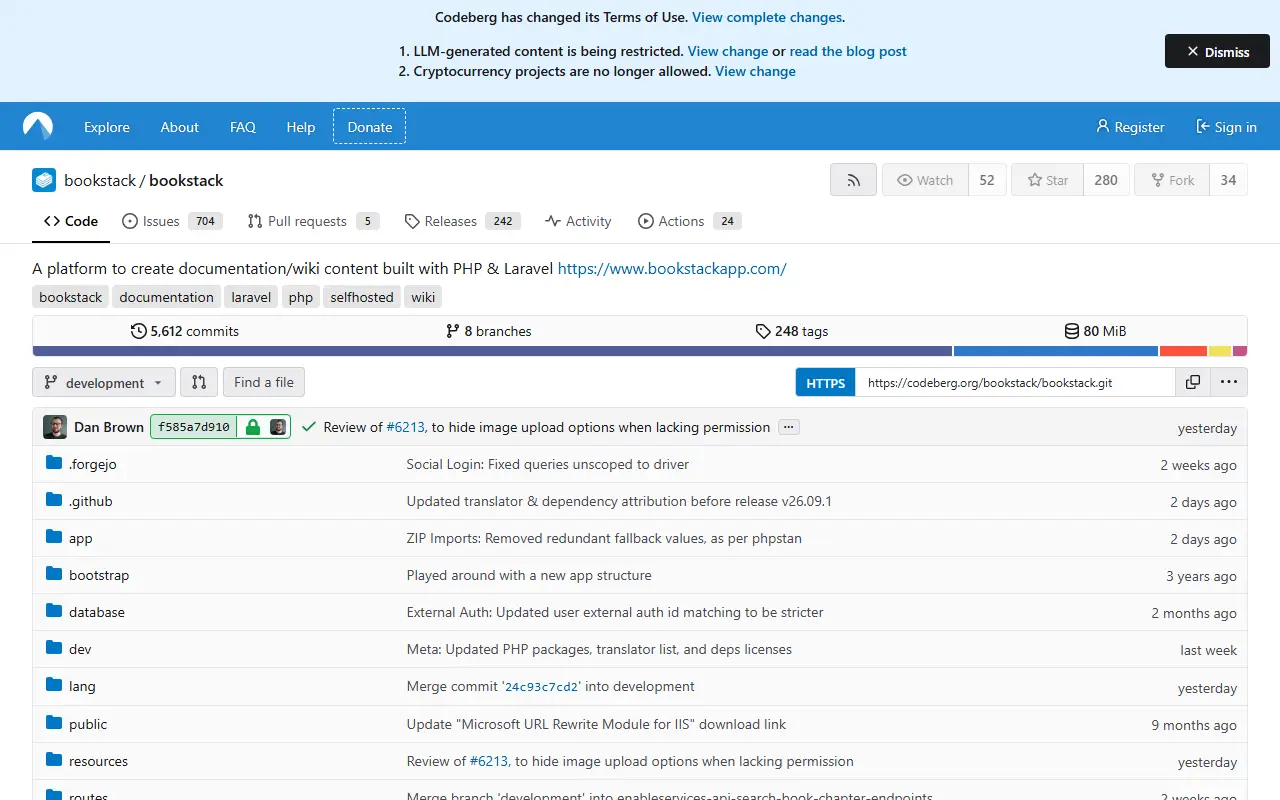
BookStack is a platform for storing and organizing information and documentation, built with PHP and the Laravel framework. It is deliberately opinionated: the aim is a pleasant, intuitive experience out of the box where only basic word-processing skills are needed to create content, so non-technical colleagues can contribute.
Content is organized in a book metaphor, with shelves, books, chapters and pages. Advanced capabilities are available for those who want them, but the project says they should never get in the way of the simple core experience, and it is not intended as a general extensible platform for unrelated purposes. Development is relaxed and positive, evolving slowly while keeping upgrades stable and easy. There is a demo instance, installation instructions, documentation and a blog.
BookStack is licensed under MIT and is now managed on Codeberg, which is where the primary repository and issue list live. You host it on your own server with PHP and a database. It suits teams, schools and small organizations that want an approachable internal wiki rather than a highly configurable knowledge system.
Key features
- Shelves, books, chapters and pages structure
- Simple editor for non-technical users
- Self-hosted PHP and Laravel application
- Stable and easy upgrade path
- Demo instance and documentation
- Advanced options that stay out of the way
Pricing: Free and open source under the MIT license.
#7
Simple Markdown-based knowledge base wiki for Node.js that serves file-based content with search, a browser editor and optional login.
- GitHub stars
- 2.9k
- Last commit
- 8 mo ago
- Latest release
- 0.18.1
- Licence
- MIT
- Self-hosted
- Yes
raneto.com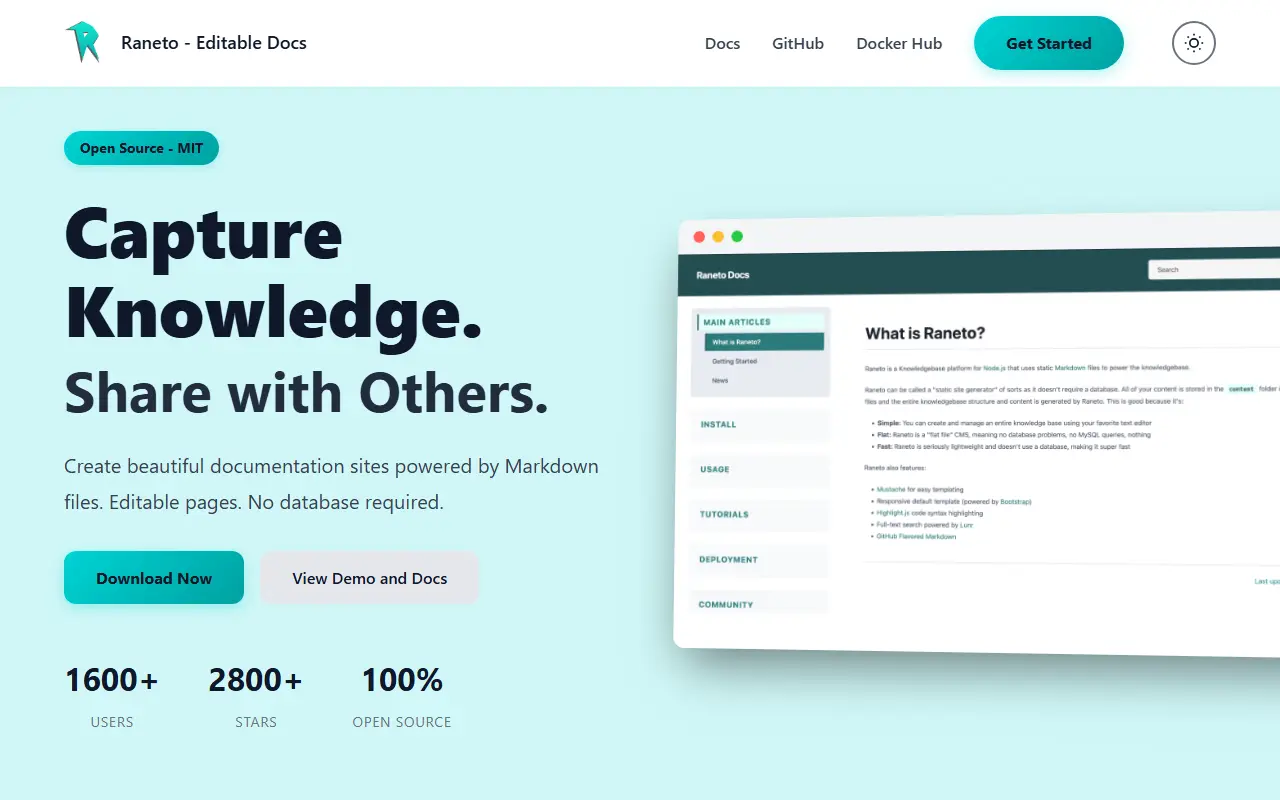
Raneto is a free, open-source knowledge base for Node.js that is powered by Markdown. All content lives in plain files on disk, so pages can be written in any editor, versioned with Git and moved around without exporting from a database.
Visitors can search both file names and page contents, and a Markdown editor is available in the browser. A login system protects editing, with admin credentials and a session secret set through environment variables or the config file. Further settings cover the content directory, base URL, site title, locale, Google Analytics ID and the address and port the server listens on.
The project positions itself as simple and lightweight, with a live demo, documentation and a mailing list for news and security alerts. It is written in JavaScript, tagged as self-hosted, and released under the MIT licence.
Key features
- File-based Markdown content
- Search across file names and contents
- Markdown editor in the browser
- Login system to protect editing
- Configuration through environment variables
- Locale and UI translation settings
Pricing: Free and open source under the MIT licence.
#8
Self-hosted knowledge base and documentation platform written in Go and Ember, positioned as a modern Confluence alternative for internal and customer-facing docs.
- GitHub stars
- 2.4k
- Last commit
- 5 mo ago
- Latest release
- v5.14.0
- Licence
- AGPL-3.0
- Self-hosted
- Yes
documize.com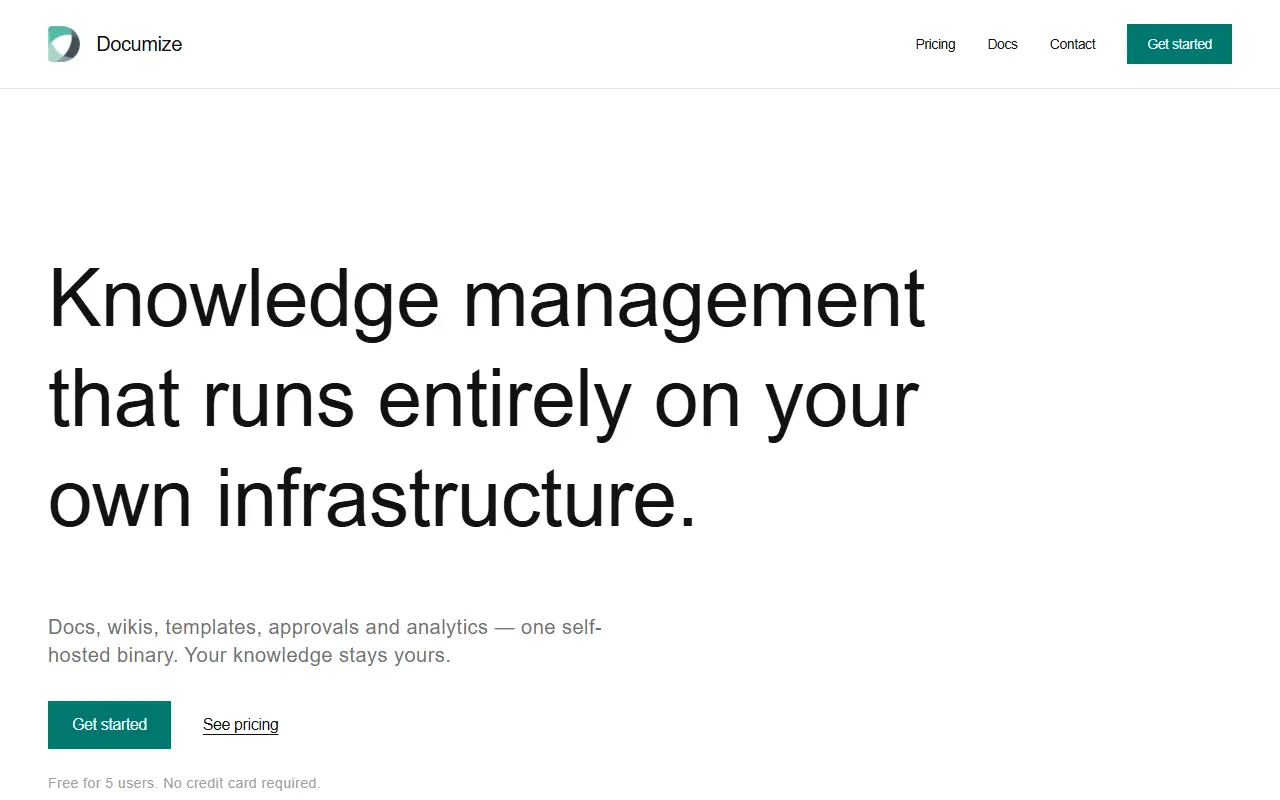
Documize Community is an open-source, self-hosted knowledge management product aimed at both technical and non-technical users. It is meant to unify customer-facing and internal documentation, organizes content through labels, spaces and categories, and is positioned as a modern alternative to Confluence.
It is written in Go and Ember.js and compiled to a single executable for Linux, Windows and macOS, including a Raspberry Pi ARM build. You supply the database, which can be PostgreSQL, Microsoft SQL Server, SQL Azure or a MySQL variant such as Percona or MariaDB, with full-text search required. Besides email and password, sign-in options include LDAP, Active Directory, Keycloak and CAS.
A Community+ edition adds enterprise features such as approval workflows, version and lifecycle management, feedback capture, PDF export, analytics, activity streams, audit logs, action assignments and support. The README states it is free for the first five users, then starts at 900 US dollars annually for 100 users. The Community edition is AGPL-3.0 licensed.
Key features
- Spaces, labels and categories for organization
- Single executable for Linux, Windows and macOS
- PostgreSQL, SQL Server and MySQL support
- LDAP, Active Directory, Keycloak and CAS login
- Internal and customer-facing documentation
- Community+ approval workflows and audit logs
Pricing: The first 5 users are free. Self-hosted annual subscriptions cost $900 per year for up to 100 users (Essential) or $1,800 per year for unlimited users (Enterprise), with every feature in both.
#9
Helpdesk application in Ruby on Rails combining email ticketing, a knowledgebase and community forums, released under the MIT licence.
- GitHub stars
- 2.5k
- Last commit
- 3 yr ago
- Latest release
- 2.8.0
- Licence
- MIT
- Self-hosted
- Yes
- Hosted version
- Available
Helpy is a help desk platform written in Ruby on Rails and released under the MIT licence. Its stated goal is to power support email and ticketing, integrate with your app, and run a customer help center.
The open source edition combines support tickets, a full-text searchable knowledgebase and a public community forum. Each part is optional and can be disabled. Incoming email works through services such as Sendgrid, Mandrill and Mailgun, and there is an embeddable JavaScript widget so users can contact you from other pages.
It is multilingual, with translations for 19 languages, themeable, able to send HTML email with attachments, and has GDPR support for deleting or anonymising users. The project is open-core: a Pro version, offered as turnkey SaaS or an AWS or Azure marketplace product, adds triggers, real time UI, advanced reporting and an AI support chatbot.
Key features
- Multichannel ticketing from inbound email
- Full text searchable knowledgebase
- Community forums for customers and agents
- Embeddable contact widget
- Translations for 19 languages
- GDPR deletion and anonymisation of users
- Each feature can be disabled
HelpDocs alternatives: questions
- What is the best open-source alternative to HelpDocs?
- Chatwoot is the top-ranked open-source alternative to HelpDocs on Enlisted: An open-source omnichannel customer support desk with live chat, email and social inbox, an AI agent and a help center, positioned against Intercom and Zendesk. Other strong options are Outline, Docmost, Wiki.js and PandaWiki.
- What are the best commercial alternatives to HelpDocs?
- Document360, KnowledgeOwl, Helpjuice, Archbee and ProProfs Knowledge Base are among the hosted, closed-source alternatives to HelpDocs listed on Enlisted, which lists 20 in total. Compare their pricing and features on each tool page.
- Are these HelpDocs alternatives free?
- All 9 are open source, so the code is free to use under its licence, and all of them can be self-hosted on your own server or computer. 5 also offer a paid or managed cloud version if you'd rather not host it yourself.
- How is this list of HelpDocs alternatives ranked?
- By a score built from GitHub stars, star growth over the last 30 days and how recently the code changed. 6 of these projects shipped code in the last 30 days. Data is refreshed daily, and nobody can pay to move up.
 TrackMedia
 TrackRev