7,363 open-source and SaaS tools, with GitHub stats refreshed every day.

6 alternatives ranked by real activity

Open-source Chrome Remote Desktop alternatives

A curated, ranked list of the 6 best open-source alternatives to Chrome Remote Desktop.

The best open-source alternative to Chrome Remote Desktop is RustDesk. If that doesn't suit you, other good options are TigerVNC, MeshCentral, KasmVNC and Apache Guacamole.

Chrome Remote Desktop alternatives are mainly networking & VPN tools. 5 of them shipped code in the last 30 days, 6 can be self-hosted, and 2 use a permissive licence.

Last updated October 3, 2026 · ranked by GitHub stars, growth and recent commits

RustDesk

An open-source remote desktop application written in Rust, designed for self-hosting and positioned as an alternative to TeamViewer.

GitHub stars
125k
Last commit
today
Latest release
1.5.0
Licence
AGPL-3.0
Self-hosted
Yes
Hosted version
Available
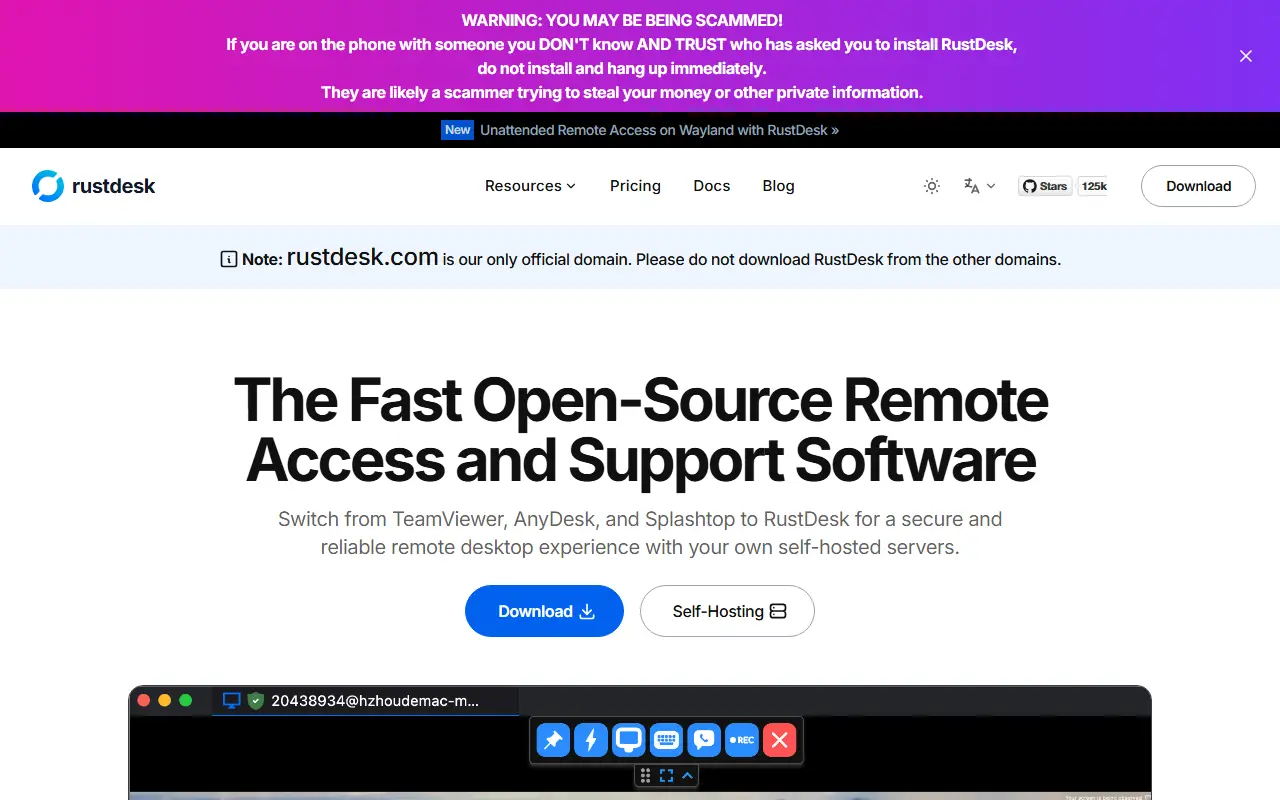
rustdesk.comRustDesk homepage screenshot

RustDesk is a remote desktop application that lets you view and control another computer over the network. It is written in Rust with a Flutter interface, released under AGPL-3.0, and designed for self-hosting, making it an open-source alternative to TeamViewer. The project says no setup is needed to get started.

You decide where connection brokering happens: use the project's rendezvous and relay servers, run your own, or write a custom one. Clients exist for Windows, macOS, Linux, Android and iOS, with Wayland support on Linux, and the codebase includes peer-to-peer connection support. Because you can host the servers yourself, you keep control of your data.

Desktop builds use Flutter for the interface, while the older Sciter interface is deprecated. The README includes a misuse disclaimer stating that the developers do not support unauthorized access or privacy invasion. It suits IT teams, support staff and individuals who want remote access without relying entirely on a third-party service.

Key features

  • Remote desktop viewing and control
  • Self-hostable rendezvous and relay servers
  • Clients for desktop and mobile platforms
  • Peer-to-peer connection mode
  • Flutter-based cross-platform interface
  • Usable immediately with no setup

Pricing: Free self-hosting plan. Paid self-hosted Pro plans cost $11.88 (Individual) and $23.88 (Basic and Customized) per month billed annually; only annual payment is offered. This is not a SaaS subscription.

Read more about RustDeskWebsite GitHub

TigerVNC

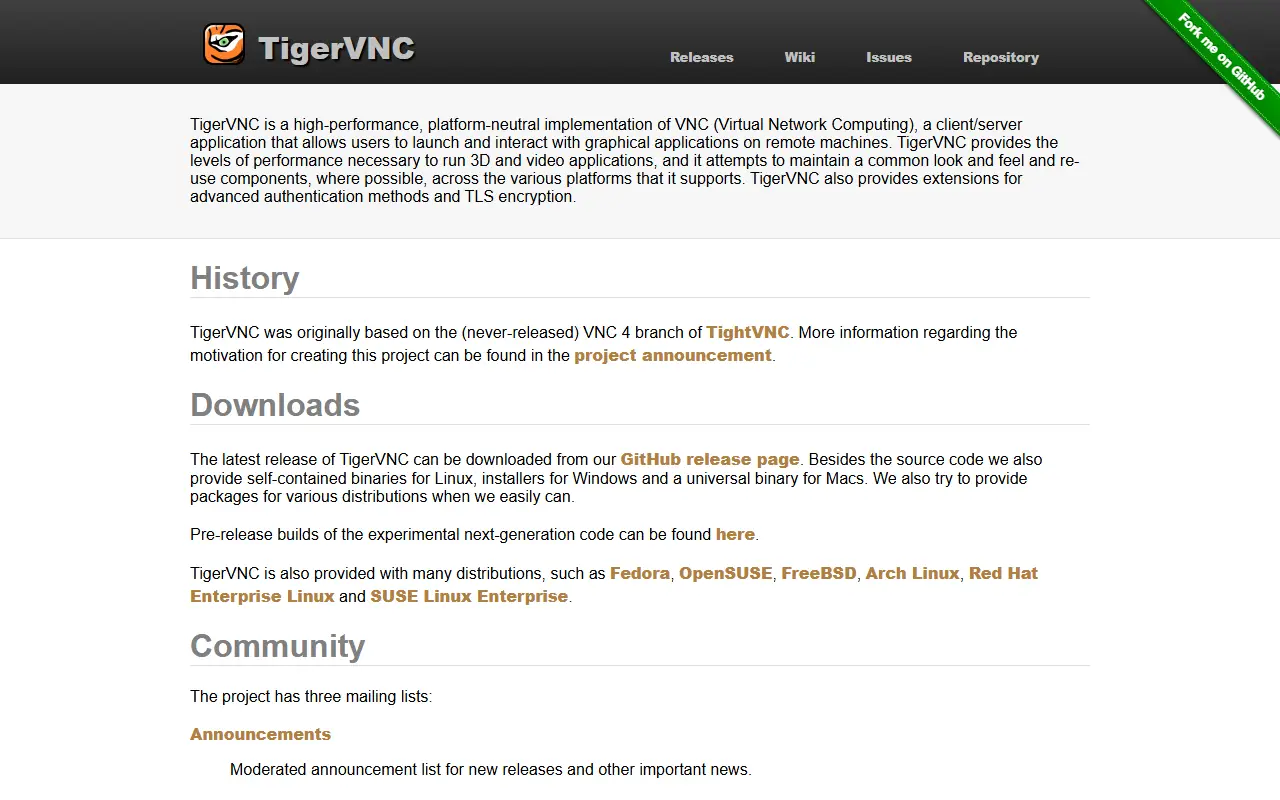
TigerVNC is a high-performance, cross-platform VNC client and server that lets you use graphical applications on remote machines over a network.

GitHub stars
7.5k
Last commit
7 days ago
Latest release
v1.16.2
Licence
GPL-2.0
Self-hosted
Yes
tigervnc.orgTigerVNC homepage screenshot

TigerVNC is a platform-independent VNC (Virtual Network Computing) implementation. VNC is a client and server system that lets users start and work with graphical applications running on remote machines. It is intended for people who administer or use remote desktops and servers.

The project aims for performance high enough to run 3D and video applications, while keeping a common look and feel and reusing components across the platforms it supports. It adds extensions for stronger authentication methods and TLS encryption. TigerVNC was originally based on the unreleased VNC 4 branch of TightVNC.

The software is written in C++ and licensed under GPL-2.0. Releases include the source code, a standalone Linux binary, a Windows installer and a universal Mac binary, and many distributions package it, among them Fedora, openSUSE, FreeBSD, Arch Linux, RHEL and SLE. The project runs announcement, user and development mailing lists.

Key features

  • VNC client and server in one project
  • Performance suited to 3D and video applications
  • TLS encryption extensions
  • Advanced authentication methods
  • Binaries for Linux, Windows and macOS

Pricing: Free software under the GPL-2.0 licence.

Read more about TigerVNCWebsite GitHub

MeshCentral

MeshCentral is a self-hosted web platform for remotely managing computers, with agents, remote desktop, terminal and file management in the browser.

GitHub stars
7.3k
Last commit
9 days ago
Latest release
1.2.6
Licence
Apache-2.0
Self-hosted
Yes
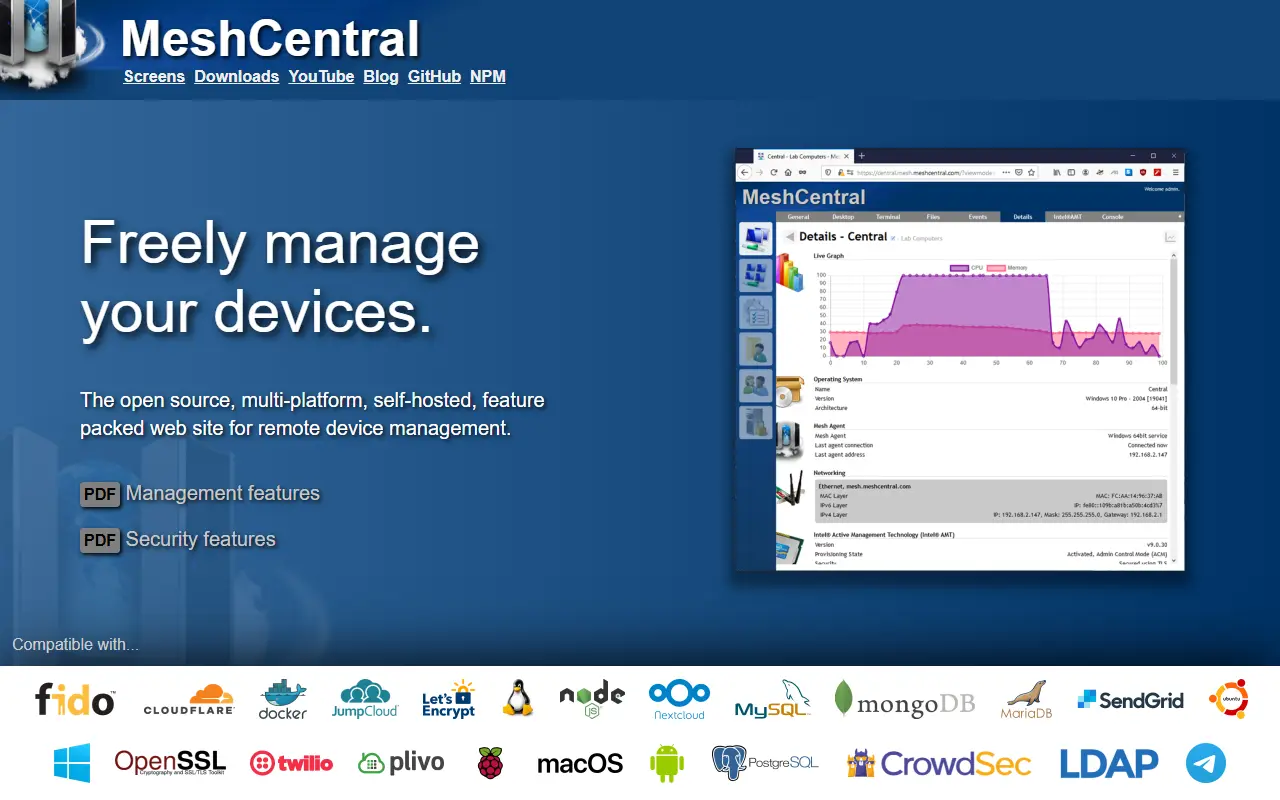
meshcentral.comMeshCentral homepage screenshot

MeshCentral is a web-based remote monitoring and management platform. You run your own web server, create device groups, and install an agent on every machine you want to control. Shortly afterward the machine appears on the site, and you can take control of it over a local network or across the internet.

The platform includes web-based remote desktop, a terminal and file management. Repository topics reference Intel AMT, KVM, remote control and file transfer. The documentation covers topics such as server configuration, database choices, Let's Encrypt, TLS offloading, IP filtering, email and reverse proxy setup, multi-factor authentication, branding, HashiCorp Vault support and SSO.

MeshCentral is licensed under Apache-2.0. A design and architecture guide explains the agent-to-server handshake and the browser-to-agent relay with WebRTC, and the project maintains video tutorials for installing on Windows, Linux and macOS.

Key features

  • Web-based remote desktop
  • Remote terminal access
  • Browser file management
  • Agent install per managed computer
  • Device groups
  • Multi-factor authentication and SSO support

Pricing: Free and open source under the Apache-2.0 licence.

Read more about MeshCentralWebsite GitHub

KasmVNC

A web-based VNC server and client that gives remote access to a Linux desktop or application from any modern browser.

GitHub stars
5.3k
Last commit
yesterday
Latest release
v1.5.0
Licence
GPL-2.0
Self-hosted
Yes

KasmVNC provides remote, web-based access to a desktop or an individual application. Despite the VNC name, it departs from the RFB specification used by variants such as TigerVNC, RealVNC and TurboVNC so it can support modern technologies and improve security.

Users connect from any modern browser, and legacy VNC viewer applications are not supported. Configuration uses YAML at both the server level and the user level, with the server file located at /etc/kasmvnc/kasmvnc.yaml, and the project documents optional systemd auto-start on boot. Installation packages exist for Debian, Ubuntu, Kali and Oracle 8.

KasmVNC is developed by Kasm Technologies, the company behind the Kasm Workspaces containerized streaming platform. Kasm has also open-sourced Workspace Docker images with full desktops and apps, which can be used standalone or inside Kasm Workspaces. KasmVNC is written in C++ and licensed under GPL-2.0, and its README advises using the documentation for your specific release.

Key features

  • Browser-based remote desktop access
  • No separate VNC viewer needed
  • YAML server and user configuration
  • Departs from RFB for added security
  • Packages for Debian, Ubuntu and Kali
  • Optional systemd auto-start

Pricing: Free and open source under the GPL-2.0 licence.

Read more about KasmVNCGitHub

Apache Guacamole

The server-side components of Apache Guacamole, a clientless remote desktop gateway that provides VNC, RDP and SSH access through a web browser.

GitHub stars
4k
Last commit
18 days ago
Licence
Apache-2.0
Self-hosted
Yes
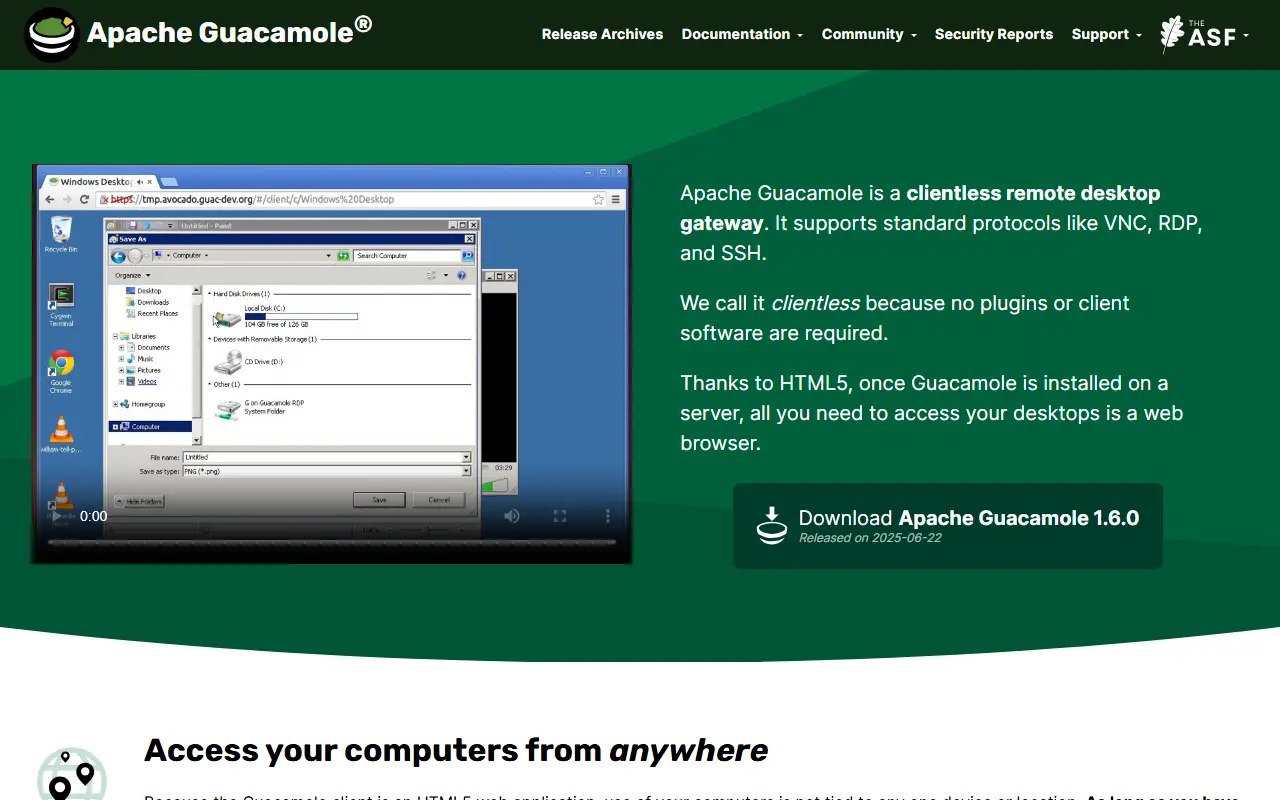
guacamole.apache.orgApache Guacamole homepage screenshot

This repository holds the server-side parts of Apache Guacamole: the guacd proxy daemon, the libguac C API and protocol support. Guacamole itself is a clientless remote desktop gateway that supports standard protocols such as VNC, RDP and SSH.

It is called clientless because no plugins or client software are needed. Once Guacamole is installed on a server, a web browser is all that is required to reach your desktops, since the client is an HTML5 web application. That frees access from any one device or location, and the desktops can even be virtual machines hosted in the cloud.

Guacamole is built on its own documented stack of core APIs, with tutorials and conceptual overviews in the online manual. It is a project of the Apache Software Foundation, licensed under Apache-2.0, and the codebase combines C, Java and JavaScript. The project provides release archives, mailing lists, an issue tracker and commercial support options.

Key features

  • Clientless remote desktop gateway
  • VNC, RDP and SSH protocol support
  • HTML5 browser client
  • guacd proxy daemon
  • libguac C API
  • Documented core APIs

Pricing: Free and open source under the Apache-2.0 licence.

Read more about Apache GuacamoleWebsite GitHub

Remmina

GTK remote desktop client for Linux that connects to other computers over RDP, VNC, SPICE, X2Go, SSH and more.

GitHub stars
2.6k
Last commit
7 mo ago
Latest release
v1.2.30
Licence
GPL-2.0
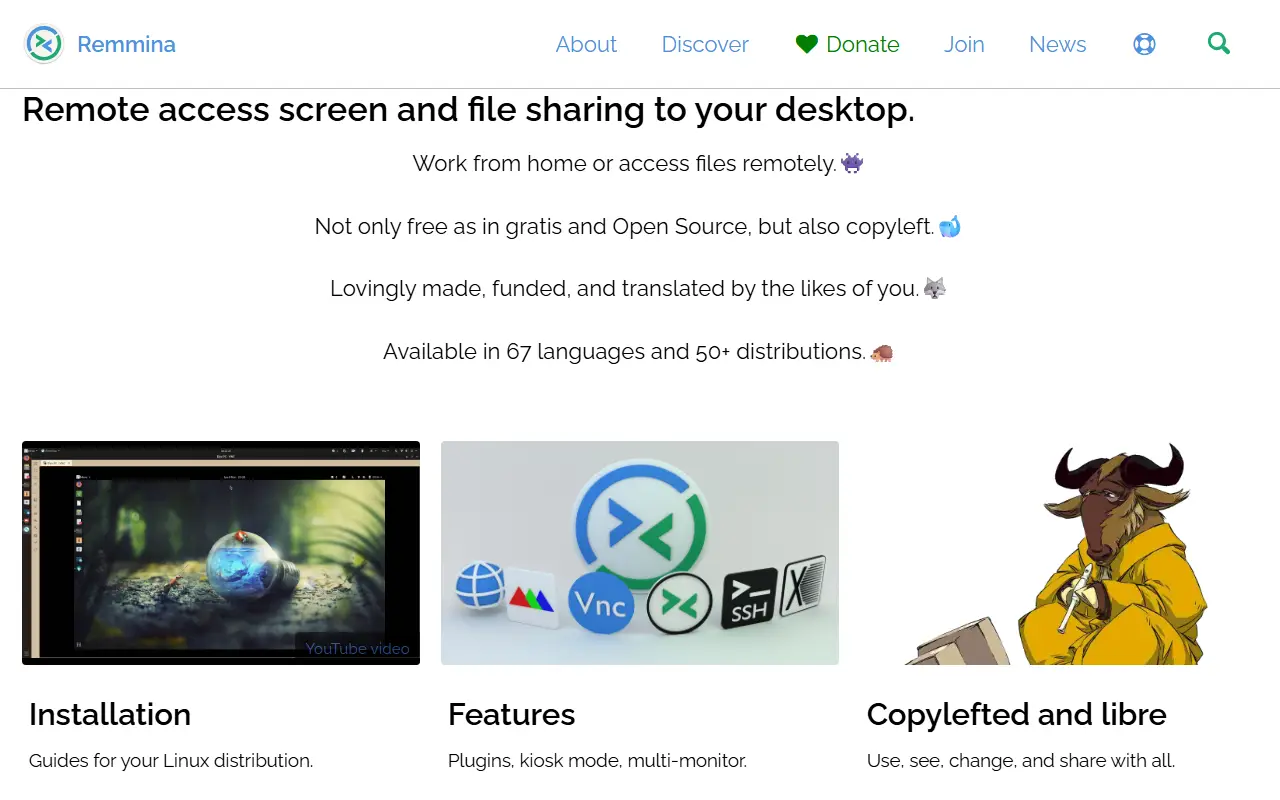
remmina.orgRemmina homepage screenshot

Remmina is a remote desktop client written in GTK that lets you use other computers from a small screen or a large monitor. It supports RDP, VNC, SPICE, X2Go, SSH, WWW (HTTP) and EXEC connection types, so a single tool can reach Windows machines, Linux desktops, virtual machines and shell sessions.

The software ships as the main remmina program plus a separate remmina-plugins package that provides the protocol support. Connections can be set up from the graphical interface, or by working with the files in the user's config directory. A port to Qt is described as underway. Installation steps are kept on the project wiki.

Remmina is copylefted free software, licensed under GPL version 2 or later, and was first developed by Vic Lee. It is now maintained by a small team of volunteers, with community chat on IRC and Matrix. The GitHub repository is a mirror of the official GitLab project.

Key features

  • Remote desktop over RDP, VNC and SPICE
  • SSH and X2Go session support
  • HTTP and command-based connection types
  • Configuration through a graphical interface
  • Plugin package for protocol support

Pricing: Free and open source under GPL-2.0 or later; donations are accepted.

Read more about RemminaWebsite GitHub

Chrome Remote Desktop alternatives: questions

What is the best open-source alternative to Chrome Remote Desktop?
RustDesk is the top-ranked open-source alternative to Chrome Remote Desktop on Enlisted: An open-source remote desktop application written in Rust, designed for self-hosting and positioned as an alternative to TeamViewer. Other strong options are TigerVNC, MeshCentral, KasmVNC and Apache Guacamole.
Are these Chrome Remote Desktop alternatives free?
All 6 are open source, so the code is free to use under its licence, and all of them can be self-hosted on your own server or computer. 1 also offers a paid or managed cloud version if you'd rather not host it yourself.
How is this list of Chrome Remote Desktop alternatives ranked?
By a score built from GitHub stars, star growth over the last 30 days and how recently the code changed. 5 of these projects shipped code in the last 30 days. Data is refreshed daily, and nobody can pay to move up.

People also look for alternatives to…

View all