
About TigerVNC
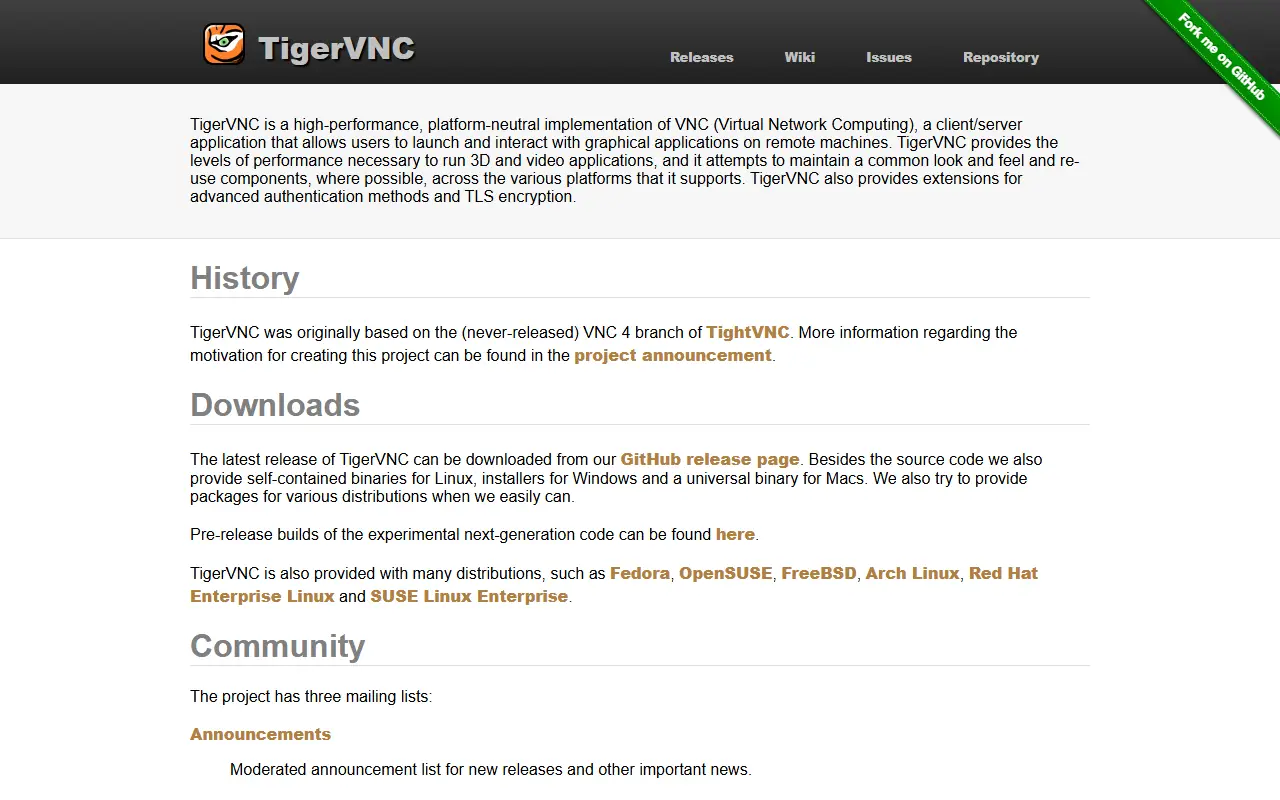
TigerVNC is a platform-independent VNC (Virtual Network Computing) implementation. VNC is a client and server system that lets users start and work with graphical applications running on remote machines. It is intended for people who administer or use remote desktops and servers.
The project aims for performance high enough to run 3D and video applications, while keeping a common look and feel and reusing components across the platforms it supports. It adds extensions for stronger authentication methods and TLS encryption. TigerVNC was originally based on the unreleased VNC 4 branch of TightVNC.
The software is written in C++ and licensed under GPL-2.0. Releases include the source code, a standalone Linux binary, a Windows installer and a universal Mac binary, and many distributions package it, among them Fedora, openSUSE, FreeBSD, Arch Linux, RHEL and SLE. The project runs announcement, user and development mailing lists.
Key features
- VNC client and server in one project
- Performance suited to 3D and video applications
- TLS encryption extensions
- Advanced authentication methods
- Binaries for Linux, Windows and macOS
Good fit for
- →Accessing a Linux desktop remotely
- →Administering graphical applications on servers
- Built with
- C++
- Tags
- vnc
- remote-desktop
- remote-access
- tls
- cross-platform
- cpp
- linux
- server
TigerVNC: questions and answers
- What is TigerVNC used for?
- TigerVNC is a high-performance, cross-platform VNC client and server that lets you use graphical applications on remote machines over a network. It is a good fit for accessing a Linux desktop remotely and administering graphical applications on servers.
- Is TigerVNC open source?
- Yes. TigerVNC is open source under the GPL-2.0 licence. Its source code is on GitHub at TigerVNC/tigervnc and is written mainly in C++.
- Is TigerVNC free?
- Yes. TigerVNC is open source, so the software itself is free to use.
- Can I self-host TigerVNC?
- Yes. TigerVNC can be self-hosted on your own server or infrastructure; there is no official hosted version.
- What is TigerVNC an alternative to?
- TigerVNC is an open-source alternative to TeamViewer, AnyDesk, Splashtop and Chrome Remote Desktop. Other open-source alternatives to TeamViewer include Remmina, KasmVNC and Apache Guacamole.
- Is TigerVNC actively maintained?
- Yes. The most recent commit to TigerVNC was on 25 September 2026, and the latest release is v1.16.2, published on 26 March 2026. The project has 7.5k stars on GitHub.
Open-source alternatives to TigerVNC
See all
Remmina
Networking & VPN
Mirror of https://gitlab.com/Remmina/Remmina The GTK+ Remmina Remote Desktop Client
GPL-2.0vs TeamViewer★ 2.6k
KasmVNC
Networking & VPN
Modern VNC Server and client, web based and secure
GPL-2.0vs TeamViewer★ 5.3k
Apache Guacamole
Networking & VPN
The Apache Guacamole proxy daemon (guacd), C API (libguac), and protocol support.
Apache-2.0vs TeamViewer★ 4k
RustDesk
Networking & VPN
RustDesk is the best open-source remote desktop software. Secure alternative to TeamViewer
AGPL-3.0vs TeamViewer★ 125k
MeshCentral
Networking & VPN
A complete web-based remote monitoring and management web site. Once setup you can install
Apache-2.0vs TeamViewer★ 7.3k
FreeRDP
Networking & VPN
FreeRDP is a free remote desktop protocol library and clients
Apache-2.0vs TeamViewer★ 14k
SaaS alternatives to TigerVNC
See all
TeamViewer
Networking & VPN
Remote access and support software for desktops, servers and mobile devices
SaaS
AnyDesk
Networking & VPN
Remote desktop software for support, administration and file transfer
SaaS
Splashtop
Networking & VPN
Remote access and remote support software for desktops and IT teams
SaaS
Chrome Remote Desktop
Networking & VPN
Free remote desktop access tool from Google that works through Chrome
SaaS
RealVNC
Networking & VPN
Remote access software built on the VNC protocol
SaaS
Zoho Assist
Networking & VPN
Remote support and unattended remote access software
SaaS