6,598 open-source and SaaS tools, with GitHub stats refreshed every day.

8 alternatives ranked by real activity

Open-source Amplitude alternatives

A curated, ranked list of the 8 best open-source alternatives to Amplitude.

The best open-source alternative to Amplitude is PostHog. If that doesn't suit you, other good options are OpenPanel, Countly, Aptabase and Snowplow.

Amplitude alternatives are mainly Analytics tools. 4 of them shipped code in the last 30 days, 8 can be self-hosted, and 2 use a permissive licence.

Last updated October 2, 2026 · ranked by GitHub stars, growth and recent commits

PostHog

An open-source product platform combining analytics, session replay, feature flags, experiments, surveys and error tracking, with AI that turns signals into reports.

GitHub stars
40k
Last commit
today
Latest release
desktop-v0.61.621
Self-hosted
Yes
Hosted version
Available
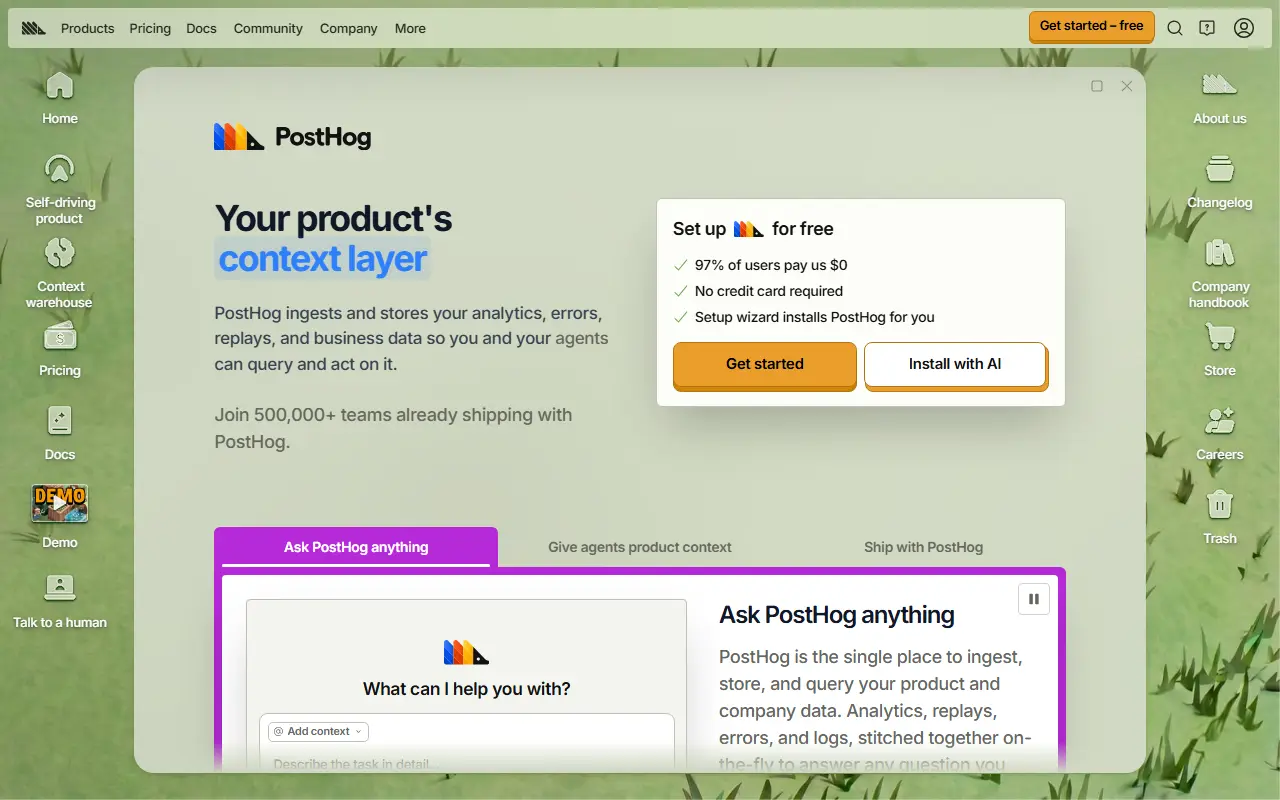
posthog.comPostHog homepage screenshot

PostHog is an open-source platform that bundles the tools product teams use to understand and improve what they ship. It captures event data, user sessions and errors in one place, and its newer self-driving mode aims to turn signals such as errors, rage clicks and failed queries into researched reports and pull requests that engineers review and merge.

The product suite includes product analytics with autocapture or manual instrumentation and SQL analysis, web analytics with a dashboard resembling Google Analytics, session replays for web and mobile, feature flags, experiments with statistical measurement, surveys, error tracking, logs, a data warehouse and a customer data platform. The back end is Python and the front end is React and TypeScript.

PostHog's repository license is listed as 'Other' on GitHub, so check which parts are open source and which are enterprise-only. It can be self-hosted, and the company also runs a managed cloud service. It suits product and engineering teams that prefer a single tool over separate analytics, flagging and replay vendors.

Key features

  • Product analytics with autocapture and SQL
  • Web analytics dashboard
  • Session replay for web and mobile
  • Feature flags and experiments
  • Surveys and error tracking
  • Data warehouse and customer data platform
  • AI-assisted detection of product issues

Pricing: Every product has a free monthly tier with no credit card needed. Pay-as-you-go charges only for usage beyond the free limits; per-unit rates are not shown here and volume discounts are available.

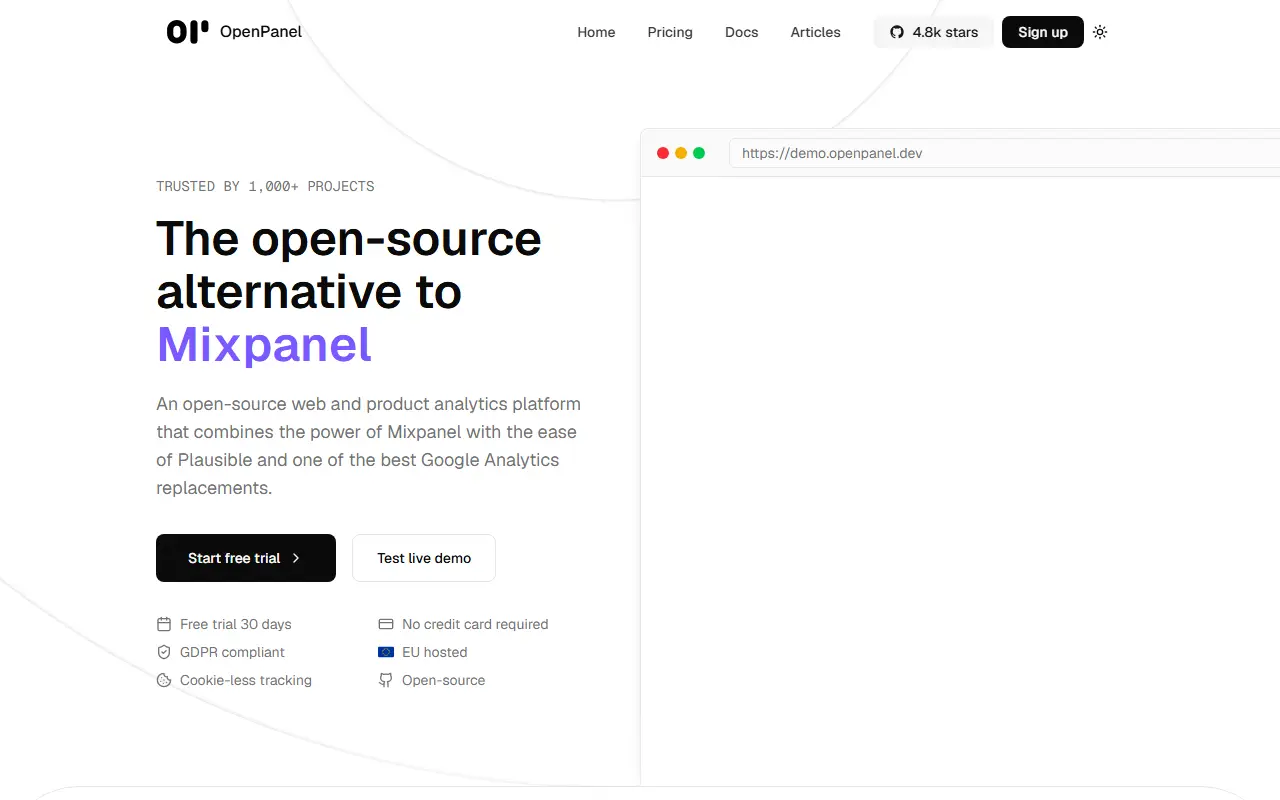
OpenPanel

An open-source web and product analytics platform positioned as an alternative to Mixpanel, with funnels, session replay, A/B tests, cookieless tracking and self-hosting.

GitHub stars
7.1k
Last commit
2 days ago
Licence
AGPL-3.0
Self-hosted
Yes
Hosted version
Available
openpanel.devOpenPanel homepage screenshot

OpenPanel is a web and product analytics platform, released as open source, that sets out to combine the depth of Mixpanel with the simplicity of Plausible. It is presented as an alternative to Mixpanel and Google Analytics, with optional self-hosting and cookieless tracking by default.

Its feature list covers funnels and cohorts, user profiles with session history, session replay that has privacy controls, real-time dashboards, built-in A/B testing, event and funnel alerts, custom dashboards, revenue tracking for purchases, subscriptions and lifetime value, SDKs and an API for web, mobile and server-side tracking, integrations such as Google Search Console, and an MCP server so AI clients can query user data. A comparison table in the README sets it against Mixpanel, GA4 and Plausible.

OpenPanel is written in TypeScript and licensed under AGPL-3.0. It can be self-hosted for full control of data, and a hosted version with sign-in is also available. The project emphasizes transparent pricing with no hidden costs or usage limits. It suits product teams that want privacy-friendly analytics with product-level depth.

Key features

  • Funnels, cohorts and user profiles
  • Session replay with privacy controls
  • Real-time dashboards and custom charts
  • Built-in A/B testing
  • Cookieless, GDPR-friendly tracking
  • Web, mobile and server-side SDKs
  • MCP server for AI clients

Pricing: Self-hosting is free. Cloud is priced by monthly event volume, from $2.50 for 5K events up to $900.00 for 50M, with unlimited users and a 30-day free trial.

Countly

Countly is a privacy-focused product analytics and customer engagement platform for web, mobile, desktop and IoT apps that you can run on-premises.

GitHub stars
5.9k
Last commit
yesterday
Latest release
25.03.53-LTS
Self-hosted
Yes
Hosted version
Available
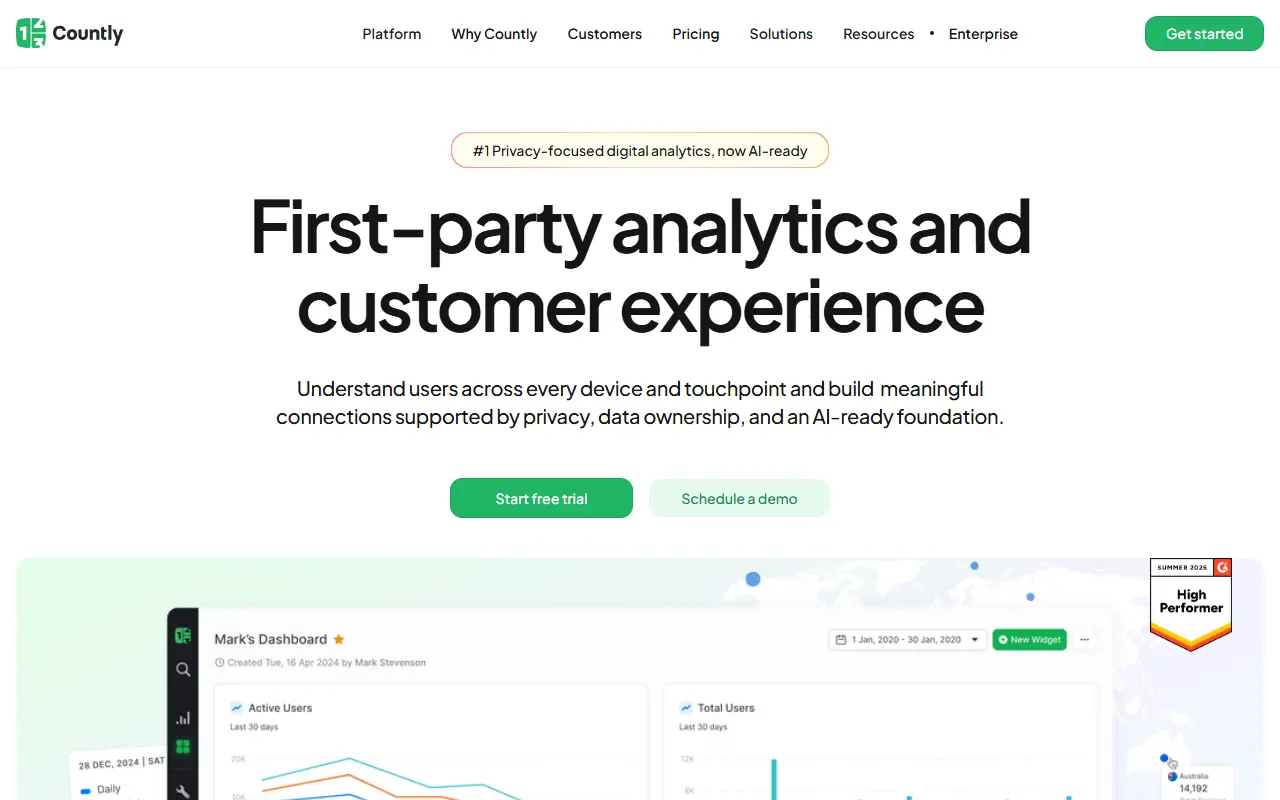
countly.comCountly homepage screenshot

Countly is a product analytics and customer engagement system for organizations that insist on owning their data. Teams use it to see how people behave in mobile, web, desktop and connected products, to improve product experiences, and to automate and personalize how they engage with customers.

The repository topics reflect a broad toolset: web and mobile analytics, crash analytics, push notifications, feature flags, remote configuration, user feedback, dashboards and user journeys. Privacy is a central theme, with references to GDPR, COPPA and HIPAA, and the README stresses that, unlike SaaS-only tools, it can run on your own premises or inside a private cloud. SDKs are provided for many platforms, and the project has a Discord community.

The server code is JavaScript and published under a license that GitHub lists as 'Other', so check the repository for the terms that apply to the edition you use. Countly also offers hosted and enterprise options through the vendor. It suits product and marketing teams that need analytics without sending data to a third party.

Key features

  • Cross-platform product and user analytics
  • Crash reporting for mobile apps
  • Push notifications and engagement tools
  • Feature flags and remote configuration
  • User feedback collection
  • On-premises or private cloud deployment

Pricing: Free self-hosted Lite edition. Flex starts at $175 per month on a managed private cloud with usage-based pricing and a 14-day trial; Enterprise is custom.

Aptabase

Open-source, privacy-first analytics for mobile, desktop, and web apps, with SDKs for many frameworks and a simple built-in dashboard.

GitHub stars
1.8k
Last commit
2 days ago
Licence
AGPL-3.0
Self-hosted
Yes
Hosted version
Available
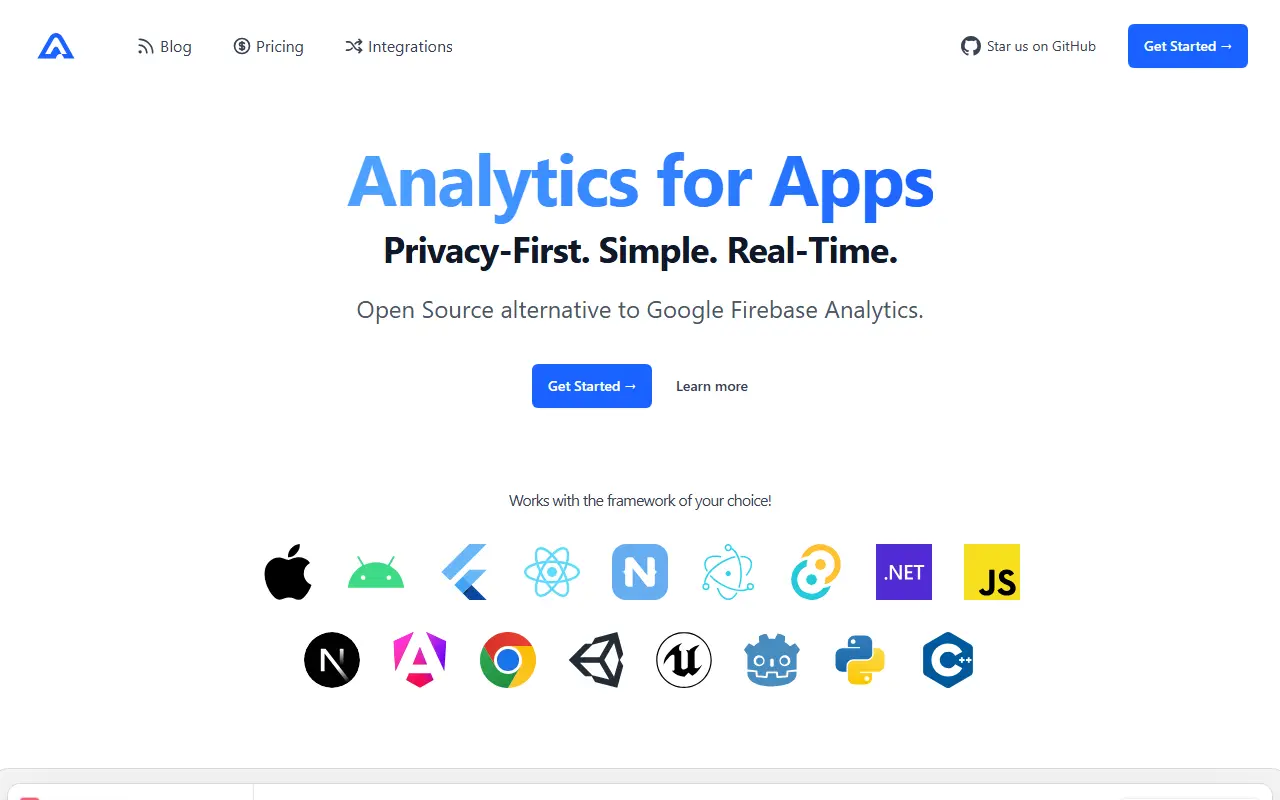
aptabase.comAptabase homepage screenshot

Aptabase is an analytics product built specifically for apps rather than websites. It positions itself as an open-source alternative to Firebase and Google Analytics for mobile, desktop, and web applications. The code is released under the AGPL-3.0 license and the server is written in TypeScript.

It provides SDKs for a long list of frameworks and languages, including Swift, React Native, Flutter, Electron, Kotlin, Tauri, and .NET MAUI. The project emphasizes privacy: it collects minimal usage data without unique identifiers, focuses on sessions, and states compliance with GDPR, CCPA, and PECR. A built-in dashboard shows the essential metrics in a simple form.

You can use the hosted cloud service or self-host the open-source version. Aptabase suits indie developers and small product teams who want to understand how people use their apps without invasive tracking or a heavy analytics setup.

Key features

  • SDKs for Swift, React Native, Flutter, Electron, and more
  • Minimal data collection without unique identifiers
  • Session-based metrics
  • Built-in dashboard for key metrics
  • GDPR, CCPA, and PECR focus
  • Open source with a hosted option

Pricing: Free up to 20,000 events per month. Paid volume tiers run from $10 per month for 200,000 events to $450 for 50,000,000; larger volumes are custom.

Snowplow

Snowplow is a behavioral data collection pipeline that gathers event-level data and delivers it to warehouses, lakes and streams; newer versions use a limited-use licence.

GitHub stars
7k
Last commit
3 mo ago
Latest release
22.01
Licence
Apache-2.0
Self-hosted
Yes
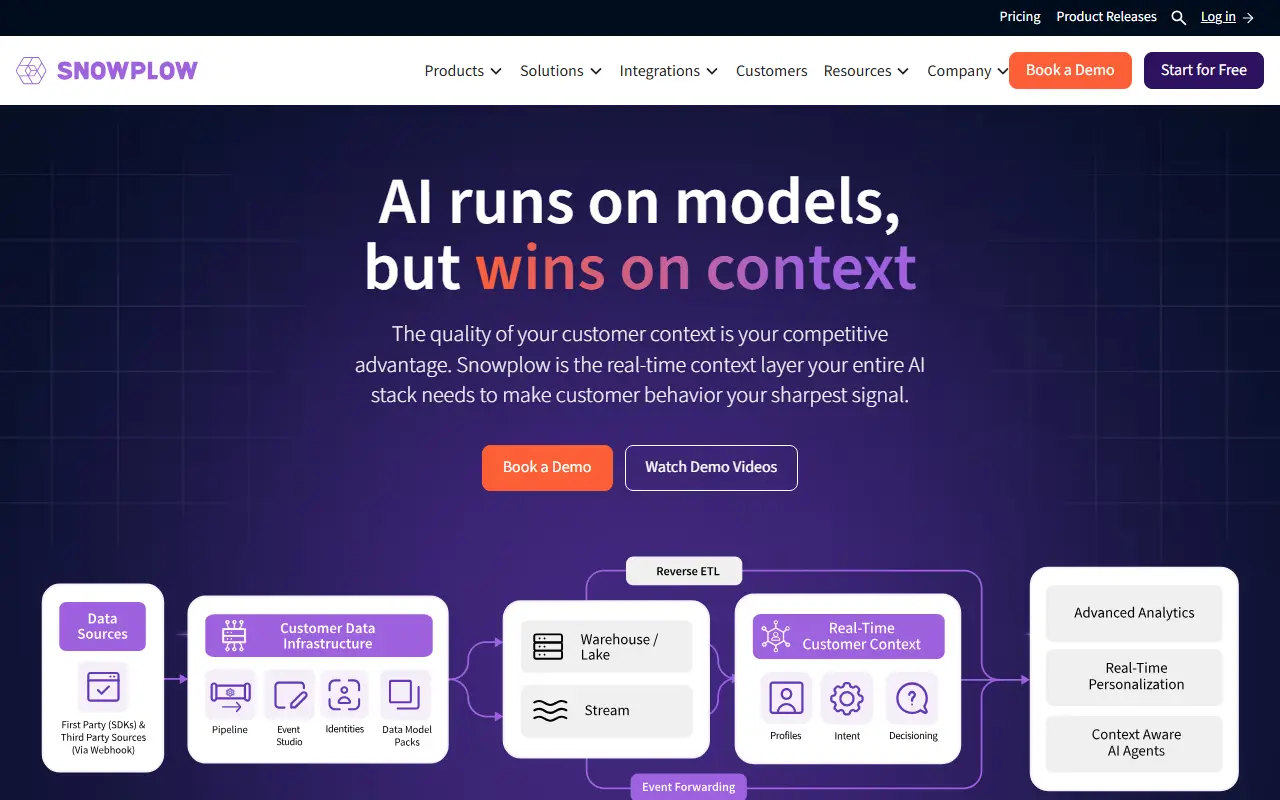
snowplow.ioSnowplow homepage screenshot

Snowplow is customer data infrastructure for collecting and processing behavioral event data in real time. It gathers event-level data from websites, apps and other sources and delivers it to a data warehouse, lake or stream, where it can feed analytics, personalization, fraud detection and AI agents with customer context.

The repository describes a Customer Context Layer with key benefits around data depth and quality, centralized governance and real-time operationalization. The topics point to data pipelines, product analytics and marketing analytics. The pipeline is written mainly in Scala and has been developed since 2012.

The README carries an important notice: since January 8, 2024, new versions of the core pipeline are released under the Snowplow Limited Use License Agreement, and versions from before January 2024 receive no security patches. Users running the pipeline in production or competing with Snowplow are told they are affected and should contact the company. The older code was Apache-2.0, which the repository still lists. Teams should read the current terms before adopting it.

Key features

  • Event-level behavioral data collection
  • Delivery to warehouses, lakes, and streams
  • Real-time data processing
  • Governance and data quality focus
  • Support for product and marketing analytics
  • Scala-based pipeline components

Pricing: A self-managed open-source environment for testing is listed at no cost, plus a 14-day free trial. The self-hosted pipeline and managed Platform are quoted individually, based on event volume and hosting.

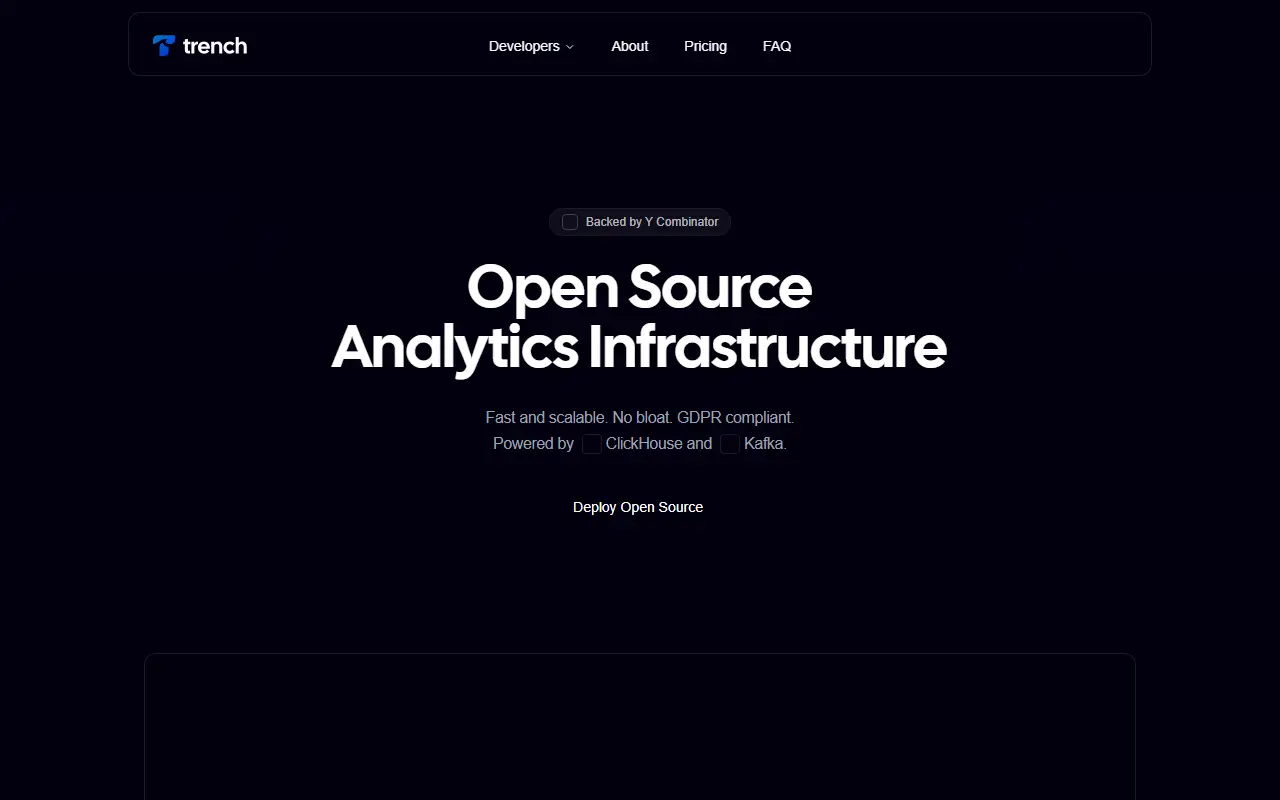
Trench

Open-source event tracking and analytics infrastructure built on ClickHouse and Kafka, compatible with the Segment API and deployable as one Docker image.

GitHub stars
1.7k
Last commit
5 mo ago
Latest release
trench-js@0.0.17
Licence
MIT
Self-hosted
Yes
Hosted version
Available
trench.devTrench homepage screenshot

Trench is an event tracking system built on Apache Kafka and ClickHouse that aims to handle large event volumes and provide real-time analytics. It was created by the Frigade team to scale its own tracking pipeline, and is meant for developers who want to build product analytics dashboards or collect events for other data uses on infrastructure they control. The README describes it as cookie-free and compliant with GDPR and PECR, with users able to access, correct or delete their data.

It is compatible with the Segment API, supporting Track, Group and Identify calls, and ships as a single production-ready Docker image. A single node can process thousands of events per second, data can be queried in real time, and webhooks connect events to other destinations. A demo shows how to build a basic Google Analytics-style dashboard using Trench and Grafana.

There are two ways to run it. Trench Self-Hosted is the open-source MIT-licensed version, which needs Docker and Docker Compose and recommends at least 4 GB of RAM and 4 CPU cores for production. Trench Cloud is a fully managed serverless offering. Support is available through a Slack community.

Key features

  • Segment-compatible Track, Group and Identify API
  • Single production-ready Docker image
  • Real-time queries on event data
  • Webhooks to other destinations
  • ClickHouse and Kafka based storage
  • Cookie-free tracking with data deletion controls

Pricing: Self-hosted version is free under MIT. A managed Trench Cloud option exists; see the vendor for pricing.

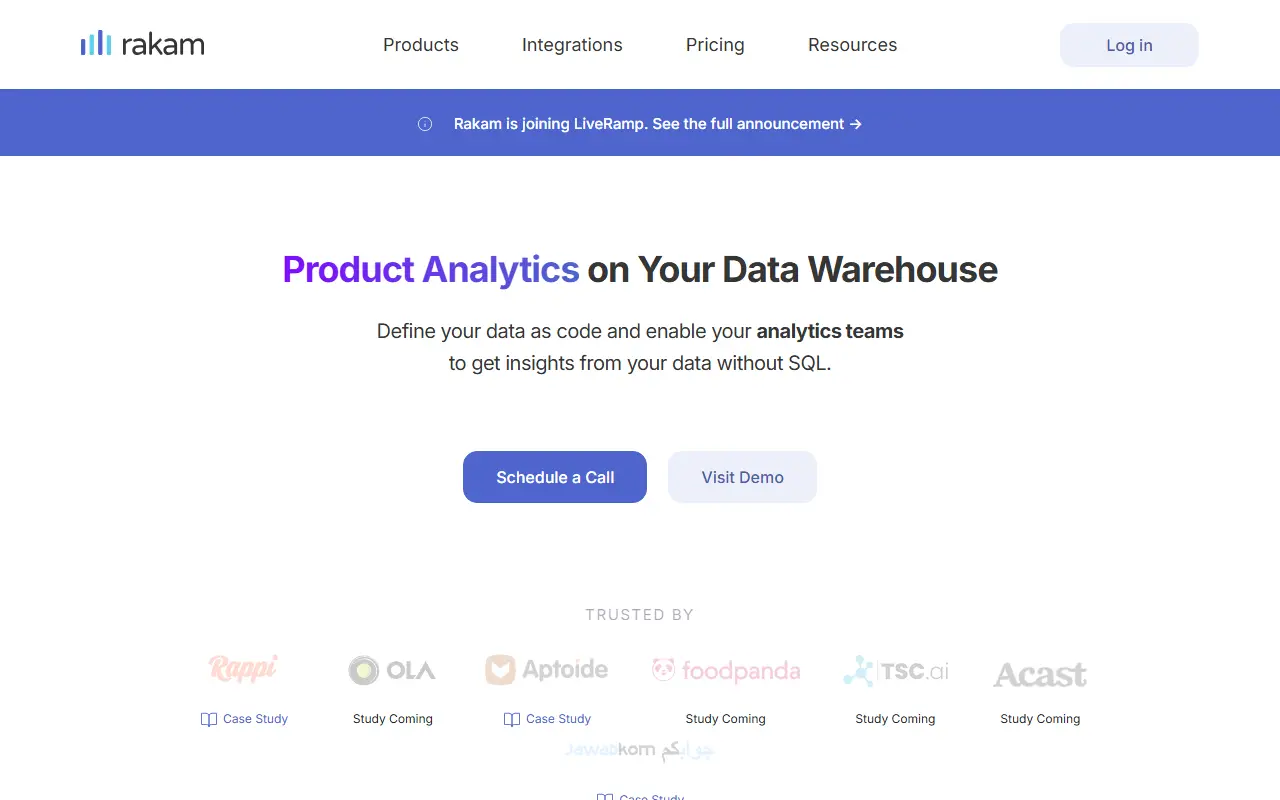
Rakam

Rakam is a modular analytics platform for collecting and storing customer event data; this repository holds the API collector rather than the UI.

GitHub stars
790
Last commit
4 yr ago
Licence
AGPL-3.0
Self-hosted
Yes
Hosted version
Available
rakam.ioRakam homepage screenshot

Rakam is a modular analytics platform for building your own analytics service. This repository contains the API collector that receives customer event data from your apps, not the visualization product, which is offered separately as Rakam UI.

A typical workflow starts with collecting data from trackers, client libraries, webhooks and tasks, then enriching and sanitizing events with event mappers, and storing them in a data warehouse such as PostgreSQL, Snowflake or S3. Event data can then be analyzed with SQL and analytics APIs for funnel, retention and segmentation reports through Rakam Cloud, and developers can write their own modules.

Deployment is configured through a config.properties file. For data that fits on a single server the project recommends PostgreSQL 11, and for heavier loads events can go to a distributed log such as Apache Kafka or Amazon Kinesis in Avro format. Rakam is written in Java and licensed under AGPL-3.0, with cloud deployment tools for scaling clusters.

Key features

  • Event collection via trackers and webhooks
  • Event mappers to enrich and sanitize data
  • Storage in PostgreSQL, Snowflake or S3
  • Funnel, retention and segmentation APIs
  • Kafka and Kinesis streaming support
  • Modular design with custom modules

Pricing: Pricing is by team size rather than data volume. Startup is free for up to 2 users, Growth costs $25 per user per month billed annually, and Enterprise is quoted.

Read more about RakamWebsite GitHub

Fusion

Fusion is an open-source user behavior analytics and engagement platform, an alternative to Mixpanel and Hotjar, though the project is no longer maintained.

GitHub stars
213
Last commit
4 yr ago
Self-hosted
Yes

Fusion is a self-hostable, open-source platform for analyzing how people use web products and for engaging with them. It is described as an alternative to Mixpanel, Amplitude, Hotjar and Fullstory. The README states that the project is no longer maintained, so it is better treated as a reference or starting point rather than a supported product.

It combines a low-code analytics engine with visual analytics. Events such as page views, button clicks and form submissions are captured automatically once a tracking snippet is added, and visual recordings of user interactions are supported. Custom dashboards allow different chart types and timescales. For engagement, it offers live chat, in-app push notifications, email and micro-surveys, and email campaigns that can be triggered automatically.

Fusion is meant to be self-hosted, with the README providing Docker-based commands for production and development, and its pitch is avoiding large SaaS bills while keeping user data in your own hands. The stack includes JavaScript, Python and PostgreSQL. The repository lists its licence as other, so terms should be read before reuse.

Key features

  • Automatic event capture with a tracking snippet
  • Visual recording of user interactions
  • Custom dashboards with multiple chart types
  • Live chat with users
  • In-app push notifications
  • Email campaigns and micro-surveys
  • Self-hosting with Docker

Pricing: Free and open source; the repository lists its licence as other, and the project is no longer maintained.

Amplitude alternatives: questions

What is the best open-source alternative to Amplitude?
PostHog is the top-ranked open-source alternative to Amplitude on Enlisted: An open-source product platform combining analytics, session replay, feature flags, experiments, surveys and error tracking, with AI that turns signals into reports. Other strong options are OpenPanel, Countly, Aptabase and Snowplow.
Are these Amplitude alternatives free?
All 8 are open source, so the code is free to use under its licence, and 8 of them can be self-hosted on your own server. 6 also offer a paid or managed cloud version if you'd rather not host it yourself.
How is this list of Amplitude alternatives ranked?
By a score built from GitHub stars, star growth over the last 30 days and how recently the code changed. 4 of these projects shipped code in the last 30 days. Data is refreshed daily, and nobody can pay to move up.

People also look for alternatives to…

View all