
About SRS
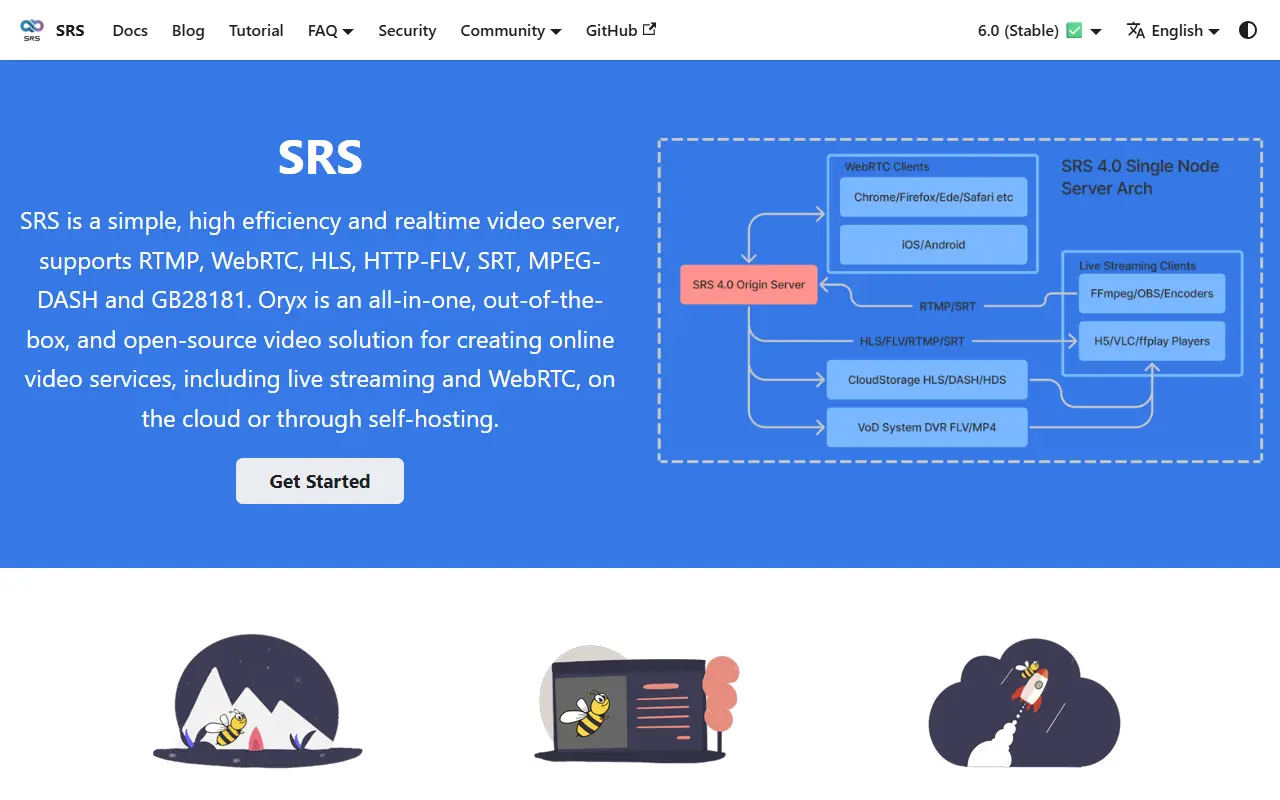
SRS, short for Simple Realtime Server, is an open-source real-time media server for live streaming and video communication. It handles many protocols in one product, among them RTMP, WebRTC, HLS, SRT, HTTP-FLV, MPEG-DASH and the GB28181 surveillance standard, and supports video codecs including H.264, H.265, AV1 and VP9 and audio codecs including AAC, Opus and G.711.
It runs on Linux and macOS across a wide range of processor architectures, from x86-64 and ARM variants to Apple M1, RISC-V, LoongArch and MIPS. The getting-started guide recommends running SRS in Docker, after which you open the local web console on port 8080 and push a stream with FFmpeg or OBS to an RTMP address, then play it back with common players using whichever protocol you prefer. A mirror registry is mentioned for users in China.
SRS is written in C++ and licensed under MIT, though some third-party libraries carry their own licenses. Topics point to low-latency streaming, live broadcasting and video conferencing. It suits teams building live video platforms, surveillance ingest or conferencing backends who want to run their own media server.
Key features
- RTMP, WebRTC, HLS, HTTP-FLV and SRT support
- MPEG-DASH and GB28181 support
- H.264, H.265, AV1 and VP9 codecs
- Runs on many CPU architectures
- Docker-based quick start
- Works with FFmpeg and OBS publishers
Good fit for
- →Live streaming platforms
- →Low-latency WebRTC video delivery
- →Ingesting and repackaging camera streams
- Built with
- C++
- Tags
- media-server
- live-streaming
- webrtc
- rtmp
- hls
- srt
- video
- cpp
- self-hosted
SRS: questions and answers
- What is SRS used for?
- SRS is a high-performance media server supporting RTMP, WebRTC, HLS, SRT, MPEG-DASH and GB28181 for live streaming and low-latency video. It is a good fit for live streaming platforms, low-latency WebRTC video delivery, and ingesting and repackaging camera streams.
- Is SRS open source?
- Yes. SRS is open source under the MIT licence. Its source code is on GitHub at ossrs/srs and is written mainly in C++.
- Is SRS free?
- Yes. SRS is open source, so the software itself is free to use.
- Can I self-host SRS?
- Yes. SRS can be self-hosted on your own server or infrastructure; there is no official hosted version.
- What is SRS an alternative to?
- SRS is an open-source alternative to Mux, Restream, Dacast and Wowza. Other open-source alternatives to Mux include Ant Media Server and OvenMediaEngine.
- Is SRS actively maintained?
- Yes. The most recent commit to SRS was on 1 October 2026, and the latest release is v6.0-r2, published on 24 September 2026. The project has 29k stars on GitHub.
Open-source alternatives to SRS
See all
Ant Media Server
Media & Streaming
Ant Media Server — Ultra-low latency streaming engine with WebRTC (~0.5s), SRT, RTMP, HLS,
OSSvs Agora★ 4.7k
OvenMediaEngine
Media & Streaming
OvenMediaEngine (OME) is a Sub-Second Latency Live Streaming Server with Large-Scale and H
AGPL-3.0vs Mux★ 3.3k
MediaMTX
Media & Streaming
Ready-to-use Media-over-QUIC / SRT / WebRTC / RTSP / RTMP / LL-HLS / MPEG-TS / RTP live me
MITvs Wowza★ 20k
Owncast
Media & Streaming
Take control over your live stream video by running it yourself. Streaming + chat out of
MITvs Twitch★ 12k
MediaCMS
Media & Streaming
MediaCMS is a modern, fully featured open source video and media CMS, written in Python/Dj
AGPL-3.0vs Vimeo★ 5.1k
PeerTube
Media & Streaming
ActivityPub-federated video streaming platform using P2P directly in your web browser
AGPL-3.0vs YouTube★ 15k
SaaS alternatives to SRS
See all
Mux
Media & Streaming
Video API for encoding, streaming and playback analytics, aimed at developers
SaaS
Restream
Media & Streaming
Multistreaming service that broadcasts live video to many platforms at once
SaaS
Dacast
Media & Streaming
Live streaming and video hosting platform for businesses
SaaS
Wowza
Media & Streaming
Streaming software and cloud services for live and on-demand video
SaaS
Castr
Media & Streaming
Live streaming platform with multistreaming, stream hosting and video on demand
SaaS
Brightcove
Media & Streaming
Enterprise online video platform for hosting, delivery and monetization
SaaS