7,380 open-source and SaaS tools, with GitHub stats refreshed every day.

6 alternatives ranked by real activity

Open-source Dacast alternatives

A curated, ranked list of the 6 best open-source alternatives to Dacast.

The best open-source alternative to Dacast is SRS. If that doesn't suit you, other good options are PeerTube, Owncast, MediaCMS and Ant Media Server.

Dacast alternatives are mainly media & streaming tools. 6 of them shipped code in the last 30 days, 6 can be self-hosted, and 2 use a permissive licence.

Last updated October 3, 2026 · ranked by GitHub stars, growth and recent commits

SRS

Simple Realtime Server is a high-performance media server supporting RTMP, WebRTC, HLS, SRT, MPEG-DASH and GB28181 for live streaming and low-latency video.

GitHub stars
29k
Last commit
yesterday
Latest release
v6.0-r2
Licence
MIT
Self-hosted
Yes
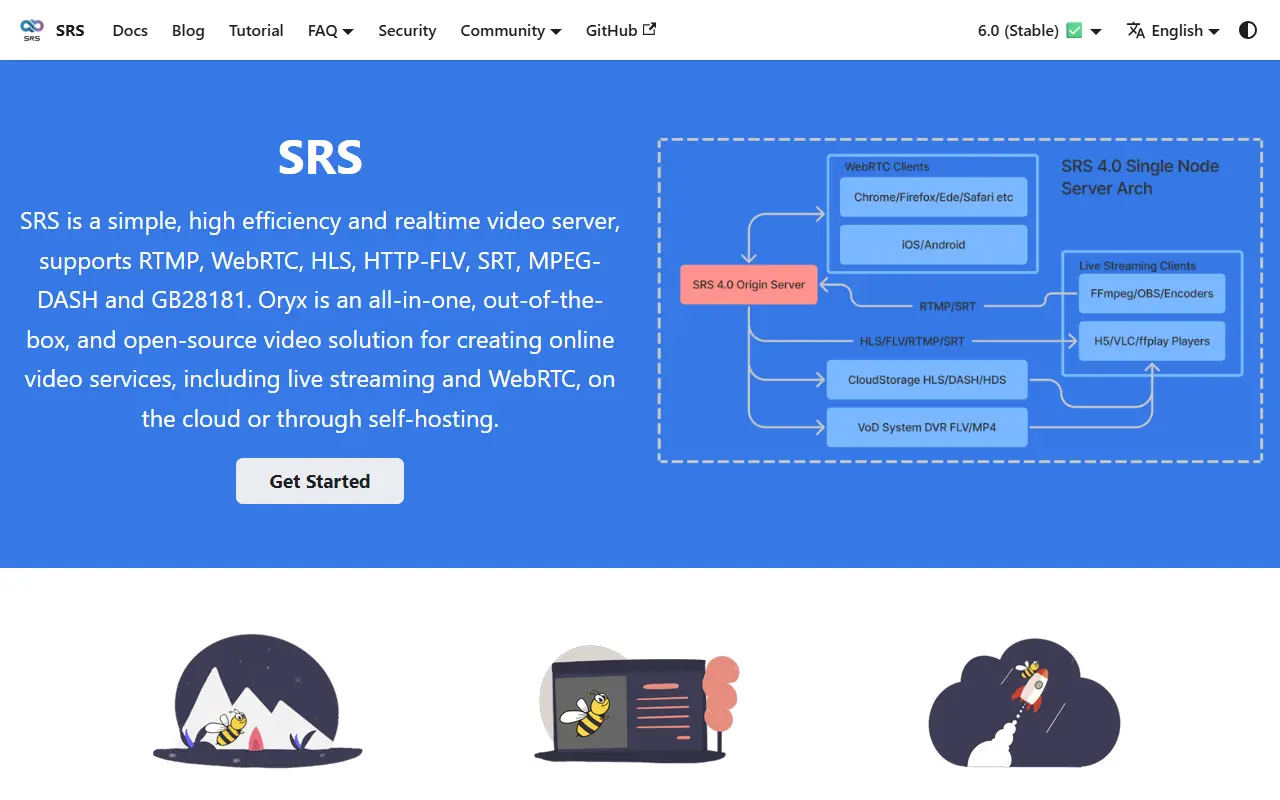
ossrs.ioSRS homepage screenshot

SRS, short for Simple Realtime Server, is an open-source real-time media server for live streaming and video communication. It handles many protocols in one product, among them RTMP, WebRTC, HLS, SRT, HTTP-FLV, MPEG-DASH and the GB28181 surveillance standard, and supports video codecs including H.264, H.265, AV1 and VP9 and audio codecs including AAC, Opus and G.711.

It runs on Linux and macOS across a wide range of processor architectures, from x86-64 and ARM variants to Apple M1, RISC-V, LoongArch and MIPS. The getting-started guide recommends running SRS in Docker, after which you open the local web console on port 8080 and push a stream with FFmpeg or OBS to an RTMP address, then play it back with common players using whichever protocol you prefer. A mirror registry is mentioned for users in China.

SRS is written in C++ and licensed under MIT, though some third-party libraries carry their own licenses. Topics point to low-latency streaming, live broadcasting and video conferencing. It suits teams building live video platforms, surveillance ingest or conferencing backends who want to run their own media server.

Key features

  • RTMP, WebRTC, HLS, HTTP-FLV and SRT support
  • MPEG-DASH and GB28181 support
  • H.264, H.265, AV1 and VP9 codecs
  • Runs on many CPU architectures
  • Docker-based quick start
  • Works with FFmpeg and OBS publishers

Pricing: Free and open source under the MIT license.

PeerTube

PeerTube is a free, federated video platform that uses ActivityPub and peer-to-peer streaming as an alternative to YouTube and Vimeo.

GitHub stars
15k
Last commit
today
Latest release
v8.3.1
Licence
AGPL-3.0
Self-hosted
Yes
Hosted version
Available
joinpeertube.orgPeerTube homepage screenshot

PeerTube is a free, decentralized and federated video platform, developed by Framasoft as an alternative to centralized services such as YouTube, Dailymotion and Vimeo. It is a network of many small, interoperable video hosting providers, called instances, and it is described as community-owned and ad-free.

Users can upload videos and have them streamed anywhere, with descriptions and tags that make them discoverable across the whole federated network, not only one instance. Live streaming, including permanent streams, is supported, and a player can be embedded on other websites. Viewers can follow channels from the Fediverse, such as Mastodon, without an account on the instance hosting the video.

PeerTube uses ActivityPub for federation and peer-to-peer technology in the browser to share bandwidth between viewers. It is written in TypeScript with Angular and released under the AGPL-3.0 license. People can join an existing instance or create their own, so it fits both self-hosters and communities, and demonstration instances are listed.

Key features

  • ActivityPub federation between instances
  • Peer-to-peer streaming in the browser
  • Live streaming and permanent streams
  • Embeddable video player
  • Follow channels from the Fediverse
  • Ad-free, community-owned hosting

Pricing: Free and open source under the AGPL-3.0 license; donations support the project.

Owncast

A self-hosted, single-user live video streaming and chat server that lets you run your own livestream with RTMP broadcasting software such as OBS.

GitHub stars
12k
Last commit
yesterday
Latest release
v0.3.0
Licence
MIT
Self-hosted
Yes
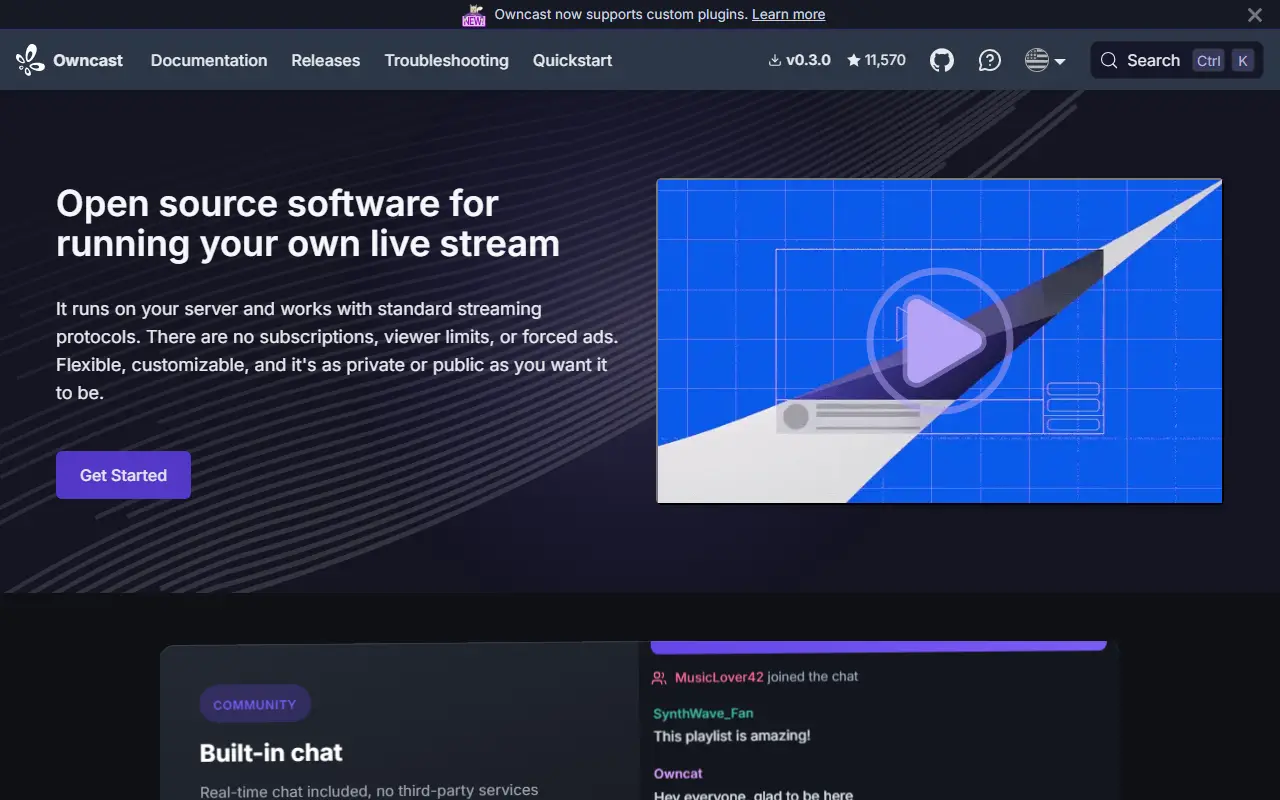
owncast.onlineOwncast homepage screenshot

Owncast is an open-source, self-hosted live video streaming and chat server for one broadcaster. It aims to work as a single service you run yourself, with streaming and chat included, so you keep ownership of your content, interface, moderation and audience instead of relying on a large streaming platform.

It works with any broadcasting software that sends video over RTMP, the protocol the major live services use, and OBS, Streamlabs and Restream have been used with it. The topics list HLS streaming, chat, ActivityPub and fediverse federation. The backend is written in Go and the frontend in React, and a quick-start guide plus a demo are available.

Owncast is licensed under MIT and deployed on your own server. The README advises using a tagged release rather than the develop branch when you want a stable version. It suits independent streamers, communities and organizations that want a branded, self-run live stream with built-in chat.

Key features

  • Live video streaming server
  • Built-in chat for viewers
  • Works with RTMP broadcasting software
  • OBS, Streamlabs and Restream compatibility
  • Control over moderation and interface
  • Fediverse and ActivityPub integration
  • Go backend with React frontend

Pricing: Free and open source under the MIT licence.

MediaCMS

MediaCMS is a self-hosted video and media content management system built with Django and React, featuring a REST API and flexible publishing workflows.

GitHub stars
5.1k
Last commit
yesterday
Latest release
v9.1.0
Licence
AGPL-3.0
Self-hosted
Yes
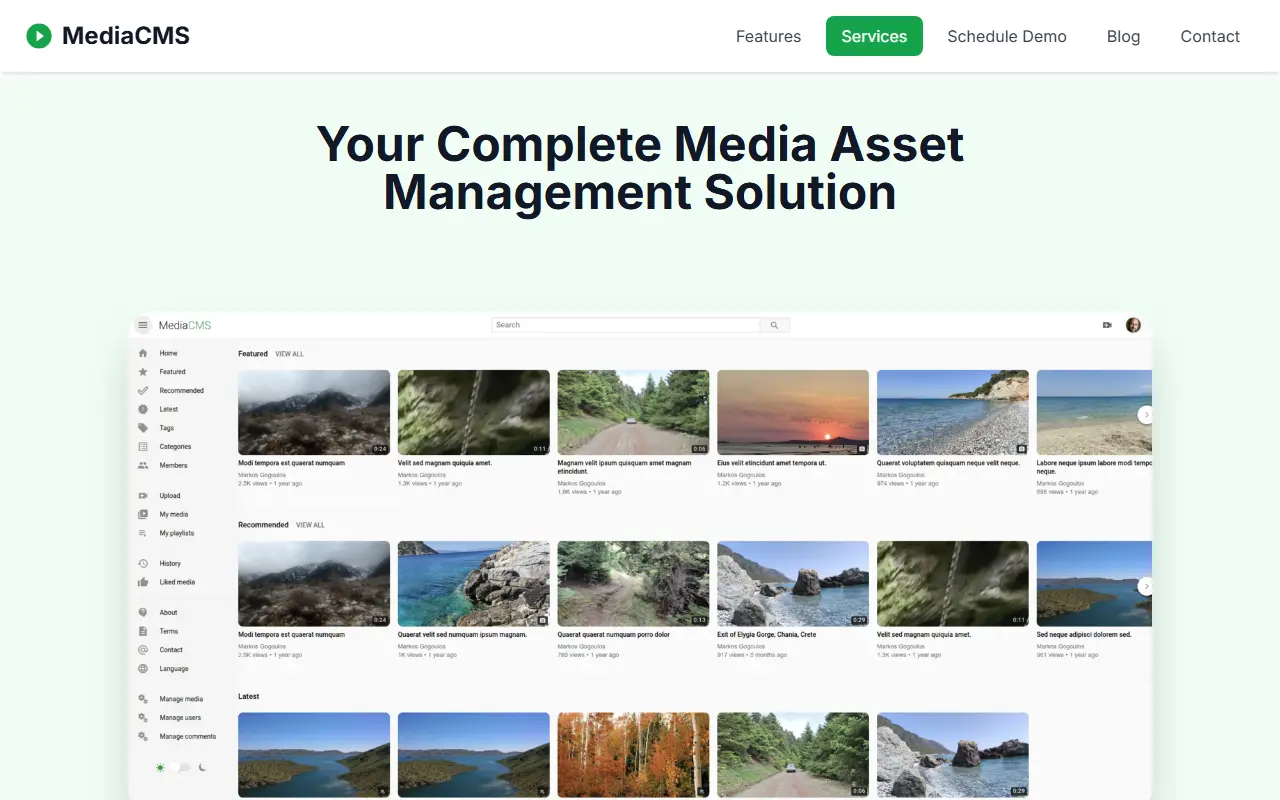
mediacms.ioMediaCMS homepage screenshot

MediaCMS is an open-source content management system for video and other media. It is meant for organizations that want their own platform for viewing and sharing media, and the README says it can be used to put together a small to medium video portal in minutes. A public demo is available.

The stack is Python with Django and Celery on the server and React on the front end, and a REST API is included for integration. Listed features include complete control over your data through self-hosting, support for several publishing workflows such as public, private, unlisted and custom, and role-based access control with RBAC categories. Repository topics also cover audio, video sharing and CMS use cases.

MediaCMS is licensed under AGPL-3.0 and is designed to run on your own server. It suits schools, companies, communities and creators that want an internal or public video library without relying on a third-party video platform, and that are comfortable administering a Django application.

Key features

  • Video and audio media portal
  • REST API for integration
  • Public, private and unlisted publishing
  • Role-based access control categories
  • Django, Celery and React stack
  • Self-hosted with full data control

Pricing: The open-source platform is self-hosted. Optional professional services cost $2,000 one-time for deployment and training or $2,000 per month for managed services; custom development is quoted.

Ant Media Server

A scalable media server for live streaming with WebRTC, SRT, RTMP, HLS and CMAF, with SDKs for mobile and web and Community and Enterprise editions.

GitHub stars
4.7k
Last commit
yesterday
Latest release
ams-v3.1.0
Self-hosted
Yes
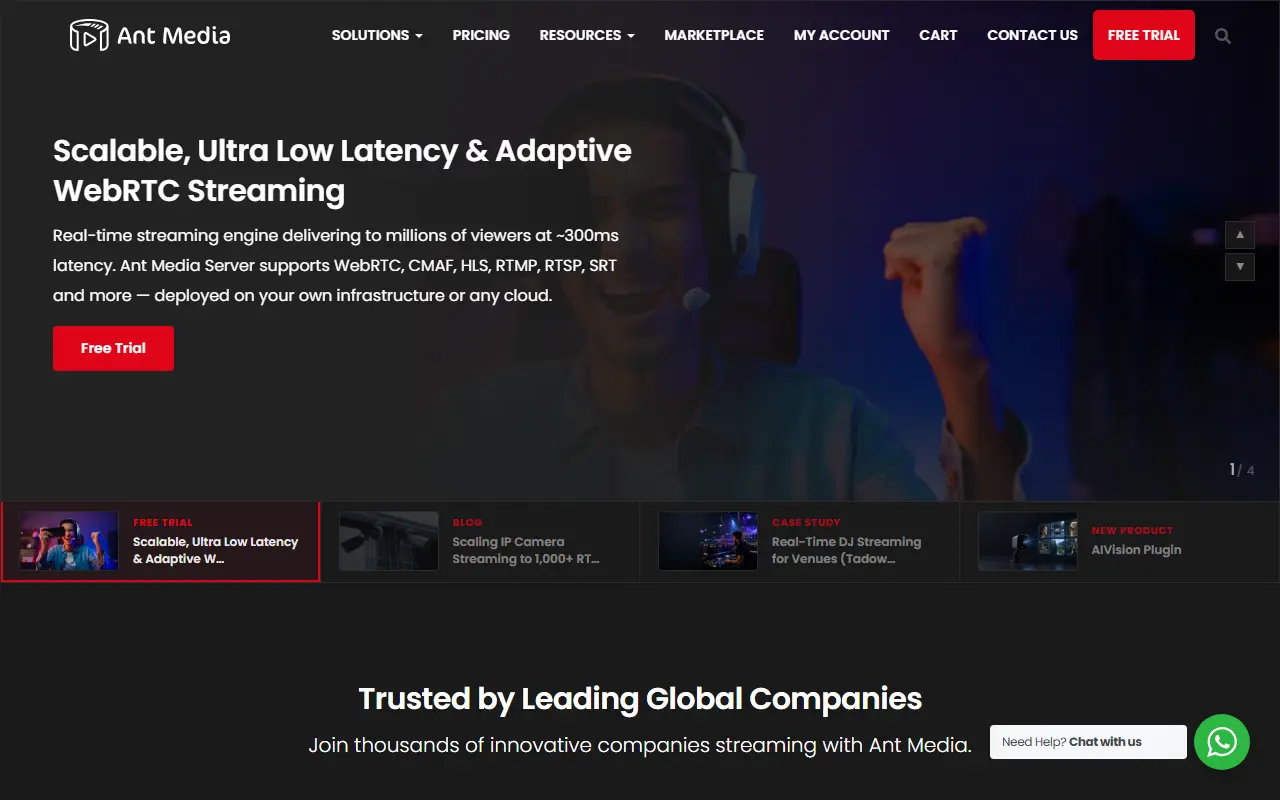
antmedia.ioAnt Media Server homepage screenshot

Ant Media Server is a scalable media server for low-latency live streaming. It supports WebRTC with a claimed latency of about half a second, along with SRT, RTMP, RTSP, HLS and CMAF low-latency HLS, and also handles H.265/HEVC. Developers use it to build real-time video applications and live broadcasting.

Capabilities include adaptive bitrate workflows, transcoding, recording and cloud auto-scaling. SDKs are provided for iOS, Android, React Native, Flutter, Unity and JavaScript, and security features include SSL/TLS, token authentication, IP filtering and watermarking. The README lists use cases such as telehealth, e-learning, sports streaming, auctions and interactive applications.

The project is split into a Community edition with the essentials and an Enterprise edition that adds advanced features and support, and a free trial of the Enterprise edition is offered. It is written in Java, and documentation covers installation, API references and tutorials.

Key features

  • Low-latency WebRTC streaming
  • SRT, RTMP, RTSP and HLS support
  • CMAF and low-latency HLS
  • Adaptive bitrate and transcoding
  • Recording and cloud auto-scaling
  • SDKs for iOS, Android, Flutter and JavaScript
  • Token authentication and IP filtering

Pricing: Self-hosted Enterprise licenses cost $109 per instance per month, $89 on an annual subscription, $0.24 per instance-hour, or $2799 perpetual. Cloud marketplace listings start at $0.33 per hour, with trials.

OvenMediaEngine

OvenMediaEngine is a live streaming server delivering sub-second latency video to large audiences over WebRTC and Low Latency HLS.

GitHub stars
3.3k
Last commit
today
Latest release
v0.21.0
Licence
AGPL-3.0
Self-hosted
Yes
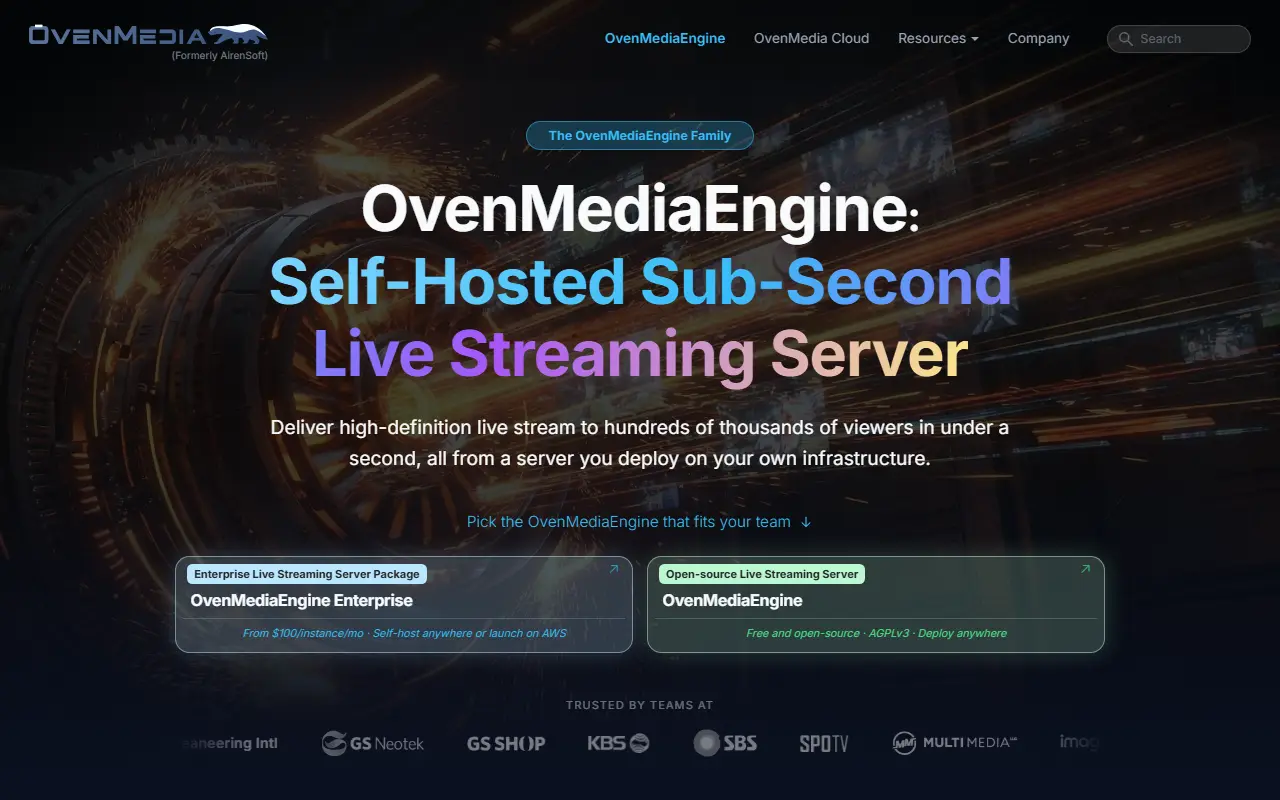
ovenmedia.comOvenMediaEngine homepage screenshot

OvenMediaEngine, or OME, is a streaming server built for live video with sub-second latency. It can deliver high-definition streams to very large audiences using Low Latency HLS and WebRTC. The project also lists a hosted demo service, OvenSpace, built with OvenMediaEngine, OvenPlayer and OvenLiveKit, with its source available for implementation examples.

On the input side, OME accepts pushed streams over WebRTC, WHIP, SRT, RTMP, Enhanced RTMP and MPEG-2 TS over UDP, and it can pull streams over RTSP and OVT. An embedded live transcoder produces adaptive bitrate renditions with codecs including VP8, H.264, AV1 and, with hardware, H.265. Viewers receive output over LLHLS and WebRTC, and legacy HLS and SRT output are also supported.

Further capabilities include scheduled channels for pre-recorded live programming, multiplex channels, DVR-style live rewind, dumping streams for video on demand, timed ID3v2 metadata, WebVTT subtitles and DRM with Widevine, FairPlay and PlayReady. An embedded TURN server and WebSocket signalling server support WebRTC. It is written in C++ and licensed under AGPL-3.0.

Key features

  • Sub-second latency over WebRTC and LLHLS
  • Ingest via WebRTC, WHIP, SRT, RTMP and RTSP
  • Embedded adaptive bitrate live transcoder
  • DVR live rewind and dump for video on demand
  • DRM with Widevine, FairPlay and PlayReady
  • Embedded TURN and signalling server for WebRTC
  • Scheduled and multiplex channels

Pricing: The open-source engine is free under AGPLv3. Enterprise costs $100 per instance per month, $1,000 per instance per year, or $2,500 perpetual; on AWS Marketplace it is $0.19 per instance-hour after a 14-day trial.

Dacast alternatives: questions

What is the best open-source alternative to Dacast?
SRS is the top-ranked open-source alternative to Dacast on Enlisted: Simple Realtime Server is a high-performance media server supporting RTMP, WebRTC, HLS, SRT, MPEG-DASH and GB28181 for live streaming and low-latency video. Other strong options are PeerTube, Owncast, MediaCMS and Ant Media Server.
Are these Dacast alternatives free?
All 6 are open source, so the code is free to use under its licence, and all of them can be self-hosted on your own server or computer. 1 also offers a paid or managed cloud version if you'd rather not host it yourself.
How is this list of Dacast alternatives ranked?
By a score built from GitHub stars, star growth over the last 30 days and how recently the code changed. 6 of these projects shipped code in the last 30 days. Data is refreshed daily, and nobody can pay to move up.

People also look for alternatives to…

View all