7 open-source alternatives ranked by real activity

Open-source Wowza alternatives

A curated, ranked list of the 7 best open-source alternatives to Wowza.

The best open-source alternative to Wowza is FFmpeg. If that doesn't suit you, other good options are OBS Studio, MediaMTX, SRS and Ant Media Server.

Commercial alternatives to Wowza include Castr, Dacast, JW Player and Mux. See all 24.

Wowza alternatives are mainly media & streaming tools, but some are also video editing tools. 7 of them shipped code in the last 30 days, 7 can be self-hosted, and 3 use a permissive licence.

Last updated November 12, 2026 · ranked by GitHub stars, growth and recent commits

FFmpeg

A collection of open-source libraries and command-line tools for processing audio, video, subtitles and related metadata, including converting and streaming media.

GitHub stars
67k
Last commit
yesterday
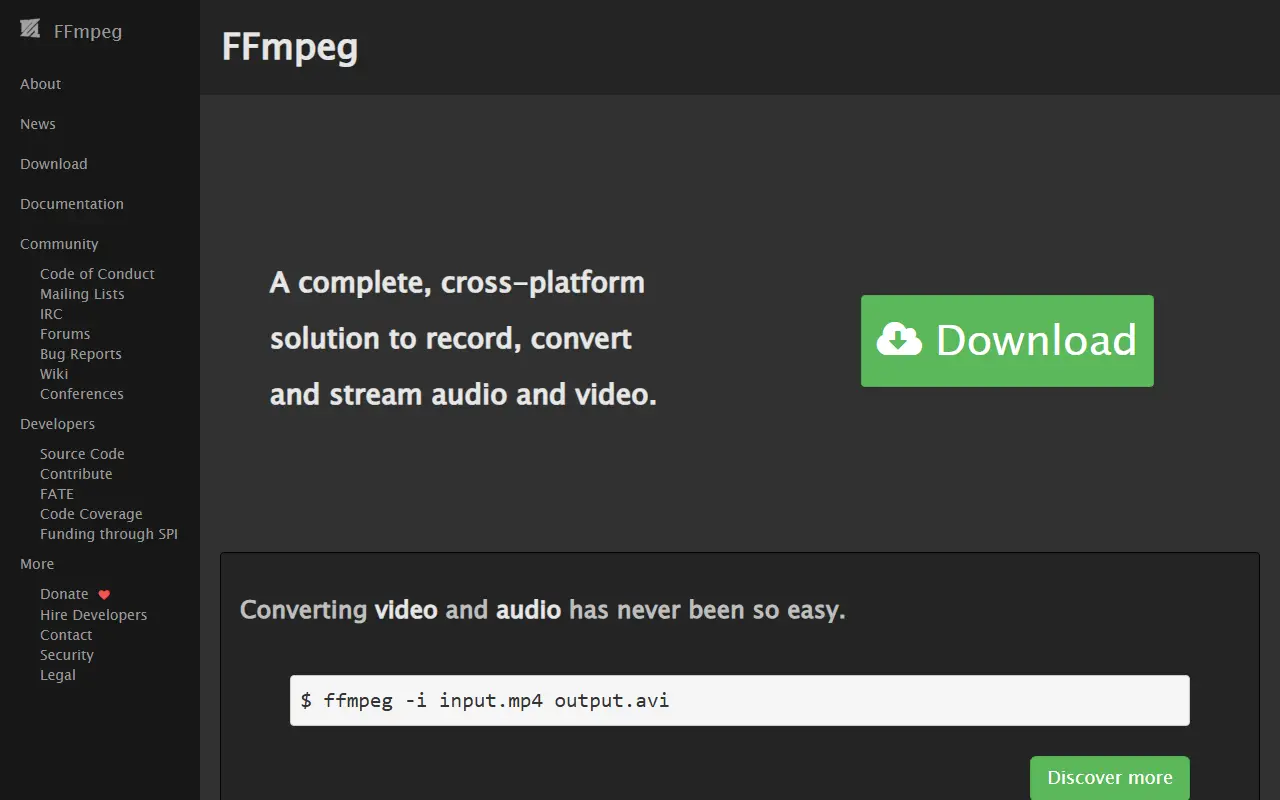
ffmpeg.orgFFmpeg homepage screenshot

FFmpeg is a set of libraries and command-line tools that process multimedia content, including audio, video, subtitles and associated metadata. It is written in C and widely used as the engine behind media conversion, streaming and playback software. Most of the code is under the LGPL, and some optional components fall under the GPL, so check the LICENSE file for details.

The libraries cover distinct jobs: libavcodec implements a wide range of codecs, libavformat handles streaming protocols and container formats, libavfilter alters decoded audio and video through a graph of connected filters, libavdevice accesses capture and playback devices, libswresample handles audio mixing and resampling, libswscale handles color conversion and scaling, and libavutil provides utility functions.

On the command line, ffmpeg manipulates, converts and streams media, ffplay is a minimalist player and ffprobe inspects content, plus small helpers including qt-faststart, ismindex and aviocat. The GitHub repository is a mirror: patches go to the ffmpeg-devel mailing list rather than through pull requests. It suits developers building media applications and anyone who converts or processes audio and video.

Key features

  • Libraries for encoding, decoding and muxing media
  • ffmpeg command-line converter and streaming tool
  • ffprobe for inspecting media files
  • ffplay minimalist media player
  • Filter graphs for audio and video processing
  • Streaming protocols and container format support

Pricing: Free and open source, mainly under the LGPL with optional GPL components.

OBS Studio

Free, open-source program for recording video and streaming live on Windows, macOS and Linux, built around scenes made from multiple sources.

GitHub stars
79k
Last commit
2 days ago
Latest release
33.0.1
Licence
GPL-2.0
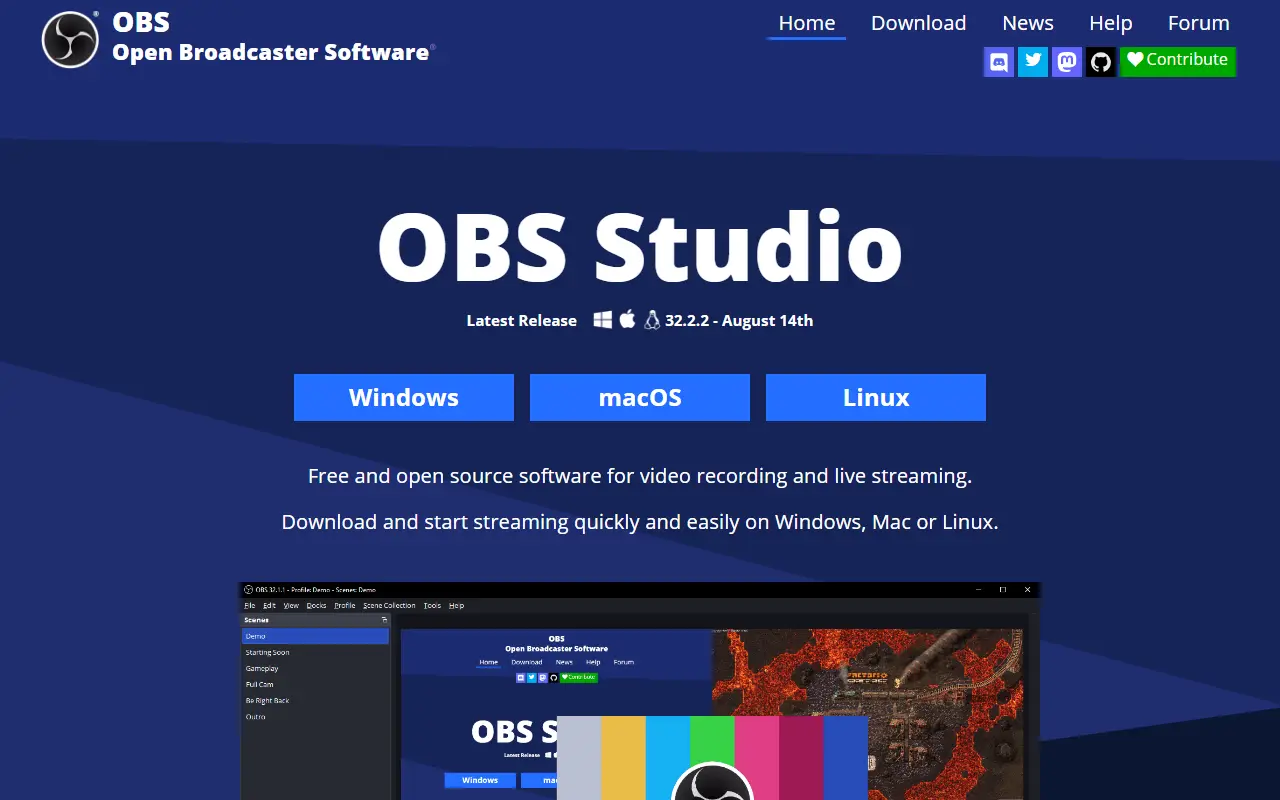
obsproject.comOBS Studio homepage screenshot

OBS Studio, from the Open Broadcaster Software project, is a free, open-source application for recording video and streaming live. It runs on Windows 10 and 11, recent macOS versions and Linux, and it is written mainly in C and C++ under the GPL-2.0 license.

Content is composed as scenes built from multiple sources, such as window captures, images, text, browser windows, webcams and capture cards. You can create as many scenes as you need and switch between them with customizable transitions. An audio mixer provides per-source filters like noise gate, noise suppression and gain, and VST plugins are supported. A modular dock-based interface can be rearranged, and individual docks can be popped out into separate windows.

OBS can stream to Twitch, YouTube and other providers, or record to local files using H.264 video and AAC audio. The project is funded through sponsors and backers. It suits streamers, educators, gamers and anyone producing tutorials or presentations who needs flexible capture and mixing without a license fee.

Key features

  • Real-time video and audio capture and mixing
  • Scenes combining windows, webcams, images and text
  • Custom transitions between scenes
  • Audio mixer with noise suppression and gain
  • VST plugin support
  • Streaming to Twitch, YouTube and other services
  • Recording with H.264 and AAC encoding

Pricing: Free and open source under the GPL-2.0 license.

MediaMTX

MediaMTX is a zero-dependency live media server and proxy that routes real-time audio and video streams between protocols such as RTSP, RTMP, SRT and WebRTC.

GitHub stars
21k
Last commit
yesterday
Latest release
v1.21.3
Licence
MIT
Self-hosted
Yes
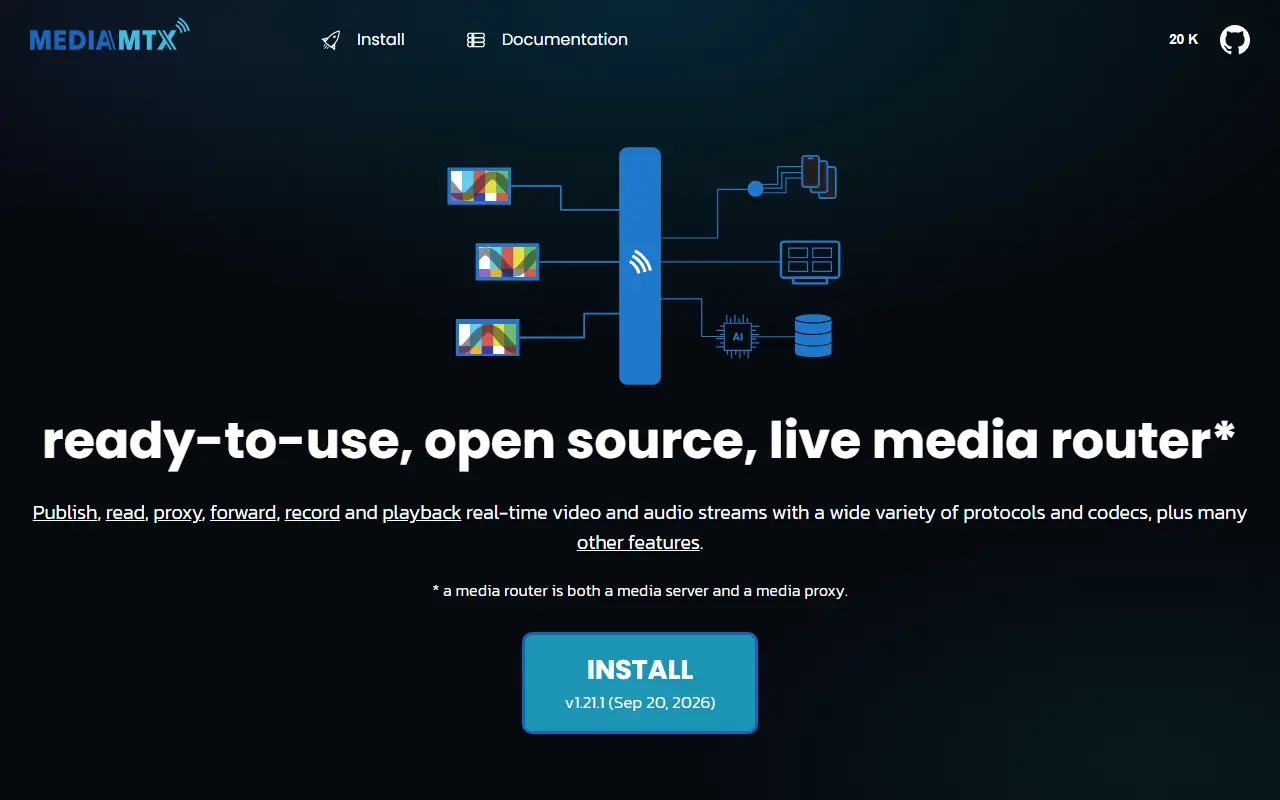
mediamtx.orgMediaMTX homepage screenshot

MediaMTX is a live media server and media proxy that publishes, reads, proxies, records and plays back real-time video and audio streams. It acts as a media router, taking a stream from one end and delivering it to the other, with an emphasis on efficiency and portability.

Streams can be published over Media-over-QUIC, SRT, WebRTC, RTSP, RTMP, HLS, MPEG-TS or RTP using tools like FFmpeg, GStreamer or OBS Studio, and they are converted automatically between protocols so viewers can read them in a different format. Several streams can run at once on separate paths, and recordings can be written to disk in fMP4 or MPEG-TS and played back later.

Operational features include hot configuration reloading, internal, HTTP or JWT authentication, a control API, Prometheus-compatible metrics, and hooks that run external commands when clients connect or publish. The Go program ships as a single executable for Linux, Windows and macOS and is released under the MIT license, so it can be self-hosted anywhere a binary runs.

Key features

  • Protocol conversion between RTSP, RTMP, SRT and WebRTC
  • Recording to fMP4 or MPEG-TS files
  • Playback of recorded streams
  • Internal, HTTP or JWT authentication
  • Prometheus-compatible metrics and control API
  • Single dependency-free executable

Pricing: Free and open source under the MIT license.

SRS

Simple Realtime Server is a high-performance media server supporting RTMP, WebRTC, HLS, SRT, MPEG-DASH and GB28181 for live streaming and low-latency video.

GitHub stars
29k
Last commit
13 days ago
Latest release
v6.0-r3
Licence
MIT
Self-hosted
Yes
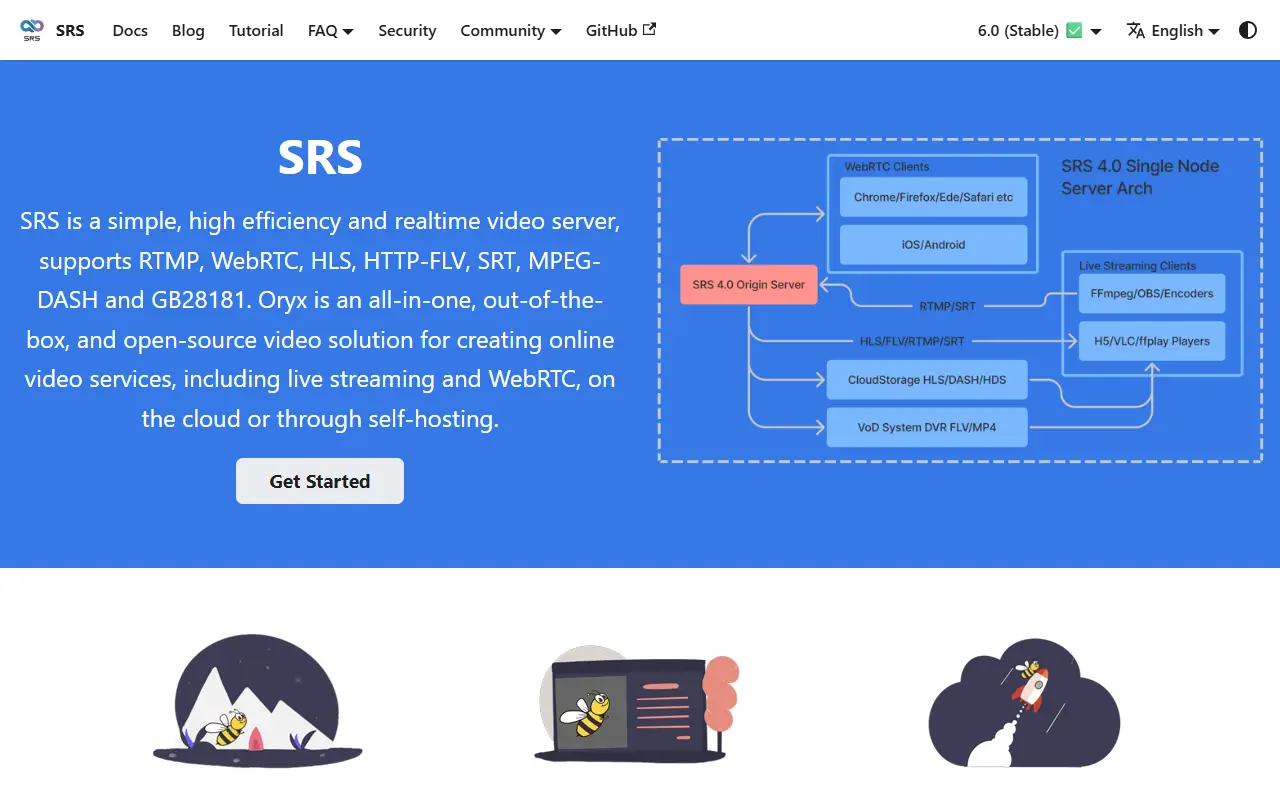
ossrs.ioSRS homepage screenshot

SRS, short for Simple Realtime Server, is an open-source real-time media server for live streaming and video communication. It handles many protocols in one product, among them RTMP, WebRTC, HLS, SRT, HTTP-FLV, MPEG-DASH and the GB28181 surveillance standard, and supports video codecs including H.264, H.265, AV1 and VP9 and audio codecs including AAC, Opus and G.711.

It runs on Linux and macOS across a wide range of processor architectures, from x86-64 and ARM variants to Apple M1, RISC-V, LoongArch and MIPS. The getting-started guide recommends running SRS in Docker, after which you open the local web console on port 8080 and push a stream with FFmpeg or OBS to an RTMP address, then play it back with common players using whichever protocol you prefer. A mirror registry is mentioned for users in China.

SRS is written in C++ and licensed under MIT, though some third-party libraries carry their own licenses. Topics point to low-latency streaming, live broadcasting and video conferencing. It suits teams building live video platforms, surveillance ingest or conferencing backends who want to run their own media server.

Key features

  • RTMP, WebRTC, HLS, HTTP-FLV and SRT support
  • MPEG-DASH and GB28181 support
  • H.264, H.265, AV1 and VP9 codecs
  • Runs on many CPU architectures
  • Docker-based quick start
  • Works with FFmpeg and OBS publishers

Pricing: Free and open source under the MIT license.

Ant Media Server

A scalable media server for live streaming with WebRTC, SRT, RTMP, HLS and CMAF, with SDKs for mobile and web and Community and Enterprise editions.

GitHub stars
4.7k
Last commit
yesterday
Latest release
ams-v3.1.0
Self-hosted
Yes
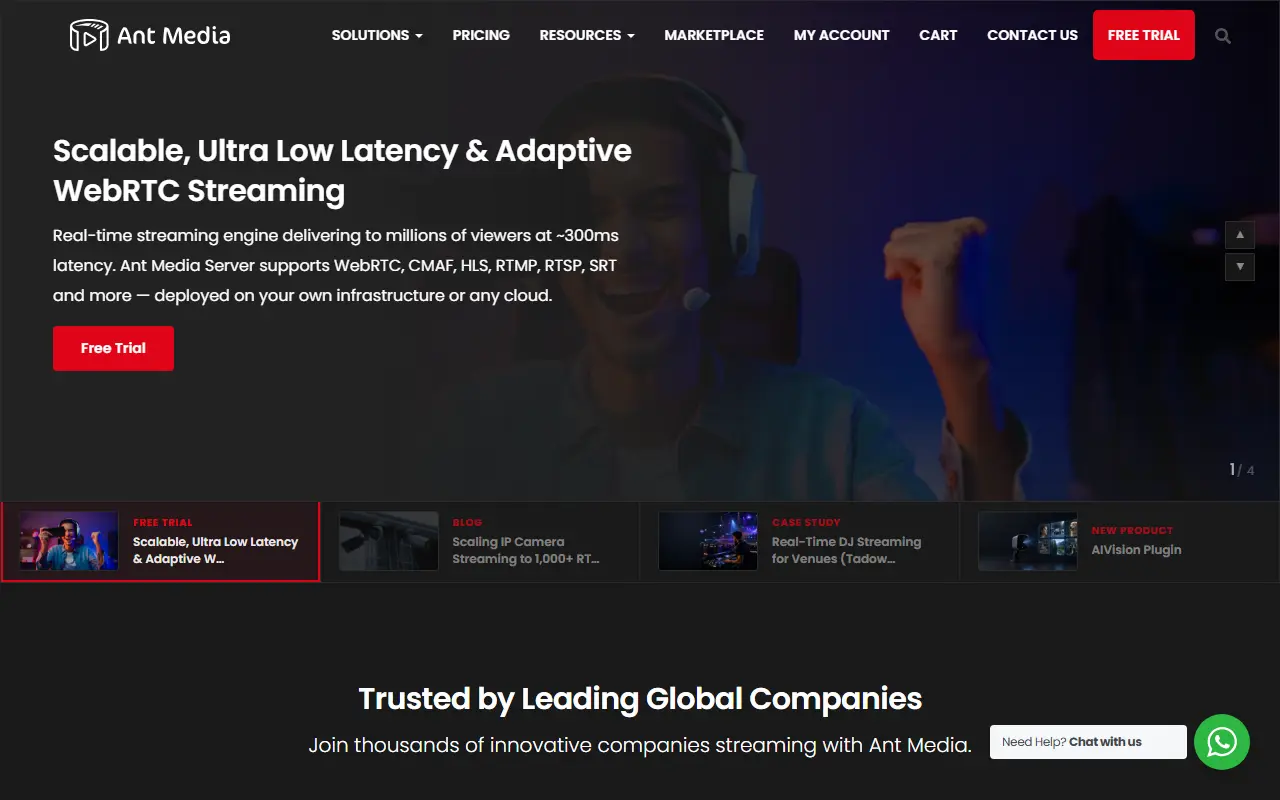
antmedia.ioAnt Media Server homepage screenshot

Ant Media Server is a scalable media server for low-latency live streaming. It supports WebRTC with a claimed latency of about half a second, along with SRT, RTMP, RTSP, HLS and CMAF low-latency HLS, and also handles H.265/HEVC. Developers use it to build real-time video applications and live broadcasting.

Capabilities include adaptive bitrate workflows, transcoding, recording and cloud auto-scaling. SDKs are provided for iOS, Android, React Native, Flutter, Unity and JavaScript, and security features include SSL/TLS, token authentication, IP filtering and watermarking. The README lists use cases such as telehealth, e-learning, sports streaming, auctions and interactive applications.

The project is split into a Community edition with the essentials and an Enterprise edition that adds advanced features and support, and a free trial of the Enterprise edition is offered. It is written in Java, and documentation covers installation, API references and tutorials.

Key features

  • Low-latency WebRTC streaming
  • SRT, RTMP, RTSP and HLS support
  • CMAF and low-latency HLS
  • Adaptive bitrate and transcoding
  • Recording and cloud auto-scaling
  • SDKs for iOS, Android, Flutter and JavaScript
  • Token authentication and IP filtering

Pricing: Self-hosted Enterprise licenses cost $109 per instance per month, $89 on an annual subscription, $0.24 per instance-hour, or $2799 perpetual. Cloud marketplace listings start at $0.33 per hour, with trials.

OvenMediaEngine

OvenMediaEngine is a live streaming server delivering sub-second latency video to large audiences over WebRTC and Low Latency HLS.

GitHub stars
3.3k
Last commit
yesterday
Latest release
v0.21.0
Licence
AGPL-3.0
Self-hosted
Yes
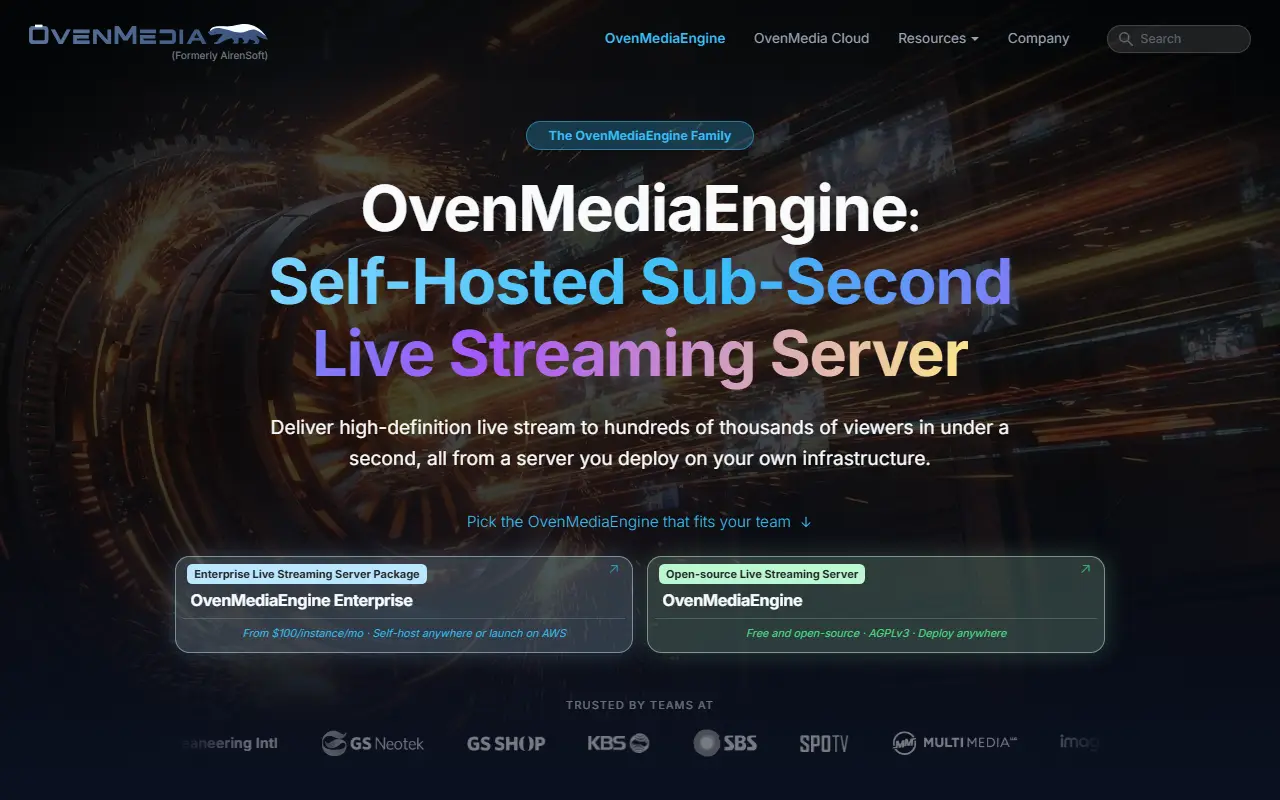
ovenmedia.comOvenMediaEngine homepage screenshot

OvenMediaEngine, or OME, is a streaming server built for live video with sub-second latency. It can deliver high-definition streams to very large audiences using Low Latency HLS and WebRTC. The project also lists a hosted demo service, OvenSpace, built with OvenMediaEngine, OvenPlayer and OvenLiveKit, with its source available for implementation examples.

On the input side, OME accepts pushed streams over WebRTC, WHIP, SRT, RTMP, Enhanced RTMP and MPEG-2 TS over UDP, and it can pull streams over RTSP and OVT. An embedded live transcoder produces adaptive bitrate renditions with codecs including VP8, H.264, AV1 and, with hardware, H.265. Viewers receive output over LLHLS and WebRTC, and legacy HLS and SRT output are also supported.

Further capabilities include scheduled channels for pre-recorded live programming, multiplex channels, DVR-style live rewind, dumping streams for video on demand, timed ID3v2 metadata, WebVTT subtitles and DRM with Widevine, FairPlay and PlayReady. An embedded TURN server and WebSocket signalling server support WebRTC. It is written in C++ and licensed under AGPL-3.0.

Key features

  • Sub-second latency over WebRTC and LLHLS
  • Ingest via WebRTC, WHIP, SRT, RTMP and RTSP
  • Embedded adaptive bitrate live transcoder
  • DVR live rewind and dump for video on demand
  • DRM with Widevine, FairPlay and PlayReady
  • Embedded TURN and signalling server for WebRTC
  • Scheduled and multiplex channels

Pricing: The open-source engine is free under AGPLv3. Enterprise costs $100 per instance per month, $1,000 per instance per year, or $2,500 perpetual; on AWS Marketplace it is $0.19 per instance-hour after a 14-day trial.

Go Livepeer

Livepeer is an open video infrastructure that enables video generation, transformation, and interpretation on a permissionless GPU network for AI video inference.

GitHub stars
587
Last commit
3 days ago
Latest release
v0.10.0
Licence
MIT
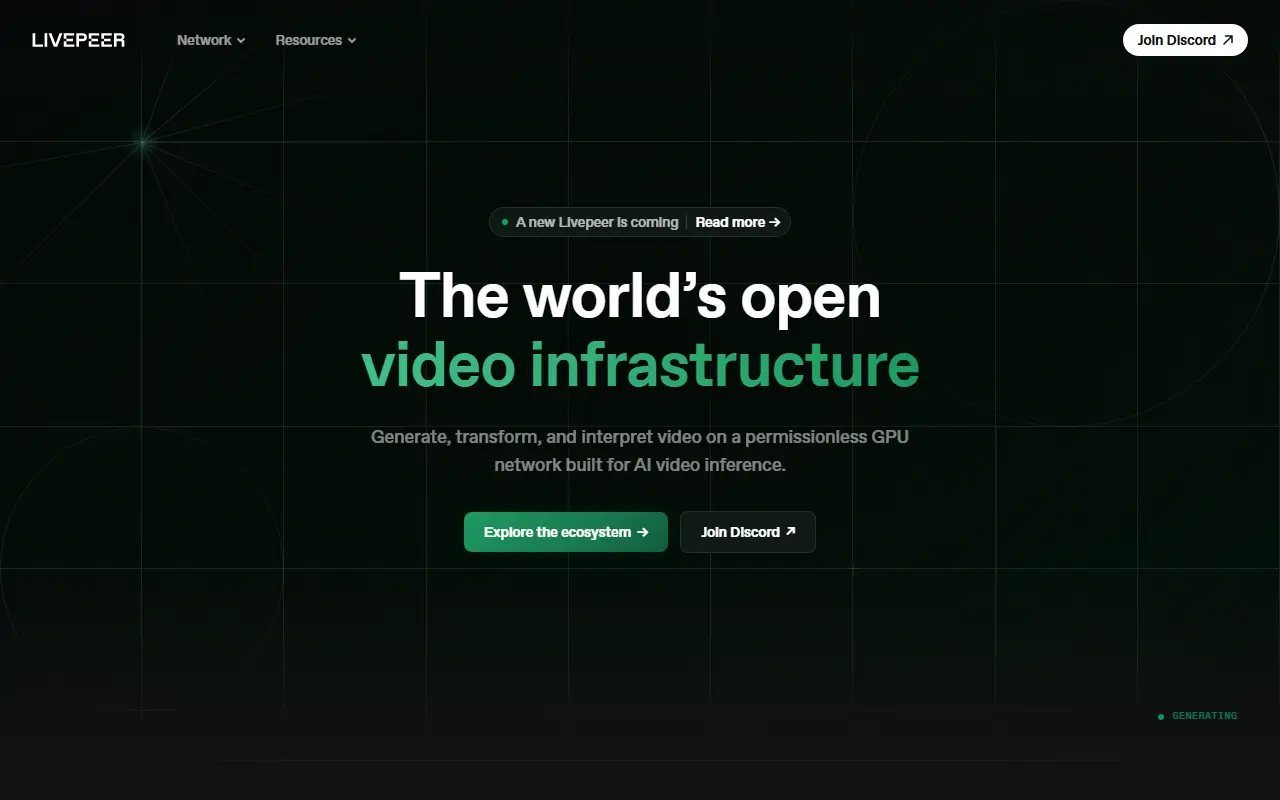
livepeer.orgGo Livepeer homepage screenshot

Livepeer is described as the world's open video infrastructure. It is a global network of independent GPU providers, builders, and engineers who run the network and shape its direction. The network is open-source and permissionless.

The platform is built for AI video inference, allowing users to generate, transform, and interpret video. It supports applications ranging from real-time AI video and AI avatars to transcoding and streaming. The ecosystem includes various applications and emerging capabilities.

Key features

  • Permissionless GPU network for AI video inference
  • Open-source and permissionless network
  • Supports real-time generative AI video
  • Provides an open streaming stack for live video
  • Acts as a video layer for decentralized social
  • Includes an open-source MCP connector for AI agent workflows

Commercial Wowza alternatives

Hosted, closed-source products that compete with Wowza. Showing 12 of 24.

See every Wowza alternative on its tool page

Wowza alternatives: questions

What is the best open-source alternative to Wowza?
FFmpeg is the top-ranked open-source alternative to Wowza on Enlisted: A collection of open-source libraries and command-line tools for processing audio, video, subtitles and related metadata, including converting and streaming media. Other strong options are OBS Studio, MediaMTX, SRS and Ant Media Server.
What are the best commercial alternatives to Wowza?
Castr, Dacast, JW Player, Mux and Restream are among the hosted, closed-source alternatives to Wowza listed on Enlisted, which lists 24 in total. Compare their pricing and features on each tool page.
Are these Wowza alternatives free?
All 7 are open source, so the code is free to use under its licence, and all of them can be self-hosted on your own server or computer.
How is this list of Wowza alternatives ranked?
By a score built from GitHub stars, star growth over the last 30 days and how recently the code changed. 7 of these projects shipped code in the last 30 days. Data is refreshed daily, and nobody can pay to move up.

People also look for alternatives to…

View all