
About Robusta
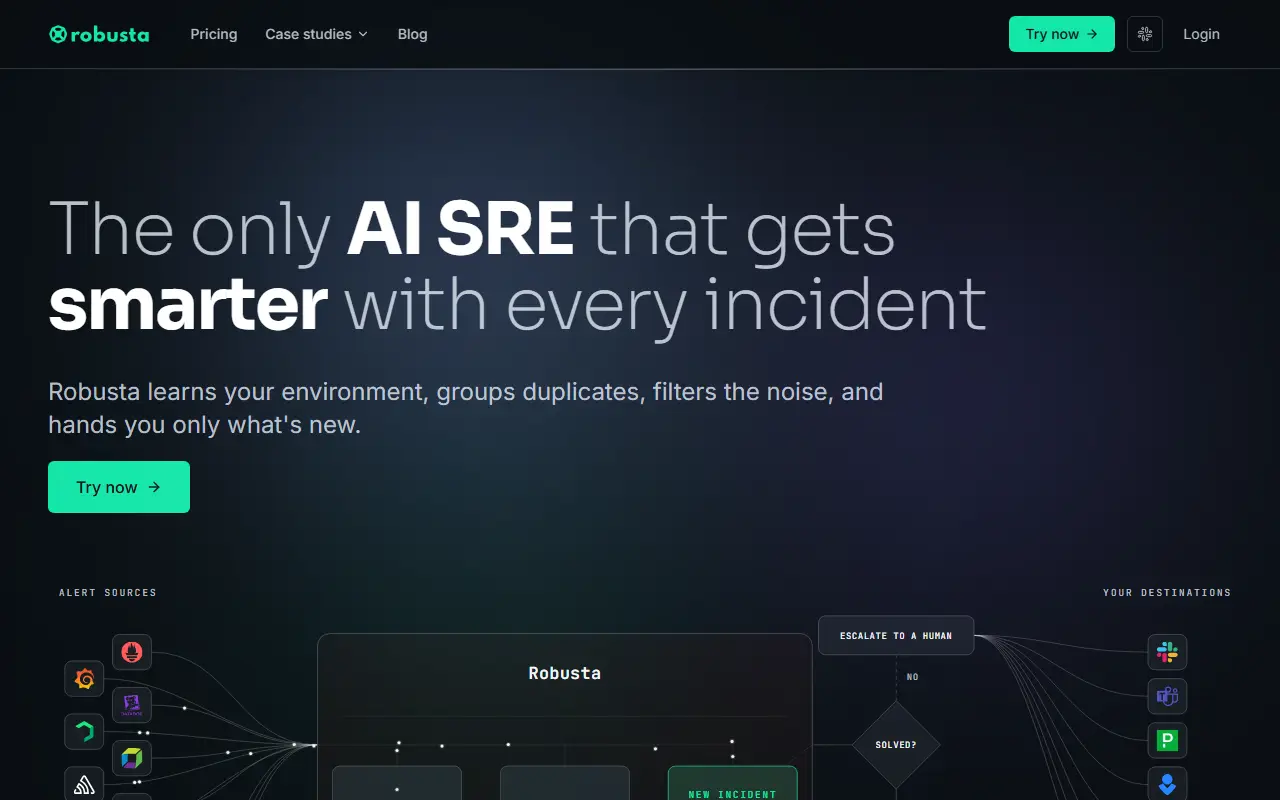
Robusta, in this repository called Robusta Classic, is a rule-based alert enrichment engine for Kubernetes. It connects to Prometheus through a webhook and improves the alerts your team receives by attaching relevant data, such as pod logs, directly to notifications. It is released under the MIT license and works with kube-prometheus-stack and the Prometheus Operator.
Features include smart grouping that reduces notification spam by using Slack threads, self-healing rules that trigger automatic remediation, advanced routing by team or namespace, problem detection that creates Kubernetes-native alerts such as OOMKills and failing Jobs without writing PromQL, and change tracking to correlate alerts with rollouts. Alerts can auto-resolve in external systems such as Jira, and an optional AI investigation can start analysis.
Robusta integrates with Slack, Microsoft Teams, Jira, and many other destinations, and it can run without Prometheus or alongside an all-in-one observability stack that includes it. AI-powered root cause analysis lives in the separate HolmesGPT project. It suits DevOps and SRE teams that want less noisy, more actionable Kubernetes alerts.
Key features
- Alert enrichment with pod logs and context
- Smart grouping of notifications into Slack threads
- Self-healing automatic remediation rules
- Routing by team, namespace, and more
- Kubernetes-native problem detection without PromQL
- Change tracking for resource rollouts
- Slack, Teams, and Jira integrations
Good fit for
- →Cutting alert noise for Kubernetes on-call teams
- →Automating first-response remediation steps
- Tags
- kubernetes
- prometheus
- alerting
- devops
- sre
- slack
- remediation
- observability
Robusta: questions and answers
- What is Robusta used for?
- Robusta: Enriches Prometheus alerts for Kubernetes with logs and context, groups noisy notifications, and can run automatic remediation or AI investigation. It is a good fit for cutting alert noise for Kubernetes on-call teams and automating first-response remediation steps.
- Is Robusta open source?
- Yes. Robusta is open source under the MIT licence. Its source code is on GitHub at robusta-dev/robusta and is written mainly in Python.
- Is Robusta free?
- Yes. Robusta is open source, so the software itself is free to use. A managed cloud version is also available.
- Can I self-host Robusta?
- Yes. Robusta can be self-hosted on your own server or infrastructure.
- What are some alternatives to Robusta?
- Similar open-source tools in the Monitoring & Observability category include Karma, Sloth and Netdata. SaaS products in the same category include Chronosphere, PagerDuty and Rootly.
- Is Robusta actively maintained?
- Yes. The most recent commit to Robusta was on 1 October 2026, and the latest release is 0.50.0, published on 16 September 2026. The project has 3.1k stars on GitHub.
Open-source alternatives to Robusta
See all
Karma
Monitoring & Observability
Alert dashboard for Prometheus Alertmanager
Apache-2.0★ 2.7k
Sloth
Monitoring & Observability
🦥 Easy and simple Prometheus SLO (service level objectives) generator
Apache-2.0★ 2.6k
Netdata
Monitoring & Observability
The fastest path to AI-powered full stack observability, even for lean teams.
GPL-3.0vs Datadog★ 81k
Prometheus Operator
Monitoring & Observability
Prometheus Operator creates/configures/manages Prometheus clusters atop Kubernetes
Apache-2.0★ 10k
Grafana
Monitoring & Observability
The open and composable observability and data visualization platform. Visualize metrics,
AGPL-3.0vs Datadog★ 77k
Prometheus
Monitoring & Observability
The Prometheus monitoring system and time series database.
Apache-2.0vs Datadog★ 66k
SaaS alternatives to Robusta
See all
Chronosphere
Monitoring & Observability
Cloud-native observability platform for metrics, traces and logs with cost controls
SaaS
PagerDuty
Monitoring & Observability
Incident response and on-call management platform with alerting and runbooks
SaaS
Rootly
Monitoring & Observability
Slack-based incident management and on-call platform
SaaS
xMatters
Monitoring & Observability
Incident response and service reliability platform for alerting and workflow automation
SaaS
FireHydrant
Monitoring & Observability
Incident management with runbooks, retrospectives and a service catalog
SaaS
Groundcover
Monitoring & Observability
eBPF-based observability that keeps collected data inside the customer's cloud
SaaS