About Password Pusher
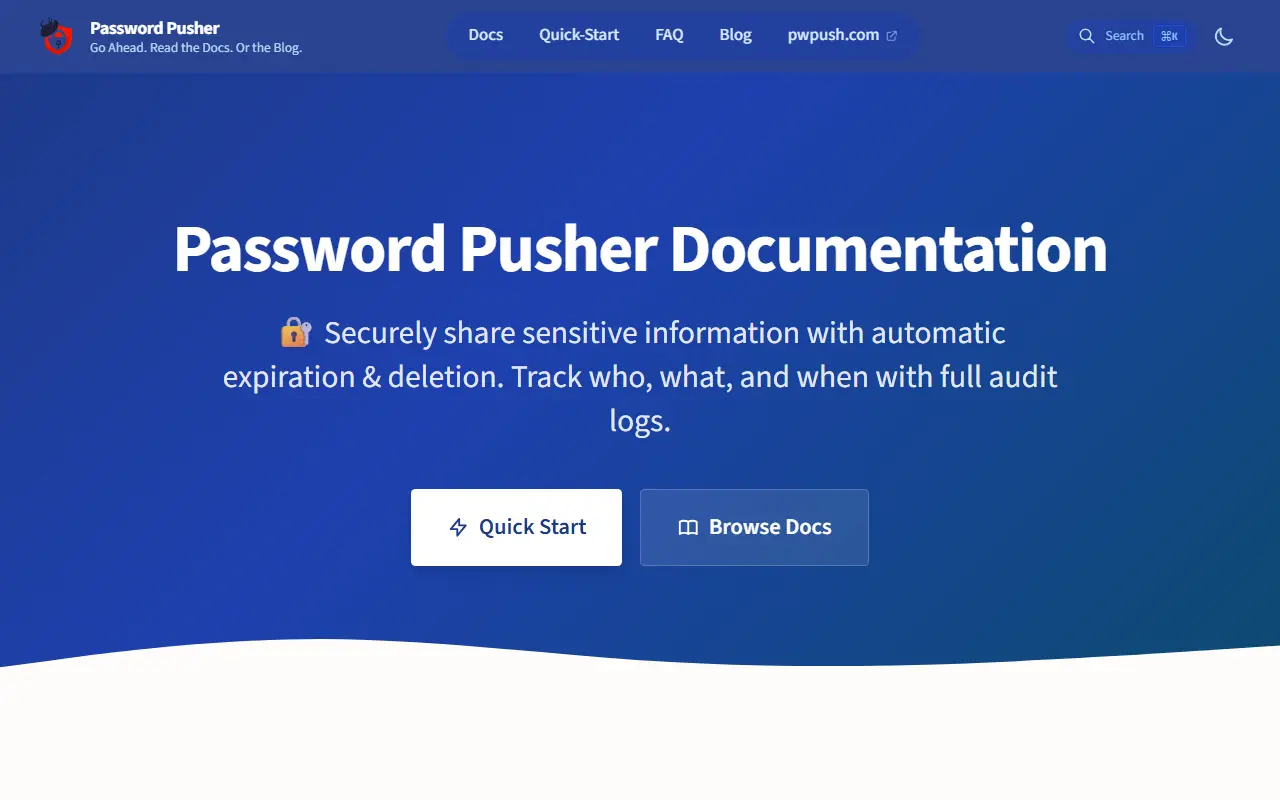
Password Pusher is an open-source web application for sending sensitive information without leaving it in chat or email history. You push a password, note, file, or URL, and the recipient receives a link that expires after a set number of views, a set time, or both. Once expired, the data is removed entirely. The project is released under the Apache-2.0 license.
Content is stored encrypted, links can be protected with an optional passphrase, and a full audit trail records when links were created and viewed, including by whom when logins are used. For teams, there is a JSON API, an official command-line tool and Chrome extension, many integrations, 31 languages, and light and dark themes.
You can use the hosted service at pwpush.com or run your own instance with Docker, Kubernetes, Helm, or on a cloud platform. A major 2.0 release introduced upgrade notes for existing self-hosters. It suits IT teams, managed service providers, and support staff who need to share credentials with customers or colleagues more safely.
Key features
- Self-deleting links with view and time limits
- Passwords, text, files, and URLs supported
- Optional passphrase protection
- Audit log of link creation and views
- JSON API, CLI, and Chrome extension
- Docker, Kubernetes, and Helm deployment
Good fit for
- →Sending credentials to customers safely
- →Sharing secrets between team members without chat history
- Built with
- Ruby
- Tags
- password-sharing
- security
- secrets
- encryption
- file-sharing
- audit-log
- self-hosted
- ruby
Password Pusher: questions and answers
- What is Password Pusher used for?
- Password Pusher is a web app for sharing passwords, notes, files, and URLs through one-time links that expire after a set number of views or time, with audit logs. It is a good fit for sending credentials to customers safely and sharing secrets between team members without chat history.
- Is Password Pusher open source?
- Yes. Password Pusher is open source under the Apache-2.0 licence. Its source code is on GitHub at pglombardo/PasswordPusher and is written mainly in Ruby.
- Is Password Pusher free?
- Yes. Password Pusher is open source, so the software itself is free to use. A managed cloud version is also available.
- Can I self-host Password Pusher?
- Yes. Password Pusher can be self-hosted on your own server or infrastructure.
- What are some alternatives to Password Pusher?
- Similar open-source tools in the Security category include Onetime Secret, Cryptgeon and OpenBao. SaaS products in the same category include BurnLinks, GitGuardian and Abnormal Security.
- Is Password Pusher actively maintained?
- Yes. The most recent commit to Password Pusher was on 2 October 2026, and the latest release is v2.14.1, published on 28 September 2026. The project has 3.2k stars on GitHub.
Open-source alternatives to Password Pusher
See all
Onetime Secret
Security
Keep passwords and other sensitive information out of your chat logs and inboxes.
MIT★ 3kCryptgeon
Security
cryptgeon is a secure, open source note / file sharing service inspired by PrivNote writte
MIT★ 1.5k
OpenBao
Security
OpenBao is a software solution to manage, store, and distribute sensitive data including s
MPL-2.0vs AWS Secrets Manager★ 8.3k
Cryptomator
Security
Cryptomator for Windows, macOS, and Linux: Secure client-side encryption for your cloud st
GPL-3.0vs Tresorit★ 16k
VeraCrypt
Security
Disk encryption with strong security based on TrueCrypt
OSS★ 12k
Infisical
Security
Infisical is the open-source platform for secrets, certificates, and privileged access man
OSSvs Doppler★ 30k
SaaS alternatives to Password Pusher
See all
BurnLinks
Security
Share text or files through one-time, self-destructing links that vanish once opened
SaaS
GitGuardian
Security
Detects leaked secrets and credentials in code repositories and developer tools
SaaS
Abnormal Security
Security
Behavior-based cloud email security that blocks phishing and account takeover
SaaS
Adverse Monitor
Security
Cyber threat intelligence tool that watches the dark web for incident claims naming your company
SaaS
AgentsAegis
Security
Proxy that injects realistic traps into AI coding assistant workflows to train safer command use
SaaS
AgentScan
Security
Scans AI coding agent skills for security issues and distributes reviewed workflows for Claude Code and others
SaaS