
About GitGuardian
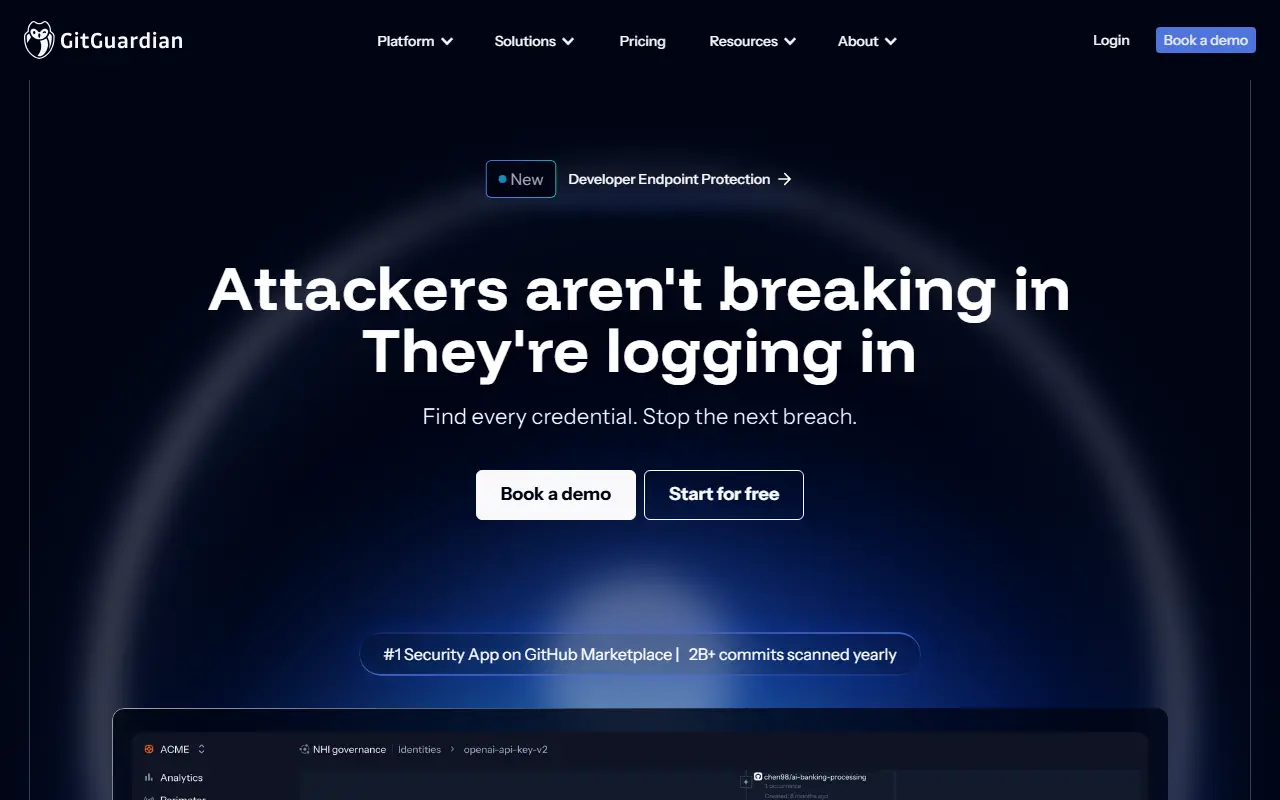
GitGuardian is a commercial platform for finding and managing exposed credentials such as API keys, tokens and passwords. It scans source code repositories and other developer tools for secrets, shows what a leaked credential can reach, and helps teams respond before attackers use it. Its audience includes developers, security engineers, SecOps analysts and identity and access teams.
Capabilities include internal and public secrets monitoring, developer endpoint protection, governance for non-human identities and honeytokens that act as tripwires. The vendor ships a command-line tool called ggshield and a scout tool, publishes detectors and integrations, and provides free utilities such as a GitHub security audit and a service for checking whether a secret has leaked publicly.
GitGuardian is proprietary and, according to its site, can be used either as SaaS or self-hosted. The homepage offers a free start as well as a demo booking, and a separate pricing page describes the available plans.
Key features
- Internal secrets monitoring across repositories
- Public secrets leak monitoring
- ggshield command-line scanning
- Developer endpoint protection
- Honeytokens as breach tripwires
- Governance for non-human identities
Good fit for
- →Preventing API keys from reaching Git history
- →Auditing a company's secrets sprawl
- Tags
- security
- secrets-detection
- devsecops
- appsec
- credentials
- self-hosted
- saas
GitGuardian: questions and answers
- What is GitGuardian used for?
- GitGuardian is a credential security platform that finds leaked secrets in code repositories and developer tools, available as SaaS or self-hosted. It is a good fit for preventing API keys from reaching Git history and auditing a company's secrets sprawl.
- Is GitGuardian free?
- Yes. GitGuardian has a free plan. Free Starter plan for up to 25 developers. Growth and Enterprise plans are quoted through sales, and Enterprise includes self-hosted deployment.
- Is GitGuardian open source?
- No. GitGuardian is proprietary (closed-source) software. Open-source alternatives to GitGuardian include TruffleHog, Infisical and Gitleaks.
- Can I self-host GitGuardian?
- Yes. Although GitGuardian is closed source, it can be self-hosted on your own servers, and the vendor also offers a hosted version.
- What are some alternatives to GitGuardian?
- GitGuardian competes with Snyk, Aikido Security and Checkmarx. For open-source options, see Enlisted's ranked list of open-source GitGuardian alternatives.
Open-source alternatives to GitGuardian
See all
TruffleHog
Security
Find, verify, and analyze leaked credentials
AGPL-3.0vs GitGuardian★ 28k
Infisical
Security
Infisical is the open-source platform for secrets, certificates, and privileged access man
OSSvs Doppler★ 30k
Gitleaks
Security
Find secrets with Gitleaks 🔑
MITvs GitGuardian★ 30k
Trivy
Security
Find vulnerabilities, misconfigurations, secrets, SBOM in containers, Kubernetes, code rep
Apache-2.0vs Snyk★ 38k
DefectDojo
Security
Open-Source Unified Vulnerability Management, DevSecOps & ASPM
BSD-3-Clausevs Tenable★ 5k
SafeLine
Security
CyberServal open-source WAF is a self-hosted WAF with 20.9K GitHub stars. Block SQL inject
GPL-3.0vs Cloudflare★ 23k
SaaS alternatives to GitGuardian
See all
Snyk
Security
Developer security platform that scans code, dependencies, containers and IaC
SaaS
Aikido Security
Security
All-in-one application security platform for code, cloud and runtime scanning
SaaS
Checkmarx
Security
Application security testing platform with SAST, SCA and API security
SaaSBeesecure
Security
Security scanning platform that finds vulnerabilities in codebases for developers and indie hackers
SaaS
Socket
Security
Supply chain security that detects risky open source packages before install
SaaSVeracode
Security
Application security testing platform covering static, dynamic and software composition
SaaS