#1
Gitleaks is a command-line scanner that finds hardcoded passwords, API keys and tokens in git repositories, files and piped input.
- GitHub stars
- 31k
- Last commit
- 16 days ago
- Latest release
- v8.30.1
- Licence
- MIT
gitleaks.io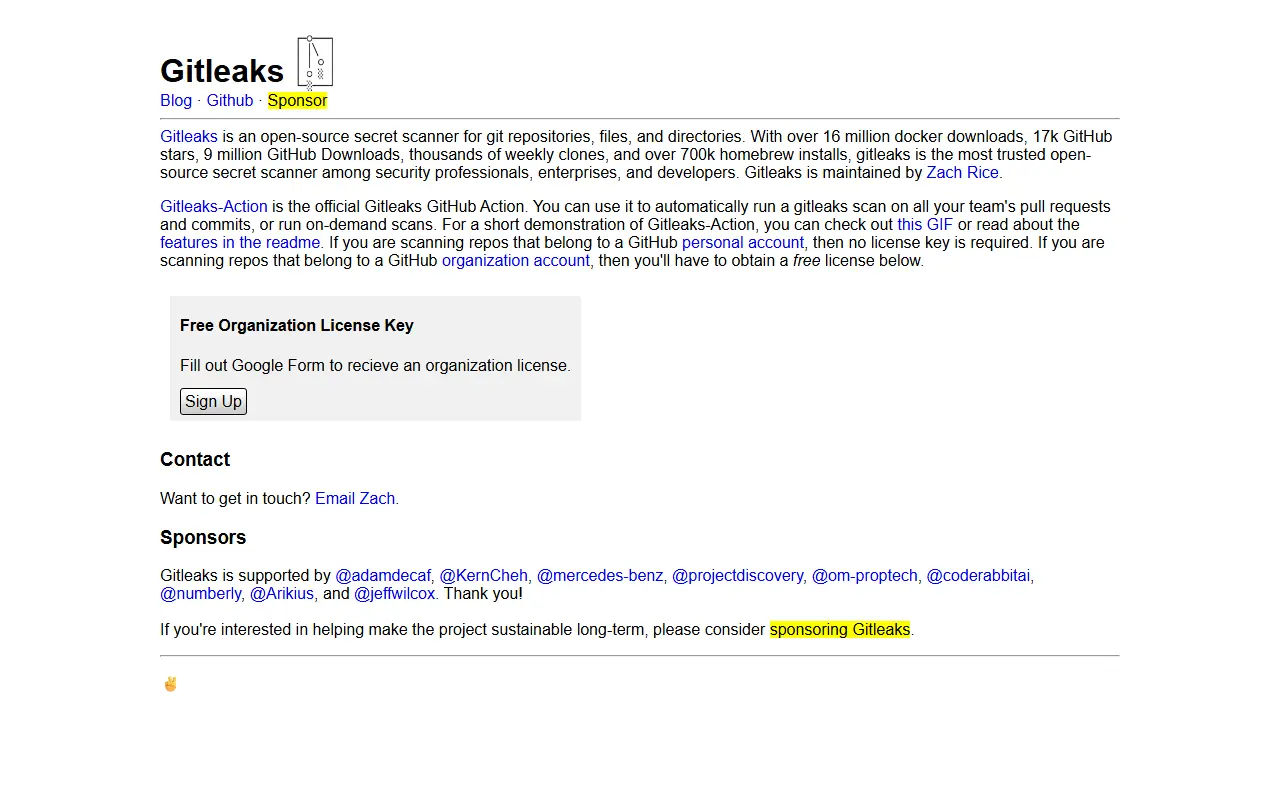
Gitleaks is a tool for detecting secrets such as passwords, API keys and tokens in git repositories, in files, and in anything you pipe to it through standard input. It is written in Go, released under the MIT license, and aimed at DevSecOps, CI/CD and data-loss-prevention use. A maintainer warning in the README says it is feature complete, that future releases will be security patches only, and that the author is shifting focus to a successor project called Betterleaks.
Gitleaks can be installed with Homebrew, Docker or Go, and binaries for many platforms are on the releases page. It can run as a pre-commit hook and has a GitHub Action for CI use. The detection engine is built on regular expressions, and the author has written about how that approach works. It does not need a hosted service, because scans run wherever you execute the binary, including in CI pipelines.
Key features
- Scans git history, files and stdin
- Detects passwords, API keys and tokens
- Runs as a pre-commit hook
- GitHub Action for CI scanning
- Install via Homebrew, Docker or Go
- Maintenance now limited to security patches
Pricing: Free and open source under the MIT license.
#2
A security scanner that finds vulnerabilities, misconfigurations, secrets and license issues in container images, filesystems, Git repositories and Kubernetes.
- GitHub stars
- 39k
- Last commit
- yesterday
- Latest release
- v0.76.2
- Licence
- Apache-2.0
trivy.dev
Trivy is a security scanner from Aquasec, written in Go and released under the Apache-2.0 license. It has scanners that look for different security issues and targets where those issues can be found. The README describes it as comprehensive and versatile, and it covers the major programming languages, operating systems and platforms.
Targets include container images, filesystems, remote Git repositories, virtual machine images and Kubernetes. Scanners look for OS packages and software dependencies in use, which produces an SBOM, known vulnerabilities (CVEs), infrastructure-as-code issues and misconfigurations, sensitive information and secrets, and software licenses. Its topics reference DevSecOps and vulnerability scanning.
Trivy is available through most common channels, including Homebrew, a Docker image and downloadable binaries, and integrates with platforms such as GitHub Actions, a Kubernetes operator and a VS Code plugin. Canary builds are produced with each push to the main branch. It suits developers, platform teams and security engineers who want to scan images and code in CI pipelines.
Key features
- Scans container images and filesystems
- Scans Git repositories and Kubernetes
- Known vulnerability (CVE) detection
- IaC misconfiguration and secret detection
- SBOM generation and license scanning
- GitHub Actions and VS Code integrations
Pricing: Free and open source under the Apache-2.0 license.
#3
TruffleHog finds, classifies and verifies leaked credentials across Git, chats, wikis, logs, filesystems and cloud storage.
- GitHub stars
- 29k
- Last commit
- yesterday
- Latest release
- v3.99.8
- Licence
- AGPL-3.0
- Self-hosted
- Yes
trufflesecurity.com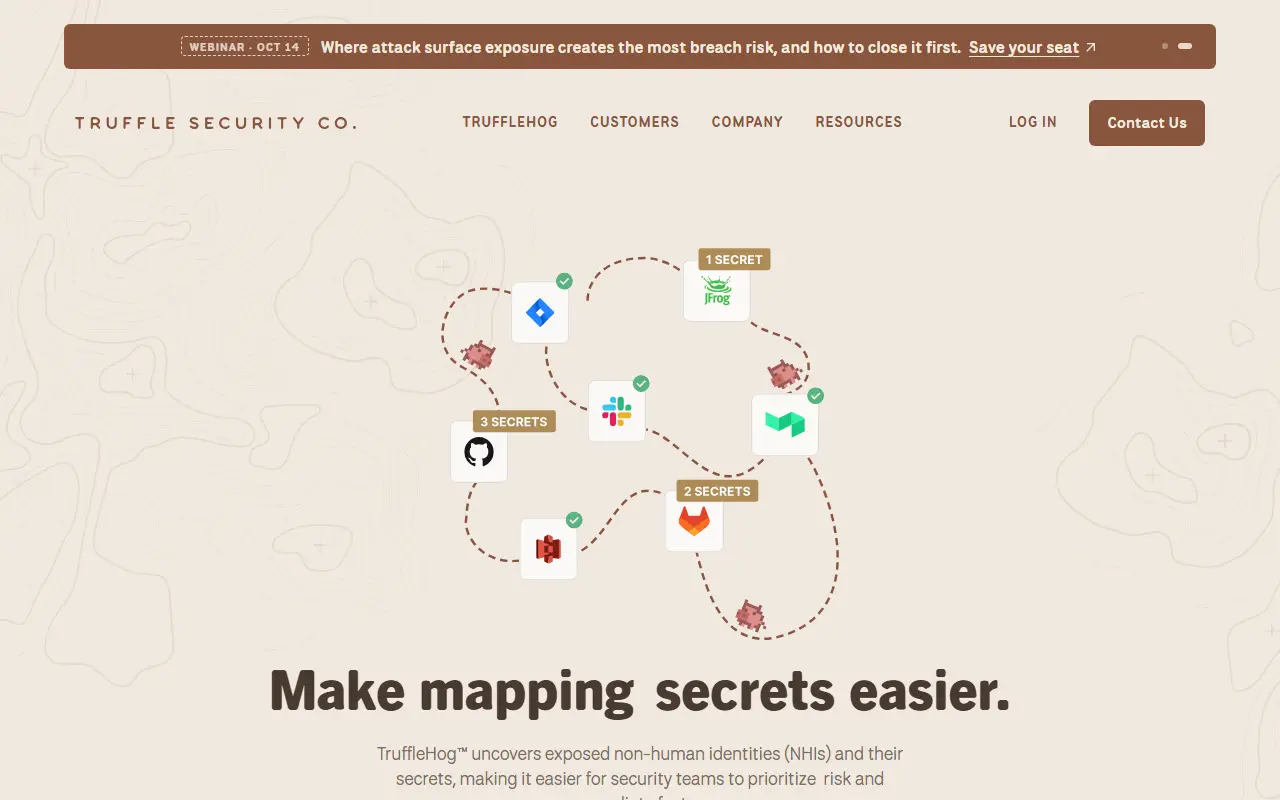
TruffleHog is a tool for discovering, classifying, validating and analyzing secrets, meaning credentials a machine uses to authenticate to another machine, such as API keys, database passwords and private keys. It is written in Go and released under the AGPL-3.0 license. It can be used from the command line and in pre-commit and CI scans as part of DevSecOps work.
Discovery reaches into Git repositories, chat tools, wikis, log files, API testing platforms, object stores and filesystems. Classification identifies more than 800 secret types and maps each to the identity it belongs to. Validation attempts to log in with the found secret to confirm whether it is still live, and analysis for roughly twenty common credential types sends further requests to learn who created the secret and what it can access. Truffle Security also sells an enterprise product that monitors systems such as Git, Jira, Slack and Confluence.
Key features
- Scans Git, chats, wikis, logs and filesystems
- Classifies over 800 secret types
- Validates whether a found secret is live
- Analyzes permissions of common credential types
- Runs from the CLI and in pre-commit checks
- Enterprise monitoring product available separately
Pricing: The open-source edition is free. Enterprise adds a dashboard, integrations, SSO and priority support, with pricing available by contacting the vendor.
#4
Infisical is an open-source platform for managing secrets, certificates and privileged access, with syncing, rotation and leak prevention.
- GitHub stars
- 30k
- Last commit
- yesterday
- Latest release
- v0.167.8
- Self-hosted
- Yes
- Hosted version
- Available
infisical.com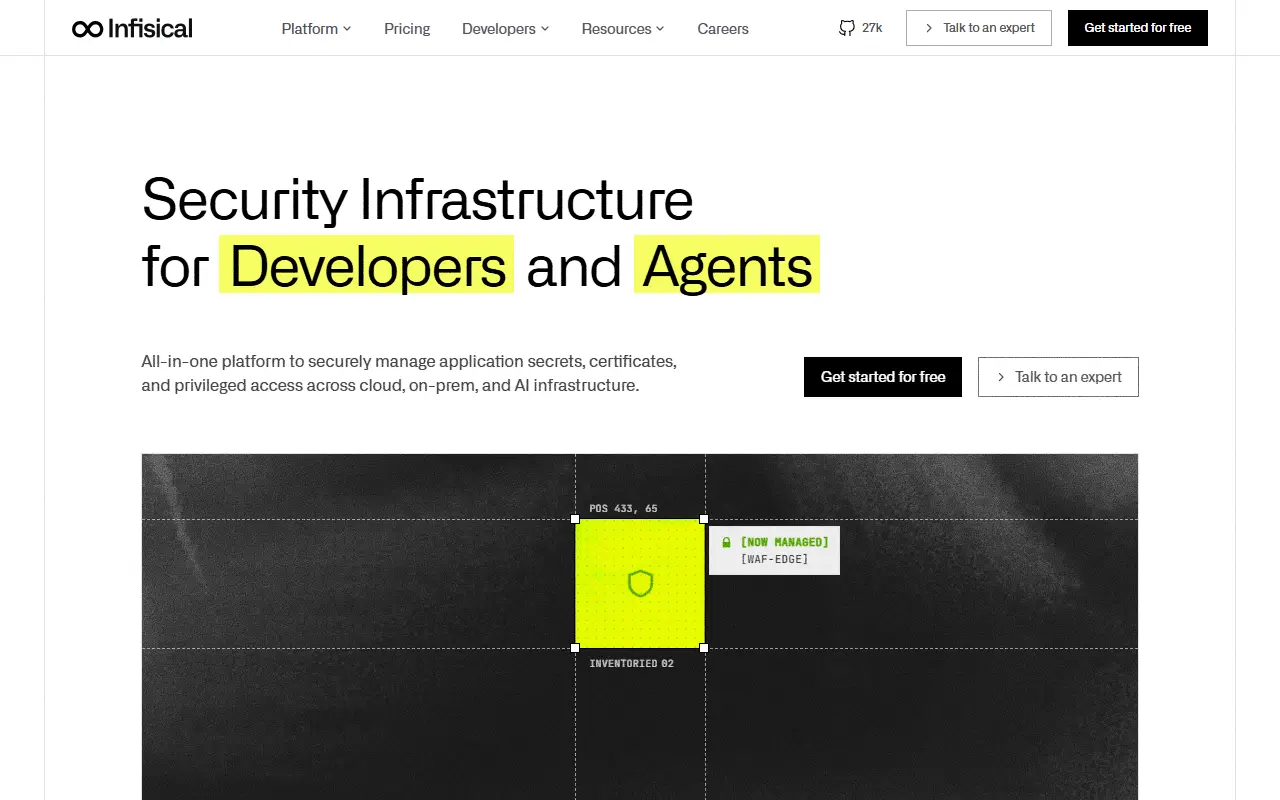
Infisical is an open-source security infrastructure platform used by teams to manage application secrets, certificates and privileged access. It centralizes secrets and configuration across environments, with versioning, rotation and leak prevention. The stack is TypeScript and Go on PostgreSQL, and the project offers both a hosted Infisical Cloud and a self-hosting option.
Secrets are organized by project and environment, such as development and production, in a dashboard. Secret syncs push values to platforms like GitHub, Vercel and AWS and work with tools such as Terraform and Ansible. Further features include point-in-time recovery, scheduled rotation for databases and AWS IAM, ephemeral dynamic secrets, secret scanning that stops leaks into git, a Kubernetes operator, and an agent that injects secrets without code changes. It also offers honey tokens as decoy credentials and brokered access for AI agents. The repository metadata lists the license as Other, so check it for exact terms.
Key features
- Secrets dashboard across projects and environments
- Secret syncs to GitHub, Vercel and AWS
- Versioning with point-in-time recovery
- Automatic secret rotation and dynamic secrets
- Secret scanning to prevent leaks into git
- Kubernetes operator and injection agent
Pricing: Free for up to 5 identities. Pro is $23 and Advanced $46 per identity per month, or $20 and $40 billed annually; Enterprise is custom. Paid plans include a free trial.
#5
Semgrep is a fast, open-source static analysis tool that finds bugs and enforces security and coding standards across 30+ languages.
- GitHub stars
- 18k
- Last commit
- 2 days ago
- Latest release
- v1.185.0
- Licence
- LGPL-2.1
- Self-hosted
- Yes
- Hosted version
- Available
semgrep.dev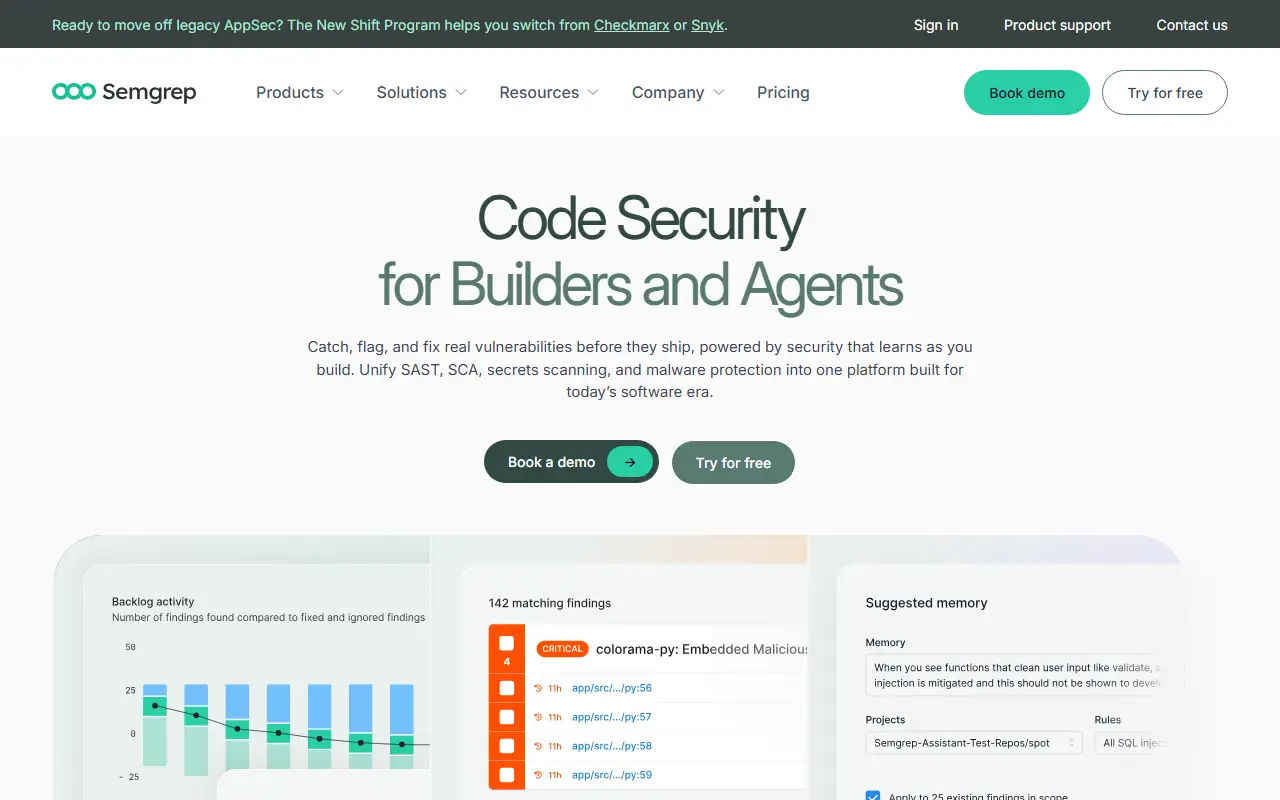
Semgrep is a lightweight static analysis tool that searches code, finds bugs and enforces secure guardrails and coding standards. It supports more than 30 languages and can run in an IDE, as a pre-commit check or inside CI/CD workflows. The core engine is released under the LGPL-2.1 license.
It works like a semantic grep for code. Rules are written to look like the source code developers already write, so matching a pattern does not require abstract syntax trees, regular expressions or a separate query language, and a search for a value can match code that computes it. The aim is to find variants of a known bug quickly.
The Community Edition analyzes code within a single function or file, which the maintainers note means it will miss many true positives for security work. For SAST, software composition analysis and secrets scanning they recommend the commercial Semgrep AppSec Platform, which adds cross-file and data-flow analysis, AI-assisted triage and managed rule sets.
Key features
- Pattern-based code search that looks like code
- Support for 30+ programming languages
- Runs in IDEs, pre-commit hooks and CI/CD
- Custom rules without ASTs or regex
- SAST, SCA and secrets scanning via AppSec Platform
Pricing: Free for up to 10 contributors. Teams starts at $30 per contributor per month (Secrets $15); Enterprise is custom.
#6
Static code analysis platform that finds bugs, vulnerabilities and maintainability problems in code, in IDEs, pull requests and CI.
- GitHub stars
- 11k
- Last commit
- yesterday
- Latest release
- 26.11.0.134175
- Licence
- LGPL-3.0
- Self-hosted
- Yes
sonarqube.org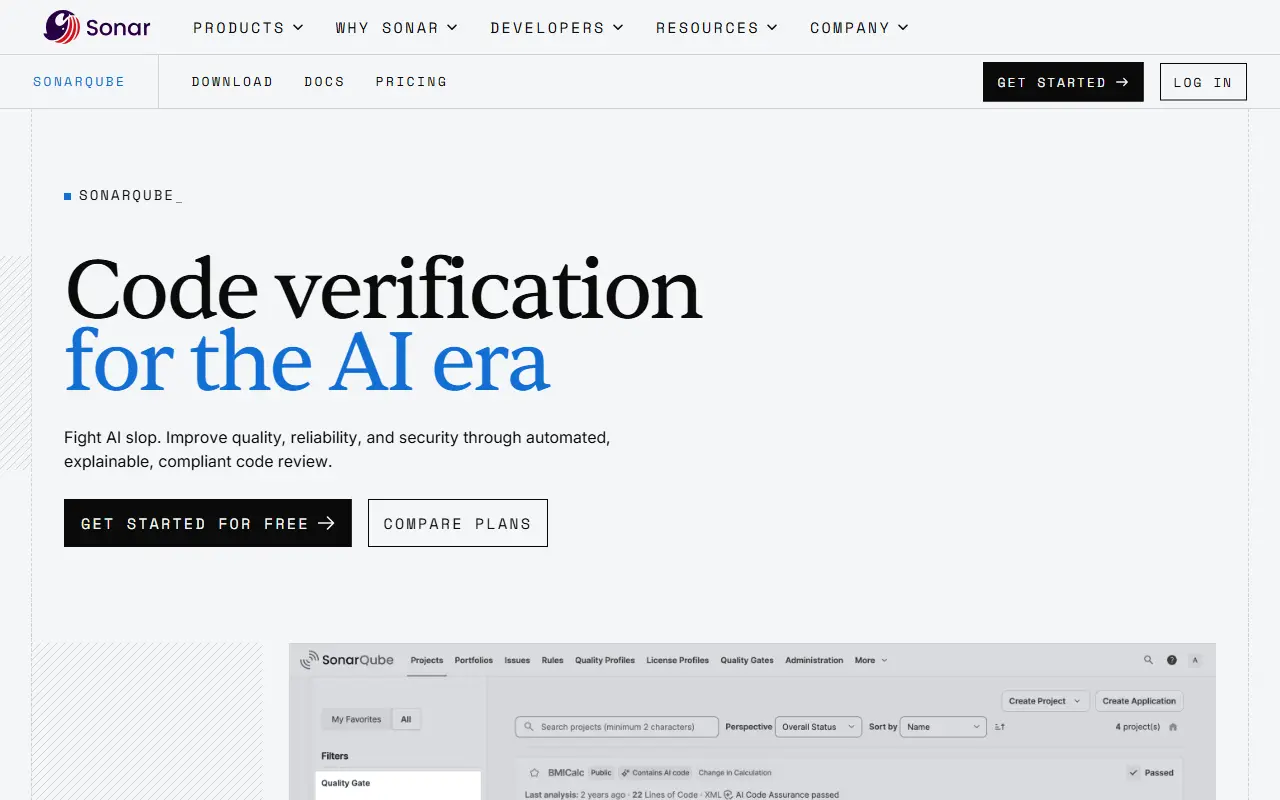
SonarQube is a code quality and security platform. Its static analysis uses techniques such as symbolic execution and data and control flow analysis to inspect source code, find bugs and vulnerabilities, and explain what to fix and why. Results appear in the IDE, in pull requests and in CI pipelines.
This repository holds the source of the SonarQube Community Build, the free, open-source edition that shares the analysis used across the product line. It reports reliability bugs, security vulnerabilities and security hotspots, maintainability and structural issues, and coverage on new code. More than 40 programming languages and frameworks are covered, and the same code always produces the same findings.
The project positions itself as a verification step for code written by people or by AI agents before it merges. SonarQube is written in Java and licensed under LGPL-3.0. Commercial editions from SonarSource add further features, while the Community Build can be run on your own servers.
Key features
- Static analysis for bugs and vulnerabilities
- Security hotspot review guidance
- Maintainability and structural issue detection
- Coverage tracking on new code
- Support for 40+ languages and frameworks
- Feedback in IDE, pull requests and CI
Pricing: A free tier covers private projects up to 50k lines of code and an open-source Community Build is available. The Team plan starts at $34 a month for up to 100k lines of code; Enterprise is quoted.
#7
Checkov scans cloud infrastructure configurations to find misconfigurations before they are deployed.
- GitHub stars
- 9.2k
- Last commit
- yesterday
- Latest release
- 3.4.4
- Licence
- Apache-2.0
checkov.io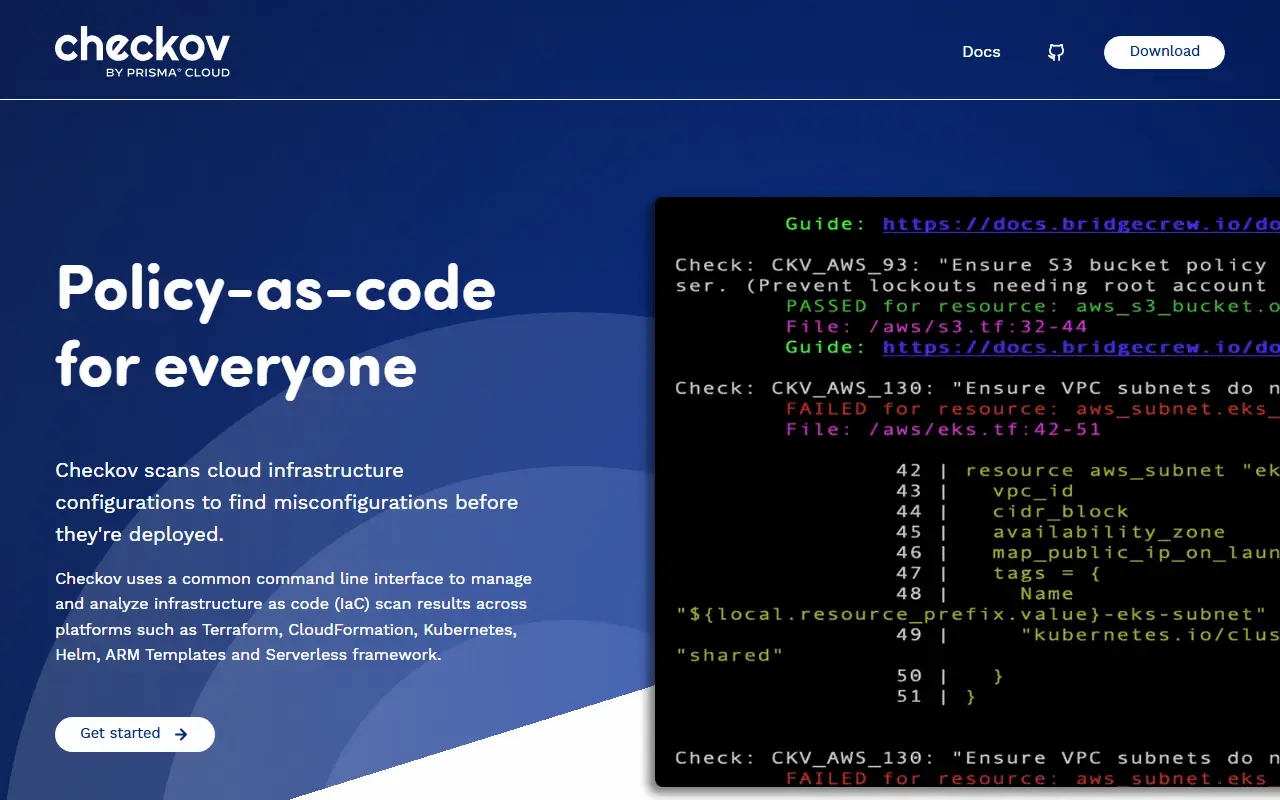
Checkov is a policy-as-code tool that scans cloud infrastructure configurations to find misconfigurations before they are deployed. It uses a common command line interface to manage and analyze infrastructure as code scan results across platforms such as Terraform, CloudFormation, Kubernetes, Helm, ARM Templates, and Serverless framework.
The tool supports attribute-based policies for scanning cloud resources at build-time and graph-based policies for analyzing relationships between cloud resources. It can be integrated into existing developer workflows and CI/CD pipelines to prevent misconfigurations from being deployed.
Key features
- Scans cloud infrastructure configurations for misconfigurations before deployment
- Supports Terraform, CloudFormation, Kubernetes, Helm, ARM Templates, Serverless, and AWS CDK
- Attribute-based policies for scanning cloud resources at build-time
- Graph-based policies for analyzing relationships between cloud resources
- Extensible policy management for custom policies, providers, and suppressions
- Integration with CI/CD and version control systems

KICS scans Infrastructure as Code for security vulnerabilities, compliance issues, and misconfigurations.
- GitHub stars
- 2.7k
- Last commit
- 3 days ago
- Latest release
- v2.2.1
- Licence
- Apache-2.0
- Self-hosted
- Yes
kics.io
KICS is an open source static code analysis tool for Infrastructure as Code. It scans IaC files to find security vulnerabilities, compliance issues, and infrastructure misconfigurations early in the development cycle.
The tool supports multiple IaC platforms including Terraform, Kubernetes, Docker, AWS CloudFormation, Ansible, Helm, and others. It includes over 2400 customizable queries and is designed to be easy to install, run, and integrate into CI pipelines.
Key features
- Scans Infrastructure as Code for security vulnerabilities, compliance issues, and misconfigurations
- Supports Terraform, Kubernetes, Docker, AWS CloudFormation, Ansible, Helm, Google Deployment Manager, AWS SAM, Microsoft ARM, Azure
- Includes over 2400 customizable queries
- Open source scanning engine and queries
- Extensible architecture for adding new IaC support and custom queries
- Easy to integrate into CI pipelines
Commercial GitGuardian alternatives
Hosted, closed-source products that compete with GitGuardian.
GitGuardian alternatives: questions
- What is the best open-source alternative to GitGuardian?
- Gitleaks is the top-ranked open-source alternative to GitGuardian on Enlisted: Gitleaks is a command-line scanner that finds hardcoded passwords, API keys and tokens in git repositories, files and piped input. Other strong options are Trivy, TruffleHog, Infisical and Semgrep.
- What are the best commercial alternatives to GitGuardian?
- Snyk, Beesecure, Black Duck, Aikido Security and Checkmarx are among the hosted, closed-source alternatives to GitGuardian listed on Enlisted, which lists 10 in total. Compare their pricing and features on each tool page.
- Are these GitGuardian alternatives free?
- All 8 are open source, so the code is free to use under its licence, and all of them can be self-hosted on your own server or computer. 2 also offer a paid or managed cloud version if you'd rather not host it yourself.
- How is this list of GitGuardian alternatives ranked?
- By a score built from GitHub stars, star growth over the last 30 days and how recently the code changed. 8 of these projects shipped code in the last 30 days. Data is refreshed daily, and nobody can pay to move up.
 TrackMedia
 TrackRev