 TrackMedia
 TrackRev

 Keyfactor
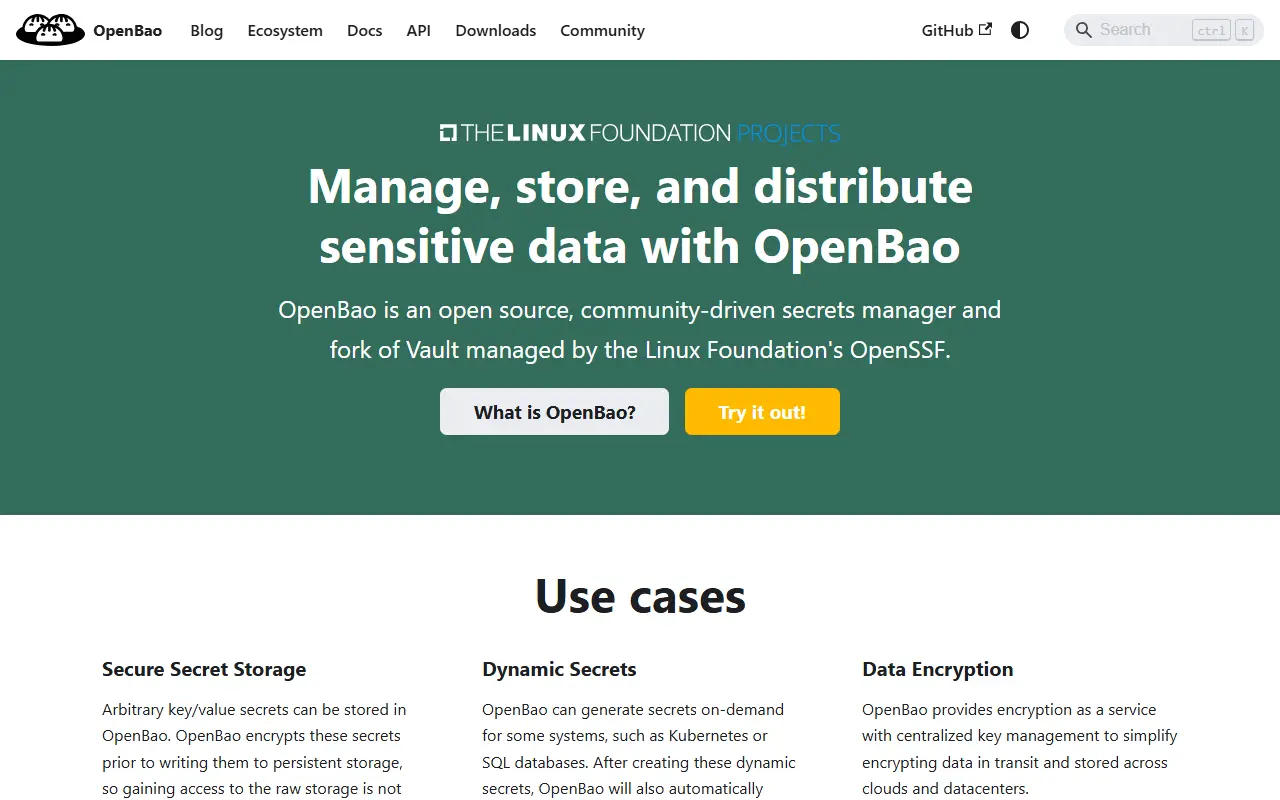
About OpenBao
OpenBao is a software solution for managing, storing and distributing sensitive data such as secrets, certificates and keys. It is a community-led project, run under open-governance principles, that intends to stay available under an OSI-approved open-source licence, currently MPL-2.0.
The README describes the problem it targets: modern systems need many secrets, including database credentials, API keys for external services and credentials for service-to-service communication, and tracking who accesses what is hard without a dedicated tool. OpenBao encrypts key/value secrets before they reach persistent storage, so access to the raw storage alone does not expose them. It can write to disk, PostgreSQL and other backends, and it can generate dynamic secrets on demand for systems such as AWS or SQL databases.
OpenBao is written in Go and is widely known as a fork of HashiCorp Vault, which makes it a candidate for teams looking for an open-governance alternative in that space. It runs on your own infrastructure, and the project coordinates through a mailing list, GitHub Discussions and chat channels, with working groups for areas such as namespaces and the UI.
Key features
- Encrypted key/value secret storage
- Dynamic secrets for AWS and SQL databases
- Multiple storage backends including PostgreSQL
- Certificate and key management
- Audit logging of secret access
- Open-governance community project
Good fit for
- Centralizing application secrets
- Issuing short-lived database credentials
OpenBao: questions and answers
- What is OpenBao used for?
- OpenBao is an open-source, community-governed secrets manager that stores, encrypts and distributes secrets, certificates and keys for modern infrastructure. It is a good fit for centralizing application secrets and issuing short-lived database credentials.
- Is OpenBao open source?
- Yes. OpenBao is open source under the MPL-2.0 licence. Its source code is on GitHub at openbao/openbao and is written mainly in Go.
- Is OpenBao free?
- Yes. OpenBao is open source, so the software itself is free to use.
- Can I self-host OpenBao?
- Yes. OpenBao can be self-hosted on your own server or infrastructure.
- What is OpenBao an alternative to?
- OpenBao is an open-source alternative to AWS Secrets Manager, Azure Key Vault, Akeyless and Doppler. Other open-source alternatives to AWS Secrets Manager include Infisical, Bitwarden and Conjur.
- Is OpenBao actively maintained?
- Yes. The most recent commit to OpenBao was on 12 November 2026, and the latest release is v2.7.2, published on 26 October 2026. The project has 9k stars on GitHub, with 589 added in the last 30 days.
Open-source alternatives to OpenBao
See all
Infisical
Security
Infisical is the open-source platform for secrets, certificates, and privileged access man
OSSvs Doppler★ 30k
Bitwarden
Password Management
Bitwarden infrastructure/backend (API, database, Docker, etc).
OSSvs 1Password★ 21k
Conjur
Password Management
CyberArk Conjur automatically secures secrets used by privileged users and machine identit
OSSvs CyberArk★ 956
External Secrets
Password Management
External Secrets Operator reads information from a third-party service like AWS Secrets Ma
Apache-2.0vs Google Secret Manager★ 6.9k
GitLab Community Edition
CI/CD & DevOps
Open-core GitLab edition you install yourself, with Git hosting, CI/CD and issue tracking
MITvs GitHub★ 25k
Kubernetes
Infrastructure & Containers
Production-Grade Container Scheduling and Management
Apache-2.0vs Amazon EKS★ 129k
SaaS alternatives to OpenBao
See all
AWS Secrets Manager
Security
Managed service to store, rotate and retrieve database credentials and API keys
SaaS
Azure Key Vault
Security
Azure service for storing secrets, encryption keys and certificates
SaaS
Akeyless
Security
SaaS secrets management and machine identity platform for apps and pipelines
SaaS
Doppler
Security
Secrets management platform that syncs environment variables across apps and teams
SaaS
CyberArk
Security
Identity security and privileged access management for people, machines and AI agents
SaaS
Google Secret Manager
Security
Google Cloud service for storing and versioning API keys, passwords and certificates
SaaS