7 open-source alternatives ranked by real activity

Open-source AWS Secrets Manager alternatives

A curated, ranked list of the 7 best open-source alternatives to AWS Secrets Manager.

The best open-source alternative to AWS Secrets Manager is Vaultwarden. If that doesn't suit you, other good options are OpenBao, Kubernetes, Infisical and Bitwarden.

Commercial alternatives to AWS Secrets Manager include Doppler, Akeyless, Azure Key Vault and Google Secret Manager. See all 10.

AWS Secrets Manager alternatives are mainly password managers, but some are also security tools and infrastructure & container tools. 6 of them shipped code in the last 30 days, 7 can be self-hosted, and 3 use a permissive licence.

Last updated November 12, 2026 · ranked by GitHub stars, growth and recent commits

Vaultwarden

Vaultwarden is an AGPL-3.0 server written in Rust that implements the Bitwarden client API for self-hosted password vaults.

GitHub stars
71k
Last commit
yesterday
Latest release
1.37.5
Licence
AGPL-3.0
Self-hosted
Yes

Vaultwarden is an alternative server for the Bitwarden Client API, written in Rust and compatible with the official Bitwarden clients. The README positions it for self-hosting where running the official, more resource-heavy service may not suit. It is unofficial and not associated with Bitwarden, and bug reports go to its own maintainers rather than Bitwarden support.

The listed coverage is nearly the whole client API: personal vault, Send, attachments, website icons, a personal API key, organizations with collections, sharing, roles, groups, event logs, policies and the Directory Connector, plus several two-factor methods (authenticator, email, FIDO2 WebAuthn, YubiKey and Duo) and emergency access. An admin backend and a modified web vault are bundled.

The recommended install is the container image from ghcr.io, docker.io or quay.io, run with Docker, Podman or Docker Compose with a data volume mounted for persistence. The web vault needs HTTPS for the Web Crypto API, so a reverse proxy is suggested. Community packages exist, and you can build it yourself.

Key features

  • Personal vault, Send, attachments and website icons
  • Organizations with collections, groups and policies
  • Several two-factor options including FIDO2 and YubiKey
  • Emergency access and an admin backend
  • Works with the official Bitwarden clients
  • Container images on ghcr.io, docker.io and quay.io
  • Run with Docker, Podman or Docker Compose
Read more about VaultwardenGitHub#1 AWS Secrets Manager alternative

OpenBao

OpenBao is an open-source, community-governed secrets manager that stores, encrypts and distributes secrets, certificates and keys for modern infrastructure.

GitHub stars
9k
Last commit
yesterday
Latest release
v2.7.2
Licence
MPL-2.0
Self-hosted
Yes
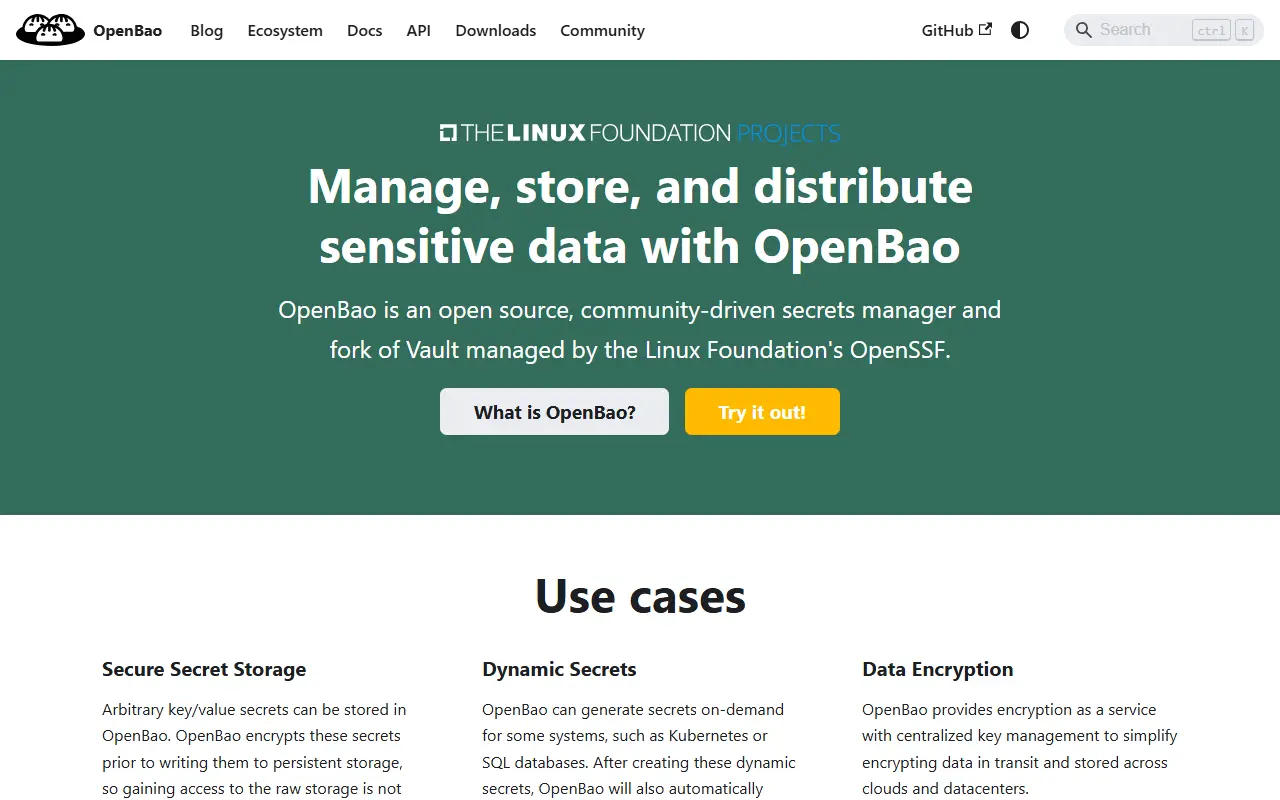
openbao.orgOpenBao homepage screenshot

OpenBao is a software solution for managing, storing and distributing sensitive data such as secrets, certificates and keys. It is a community-led project, run under open-governance principles, that intends to stay available under an OSI-approved open-source licence, currently MPL-2.0.

The README describes the problem it targets: modern systems need many secrets, including database credentials, API keys for external services and credentials for service-to-service communication, and tracking who accesses what is hard without a dedicated tool. OpenBao encrypts key/value secrets before they reach persistent storage, so access to the raw storage alone does not expose them. It can write to disk, PostgreSQL and other backends, and it can generate dynamic secrets on demand for systems such as AWS or SQL databases.

OpenBao is written in Go and is widely known as a fork of HashiCorp Vault, which makes it a candidate for teams looking for an open-governance alternative in that space. It runs on your own infrastructure, and the project coordinates through a mailing list, GitHub Discussions and chat channels, with working groups for areas such as namespaces and the UI.

Key features

  • Encrypted key/value secret storage
  • Dynamic secrets for AWS and SQL databases
  • Multiple storage backends including PostgreSQL
  • Certificate and key management
  • Audit logging of secret access
  • Open-governance community project

Pricing: Free and open source under the MPL-2.0 licence.

Read more about OpenBaoWebsiteGitHub#2 AWS Secrets Manager alternative

Kubernetes

An open-source system for deploying, scaling and managing containerized applications across clusters of hosts, hosted by the CNCF.

GitHub stars
129k
Last commit
yesterday
Latest release
v1.37.2
Licence
Apache-2.0
Self-hosted
Yes
Hosted version
Available
kubernetes.ioKubernetes homepage screenshot

Kubernetes, also written K8s, is an open-source system that manages containerized applications across multiple hosts. It provides the basic mechanisms for deploying, maintaining and scaling applications, so teams can run containers reliably without scheduling each one by hand. It is written in Go and released under the Apache-2.0 license.

The project builds on years of experience running production workloads at Google with an internal system called Borg, combined with practices from the wider community. The Cloud Native Computing Foundation hosts the project. Users interact with it through declarative configuration and the documentation on kubernetes.io, which includes tutorials and a free course on scalable microservices.

Kubernetes can be run on your own infrastructure, and major cloud providers also offer managed Kubernetes services. The README adds that the k8s.io/kubernetes module is not supported for use as a library. It suits platform and DevOps teams running microservices that need scheduling, scaling and automatic recovery.

Key features

  • Container scheduling across multiple hosts
  • Automated application deployment and rollouts
  • Scaling of containerized workloads
  • Maintenance and self-healing of applications
  • Declarative configuration of desired state
  • CNCF-hosted with extensive documentation

Pricing: Free and open source under the Apache-2.0 license; cloud providers sell managed services built on it.

Read more about KubernetesWebsiteGitHub#3 AWS Secrets Manager alternative

Infisical

Infisical is an open-source platform for managing secrets, certificates and privileged access, with syncing, rotation and leak prevention.

GitHub stars
30k
Last commit
yesterday
Latest release
v0.167.8
Self-hosted
Yes
Hosted version
Available
infisical.comInfisical homepage screenshot

Infisical is an open-source security infrastructure platform used by teams to manage application secrets, certificates and privileged access. It centralizes secrets and configuration across environments, with versioning, rotation and leak prevention. The stack is TypeScript and Go on PostgreSQL, and the project offers both a hosted Infisical Cloud and a self-hosting option.

Secrets are organized by project and environment, such as development and production, in a dashboard. Secret syncs push values to platforms like GitHub, Vercel and AWS and work with tools such as Terraform and Ansible. Further features include point-in-time recovery, scheduled rotation for databases and AWS IAM, ephemeral dynamic secrets, secret scanning that stops leaks into git, a Kubernetes operator, and an agent that injects secrets without code changes. It also offers honey tokens as decoy credentials and brokered access for AI agents. The repository metadata lists the license as Other, so check it for exact terms.

Key features

  • Secrets dashboard across projects and environments
  • Secret syncs to GitHub, Vercel and AWS
  • Versioning with point-in-time recovery
  • Automatic secret rotation and dynamic secrets
  • Secret scanning to prevent leaks into git
  • Kubernetes operator and injection agent

Pricing: Free for up to 5 identities. Pro is $23 and Advanced $46 per identity per month, or $20 and $40 billed annually; Enterprise is custom. Paid plans include a free trial.

Read more about InfisicalWebsiteGitHub#4 AWS Secrets Manager alternative

Bitwarden

This is the Bitwarden server: the API, database and Docker-based infrastructure behind the Bitwarden password manager's client apps.

GitHub stars
21k
Last commit
yesterday
Latest release
v2026.10.1
Self-hosted
Yes
Hosted version
Available
bitwarden.comBitwarden homepage screenshot

Bitwarden is a password manager, and this repository contains its server side: the APIs, database and other core infrastructure that all Bitwarden client applications connect to. The code is written in C# on .NET Core with ASP.NET Core, and the database layer is written in T-SQL for SQL Server.

The server can be developed, built, run and deployed on Windows, macOS and Linux. For deployment, the project provides Docker containers along with PowerShell and Bash scripts that bootstrap an installation, and the images are published on GitHub Container Registry. The services include Admin, API, Billing, Events, Identity, Notifications, SCIM and SSO components.

Organizations that want to keep their vaults on their own infrastructure can follow the on-premise install guide in the Bitwarden help center, which requires Docker and Docker Compose. Bitwarden also runs managed cloud clusters in the US and EU. The repository lists its license as 'Other', so check the license files for the exact terms.

Key features

  • APIs used by all Bitwarden client apps
  • Identity, SCIM and SSO services
  • SQL Server database layer
  • Docker-based on-premise deployment
  • Install scripts for Windows, macOS and Linux
  • Admin and event processing services

Pricing: A free personal plan exists. Premium is $1.65 a month, Families $3.99 a month for six users, Teams $4 and Enterprise $6 per user per month, all billed annually.

Read more about BitwardenWebsiteGitHub#5 AWS Secrets Manager alternative

External Secrets

Kubernetes operator that syncs secrets from external managers such as AWS Secrets Manager and HashiCorp Vault into native Kubernetes Secrets.

GitHub stars
6.9k
Last commit
2 days ago
Latest release
helm-chart-2.15.0
Licence
Apache-2.0
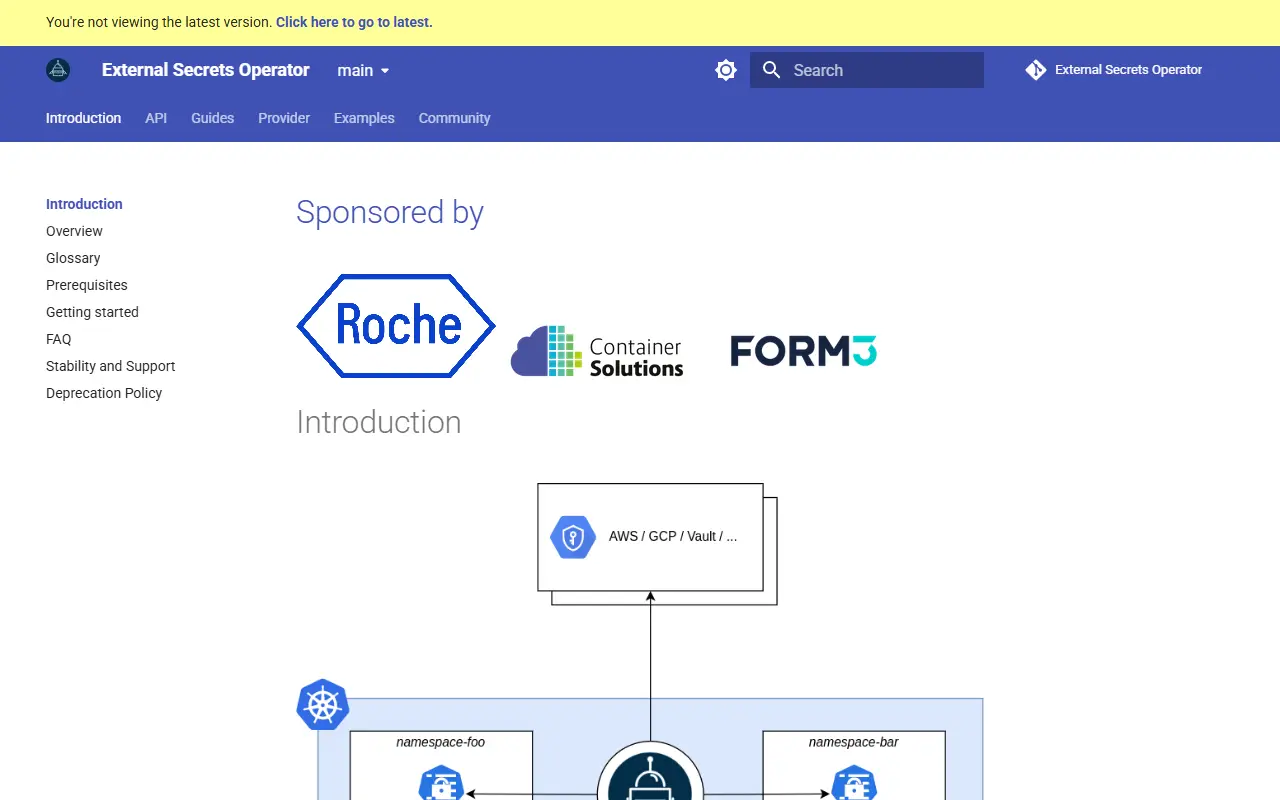
external-secrets.ioExternal Secrets homepage screenshot

External Secrets Operator (ESO) is a Kubernetes operator that connects external secret management systems to a cluster. It reads from the external API and injects the values into a Kubernetes Secret automatically, so applications keep using ordinary Secret objects.

The stated goal is to synchronise secrets from external APIs into Kubernetes. To do that, ESO adds custom API resources: ExternalSecret, SecretStore and ClusterSecretStore, which wrap the external API and manage the lifecycle of the secrets. The documentation also lists ClusterExternalSecret, PushSecret and ClusterPushSecret resources, plus generators for things like container registry credentials and passwords.

The provider list is long. It names AWS Secrets Manager, Parameter Store, Azure Key Vault, Google Cloud Secret Manager, HashiCorp Vault, IBM Secrets Manager, Akeyless, 1Password, Doppler, Bitwarden Secrets Manager, Infisical, OpenBao and many more. Guides cover templating, multi-tenancy, security best practices and a threat model, and the licence is Apache-2.0.

Key features

  • Integrates external secret managers with Kubernetes
  • Injects external values into Kubernetes Secrets
  • Syncs secrets from external APIs into Kubernetes
  • Custom resources for ExternalSecret, SecretStore and ClusterSecretStore
  • Many providers including AWS, Azure, Google, Vault and IBM
Read more about External SecretsWebsiteGitHub#6 AWS Secrets Manager alternative

Conjur

Conjur is a secrets management service that stores credentials and controls which people and machines may read them, using role-based access policies.

GitHub stars
956
Last commit
4 mo ago
Latest release
v1.27.0
Self-hosted
Yes
conjur.orgConjur homepage screenshot

Conjur is a secrets management and application identity service. Its repository describes it as a way to secure the secrets used by privileged users and machine identities. Access is defined with a role-based policy language that describes system components, their roles, privileges and metadata.

The core is a REST web service that manages identity life cycles for humans and machines, organises and searches roles and data, authorises access to resources and stores secrets so they can be handed out securely. Authenticators can be switched on or off, and variables can be rotated on a schedule with built-in rotators or custom ones.

Conjur is built to run in Docker containers with PostgreSQL as its data store. It creates and updates its own database schema at startup, and connects through a DATABASE_URL setting that can point to a linked container or an external managed database such as AWS RDS. Integrations cover infrastructure as a service, configuration management, CI/CD and container orchestration. Its homepage now sits on a commercial Secrets Manager product offered as SaaS or self-hosted.

Key features

  • Role-based access policy language for system components
  • REST API for human and machine identity life cycles
  • Built-in authenticators that can be enabled or disabled
  • Scheduled rotation of variables with built-in rotators
  • Custom authenticators can be created
  • AES-256-GCM encryption of stored data
  • Integrations across CI/CD and container tooling
Read more about ConjurWebsiteGitHub#7 AWS Secrets Manager alternative

Commercial AWS Secrets Manager alternatives

Hosted, closed-source products that compete with AWS Secrets Manager.

AWS Secrets Manager alternatives: questions

What is the best open-source alternative to AWS Secrets Manager?
Vaultwarden is the top-ranked open-source alternative to AWS Secrets Manager on Enlisted: Vaultwarden is an AGPL-3.0 server written in Rust that implements the Bitwarden client API for self-hosted password vaults. Other strong options are OpenBao, Kubernetes, Infisical and Bitwarden.
What are the best commercial alternatives to AWS Secrets Manager?
Doppler, Akeyless, Azure Key Vault, Google Secret Manager and Envmanager are among the hosted, closed-source alternatives to AWS Secrets Manager listed on Enlisted, which lists 10 in total. Compare their pricing and features on each tool page.
Are these AWS Secrets Manager alternatives free?
All 7 are open source, so the code is free to use under its licence, and all of them can be self-hosted on your own server or computer. 3 also offer a paid or managed cloud version if you'd rather not host it yourself.
How is this list of AWS Secrets Manager alternatives ranked?
By a score built from GitHub stars, star growth over the last 30 days and how recently the code changed. 6 of these projects shipped code in the last 30 days. Data is refreshed daily, and nobody can pay to move up.

People also look for alternatives to…

View all