 TrackMedia
 TrackRev
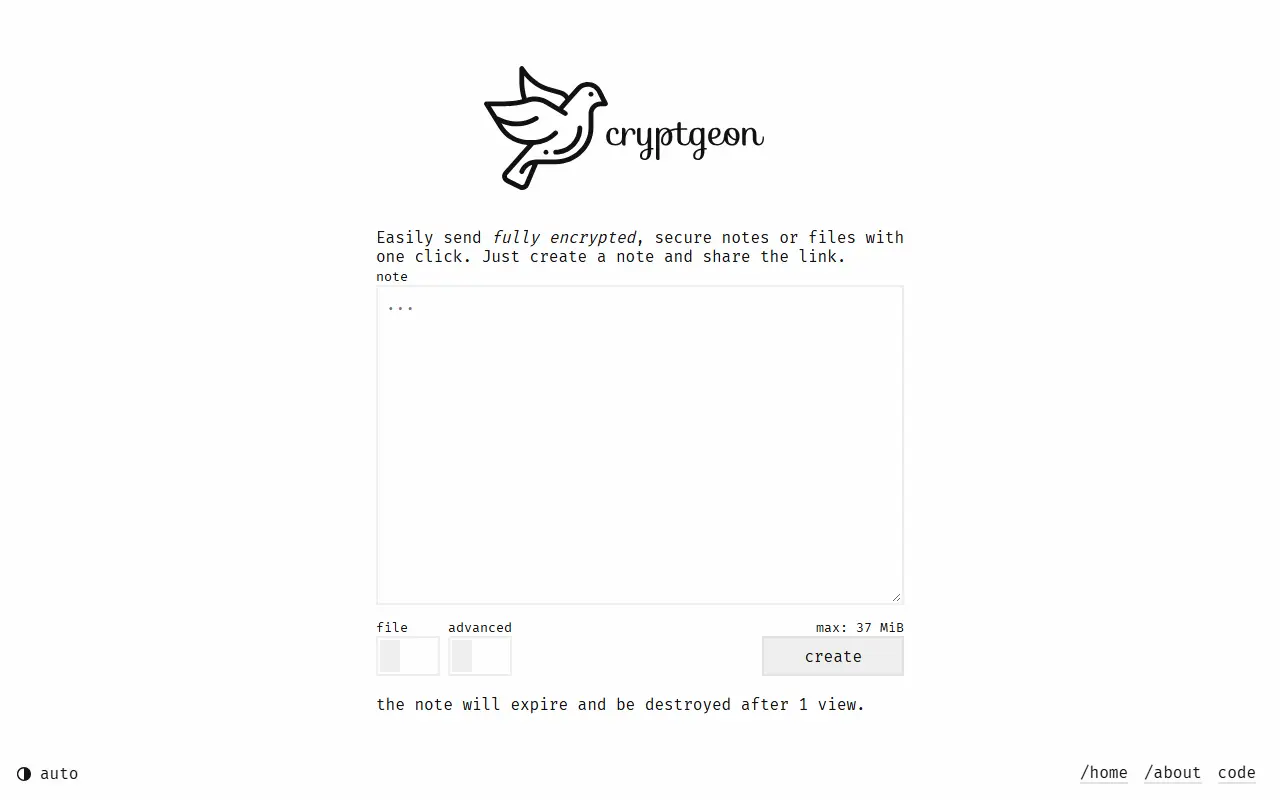
About Cryptgeon
Cryptgeon is a service for sharing notes or files securely, inspired by PrivNote, written in Rust and Svelte under the MIT licence. It comes with a server, a web page and a CLI client, plus an official Raycast extension. A live service and demo run at cryptgeon.org.
Each note gets a generated 256-bit id and key. The note is encrypted on the client with XChaCha20-Poly1305 before it is sent, so the server never sees the key and cannot read the contents. Data is kept in memory and never written to disk. Notes can be limited by view count or by time.
Operators configure it through environment variables such as the cache URL (Valkey or Redis), size limit, maximum views and expiration, whether files are allowed, and theme and imprint options. Docker is the easiest way to deploy it, a health endpoint is available, and HTTPS is required for the browser cryptography to work.
Key features
- Server, web page and CLI client in one project
- Notes encrypted in the client with XChaCha20-Poly1305
- Data held in memory and never persisted to disk
- Server cannot decrypt note contents
- CLI supports text, files, expiration and passwords
- Option to restrict to text notes only
- Health endpoint for monitoring
Good fit for
- Sharing a password that expires after one view
- Sending a short-lived secret file
- Running a private PrivNote alternative
Cryptgeon: questions and answers
- What is Cryptgeon used for?
- Cryptgeon is a secure, open source note and file sharing service inspired by PrivNote, with client-side encryption and in-memory storage. It is a good fit for sharing a password that expires after one view, sending a short-lived secret file and running a private PrivNote alternative.
- Is Cryptgeon open source?
- Yes. Cryptgeon is open source under the MIT licence. Its source code is on GitHub at cupcakearmy/cryptgeon and is written mainly in Svelte.
- Is Cryptgeon free?
- Yes. Cryptgeon is open source, so the software itself is free to use.
- Can I self-host Cryptgeon?
- Yes. Cryptgeon can be self-hosted on your own server or infrastructure.
- What are some alternatives to Cryptgeon?
- Similar open-source tools in the Security category include Password Pusher, OpenBao and VeraCrypt. SaaS products in the same category include BurnLinks, GitGuardian and L7 Admin Guard.
- Is Cryptgeon actively maintained?
- Yes. The most recent commit to Cryptgeon was on 20 October 2026, and the latest release is v2.9.3, published on 25 June 2026. The project has 1.6k stars on GitHub, with 30 added in the last 30 days.
Open-source alternatives to Cryptgeon
See allPassword Pusher
Security
🔐 Securely share sensitive information with automatic expiration & deletion after a set
Apache-2.0★ 3.2k
OpenBao
Security
OpenBao is a software solution to manage, store, and distribute sensitive data including s
MPL-2.0vs AWS Secrets Manager★ 9k
VeraCrypt
Security
Disk encryption with strong security based on TrueCrypt
OSSvs MEGA★ 12k
Cryptomator
Security
Cryptomator for Windows, macOS, and Linux: Secure client-side encryption for your cloud st
GPL-3.0vs Tresorit★ 16k
Certimate
Security
ssl tls https ssl-certificate ssl-certificates ssl-cert https-certificate https-certificat
MITvs Sectigo★ 9.4k
Certd
Security
开源SSL证书管理工具;全自动证书申请、更新、续期;通配符证书,泛域名证书申请;证书自动化部署到阿里云、腾讯云、主机、群晖、宝塔;https证书,pfx证书,der证书,TLS证书
AGPL-3.0vs Sectigo★ 5.1k
SaaS alternatives to Cryptgeon
See all
BurnLinks
Security
Share text or files through one-time, self-destructing links that vanish once opened
SaaS
GitGuardian
Security
Detects leaked secrets and credentials in code repositories and developer tools
SaaS
L7 Admin Guard
Security
Hides admin panels and internal tools from bots, returning 404 unless a short token is used
SaaS
Thales SafeNet
Security
Cyber security solutions for data protection, application security, and identity and access management
SaaS
Threema
Security
Secure instant messenger with end-to-end encryption for individuals and organizations
SaaS
Vaultree
Security
Encryption solutions for data-in-use, enabling secure search, storage, sharing, and analytics
SaaS