
 Iru
Iru Omnissa Workspace ONE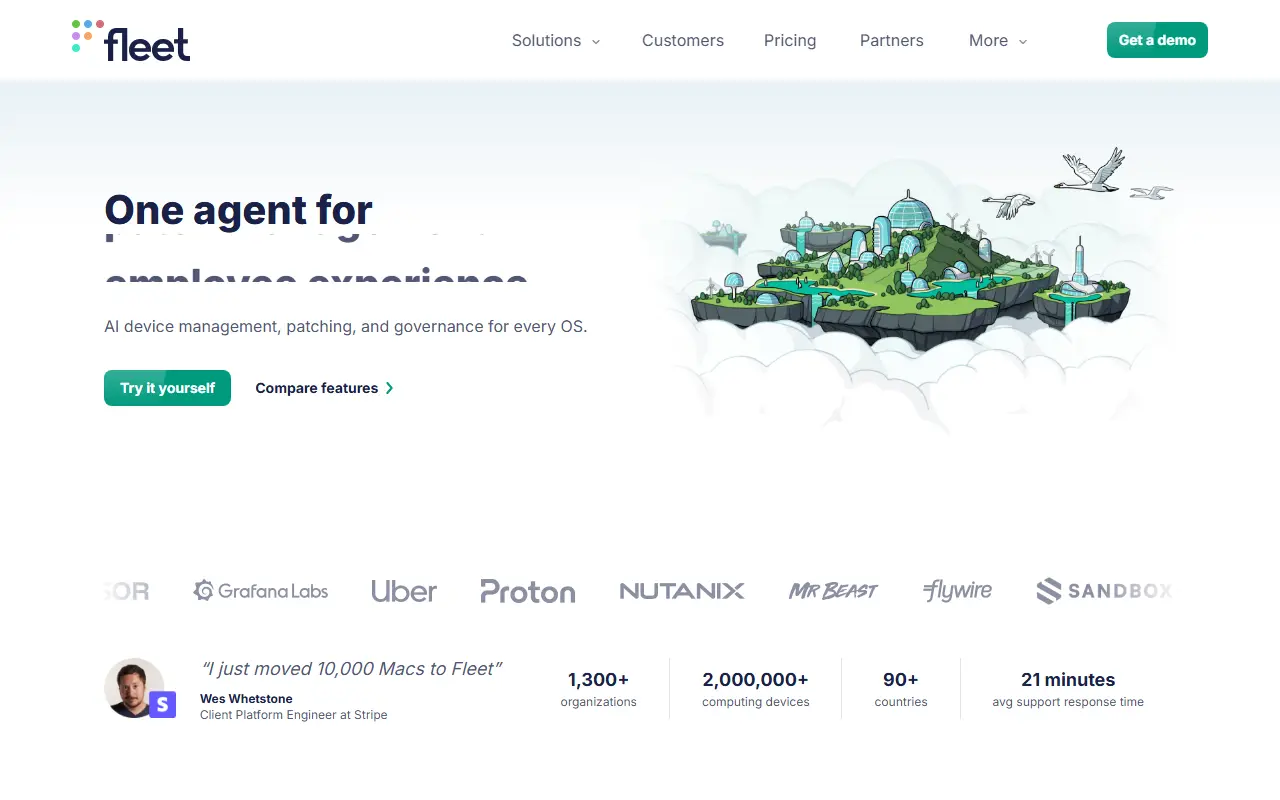
About Fleet
Fleet is an open-source platform for IT and security teams that manage large numbers of computers. It gives a single system to secure and maintain devices over the air, covering mobile device management, patching, software deployment and verification across all the operating systems an organization uses.
It gathers data and events straight from each device's operating system using osquery, and can report on hundreds of device attributes. It ships with CIS benchmarks for macOS and Windows. Platforms include Linux, macOS, Windows, Chromebooks, iOS and Android, as well as cloud and container environments. Fleet is built for infrastructure as code, so it can be managed with GitOps, a graphical interface, a REST API, webhook events or the fleetctl command-line tool.
Fleet is written in Go. The repository lists its licence as other, so check the project for the exact terms of its open-source and commercial components. Documentation, a demo and the option to talk to maintainers are linked from the README.
Key features
- Mobile device management
- Patching and software deployment
- osquery-based device visibility
- CIS benchmarks for macOS and Windows
- GitOps, REST API and webhooks
- Linux, macOS, Windows and mobile support
Good fit for
- →Managing a mixed fleet of laptops and servers
- →Collecting audit evidence for compliance
- Built with
- Go
- Tags
- device-management
- mdm
- osquery
- security
- gitops
- vulnerability-management
- go
- endpoint
Fleet: questions and answers
- What is Fleet used for?
- Fleet is an open-source device management platform for IT and security teams, combining MDM, patching, software deployment and osquery-based visibility. It is a good fit for managing a mixed fleet of laptops and servers, and collecting audit evidence for compliance.
- Is Fleet open source?
- Yes. Fleet is open source under a custom licence. Its source code is on GitHub at fleetdm/fleet and is written mainly in Go.
- Is Fleet free?
- Yes. Fleet is open source, so the software itself is free to use under the terms of its own licence. A managed cloud version is also available, with paid plans from $7 per seat per month.
- Can I self-host Fleet?
- Yes. Fleet can be self-hosted on your own server or infrastructure.
- What is Fleet an alternative to?
- Fleet is an open-source alternative to Jamf, Microsoft Intune, Mosyle and Tanium. Other open-source alternatives to Tanium include osquery and Wazuh.
- Is Fleet actively maintained?
- Yes. The most recent commit to Fleet was on 2 October 2026. The project has 6.9k stars on GitHub.
Open-source alternatives to Fleet
See all
osquery
Security
SQL powered operating system instrumentation, monitoring, and analytics.
OSSvs Tanium★ 24k
Wazuh
Security
Wazuh - The Open Source Security Platform. Unified XDR and SIEM protection for endpoints a
OSSvs Splunk★ 17k
step-ca
Security
🛡️ A private certificate authority (X.509 & SSH) & ACME server for secure automated certi
Apache-2.0vs Entrust★ 8.9k
OpenBao
Security
OpenBao is a software solution to manage, store, and distribute sensitive data including s
MPL-2.0vs AWS Secrets Manager★ 8.3k
DefectDojo
Security
Open-Source Unified Vulnerability Management, DevSecOps & ASPM
BSD-3-Clausevs Tenable★ 5k
OpenVAS
Security
This repository contains the scanner component for Greenbone Community Edition.
GPL-2.0vs Tenable★ 4.8k
SaaS alternatives to Fleet
See all
Jamf
Security
Apple device management and security for Mac, iPhone and iPad fleets
SaaS
Microsoft Intune
Security
Cloud endpoint management for devices, apps and compliance policies
SaaS
Mosyle
Security
Apple device management and security platform for schools and businesses
SaaS
Tanium
Security
Endpoint management and security platform
SaaS
Ivanti
Security
IT and security management software for endpoints, patching and service management
SaaS
NinjaOne
Security
Endpoint management and remote monitoring software for IT teams and MSPs
SaaS