11 open-source alternatives ranked by real activity

Open-source Nova alternatives

A curated, ranked list of the 11 best open-source alternatives to Nova.

The best open-source alternative to Nova is Zed. If that doesn't suit you, other good options are Visual Studio Code, Neovim, Helix and VSCodium.

Commercial alternatives to Nova include BBEdit, RubyMine, PhpStorm and Cursor. See all 7.

Nova alternatives are mainly developer tools, but some are also security tools. 9 of them shipped code in the last 30 days, 11 can be self-hosted, and 4 use a permissive licence.

Last updated November 12, 2026 · ranked by GitHub stars, growth and recent commits

Zed

A performance-focused, multiplayer code editor written in Rust by the creators of Atom and Tree-sitter, available on macOS, Linux and Windows.

GitHub stars
95k
Last commit
yesterday
Latest release
v1.28.1
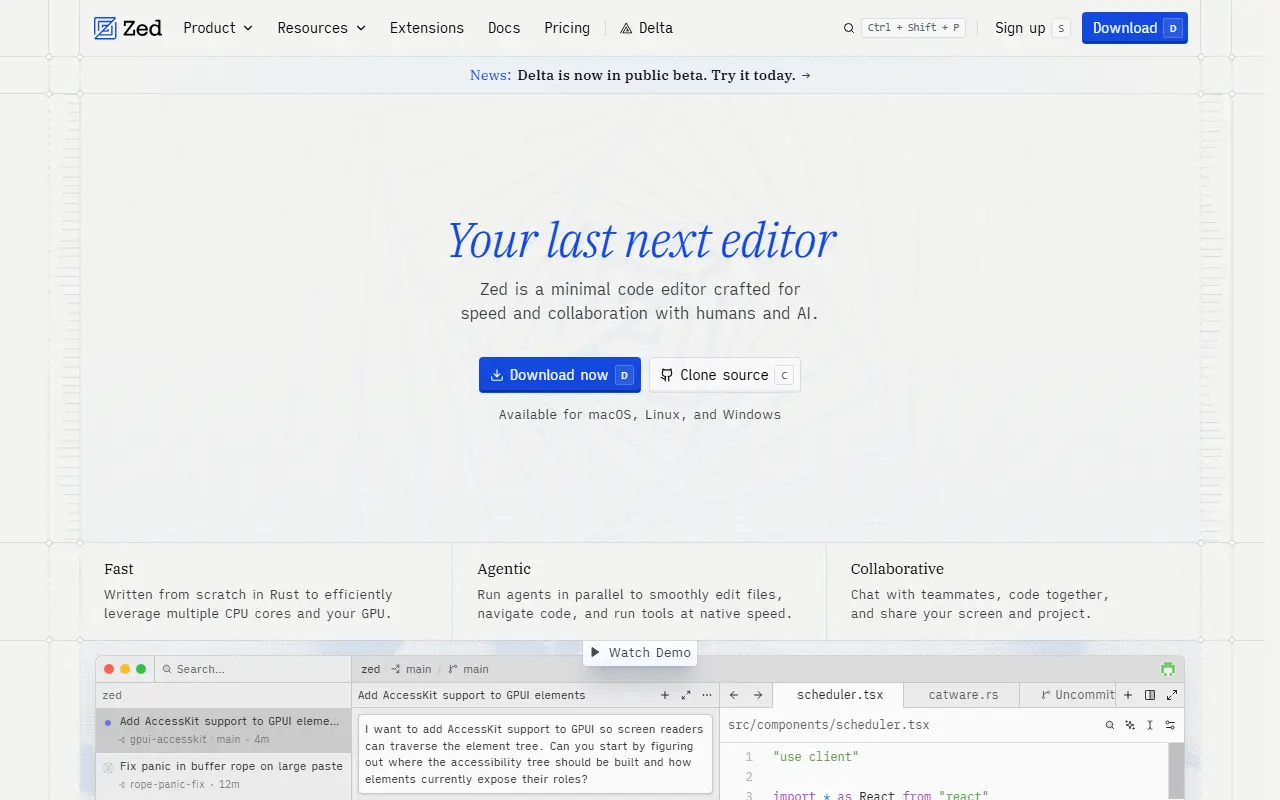
zed.devZed homepage screenshot

Zed is a code editor built for speed and for editing together with other people, created by the team behind Atom and Tree-sitter. It is written in Rust and available for macOS, Linux and Windows, with a web version still only under discussion. It is developed by Zed Industries, a for-profit company.

The code is mostly GPL-3.0-or-later, with some Apache-2.0 components that are labeled as such, and the project uses tooling to keep third-party license information correct. Installation is by direct download or through local package managers on each platform, and the repository documents how to build Zed for each operating system.

Zed suits developers who want a fast native editor with collaboration built in and are comfortable with a GPL-licensed codebase. Sponsorship donations through GitHub Sponsors go directly to the company, and contributions are welcome through the guidelines in CONTRIBUTING.md.

Key features

  • Native code editor written in Rust
  • Multiplayer editing with collaborators
  • Available on macOS, Linux and Windows
  • Built on the GPUI framework
  • Buildable from source on each platform

Pricing: Free Personal plan. Pro costs $10 per month with $5 of tokens included and a 14-day free trial; Business costs $30 per seat per month.

Visual Studio Code

The open-source Code - OSS repository from Microsoft that Visual Studio Code is built from, a cross-platform code editor with debugging and extensions.

GitHub stars
195k
Last commit
yesterday
Latest release
1.146.0
Licence
MIT
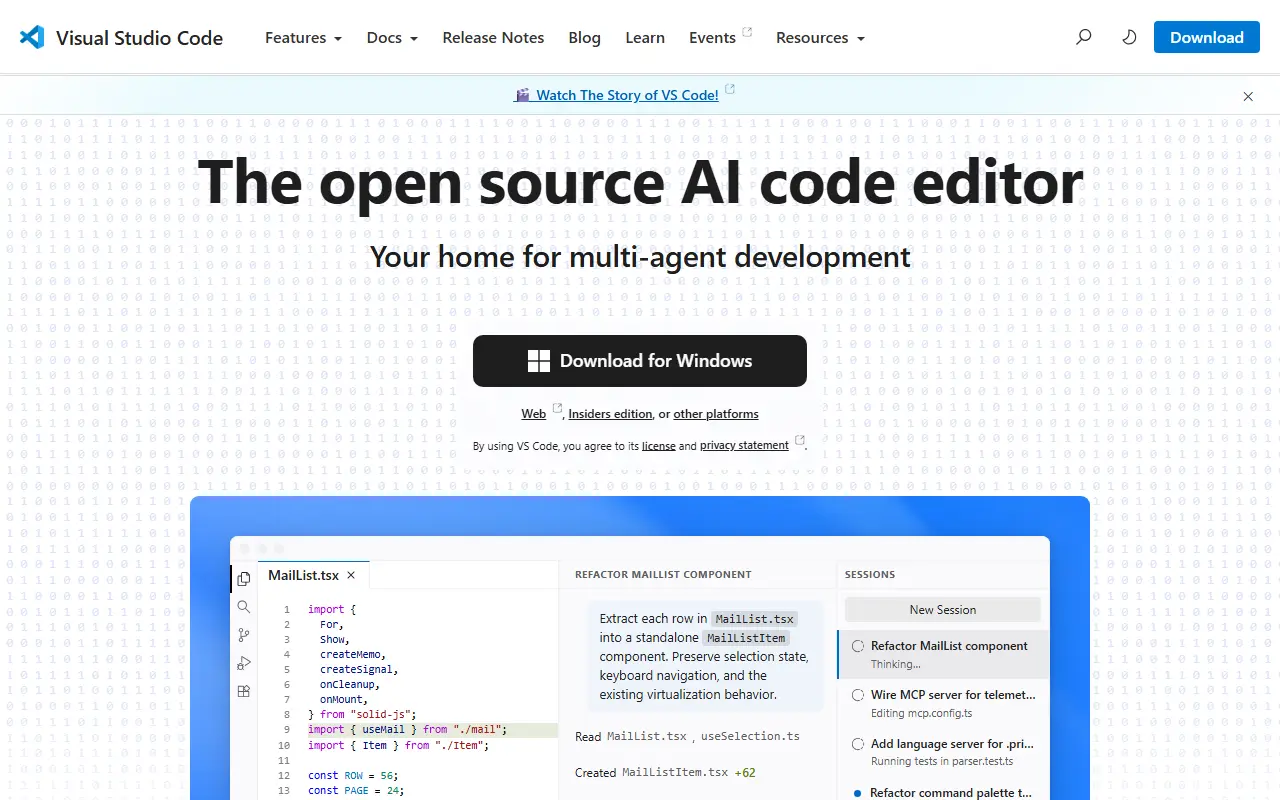
code.visualstudio.comVisual Studio Code homepage screenshot

This repository, known as Code - OSS, is where Microsoft develops Visual Studio Code together with the community. Visual Studio Code is a code editor that pairs the simplicity of a lightweight editor with the tools developers need to edit, build and debug, and it runs on Windows, macOS and Linux. Roadmap and iteration plans are published alongside the code.

Main capabilities include code editing, navigation and code understanding support, lightweight debugging and integration with existing tools. A rich extension model lets people add languages, themes and tooling. The editor is built with TypeScript on Electron and is updated monthly, with a daily Insiders build for those who want the newest changes.

The source code is available under the MIT license. The downloadable Visual Studio Code product is a distribution of this repository that adds Microsoft-specific customizations and ships under a traditional Microsoft product license. That distinction matters for anyone who wants to build a fully open-source editor straight from the repository.

Key features

  • Code editing with navigation and code understanding
  • Lightweight built-in debugging
  • Extension model for languages and tools
  • Integration with existing development tools
  • Runs on Windows, macOS and Linux
  • Monthly releases plus daily Insiders builds

Pricing: Source code is MIT licensed; the Microsoft-branded Visual Studio Code build ships under a separate product license.

Neovim

A refactored fork of Vim focused on extensibility and usability, with an API for many languages and an embedded terminal emulator.

GitHub stars
104k
Last commit
yesterday
Latest release
v0.12.6
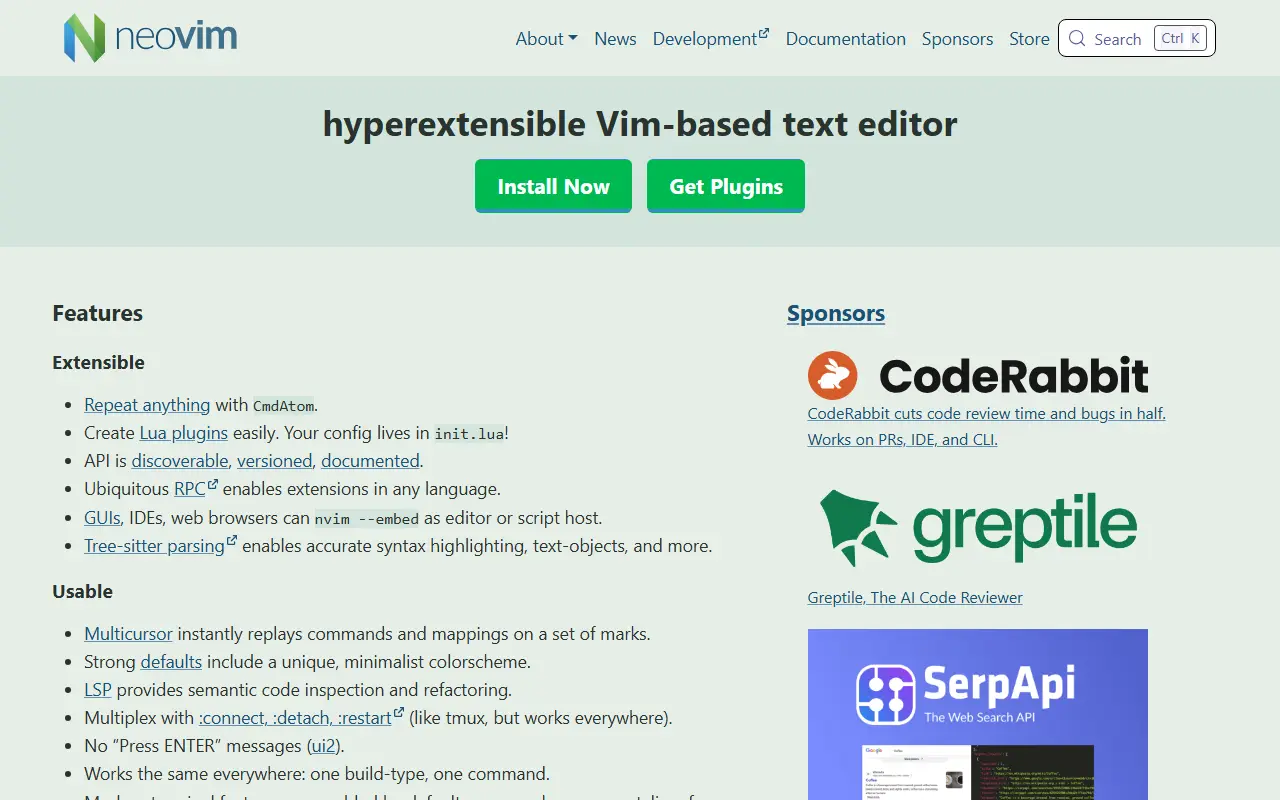
neovim.ioNeovim homepage screenshot

Neovim is a text editor that refactors Vim to simplify maintenance, encourage contributions, split work among several developers, and allow advanced user interfaces without changes to the core. Most Vim plugins work with it, as do Ruby and Python-based ones, so existing setups largely carry over.

Key features include modern GUIs, an API that can be accessed from many languages such as C, Go, JavaScript, Python, Lua and Rust, a terminal emulator embedded in the editor and open to scripting, asynchronous job control, data shared across multiple editor instances, and support for XDG base directories. The full feature list is available in the built-in help.

Pre-built packages are provided for Windows, macOS and Linux, and many distributions package it, including Homebrew, Debian, Ubuntu, Fedora and Arch Linux. It can also be built from source with CMake. The README includes guidance for moving over from Vim. GitHub lists the license as 'Other', so check the repository for details. It suits developers and writers who like modal editing and want a scriptable editor.

Key features

  • Vim-compatible modal editing and plugins
  • API accessible from many languages
  • Terminal emulator built into the editor
  • Asynchronous job control
  • Shared data across editor instances
  • Support for modern GUIs

Pricing: Free and open source; check the repository for the exact license terms.

Helix

A terminal-based modal text editor written in Rust, inspired by Kakoune and Neovim, with multiple selections and built-in language server support.

GitHub stars
47k
Last commit
3 days ago
Latest release
25.07.1
Licence
MPL-2.0
helix-editor.comHelix homepage screenshot

Helix is a modal text editor written in Rust and inspired by Kakoune and Neovim. Its editing model is heavily based on Kakoune, whose design decisions the author largely agreed with while building it. It is released under the MPL-2.0 license and is primarily a terminal-based editor.

It offers modal editing in the Vim style, several simultaneous selections, language server support out of the box, and incremental syntax highlighting and code editing built on tree-sitter. The author has said they may explore a custom wgpu-based renderer, along the lines of Emacs. Shortcuts and keymaps are documented on the project website.

The README notes that only certain languages currently have indentation definitions. Installation instructions, a FAQ and a community Matrix space are linked for help. Helix suits developers who like modal editing and want language tooling that works out of the box without assembling many plugins.

Key features

  • Vim-like modal editing
  • Multiple selections and cursors
  • Built-in language server support
  • Tree-sitter syntax highlighting and editing
  • Terminal-based editor written in Rust

Pricing: Free and open source under the MPL-2.0 license.

VSCodium

VSCodium provides community-built binaries of Visual Studio Code without Microsoft branding, telemetry or proprietary licensing.

GitHub stars
34k
Last commit
13 days ago
Latest release
1.143.17232
Licence
MIT
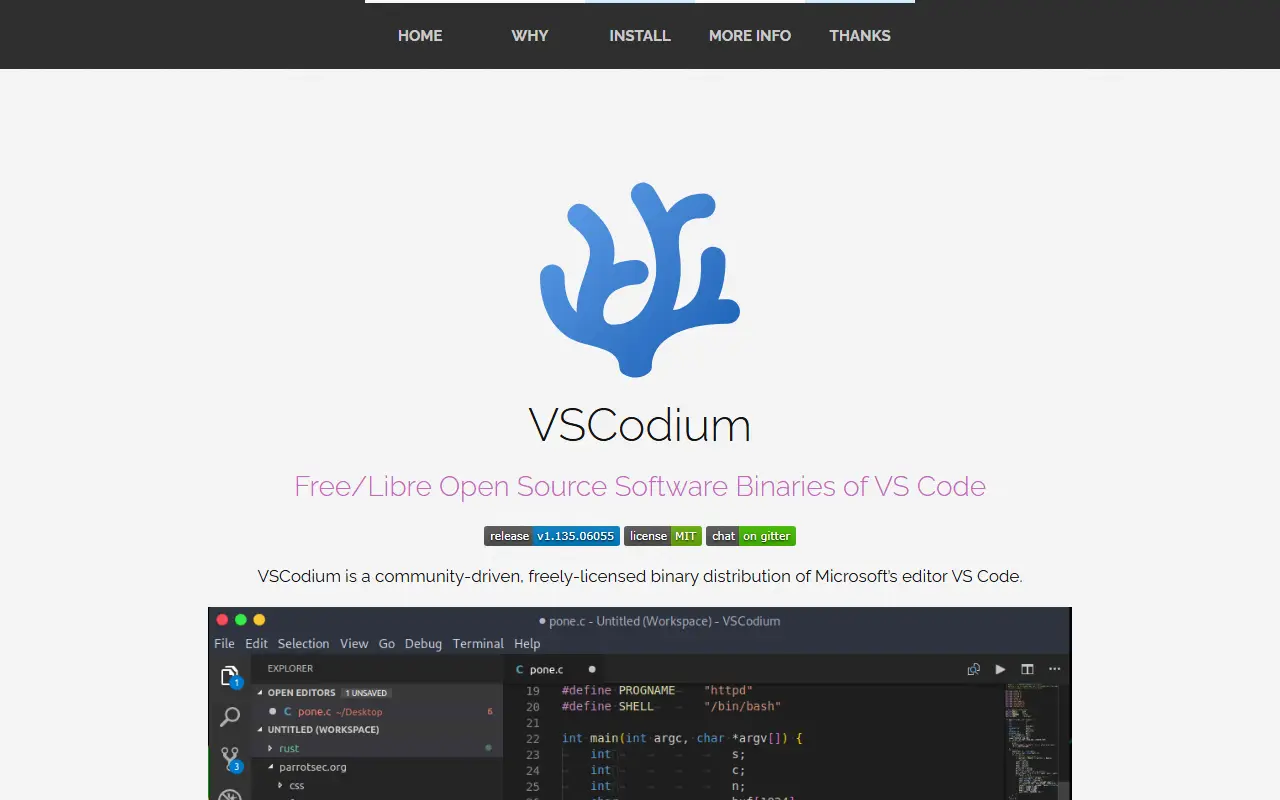
vscodium.comVSCodium homepage screenshot

VSCodium is a repository of scripts that automatically build Microsoft's open-source vscode source code into freely licensed binaries with a community-driven default configuration. The maintainers stress that it is not a fork. The result is a code editor and IDE that feels like Visual Studio Code but drops the Microsoft branding, telemetry and the licensing terms of Microsoft's own distribution.

Releases come as stable and insiders builds and can be installed through Homebrew, WinGet, Chocolatey, Scoop, Snap, Flatpak, the Arch User Repository, or apt, dnf and zypper repositories, as well as deb, rpm and tar downloads. The build scripts are written in Shell and published under the MIT license, so anyone can inspect how the binaries are produced. Extensions are a common area of difference, so review the project's notes before relying on a specific one.

Key features

  • Free-licensed builds of VS Code
  • No Microsoft branding or telemetry by default
  • Stable and insiders release channels
  • Install via Homebrew, WinGet, Snap and more
  • Transparent shell-script build process
  • Windows, macOS and Linux packages

Pricing: Free and open source; the build scripts are MIT licensed.

Notepad++

Notepad++ is a free source code editor and Notepad replacement for Windows that supports many programming and natural languages.

GitHub stars
30k
Last commit
yesterday
Latest release
v8.9.9.1
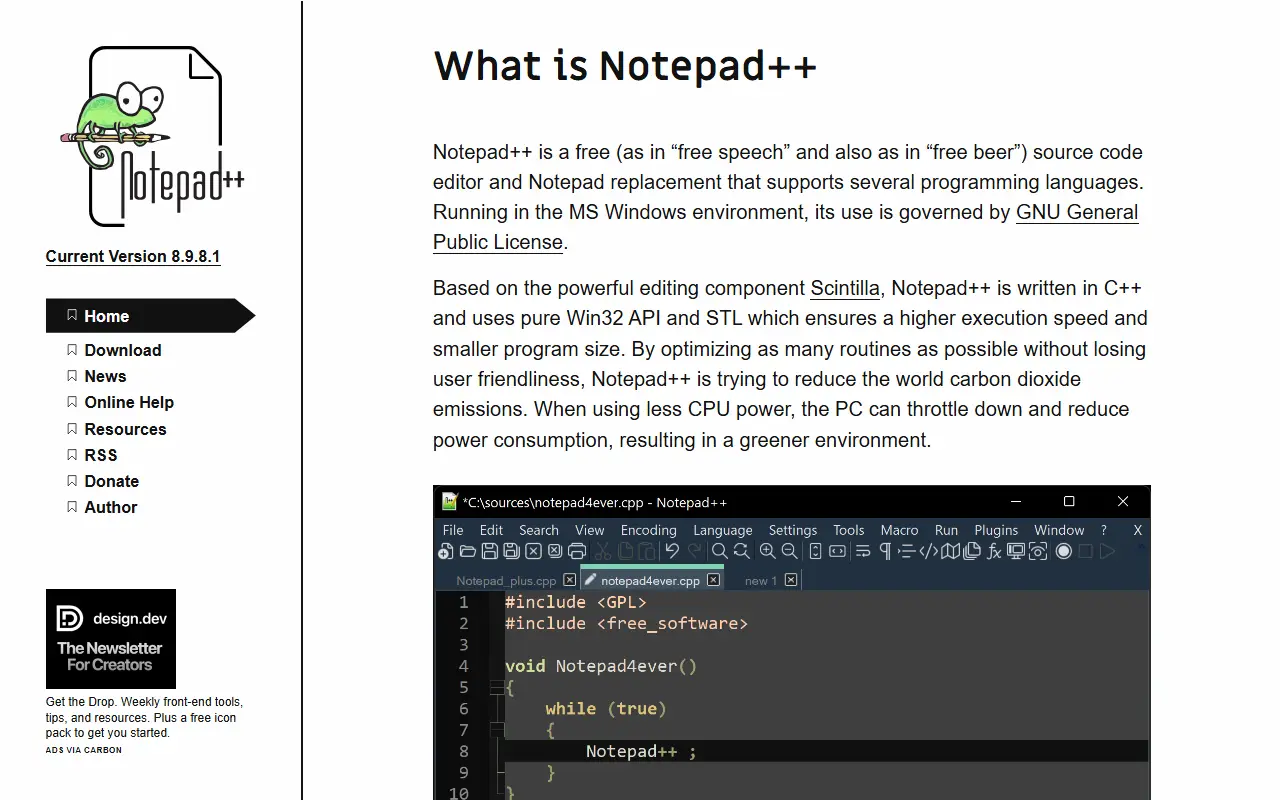
notepad-plus-plus.orgNotepad++ homepage screenshot

Notepad++ is a free source code editor that also works as a replacement for the built-in Windows Notepad. It supports a number of programming languages and natural languages, and runs in the Microsoft Windows environment. The README describes it as free in both senses of the word, and says its use is governed by the GPL. It is written in C++.

The project supports all Windows systems that Microsoft still supports, and publishes a page of supported-system information for users who run older versions. Releases since version 7.6.5 have been signed with GPG, and the README publishes the signing key details so that downloads can be verified. Build instructions are provided for people who want to compile it from source, and contributions are welcome under the project's contribution rules. Further details are on the official site.

Key features

  • Source code editor for Windows
  • Replacement for the built-in Notepad
  • Support for many programming languages
  • Support for natural-language text editing
  • GPG-signed releases for verification
  • Official guide for building from source

Pricing: Free software distributed under the GPL.

Fleet

Fleet is an open-source device management platform for IT and security teams, combining MDM, patching, software deployment and osquery-based visibility.

GitHub stars
7.2k
Last commit
yesterday
Latest release
fleet-v4.94.1
Self-hosted
Yes
Hosted version
Available
fleetdm.comFleet homepage screenshot

Fleet is an open-source platform for IT and security teams that manage large numbers of computers. It gives a single system to secure and maintain devices over the air, covering mobile device management, patching, software deployment and verification across all the operating systems an organization uses.

It gathers data and events straight from each device's operating system using osquery, and can report on hundreds of device attributes. It ships with CIS benchmarks for macOS and Windows. Platforms include Linux, macOS, Windows, Chromebooks, iOS and Android, as well as cloud and container environments. Fleet is built for infrastructure as code, so it can be managed with GitOps, a graphical interface, a REST API, webhook events or the fleetctl command-line tool.

Fleet is written in Go. The repository lists its licence as other, so check the project for the exact terms of its open-source and commercial components. Documentation, a demo and the option to talk to maintainers are linked from the README.

Key features

  • Mobile device management
  • Patching and software deployment
  • osquery-based device visibility
  • CIS benchmarks for macOS and Windows
  • GitOps, REST API and webhooks
  • Linux, macOS, Windows and mobile support

Pricing: Free tier at $0 per host per month with basic features and no support. Premium costs $7.00 per host per month; large deployments are quoted through sales.

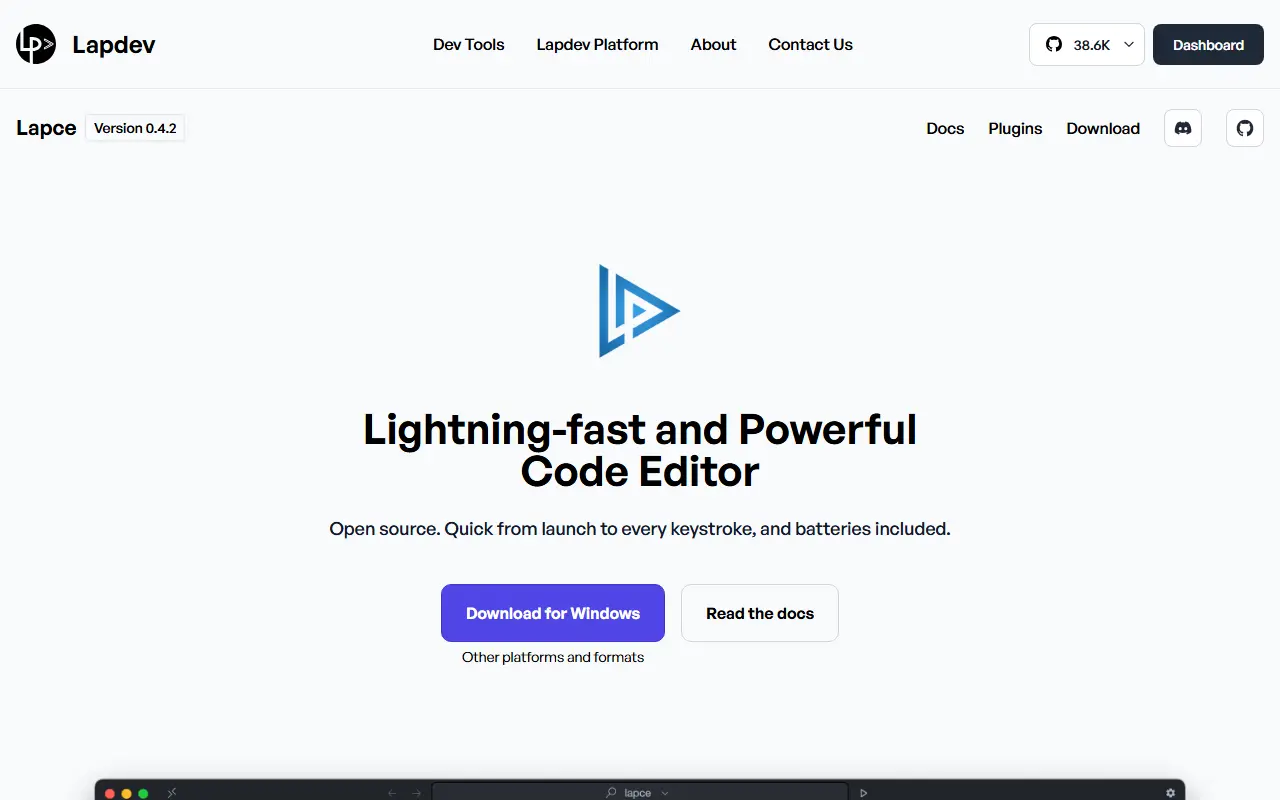
Lap

Lapce is an open source code editor written in Rust, featuring a native GUI, GPU acceleration, remote development, and built-in LSP support.

GitHub stars
39k
Last commit
1 mo ago
Latest release
v0.4.6
Licence
Apache-2.0
lap.devLap homepage screenshot

Lapce is a modern open source code editor written in Rust. It uses a native GUI with GPU acceleration via Floem, aiming for fast launch and responsive keystrokes. The editor includes features like syntax highlighting with Tree-sitter, built-in LSP support, Vim-like modal editing, a WASI plugin system, and a built-in terminal.

It supports remote development, allowing users to connect to remote machines with a local experience. The editor is available for download in various formats and platforms, and it is part of the Lapdev ecosystem which includes a platform for managing Kubernetes development environments.

Key features

  • Native GUI with GPU acceleration
  • Remote development support
  • Syntax highlighting using Tree-sitter
  • Built-in LSP support for code intelligence
  • Vim-like modal editing
  • WASI plugin system
  • Built-in terminal

MacVim

MacVim is a macOS version of the Vim text editor that adds a native graphical interface and integrates with macOS features.

GitHub stars
7.9k
Last commit
12 days ago
Latest release
release-184
Licence
Vim
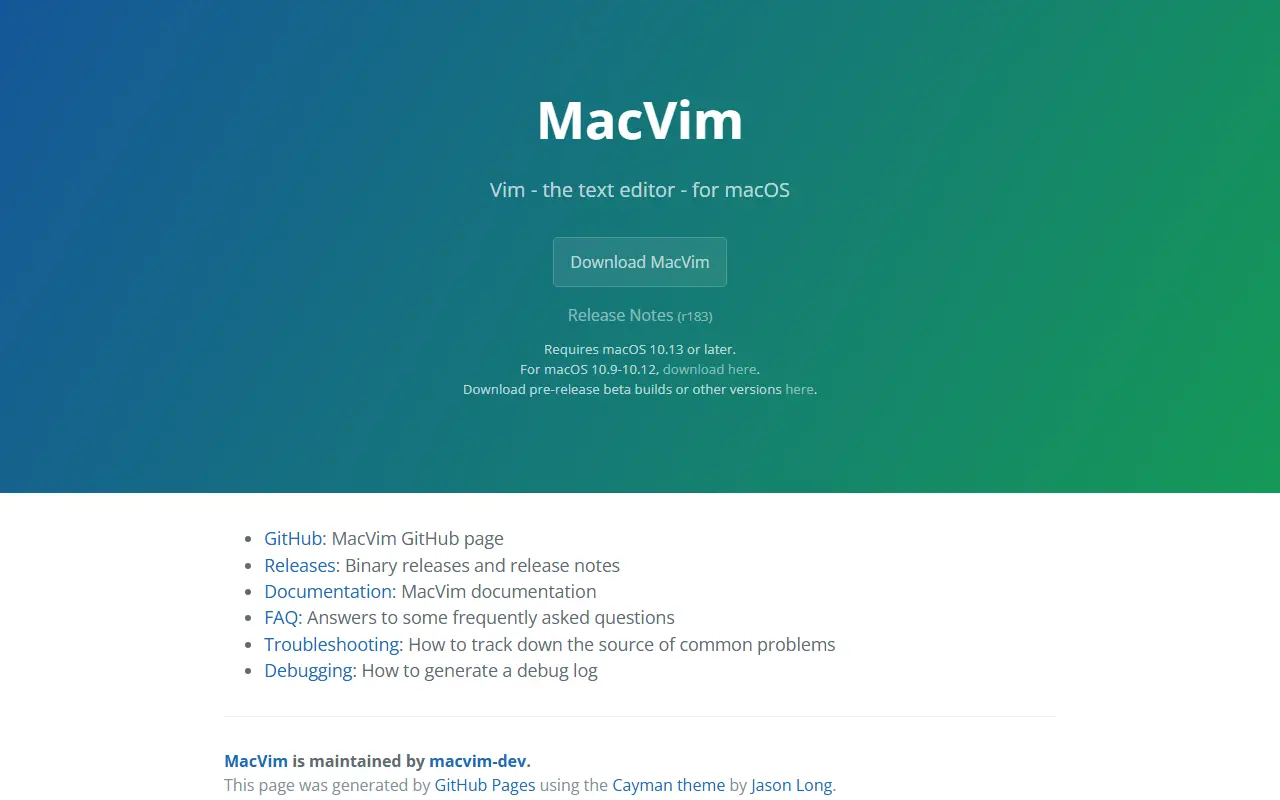
macvim.orgMacVim homepage screenshot

MacVim is a macOS version of the Vim text editor. It provides a graphical user interface for Vim while tightly integrating with macOS and offering features specific to the platform. The GUI supports menus, dialog boxes, toolbars and scroll bars, along with native and non-native full-screen modes, Vim GUI tabs with customizable colors, and font ligatures.

Mac-specific hooks include trackpad gestures, the Touch Bar and Command key shortcuts that can be mapped to Vim actions. It connects to system services, dictionary lookup and Apple Intelligence Writing Tools, and the reference manual describes an mvim:// URL handler. After installation it can be started from the Dock or from the terminal with the mvim command.

MacVim is a downstream fork of Vim and routinely merges from upstream. Vim itself also runs on macOS but has no GUI. It can be downloaded from the Releases page, installed with Homebrew, either as a formula or as the macvim-app cask, or built from source. The current release requires macOS 10.13 or later, and older builds are linked for macOS 10.9 to 10.12. It uses the Vim License.

Key features

  • Native GUI with menus, dialogs, toolbars and scroll bars
  • Gestures, Touch Bar and Command shortcuts map to Vim actions
  • Works with system services and Apple Intelligence Writing Tools
  • GUI tabs with custom colors and font ligatures
  • Launches from the Dock or the mvim command
  • Installable with Homebrew

Geany

Geany is a lightweight, cross-platform text editor and IDE with plugin support and built-in handling of more than 50 programming languages.

GitHub stars
3.8k
Last commit
11 days ago
Latest release
2.1.0
Licence
GPL-2.0
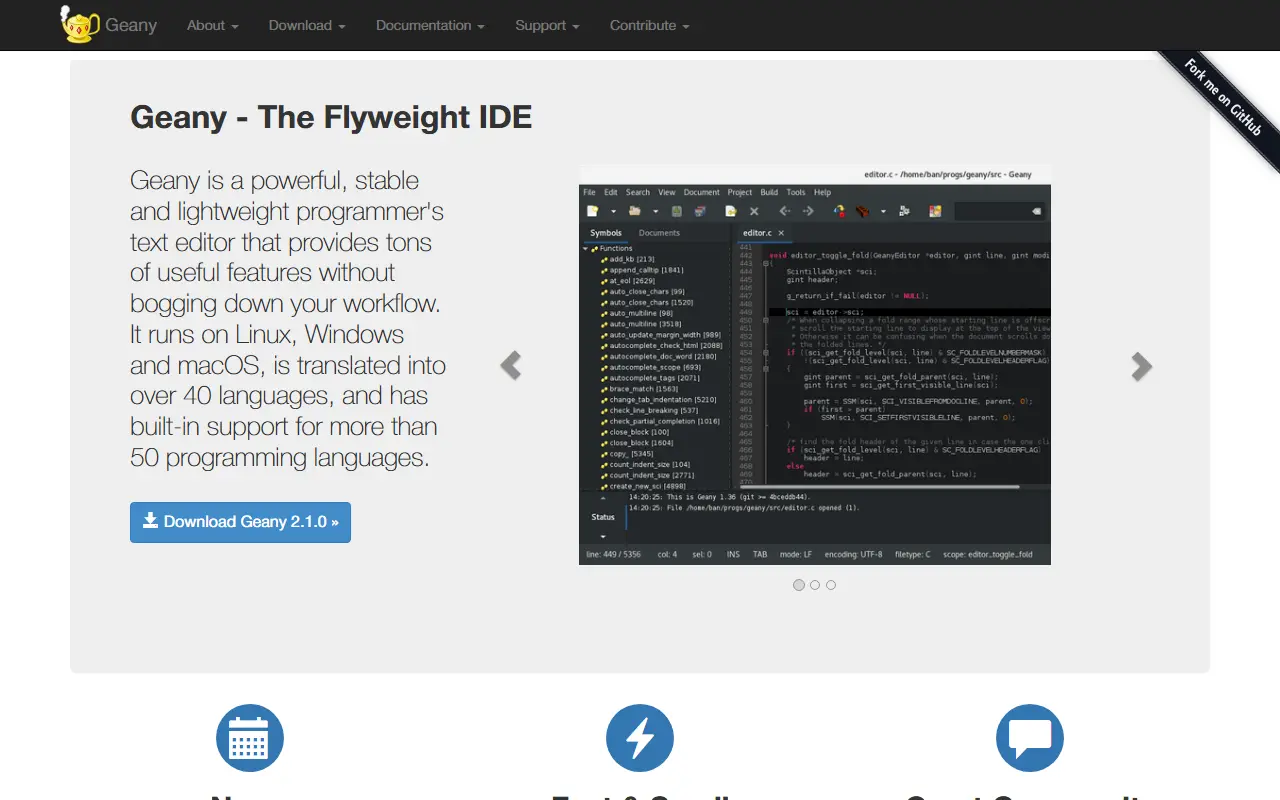
geany.orgGeany homepage screenshot

Geany is a programmer's text editor that describes itself as the flyweight IDE. It runs on Linux, Windows and macOS, is translated into over 40 languages and has built-in support for more than 50 programming languages. The current release shown on the site is Geany 2.1.0.

Customisation covers color themes and the ability to add new filetypes, plus many settings for adjusting behaviour. Supported filetypes include C, Java, PHP, HTML, JavaScript, Python and Perl, and also ini-style config files, diff output and SQL files.

A plugin system adds features. The site names a VCS plugin for Git and SVN, spell checking, a project organizer and a translation helper. Geany is released under the GPL v2 and has community channels on mailing lists, GitHub, Matrix and Mastodon.

Key features

  • Runs on Linux, Windows and macOS
  • Color themes and custom filetypes
  • Plugins such as VCS, spell check and project organizer
  • Support for common languages and config formats

1 more Nova alternative

Commercial Nova alternatives

Hosted, closed-source products that compete with Nova.

Nova alternatives: questions

What is the best open-source alternative to Nova?
Zed is the top-ranked open-source alternative to Nova on Enlisted: A performance-focused, multiplayer code editor written in Rust by the creators of Atom and Tree-sitter, available on macOS, Linux and Windows. Other strong options are Visual Studio Code, Neovim, Helix and VSCodium.
What are the best commercial alternatives to Nova?
BBEdit, RubyMine, PhpStorm, Cursor and Sublime Text are among the hosted, closed-source alternatives to Nova listed on Enlisted, which lists 7 in total. Compare their pricing and features on each tool page.
Are these Nova alternatives free?
All 11 are open source, so the code is free to use under its licence, and all of them can be self-hosted on your own server or computer. 1 also offers a paid or managed cloud version if you'd rather not host it yourself.
How is this list of Nova alternatives ranked?
By a score built from GitHub stars, star growth over the last 30 days and how recently the code changed. 9 of these projects shipped code in the last 30 days. Data is refreshed daily, and nobody can pay to move up.

People also look for alternatives to…

View all