 TrackMedia
 TrackRev

 DBCode
 Cloudflare D1
About DuckDB
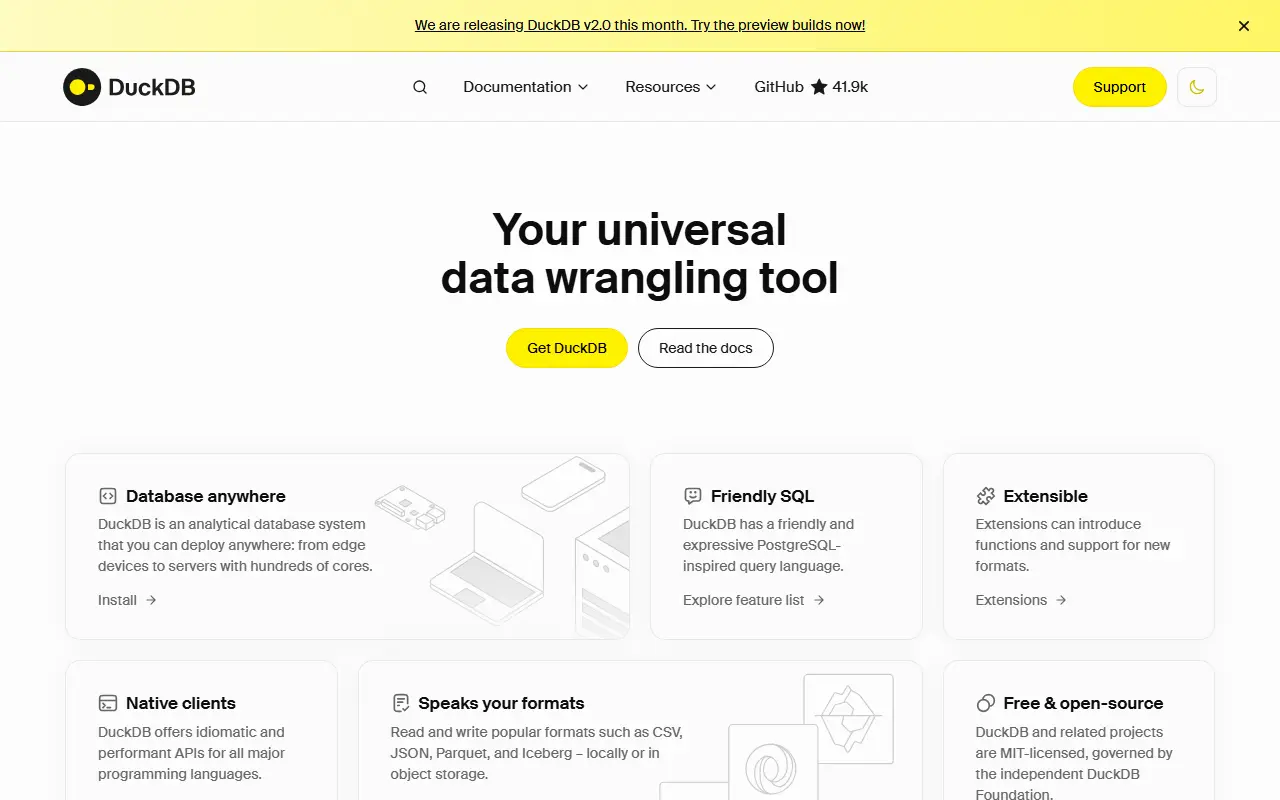
DuckDB is an analytical SQL database management system that runs in-process, meaning it is embedded in your application or notebook rather than running as a separate server. The goals are speed, reliability, portability and ease of use for analytical queries, and it is written in C++.
Its SQL dialect goes well beyond the basics: it handles arbitrary nested correlated subqueries, window functions, collations and complex types such as arrays, structs and maps, plus extensions that make SQL more convenient. CSV and Parquet files can be queried by naming them in a FROM clause. DuckDB is available as a standalone command line tool and has clients for Python, R, Java and WebAssembly, with deep integration into packages such as pandas and dplyr.
The project is MIT licensed. Building from source needs CMake, Python 3 and a C++17 compiler. Because it needs no server, DuckDB is popular with data analysts and engineers for exploring files and running local analytics, and it complements larger warehouses rather than replacing them.
Key features
- In-process analytical SQL engine
- Direct querying of CSV and Parquet files
- Window functions and correlated subqueries
- Arrays, structs and maps data types
- CLI plus Python, R, Java and Wasm clients
- Integrations with pandas and dplyr
Good fit for
- Analyzing local files with SQL
- Embedded analytics inside applications
- Data science workflows in Python or R
DuckDB: questions and answers
- What is DuckDB used for?
- DuckDB is an analytical, in-process SQL database that runs inside your application or from a CLI, with a rich SQL dialect and easy CSV and Parquet querying. It is a good fit for analyzing local files with SQL, embedded analytics inside applications and data science workflows in Python or R.
- Is DuckDB open source?
- Yes. DuckDB is open source under the MIT licence. Its source code is on GitHub at duckdb/duckdb and is written mainly in C++.
- Is DuckDB free?
- Yes. DuckDB is open source, so the software itself is free to use.
- Can I self-host DuckDB?
- Yes. DuckDB can be self-hosted on your own server or infrastructure; there is no official hosted version.
- What is DuckDB an alternative to?
- DuckDB is an open-source alternative to MotherDuck, Amazon Athena, Tinybird and Microsoft SQL Server. Other open-source alternatives to MotherDuck include ClickHouse, TimescaleDB and StarRocks.
- Is DuckDB actively maintained?
- Yes. The most recent commit to DuckDB was on 12 November 2026, and the latest release is v2.0.0, published on 21 October 2026. The project has 43k stars on GitHub, with 900 added in the last 30 days.
Open-source alternatives to DuckDB
See all
ClickHouse
Databases
ClickHouse is a fast open-source column-oriented database management system that allows ge
Apache-2.0vs Snowflake★ 51k
TimescaleDB
Databases
A time-series database for high-performance real-time analytics packaged as a Postgres ext
OSSvs KX kdb+★ 24k
StarRocks
Databases
The world's fastest open query engine for sub-second analytics both on and off the data la
Apache-2.0vs Snowflake★ 12k
Trino
Databases
Official repository of Trino, the distributed SQL query engine for big data, formerly know
Apache-2.0vs Amazon Redshift★ 14k
CrateDB
Databases
CrateDB is a distributed and scalable SQL database for storing and analyzing massive amoun
Apache-2.0vs SingleStore★ 4.5k
Dremio OSS
Data Pipelines & ETL
Dremio - the missing link in modern data
Apache-2.0vs Snowflake★ 1.5k
SaaS alternatives to DuckDB
See all
MotherDuck
Databases
Managed cloud service for DuckDB analytics
SaaS
Amazon Athena
Databases
Serverless interactive query service for analyzing data in Amazon S3 with SQL
SaaS
Tinybird
Databases
Real-time analytics database that turns SQL queries into API endpoints
SaaS
Microsoft SQL Server
Databases
Microsoft relational database server with free Express and Developer editions
SaaS
GoodData
BI & Dashboards
Analytics platform for embedded dashboards and headless BI
SaaS
Firebolt
Databases
Cloud data warehouse built for low-latency analytics and data applications
SaaS