#1
An analytical, in-process SQL database that runs inside your application or from a CLI, with a rich SQL dialect and easy CSV and Parquet querying.
- GitHub stars
- 43k
- Last commit
- today
- Latest release
- v2.0.0
- Licence
- MIT
- Self-hosted
- Yes
duckdb.org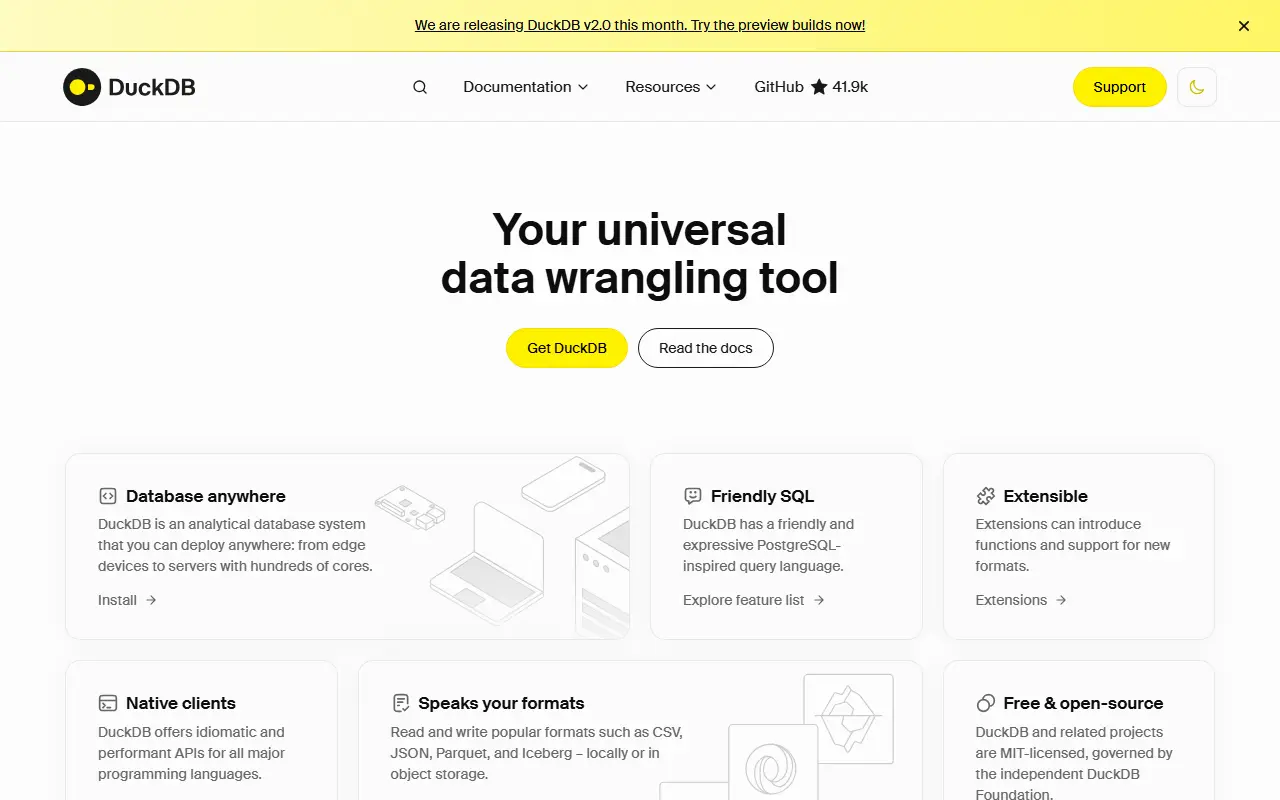
DuckDB is an analytical SQL database management system that runs in-process, meaning it is embedded in your application or notebook rather than running as a separate server. The goals are speed, reliability, portability and ease of use for analytical queries, and it is written in C++.
Its SQL dialect goes well beyond the basics: it handles arbitrary nested correlated subqueries, window functions, collations and complex types such as arrays, structs and maps, plus extensions that make SQL more convenient. CSV and Parquet files can be queried by naming them in a FROM clause. DuckDB is available as a standalone command line tool and has clients for Python, R, Java and WebAssembly, with deep integration into packages such as pandas and dplyr.
The project is MIT licensed. Building from source needs CMake, Python 3 and a C++17 compiler. Because it needs no server, DuckDB is popular with data analysts and engineers for exploring files and running local analytics, and it complements larger warehouses rather than replacing them.
Key features
- In-process analytical SQL engine
- Direct querying of CSV and Parquet files
- Window functions and correlated subqueries
- Arrays, structs and maps data types
- CLI plus Python, R, Java and Wasm clients
- Integrations with pandas and dplyr
Pricing: Free and open source under the MIT license.
#2
An open-source column-oriented database management system built for real-time analytical reports, available to self-host or as the managed ClickHouse Cloud service.
- GitHub stars
- 51k
- Last commit
- today
- Latest release
- v26.10.2.103-stable
- Licence
- Apache-2.0
- Self-hosted
- Yes
- Hosted version
- Available
clickhouse.com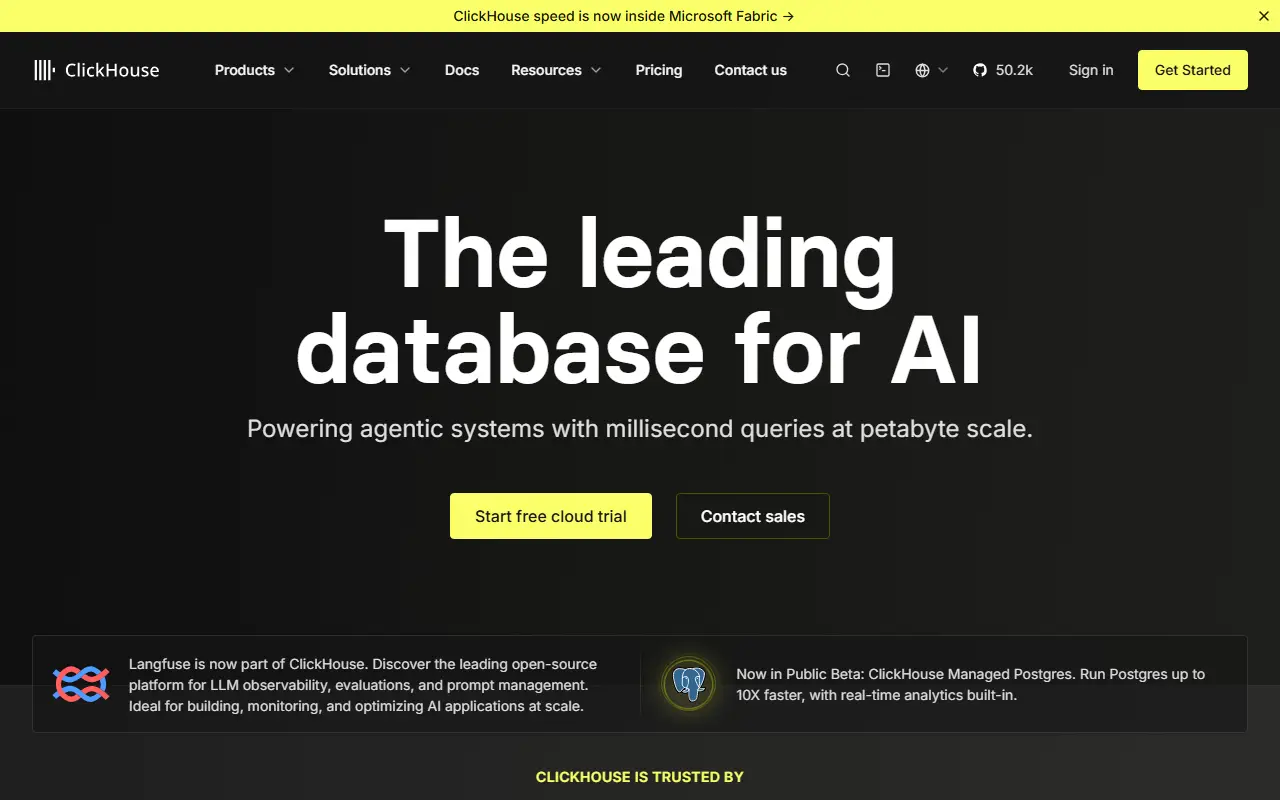
ClickHouse is an open-source database management system built to generate analytical reports in real time. Its column-oriented storage makes scans and aggregations over very large tables efficient, which is why it is widely used for event data, logs, metrics and product analytics. It is written in C++ and queried with SQL.
The project's topics describe it as an OLAP, massively parallel and distributed system, and it is used for big data workloads where query latency matters. You can install it on Linux, macOS or FreeBSD, follow a tutorial that sets up a small cluster, or skip installation by trying ClickHouse Cloud, a managed service built by its creators. Releases arrive monthly, with a community call for each one, and there are Slack and Telegram channels for help.
ClickHouse is Apache-2.0 licensed. It is a good fit for analytics engineers and platform teams who need fast aggregations over billions of rows and are comfortable operating a database, or who prefer to hand that operation to the vendor's cloud.
Key features
- Column-oriented storage for analytics
- SQL queries over large datasets
- Distributed, massively parallel processing
- Real-time analytical reporting
- Install on Linux, macOS or FreeBSD
- Managed ClickHouse Cloud option
Pricing: The open-source distribution is free. ClickHouse Cloud is usage-based, with plans from $53 (Basic), $437 (Scale) and $571 (Enterprise) per month and a 30-day trial with $300 in credits.
#3
A PostgreSQL extension that adds time-series storage, hypertables and a columnstore for fast, real-time analytics on event data.
- GitHub stars
- 24k
- Last commit
- today
- Latest release
- 2.32.0
- Self-hosted
- Yes
- Hosted version
- Available
tigerdata.com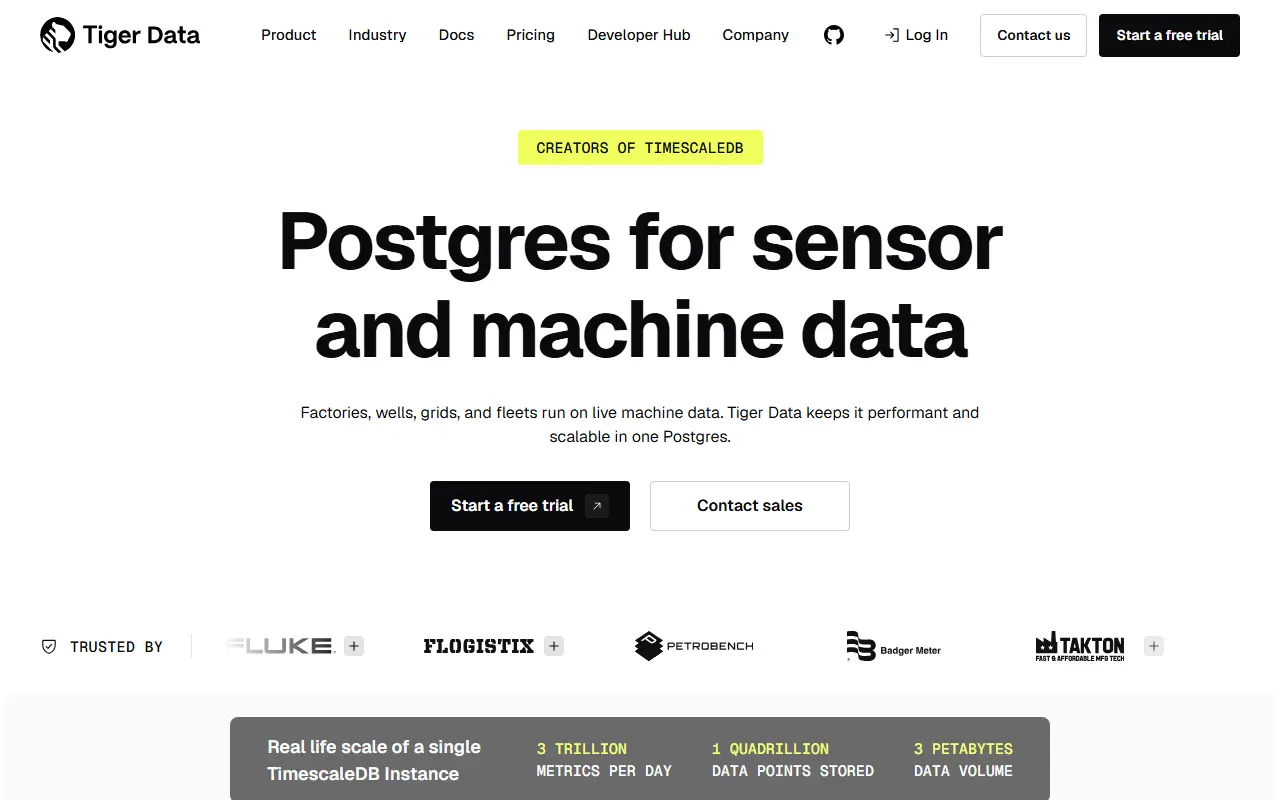
TimescaleDB is a PostgreSQL extension that turns Postgres into a database for time-series and event data, aimed at real-time analytics. Because it lives inside PostgreSQL, you keep SQL, existing tools and the broader Postgres ecosystem while gaining storage and query features designed for data that arrives continuously with timestamps.
The quick start walks through running it locally with a one-line install script or Docker, creating a hypertable with the columnstore enabled, inserting data directly into the columnstore and running analytical queries. It suggests Docker, around 8 GB of RAM and a psql or other PostgreSQL client, and warns that the install script is meant for local development and testing, not production. Topics list uses such as IoT, financial analysis and historian data.
The code is written in C, and its license is listed as 'Other' on GitHub because some features sit under Timescale's own license rather than a standard open-source one, so check which apply to you. The company, now branded TigerData, also runs a hosted cloud service. It suits teams who want time-series features without leaving PostgreSQL.
Key features
- PostgreSQL extension for time-series data
- Hypertables with columnstore
- Fast analytical queries on event data
- Full SQL and Postgres tooling compatibility
- Docker and one-line local install
- Managed cloud service from the vendor
Pricing: The open-source TimescaleDB is free to self-host. Tiger Cloud compute starts at $30 per month on Performance and $36 on Scale, plus storage, billed hourly with a 30-day free trial; Enterprise is by contact.
#4
A distributed SQL query engine for big data analytics that runs fast queries across many data sources, formerly known as PrestoSQL.
- GitHub stars
- 14k
- Last commit
- today
- Latest release
- 484
- Licence
- Apache-2.0
- Self-hosted
- Yes
trino.io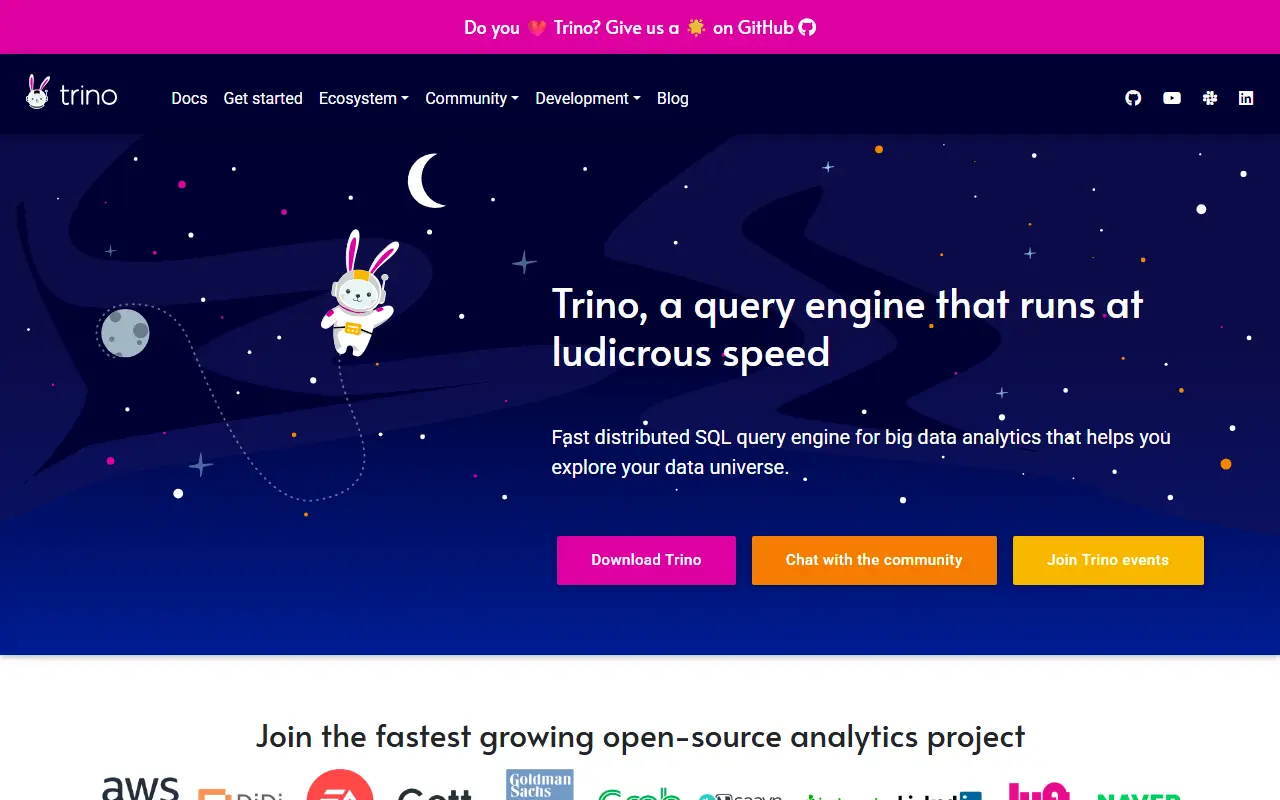
Trino is a distributed SQL query engine built for analytics on large data sets. It was formerly called PrestoSQL, and it lets analysts and engineers run interactive SQL against data wherever it lives rather than first moving it into a single warehouse.
The project's topics point to its role in the data lake ecosystem, with connectors and integrations for systems such as Hive, Hadoop, Iceberg and Delta Lake, and a JDBC driver for applications. Trino is a Maven project written in Java, and its repository covers development guidelines, plugin implementors, a security policy and reproducible builds. It runs as a cluster of servers and has a web UI.
Trino is released under the Apache-2.0 licence and is deployed and operated by the user, with deployment instructions and end-user documentation in the project's user manual. It is a fit for data platform teams that need fast, standards-based SQL over many sources, rather than for individual analysts looking for a point-and-click tool.
Key features
- Distributed SQL query engine
- Fast analytics on big data
- Connectors for data lake formats like Iceberg
- JDBC access for applications
- Plugin architecture for custom connectors
- Reproducible builds since version 449
Pricing: Free and open source under the Apache-2.0 licence.
#5
Apache Doris is an open-source, MPP real-time analytics and hybrid search database for fast SQL, lakehouse query acceleration and vector and text search.
- GitHub stars
- 16k
- Last commit
- yesterday
- Latest release
- 4.1.5-release
- Licence
- Apache-2.0
- Self-hosted
- Yes
doris.apache.org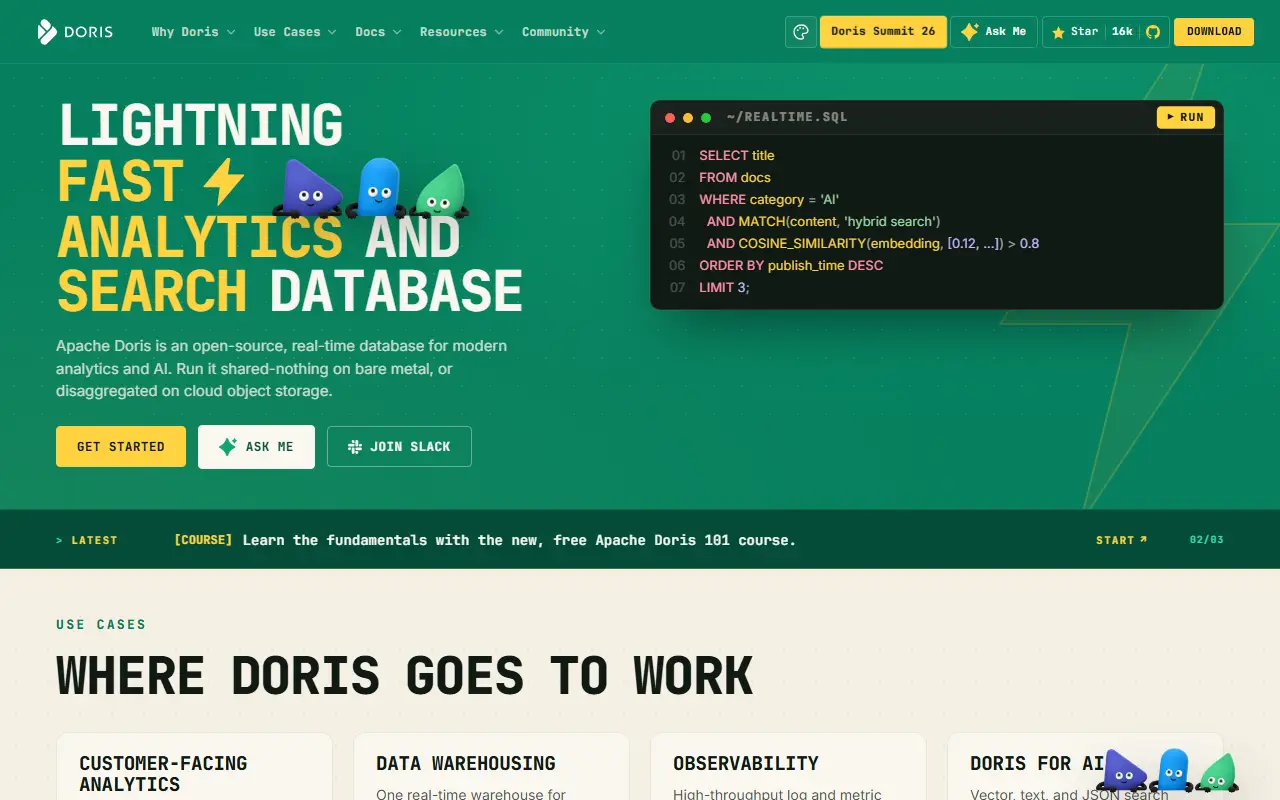
Apache Doris is an open-source analytics database built on a massively parallel processing architecture. It offers fast SQL analytics, acceleration of queries over lakehouse data, and hybrid search spanning structured, text and vector data, and it presents itself as a real-time analytics and search engine suitable for AI agents. It is written in Java.
The README lists use cases that include customer-facing analytics with sub-second interactive queries for external users, data warehousing across business domains, observability for high-throughput logs, events and metrics analyzed with SQL, and AI use where vector, text, JSON and structured search run in one SQL engine. Topics mention lakehouse formats Hudi, Iceberg and Delta Lake and comparisons with warehouses such as BigQuery, Redshift and Snowflake.
Doris is a project of the Apache Software Foundation and Apache-2.0 licensed. You can deploy it on your own clusters, and the website provides release notes, use cases and user stories, with documentation in a large number of languages. It suits data engineering teams that want an open-source, high-concurrency analytical database.
Key features
- MPP architecture for fast SQL analytics
- Lakehouse query acceleration
- Hybrid search across structured, text and vector data
- Real-time ingestion and analysis
- Support for Iceberg, Hudi and Delta Lake
- Apache Software Foundation project
Pricing: Free and open source under the Apache-2.0 license.
#6
A Linux Foundation project: an analytical SQL engine for real-time and ad-hoc queries, running on its own storage or directly over data lakehouse tables.
- GitHub stars
- 12k
- Last commit
- today
- Latest release
- 4.1.7
- Licence
- Apache-2.0
- Self-hosted
- Yes
starrocks.io
StarRocks is a query engine for analytics that returns answers quickly to multi-dimensional, real-time and ad-hoc queries. It is a Linux Foundation project written in Java, and can be used both on its own tables and over data that sits in a data lake or lakehouse without first moving it.
It uses a vectorized SQL engine that takes advantage of CPU parallelism, supports standard ANSI SQL and the MySQL protocol so existing clients and BI tools can connect, and applies a cost-based optimizer to complex queries. Primary-key tables support upserts and deletes with efficient querying during concurrent updates, and materialized views refresh during data import and are chosen automatically at query time.
Data in Hive, Iceberg, Delta Lake and Hudi tables can be queried in place, and its topics point to star-schema, MPP and distributed-database designs. The software is licensed under Apache-2.0 and can be downloaded and run yourself, with documentation, benchmarks and a demo linked from the README. It suits data teams that want fast dashboards and lakehouse analytics without heavy denormalization.
Key features
- Vectorized SQL engine for fast analytics
- ANSI SQL with MySQL protocol compatibility
- Cost-based query optimizer
- Real-time upserts and deletes by primary key
- Automatically maintained materialized views
- Direct queries over Hive, Iceberg, Delta Lake and Hudi
Pricing: Free and open source under the Apache-2.0 licence.
#7
An open-source cloud data warehouse written in Rust that unifies analytics, vector search and full-text search on object storage, with sandboxed UDFs for AI agents.
- GitHub stars
- 9.5k
- Last commit
- today
- Latest release
- v1.2.881
- Self-hosted
- Yes
- Hosted version
- Available
docs.databend.com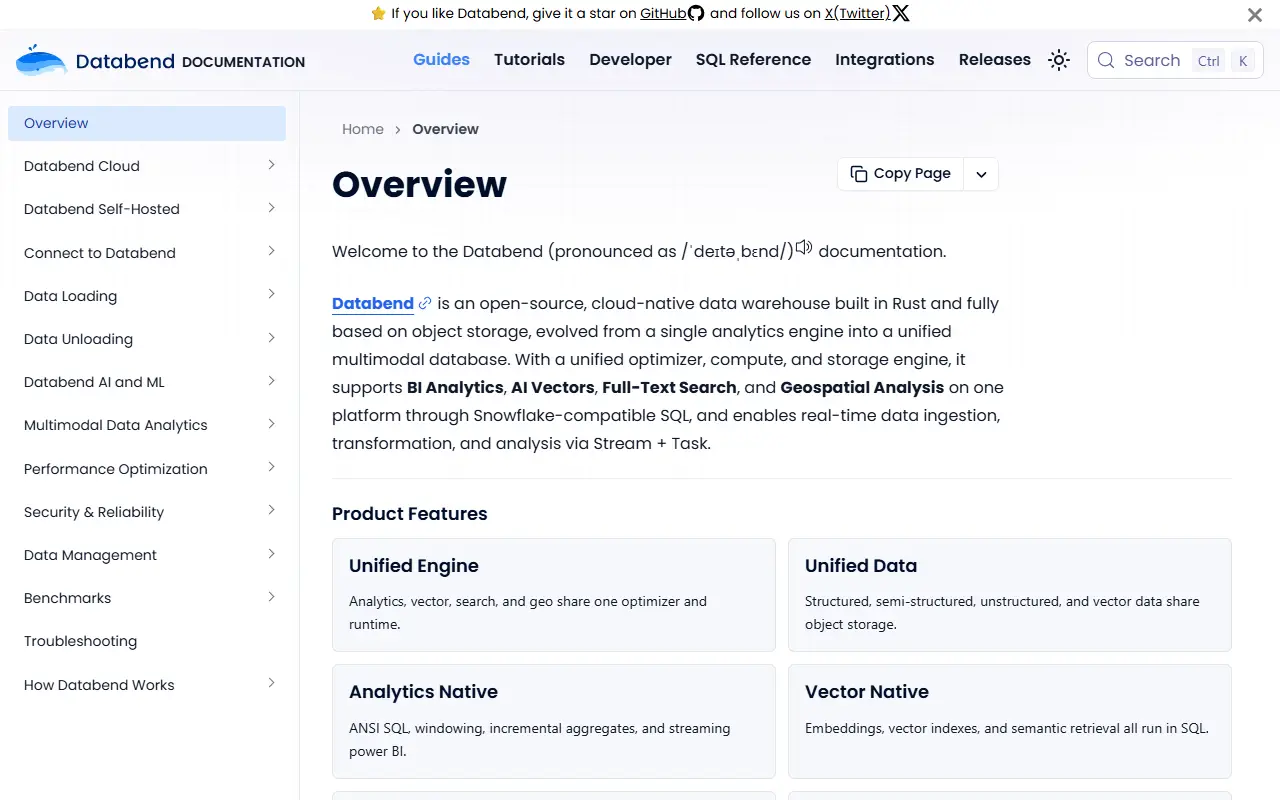
Databend is an enterprise-grade, open-source data warehouse written in Rust. It combines large-scale analytics, vector search, full-text search and automatic schema evolution in one engine, and keeps data in object storage such as S3, Azure Blob Storage or Google Cloud Storage with elastic, cloud-native compute.
The project now positions itself as a warehouse that is ready for AI agents. Sandboxed Python user-defined functions run agent logic, SQL handles orchestration, transactions provide reliability, and Git-like branching lets agents experiment safely on production snapshots. A three-layer architecture separates the control plane, the execution plane and the sandbox workers. Typical use cases listed include AI agents, analytics and BI, and search and RAG.
You can use the managed Databend Cloud, run it locally from Python for development and testing, or start the full warehouse in Docker. The repository lists the licence as Other, so review the licence file before commercial use. Topics reference Snowflake and Elasticsearch as comparable products.
Key features
- Large-scale SQL analytics
- Vector and full-text search
- Automatic schema evolution
- Sandboxed Python UDFs for agents
- Git-like data branching
- Object storage on S3, Azure or GCS
- Cloud, Docker and local Python options
Pricing: Databend Cloud offers a free start; the repository lists the license as Other.
#8
Apache Hive is data warehouse software that lets you read, write and manage large datasets in distributed storage using SQL on top of Hadoop.
- GitHub stars
- 6k
- Last commit
- today
- Licence
- Apache-2.0
- Self-hosted
- Yes
hive.apache.org
Apache Hive is data warehouse software built on Apache Hadoop. It makes it possible to read, write and manage very large datasets in distributed storage using SQL, so analysts can run extract-transform-load jobs, reports and data analysis without writing low-level processing code.
Hive provides tools for accessing data through SQL, a way of imposing structure on a variety of data formats, and access to files stored in Apache HDFS or other systems such as Apache HBase. Queries can run on the Apache Tez framework, which is designed for interactive queries and has far lower overhead than MapReduce. It supports much standard SQL functionality, including many analytics features from the 2003 and 2011 SQL standards.
Hive is an Apache Software Foundation project written in Java and licensed under Apache-2.0. You deploy it on your own Hadoop-based clusters, though hosted big data platforms from cloud providers also bundle it. It suits data engineering teams maintaining batch analytics on large distributed data.
Key features
- SQL access to distributed datasets
- Built on Apache Hadoop
- Reads data from HDFS and HBase
- Query execution on Apache Tez
- ETL, reporting and analysis workloads
- Standard SQL analytics functions
Pricing: Free and open source under the Apache-2.0 license.
#9
CrateDB is a distributed, PostgreSQL-compatible SQL database built on Lucene for real-time analytics over large volumes of time-series, JSON and vector data.
- GitHub stars
- 4.5k
- Last commit
- today
- Latest release
- 6.5.1
- Licence
- Apache-2.0
- Self-hosted
- Yes
- Hosted version
- Available
cratedb.com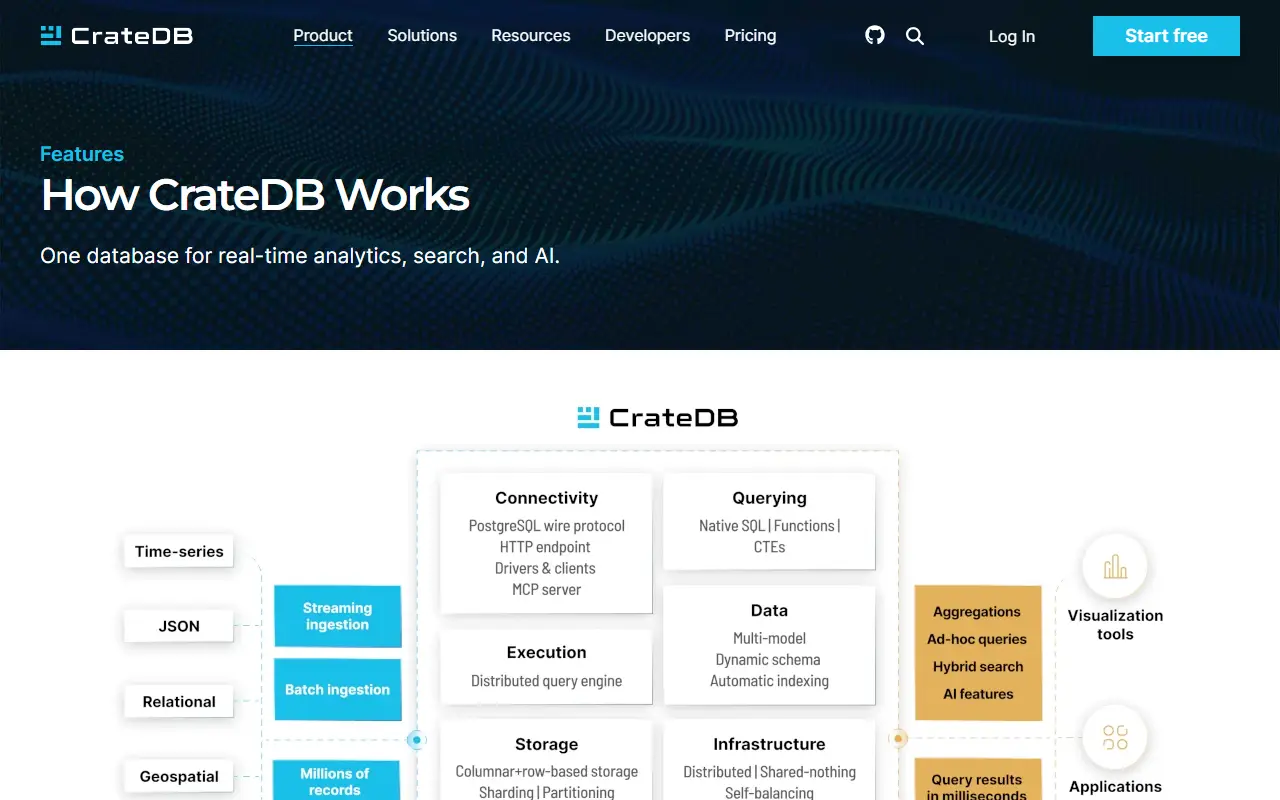
CrateDB is a scalable, distributed SQL database for storing and analyzing very large volumes of data in near real time, including complex queries. It is compatible with PostgreSQL and based on Lucene, and the vendor describes answers in under a second across datasets of millions to billions of rows and many data types, without pre-aggregation.
The product handles many data models in one engine, including time series, document and JSON, vector, full-text, spatial and relational data. Its repository topics mention IoT, industrial IoT, OLAP, analytics and vector databases. The code is written in Java, and the vendor lists solutions for real-time industrial analytics, AI operations and application analytics across industries such as manufacturing and energy.
CrateDB is licensed under Apache-2.0 in its open-source edition. It is available as the OSS build you run yourself, as an enterprise edition and as the managed CrateDB Cloud, with pricing published on the vendor's site. It suits teams building analytics on high-volume machine and event data.
Key features
- Distributed SQL engine
- PostgreSQL wire compatibility
- Time-series, JSON, vector and full-text data
- Spatial and relational data models
- Real-time analytics on large datasets
- OSS, enterprise and cloud editions
Pricing: CrateDB Cloud has a free plan with 2 vCPUs. Shared clusters start at $0.073 per hour and dedicated clusters at $0.246 per hour including basic support; custom plans are quoted.
#10
Apache Cloudberry is an open-source MPP database based on PostgreSQL for data warehousing and large-scale analytics, positioned as a Greenplum alternative.
- GitHub stars
- 1.4k
- Last commit
- today
- Latest release
- 2.2.0-incubating
- Licence
- Apache-2.0
- Self-hosted
- Yes
cloudberry.apache.org
Apache Cloudberry, currently in the Apache incubator, is an open-source massively parallel processing database. It was created by original developers of Greenplum Database and evolves from the open-source version of Pivotal Greenplum, but uses a newer PostgreSQL kernel and adds enterprise capabilities. It is described as an open-source alternative to Greenplum Database.
It can serve as a data warehouse and is also intended for large-scale analytics and AI or machine learning workloads, distributing queries across many nodes. Because it is based on PostgreSQL, it uses familiar SQL. The main repository sits alongside ecosystem repositories for the website, a backup utility, Go libraries and the Platform Extension Framework (PXF) for connecting to external data.
Cloudberry is written in C and licensed under Apache-2.0. You can build it from source on Linux, including RHEL, Rocky Linux and Ubuntu, and macOS, or try it quickly through a Docker-based sandbox. Community help is available through Slack and GitHub Discussions. It suits data engineering teams running large analytical workloads that want an open-source MPP engine they can operate themselves.
Key features
- Massively parallel processing SQL engine
- PostgreSQL-based kernel
- Data warehouse and analytics workloads
- Backup utility and PXF connectors
- Docker sandbox for trying it out
- Builds on Linux and macOS
Pricing: Free and open source under the Apache-2.0 licence.
1 more Firebolt alternative
Firebolt alternatives: questions
- What is the best open-source alternative to Firebolt?
- DuckDB is the top-ranked open-source alternative to Firebolt on Enlisted: An analytical, in-process SQL database that runs inside your application or from a CLI, with a rich SQL dialect and easy CSV and Parquet querying. Other strong options are ClickHouse, TimescaleDB, Trino and Apache Doris.
- What are the best commercial alternatives to Firebolt?
- Amazon Athena, Amazon Redshift, Google BigQuery, Exasol and Teradata are among the hosted, closed-source alternatives to Firebolt listed on Enlisted, which lists 16 in total. Compare their pricing and features on each tool page.
- Are these Firebolt alternatives free?
- All 11 are open source, so the code is free to use under its licence, and all of them can be self-hosted on your own server or computer. 4 also offer a paid or managed cloud version if you'd rather not host it yourself.
- How is this list of Firebolt alternatives ranked?
- By a score built from GitHub stars, star growth over the last 30 days and how recently the code changed. 10 of these projects shipped code in the last 30 days. Data is refreshed daily, and nobody can pay to move up.
 TrackMedia
 TrackRev