7,363 open-source and SaaS tools, with GitHub stats refreshed every day.

6 alternatives ranked by real activity

Open-source Tinybird alternatives

A curated, ranked list of the 6 best open-source alternatives to Tinybird.

The best open-source alternative to Tinybird is ClickHouse. If that doesn't suit you, other good options are QuestDB, Apache Doris, StarRocks and Databend.

Tinybird alternatives are mainly databases, but some are also API tools. 5 of them shipped code in the last 30 days, 6 can be self-hosted, and 5 use a permissive licence.

Last updated October 2, 2026 · ranked by GitHub stars, growth and recent commits

ClickHouse

An open-source column-oriented database management system built for real-time analytical reports, available to self-host or as the managed ClickHouse Cloud service.

GitHub stars
50k
Last commit
today
Latest release
v26.9.8.3-stable
Licence
Apache-2.0
Self-hosted
Yes
Hosted version
Available
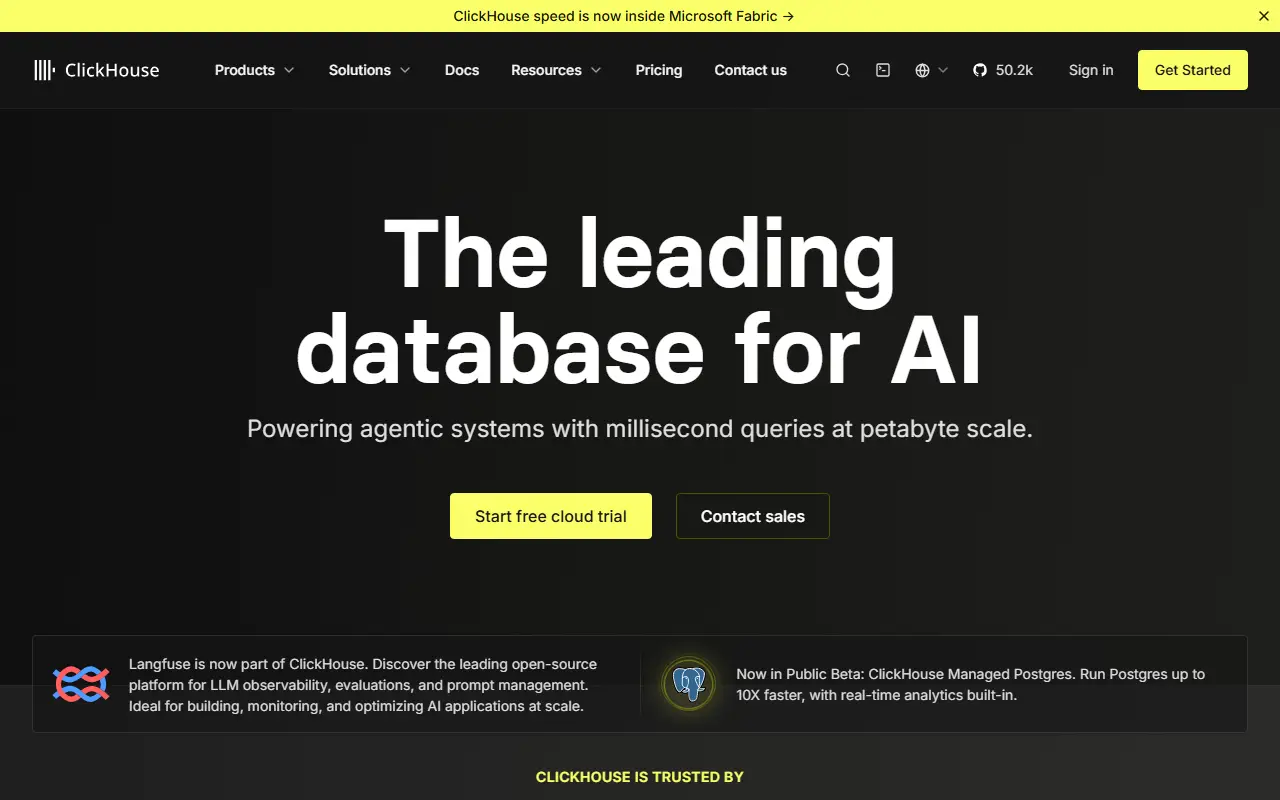
clickhouse.comClickHouse homepage screenshot

ClickHouse is an open-source database management system built to generate analytical reports in real time. Its column-oriented storage makes scans and aggregations over very large tables efficient, which is why it is widely used for event data, logs, metrics and product analytics. It is written in C++ and queried with SQL.

The project's topics describe it as an OLAP, massively parallel and distributed system, and it is used for big data workloads where query latency matters. You can install it on Linux, macOS or FreeBSD, follow a tutorial that sets up a small cluster, or skip installation by trying ClickHouse Cloud, a managed service built by its creators. Releases arrive monthly, with a community call for each one, and there are Slack and Telegram channels for help.

ClickHouse is Apache-2.0 licensed. It is a good fit for analytics engineers and platform teams who need fast aggregations over billions of rows and are comfortable operating a database, or who prefer to hand that operation to the vendor's cloud.

Key features

  • Column-oriented storage for analytics
  • SQL queries over large datasets
  • Distributed, massively parallel processing
  • Real-time analytical reporting
  • Install on Linux, macOS or FreeBSD
  • Managed ClickHouse Cloud option

Pricing: The open-source distribution is free. ClickHouse Cloud is usage-based, with plans from $53 (Basic), $437 (Scale) and $571 (Enterprise) per month and a 30-day trial with $300 in credits.

QuestDB

An open-source, low-latency time-series database with a single SQL engine for ingestion, stream processing and tiered storage on open formats like Parquet.

GitHub stars
17k
Last commit
today
Latest release
10.0.1
Licence
Apache-2.0
Self-hosted
Yes
questdb.comQuestDB homepage screenshot

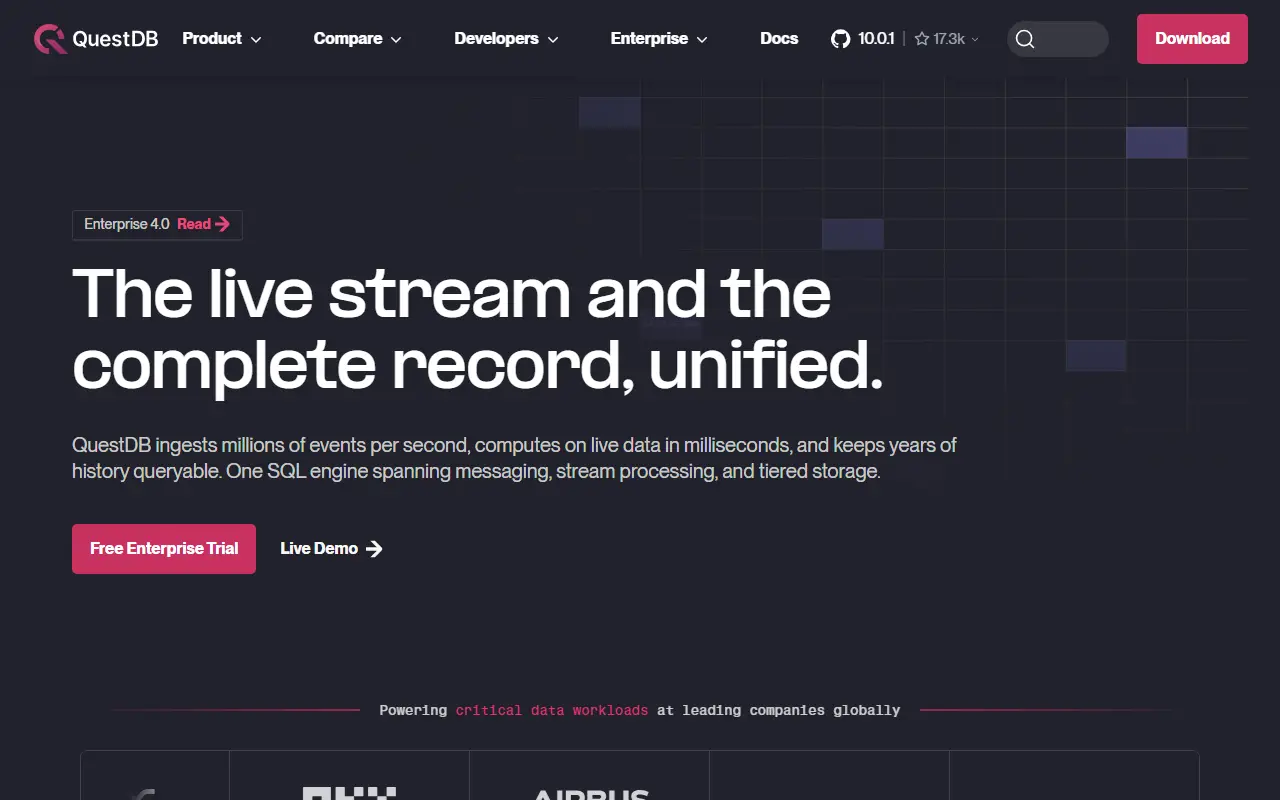
QuestDB is an open-source time-series database aimed at high-speed ingestion and fast analytical queries, with a focus on use cases such as capital markets, tick data and real-time analytics. One SQL engine covers ingestion, stream processing and long-term storage, so teams query live data and years of history the same way.

The engine is written in Java that avoids garbage collection, with C++ and Rust used on performance-critical paths. Data is held in memory-mapped, time-partitioned columns, and queries run across all CPU cores using SIMD and JIT-compiled filters. No third-party libraries sit on the data path. Data moves through three storage tiers: Apache Parquet files, native columnar partitions, and a write-ahead log that is written in parallel. In the open-source edition you convert partitions to Parquet manually, while the Enterprise edition automates tiering to object storage. Because the data stays in open formats (Parquet, Iceberg and Arrow), other tools can read it, and the README publishes benchmark figures for ingestion and query streaming.

QuestDB is Apache-2.0 licensed and runs on your own servers, with documentation also available in Chinese. It suits teams building financial, industrial or telemetry platforms who need very fast time-series ingestion.

Key features

  • Single SQL engine for time-series data
  • Very high-speed event ingestion
  • SIMD and JIT-accelerated queries
  • Tiered storage with Parquet
  • Open formats: Parquet, Iceberg and Arrow
  • Memory-mapped time-partitioned columns

Pricing: The open-source edition is free under the Apache-2.0 license; an Enterprise edition adds features such as automatic tiering.

Apache Doris

Apache Doris is an open-source, MPP real-time analytics and hybrid search database for fast SQL, lakehouse query acceleration and vector and text search.

GitHub stars
16k
Last commit
yesterday
Latest release
4.1.4.1
Licence
Apache-2.0
Self-hosted
Yes
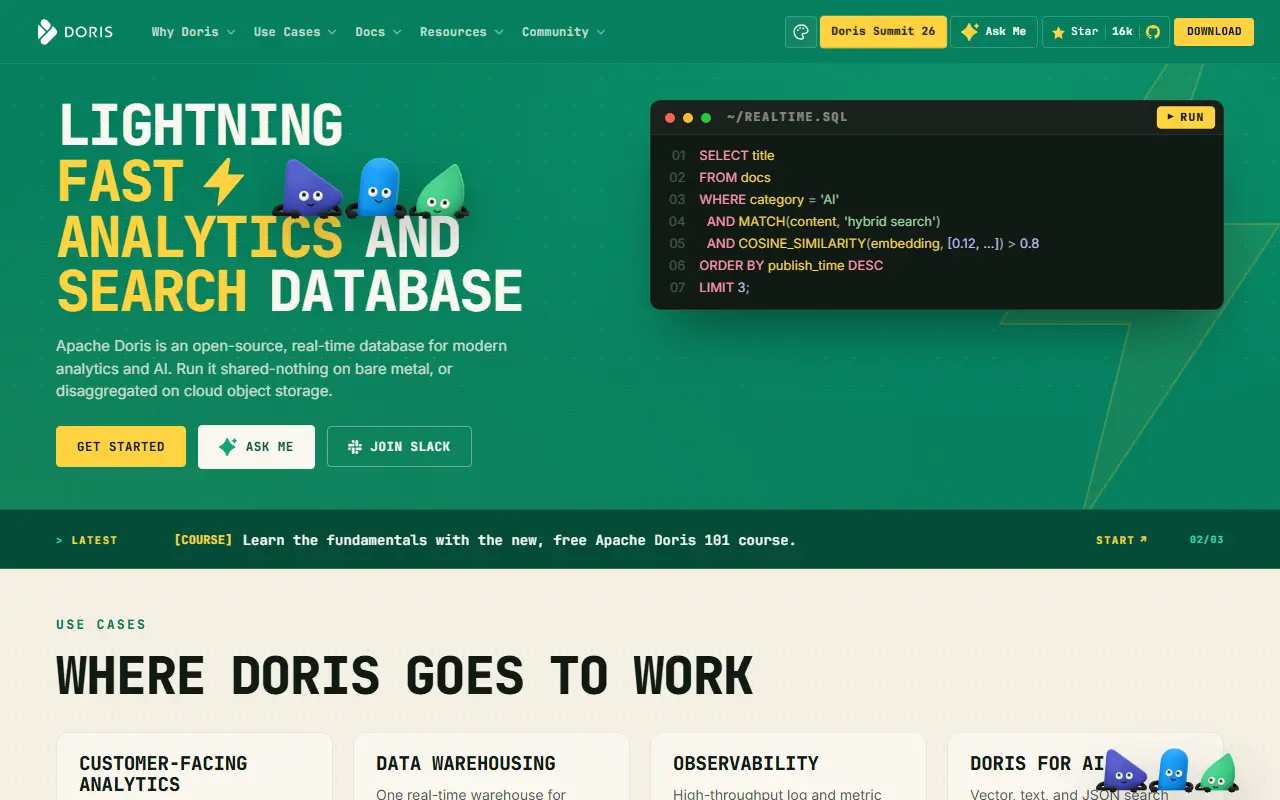
doris.apache.orgApache Doris homepage screenshot

Apache Doris is an open-source analytics database built on a massively parallel processing architecture. It offers fast SQL analytics, acceleration of queries over lakehouse data, and hybrid search spanning structured, text and vector data, and it presents itself as a real-time analytics and search engine suitable for AI agents. It is written in Java.

The README lists use cases that include customer-facing analytics with sub-second interactive queries for external users, data warehousing across business domains, observability for high-throughput logs, events and metrics analyzed with SQL, and AI use where vector, text, JSON and structured search run in one SQL engine. Topics mention lakehouse formats Hudi, Iceberg and Delta Lake and comparisons with warehouses such as BigQuery, Redshift and Snowflake.

Doris is a project of the Apache Software Foundation and Apache-2.0 licensed. You can deploy it on your own clusters, and the website provides release notes, use cases and user stories, with documentation in a large number of languages. It suits data engineering teams that want an open-source, high-concurrency analytical database.

Key features

  • MPP architecture for fast SQL analytics
  • Lakehouse query acceleration
  • Hybrid search across structured, text and vector data
  • Real-time ingestion and analysis
  • Support for Iceberg, Hudi and Delta Lake
  • Apache Software Foundation project

Pricing: Free and open source under the Apache-2.0 license.

StarRocks

A Linux Foundation project: an analytical SQL engine for real-time and ad-hoc queries, running on its own storage or directly over data lakehouse tables.

GitHub stars
12k
Last commit
today
Latest release
4.1.3
Licence
Apache-2.0
Self-hosted
Yes
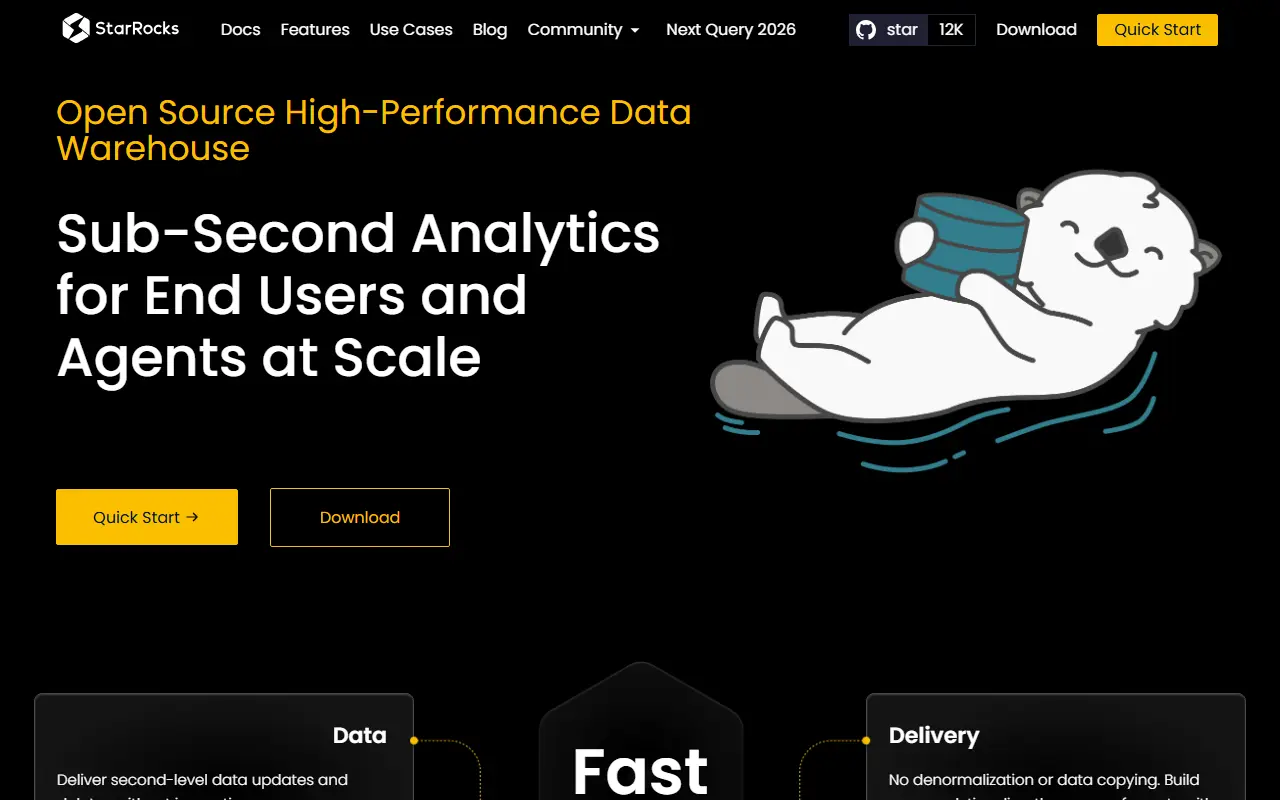
starrocks.ioStarRocks homepage screenshot

StarRocks is a query engine for analytics that returns answers quickly to multi-dimensional, real-time and ad-hoc queries. It is a Linux Foundation project written in Java, and can be used both on its own tables and over data that sits in a data lake or lakehouse without first moving it.

It uses a vectorized SQL engine that takes advantage of CPU parallelism, supports standard ANSI SQL and the MySQL protocol so existing clients and BI tools can connect, and applies a cost-based optimizer to complex queries. Primary-key tables support upserts and deletes with efficient querying during concurrent updates, and materialized views refresh during data import and are chosen automatically at query time.

Data in Hive, Iceberg, Delta Lake and Hudi tables can be queried in place, and its topics point to star-schema, MPP and distributed-database designs. The software is licensed under Apache-2.0 and can be downloaded and run yourself, with documentation, benchmarks and a demo linked from the README. It suits data teams that want fast dashboards and lakehouse analytics without heavy denormalization.

Key features

  • Vectorized SQL engine for fast analytics
  • ANSI SQL with MySQL protocol compatibility
  • Cost-based query optimizer
  • Real-time upserts and deletes by primary key
  • Automatically maintained materialized views
  • Direct queries over Hive, Iceberg, Delta Lake and Hudi

Pricing: Free and open source under the Apache-2.0 licence.

Databend

An open-source cloud data warehouse written in Rust that unifies analytics, vector search and full-text search on object storage, with sandboxed UDFs for AI agents.

GitHub stars
9.5k
Last commit
today
Latest release
v1.2.881
Self-hosted
Yes
Hosted version
Available
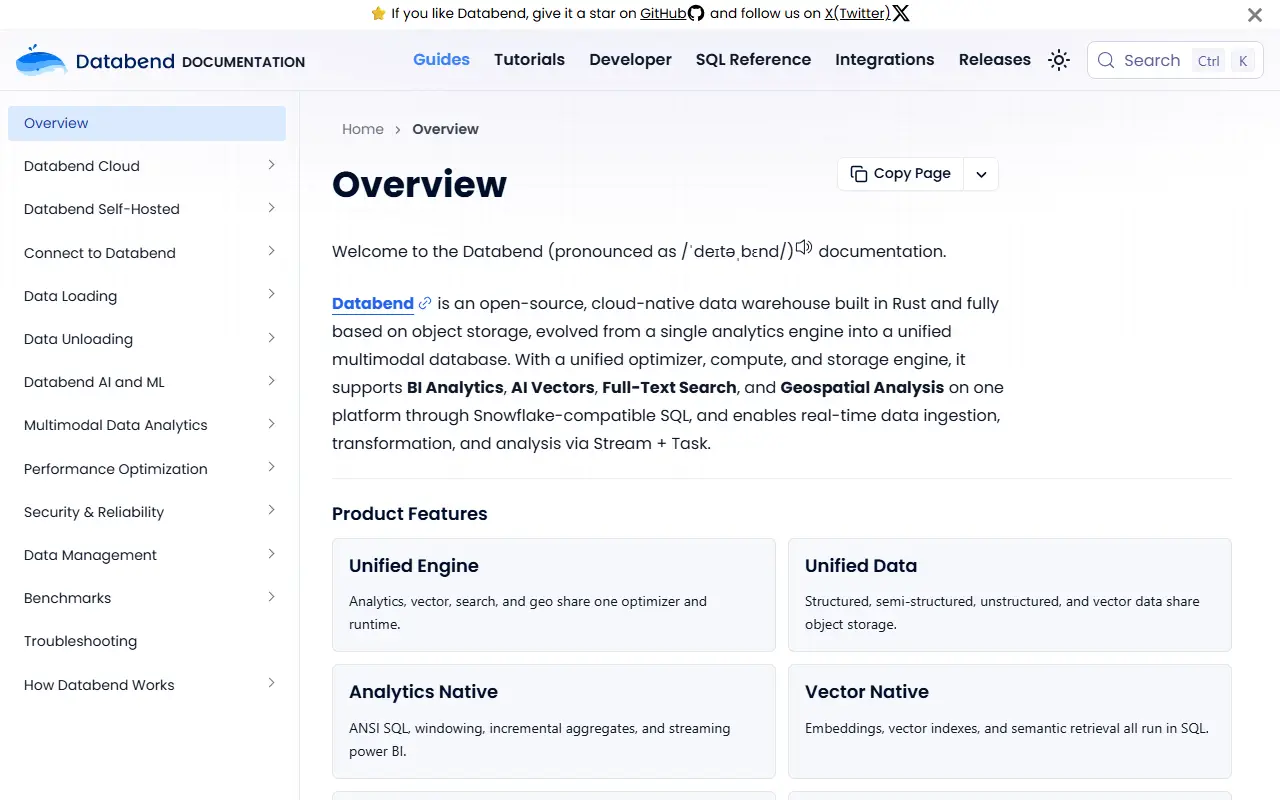
docs.databend.comDatabend homepage screenshot

Databend is an enterprise-grade, open-source data warehouse written in Rust. It combines large-scale analytics, vector search, full-text search and automatic schema evolution in one engine, and keeps data in object storage such as S3, Azure Blob Storage or Google Cloud Storage with elastic, cloud-native compute.

The project now positions itself as a warehouse that is ready for AI agents. Sandboxed Python user-defined functions run agent logic, SQL handles orchestration, transactions provide reliability, and Git-like branching lets agents experiment safely on production snapshots. A three-layer architecture separates the control plane, the execution plane and the sandbox workers. Typical use cases listed include AI agents, analytics and BI, and search and RAG.

You can use the managed Databend Cloud, run it locally from Python for development and testing, or start the full warehouse in Docker. The repository lists the licence as Other, so review the licence file before commercial use. Topics reference Snowflake and Elasticsearch as comparable products.

Key features

  • Large-scale SQL analytics
  • Vector and full-text search
  • Automatic schema evolution
  • Sandboxed Python UDFs for agents
  • Git-like data branching
  • Object storage on S3, Azure or GCS
  • Cloud, Docker and local Python options

Pricing: Databend Cloud offers a free start; the repository lists the license as Other.

VulcanSQL

VulcanSQL turns SQL queries into REST APIs over databases, data warehouses and data lakes, aimed at AI agents and data applications.

GitHub stars
793
Last commit
2 yr ago
Latest release
v0.10.4
Licence
Apache-2.0
Self-hosted
Yes
vulcansql.comVulcanSQL homepage screenshot

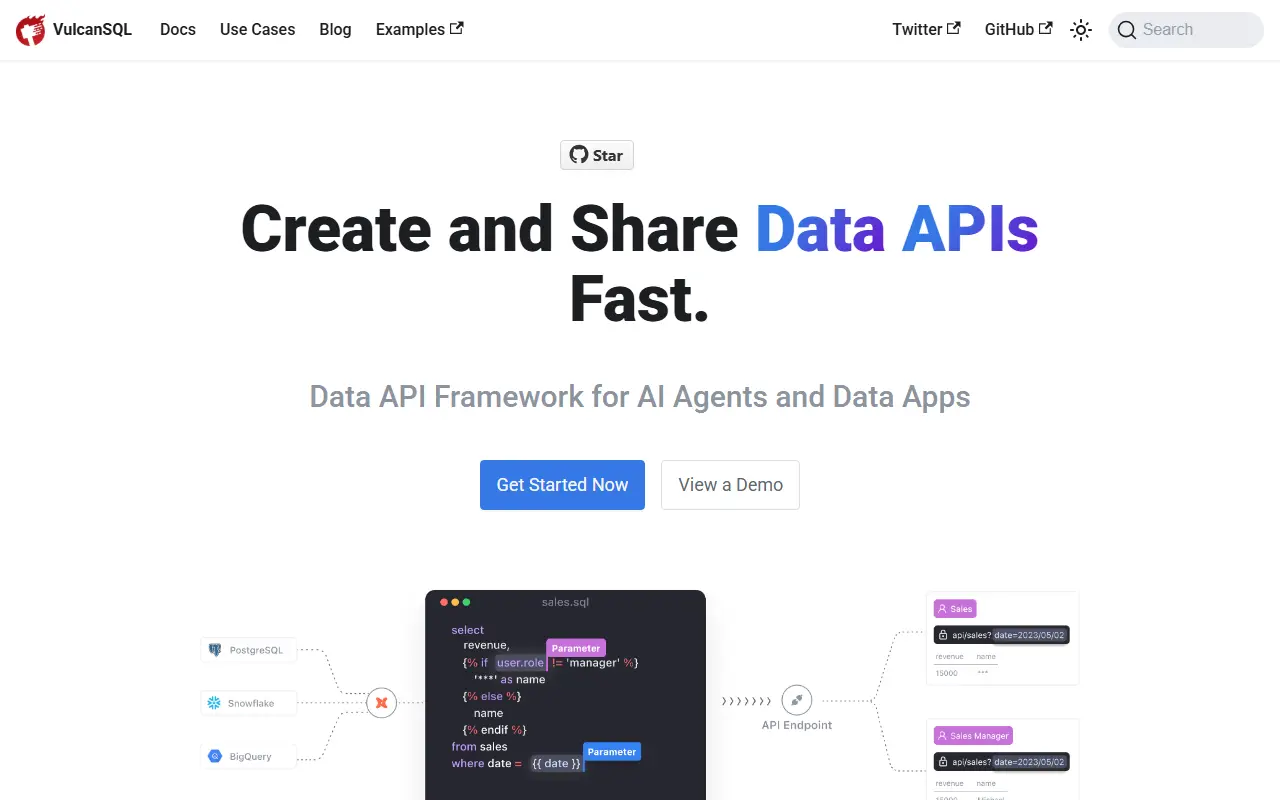
VulcanSQL is a data API framework that lets data professionals expose analytical data as RESTful APIs by writing SQL. It targets AI agents and data apps that need controlled access to databases, data warehouses or data lakes, replacing much of the hand-written API code that normally sits between the two.

The README frames the problem as slow and error-prone custom API development, the complexity of integrating diverse data sources, and the work of making APIs secure and compliant with regulations such as GDPR and HIPAA. VulcanSQL aims to standardize the approach so APIs follow consistent conventions. Its topics list integrations with BigQuery, DuckDB, PostgreSQL, Snowflake, ClickHouse and ksqlDB.

It is written in TypeScript and released under Apache-2.0. Typical users are analytics engineers and data teams who want to share data with stakeholders or feed it into AI agents without building a service from scratch; documentation is at vulcansql.com.

Key features

  • Turn SQL queries into REST APIs
  • Connects to databases, warehouses and lakes
  • Designed for AI agents and data apps
  • Support for BigQuery, Snowflake and PostgreSQL
  • DuckDB and ClickHouse connectors
  • Standardized API conventions

Pricing: Free and open source under the Apache-2.0 license.

Tinybird alternatives: questions

What is the best open-source alternative to Tinybird?
ClickHouse is the top-ranked open-source alternative to Tinybird on Enlisted: An open-source column-oriented database management system built for real-time analytical reports, available to self-host or as the managed ClickHouse Cloud service. Other strong options are QuestDB, Apache Doris, StarRocks and Databend.
Are these Tinybird alternatives free?
All 6 are open source, so the code is free to use under its licence, and all of them can be self-hosted on your own server or computer. 2 also offer a paid or managed cloud version if you'd rather not host it yourself.
How is this list of Tinybird alternatives ranked?
By a score built from GitHub stars, star growth over the last 30 days and how recently the code changed. 5 of these projects shipped code in the last 30 days. Data is refreshed daily, and nobody can pay to move up.

People also look for alternatives to…

View all