7,363 open-source and SaaS tools, with GitHub stats refreshed every day.

2 alternatives ranked by real activity

Open-source MotherDuck alternatives

A curated, ranked list of the 2 best open-source alternatives to MotherDuck.

The best open-source alternative to MotherDuck is DuckDB. If that doesn't suit you, another good option is GlareDB.

MotherDuck alternatives are mainly databases. 1 of them shipped code in the last 30 days, 2 can be self-hosted, and 2 use a permissive licence.

Last updated October 2, 2026 · ranked by GitHub stars, growth and recent commits

DuckDB

An analytical, in-process SQL database that runs inside your application or from a CLI, with a rich SQL dialect and easy CSV and Parquet querying.

GitHub stars
42k
Last commit
yesterday
Latest release
v1.5.6
Licence
MIT
Self-hosted
Yes
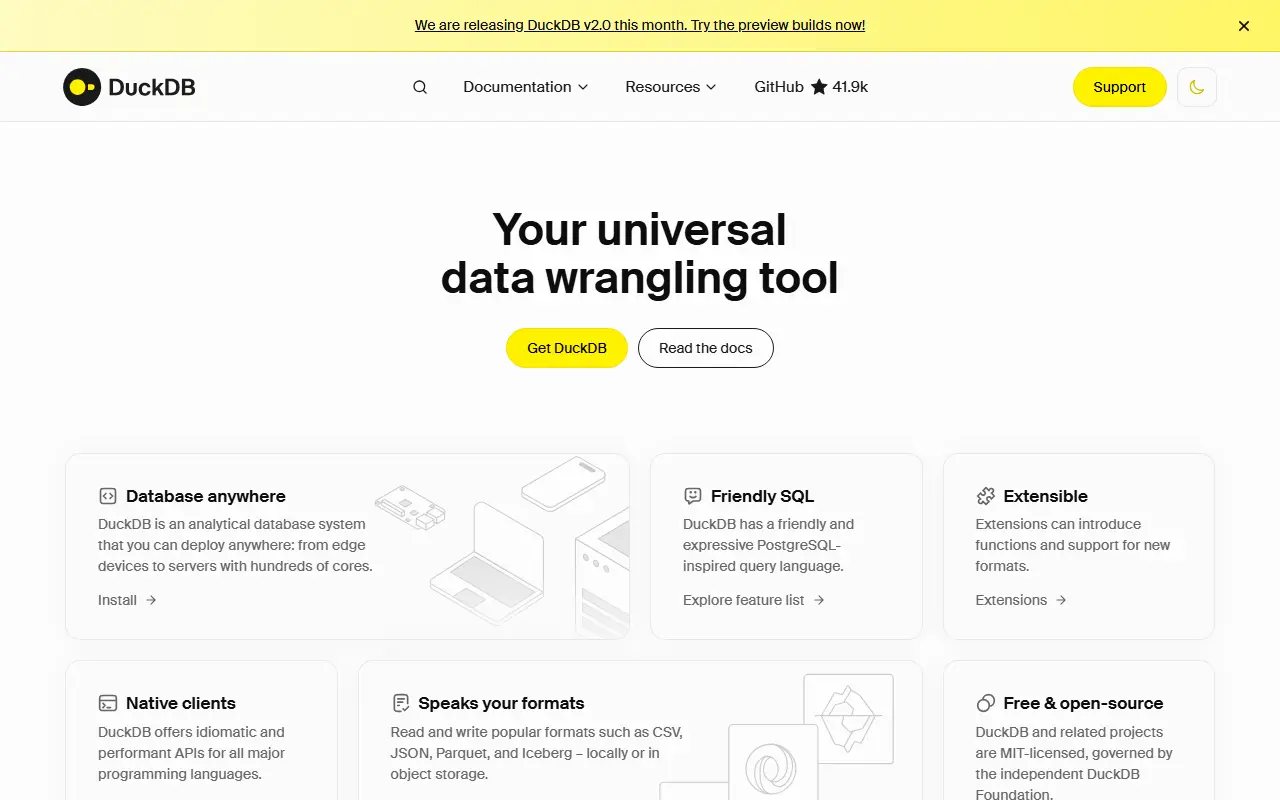
duckdb.orgDuckDB homepage screenshot

DuckDB is an analytical SQL database management system that runs in-process, meaning it is embedded in your application or notebook rather than running as a separate server. The goals are speed, reliability, portability and ease of use for analytical queries, and it is written in C++.

Its SQL dialect goes well beyond the basics: it handles arbitrary nested correlated subqueries, window functions, collations and complex types such as arrays, structs and maps, plus extensions that make SQL more convenient. CSV and Parquet files can be queried by naming them in a FROM clause. DuckDB is available as a standalone command line tool and has clients for Python, R, Java and WebAssembly, with deep integration into packages such as pandas and dplyr.

The project is MIT licensed. Building from source needs CMake, Python 3 and a C++17 compiler. Because it needs no server, DuckDB is popular with data analysts and engineers for exploring files and running local analytics, and it complements larger warehouses rather than replacing them.

Key features

  • In-process analytical SQL engine
  • Direct querying of CSV and Parquet files
  • Window functions and correlated subqueries
  • Arrays, structs and maps data types
  • CLI plus Python, R, Java and Wasm clients
  • Integrations with pandas and dplyr

Pricing: Free and open source under the MIT license.

Read more about DuckDBWebsite GitHub

GlareDB

Lightweight SQL database written in Rust for running analytics quickly across a variety of data sources.

GitHub stars
1k
Last commit
10 mo ago
Latest release
v25.6.3
Licence
MIT
Self-hosted
Yes
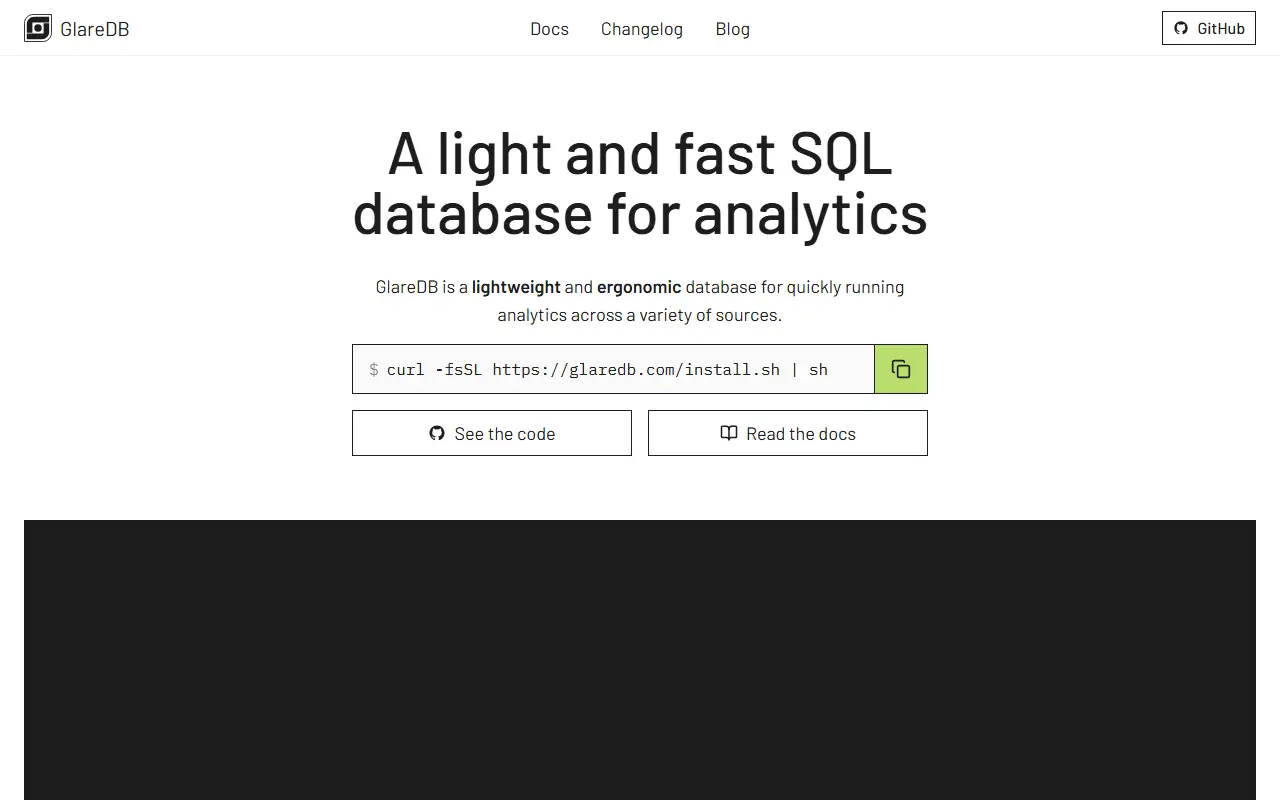
glaredb.comGlareDB homepage screenshot

GlareDB is a light and fast SQL database aimed at analytics. The project describes it as a lightweight, ergonomic database for quickly running analytics across a variety of sources, and it is written in Rust. It is meant for developers and analysts who want to query data with SQL without setting up a heavy data warehouse.

Installation is a single command from the project's site, and documentation, a blog and a changelog are available there. GlareDB uses calendar versioning in a year, month and patch format, so version 25.5.0 was the first release in May 2025. The code is licensed under MIT, and the company behind it is GlareDB, Inc. The README itself is brief, so see the documentation for supported data sources and query features.

Key features

  • SQL database focused on analytics
  • Queries across a variety of data sources
  • Written in Rust
  • Single-command installation
  • Calendar-versioned releases

Pricing: Free and open source under the MIT license.
MotherDuck alternatives: questions

What is the best open-source alternative to MotherDuck?
DuckDB is the top-ranked open-source alternative to MotherDuck on Enlisted: An analytical, in-process SQL database that runs inside your application or from a CLI, with a rich SQL dialect and easy CSV and Parquet querying. Another strong option is GlareDB.
Are these MotherDuck alternatives free?
Both are open source, so the code is free to use under its licence, and both can be self-hosted on your own server or computer.
How is this list of MotherDuck alternatives ranked?
By a score built from GitHub stars, star growth over the last 30 days and how recently the code changed. 1 of these projects shipped code in the last 30 days. Data is refreshed daily, and nobody can pay to move up.

People also look for alternatives to…

View all