7,363 open-source and SaaS tools, with GitHub stats refreshed every day.

4 alternatives ranked by real activity

Open-source GoodData alternatives

A curated, ranked list of the 4 best open-source alternatives to GoodData.

The best open-source alternative to GoodData is Superset. If that doesn't suit you, other good options are Metabase, Cube and Lightdash.

GoodData alternatives are mainly BI & dashboard tools. 4 of them shipped code in the last 30 days, 4 can be self-hosted, and 1 uses a permissive licence.

Last updated October 3, 2026 · ranked by GitHub stars, growth and recent commits

Superset

A web-based business intelligence platform from the Apache project with a no-code chart builder, SQL editor and dashboards that connects to most SQL databases.

GitHub stars
75k
Last commit
today
Latest release
6.1.0
Licence
Apache-2.0
Self-hosted
Yes
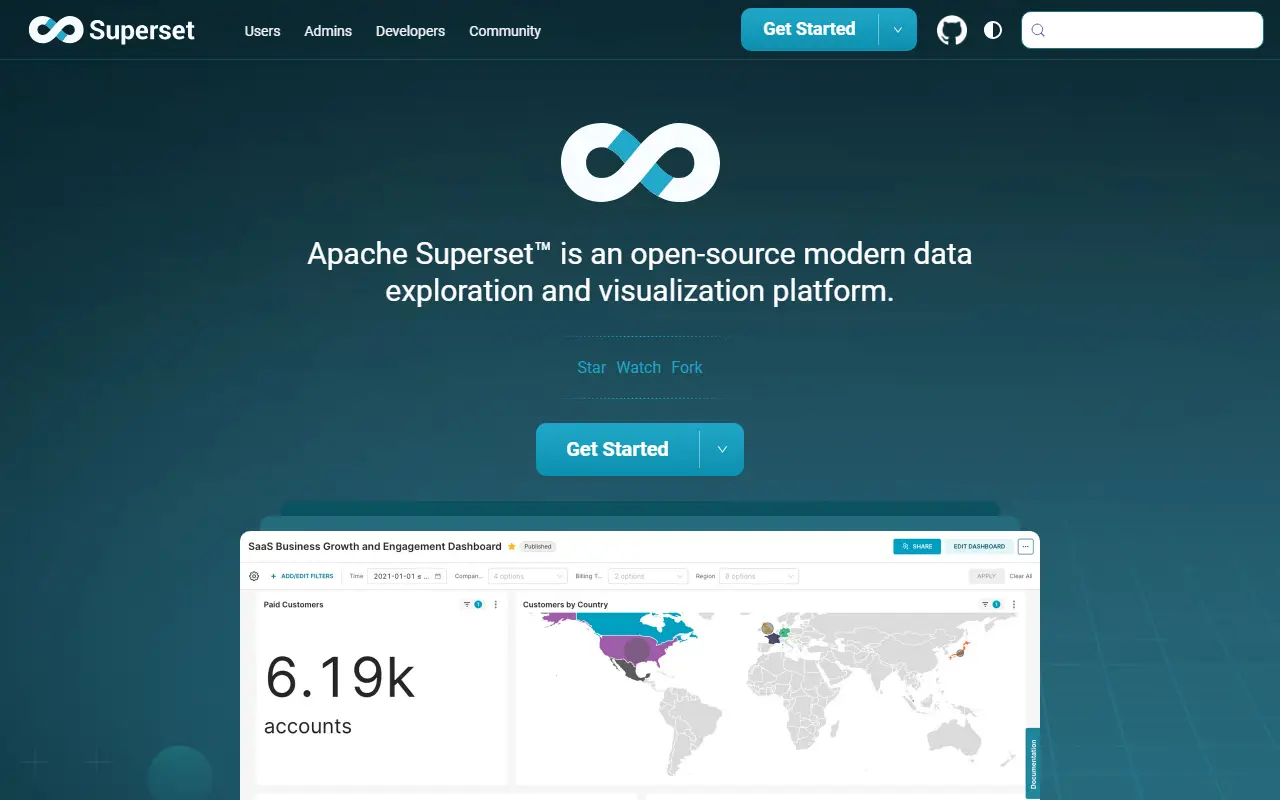
superset.apache.orgSuperset homepage screenshot

Apache Superset is a data exploration and visualization platform that runs as a web application. Analysts and business users can connect it to a database, build charts without code, assemble them into dashboards and share them, so it can augment or replace proprietary business intelligence tools for many teams.

The no-code chart builder sits next to a web-based SQL editor for advanced queries, and a lightweight semantic layer lets teams define reusable dimensions and metrics. Visualizations range from simple bar charts to geospatial views. Superset can query any SQL datastore or engine provided a matching Python database driver and SQLAlchemy dialect exist, including Presto, Trino and Athena. A configurable caching layer reduces database load, and security roles and authentication options are extensible.

The stack is Python with Flask on the back end and React on the front end, under the Apache-2.0 license. A REST API and extension framework allow programmatic control and customization. Documentation is split into guides for users, administrators and developers, and it is a typical choice for organizations that want a self-managed BI layer.

Key features

  • No-code chart builder
  • Web-based SQL editor
  • Shareable interactive dashboards
  • Lightweight semantic layer for metrics
  • Connects to any SQL database with a driver
  • Caching layer and security roles
  • REST API for programmatic customization

Pricing: Free and open source under the Apache-2.0 license.

Metabase

An open-source BI and embedded analytics tool for exploring data, building dashboards and asking questions without SQL, self-hosted or through Metabase Cloud.

GitHub stars
50k
Last commit
today
Latest release
v0.63.19
Self-hosted
Yes
Hosted version
Available
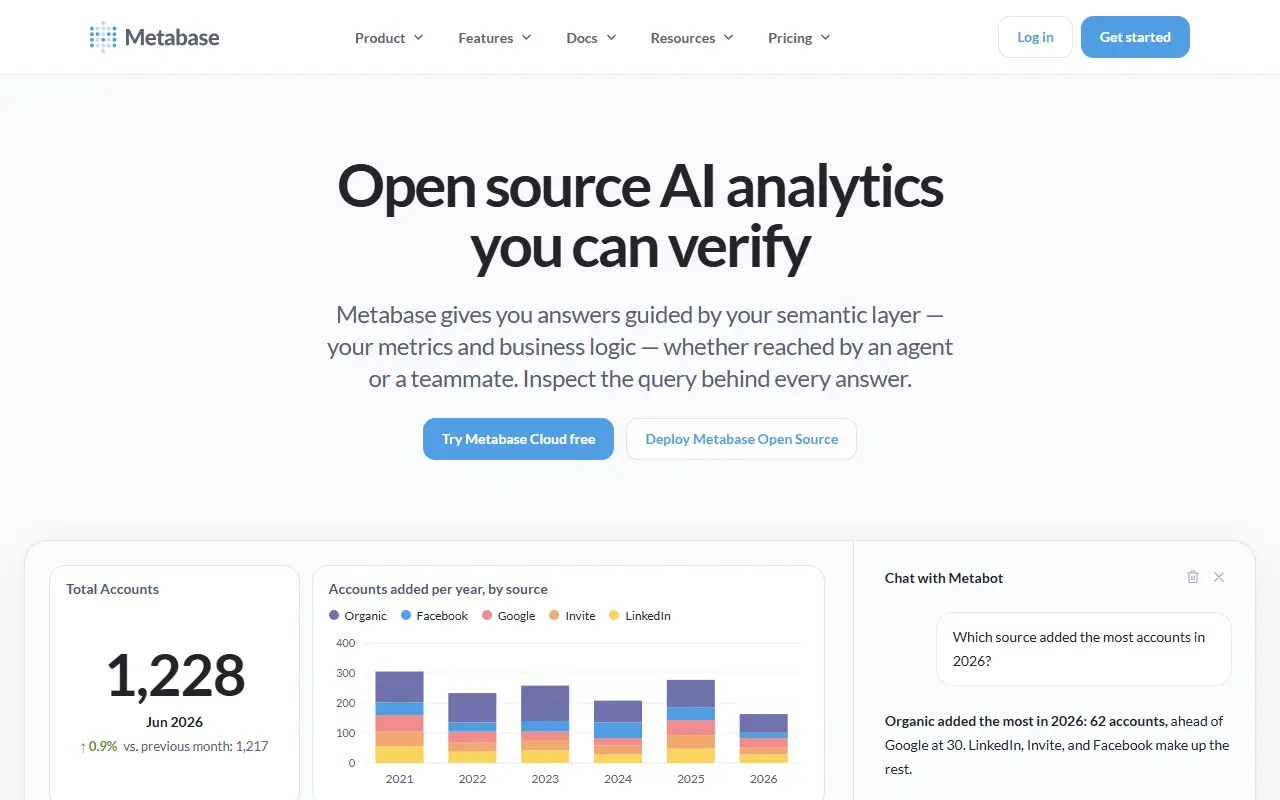
metabase.comMetabase homepage screenshot

Metabase is an open-source business intelligence and embedded analytics tool meant for everyone in a company, not only analysts. People can ask questions about their data without knowing SQL, while an SQL editor is available for more complex queries. Written in Clojure, it connects to databases such as PostgreSQL and MySQL.

Its features include interactive dashboards with filters, auto-refresh and custom click behavior, plus documents for long-form analysis that colleagues can comment on. An AI assistant called Metabot helps answer questions and write queries, and you can build your own AI agent against your data. Data Studio supports transforming raw data into analytics-ready tables and defining canonical metrics. Alerts and scheduled dashboard subscriptions go to email, Slack or a webhook, and a Library plus Git integration help version your work.

Metabase can also be embedded in your own product with components for charts, dashboards, a data browser and AI chat, and granular permissions work for internal teams and embedded customers. You can self-host it or use Metabase Cloud, which the project says includes support, backups, upgrades and a free trial. The repository license is listed as 'Other', so review its terms.

Key features

  • Question builder that needs no SQL
  • SQL editor for complex queries
  • Interactive dashboards with filters and auto-refresh
  • Alerts and scheduled subscriptions to email or Slack
  • Embedding of charts and dashboards in apps
  • Granular permissions for teams and customers
  • Metabot AI assistance for queries

Pricing: The open-source edition is free. Cloud Starter is $100 per month and Pro $575 per month with a 14-day trial; extra users cost $6 or $12 per month. Enterprise starts at $20,000 per year.

Cube

An open-source, headless semantic layer where you define metrics and access rules once in code and expose them to BI tools, apps and AI agents through SQL, REST and GraphQL.

GitHub stars
21k
Last commit
today
Latest release
v1.7.48
Self-hosted
Yes
Hosted version
Available
cube.devCube homepage screenshot

Cube Core is an open-source semantic layer. You describe your metrics, dimensions, joins and permissions a single time, as code, and Cube exposes that model through SQL, REST and GraphQL APIs to whatever sits downstream: BI tools, custom applications or AI agents. It is headless, meaning it ships no user interface of its own, which leaves you free to design the analytics experience your product needs.

The project argues that every BI tool already relies on a semantic layer to hide data complexity, but most are proprietary and tied to a single platform. Cube aims to make that layer reusable. It connects to any SQL data source, including warehouses such as BigQuery, Snowflake and Databricks, engines such as Amazon Athena and Presto, and application databases such as Postgres. A built-in relational caching engine delivers fast responses and high concurrency for API requests.

The core is written in Rust and JavaScript, and its license is listed as 'Other' on GitHub, so review the terms for commercial use. Cube can be self-hosted, and the company also offers Cube Cloud. It suits data teams building embedded analytics or wanting consistent metric definitions across tools.

Key features

  • Metrics and dimensions defined as code
  • SQL, REST and GraphQL APIs
  • Headless design with no built-in UI
  • Connects to Snowflake, BigQuery and Databricks
  • Built-in caching engine
  • Access rules for governed data

Pricing: Free forever plan for hobby projects. Starter costs $40 and Premium $80 per developer per month; Enterprise is custom via a demo request.

Lightdash

Lightdash is an open-source BI platform that defines metrics as code, with dashboards, AI agents and data apps built on a shared context layer.

GitHub stars
6.2k
Last commit
today
Latest release
2.423.2
Self-hosted
Yes
Hosted version
Available
lightdash.comLightdash homepage screenshot

Lightdash is an open-source business intelligence platform that it describes as agentic BI, meant for data teams that want analytics to be shipped like software. Metrics, joins, permissions, business logic and caching are defined once in a context layer, and that layer feeds MCP, SDKs, embedded analytics, data apps, AI agents and dashboards.

Analytics can be built as code: metrics, charts and dashboards live as files that you can edit with coding agents, preview from the Lightdash CLI, validate in CI and review in pull requests. Business users can pose questions in plain English, browse dashboards or build custom data apps, all while governance stays in place. Agents answer from the context layer rather than guessing from raw tables, respect permissions and return queries that can be inspected. The repository topics mention dbt.

Lightdash is written in TypeScript. The vendor recommends starting with Lightdash Cloud, which needs no infrastructure to run, and also offers a live demo, documentation and a sales call. The repository lists its licence as other, so check the terms before self-hosting.

Key features

  • Context layer for metrics and permissions
  • BI as code with CLI and CI validation
  • AI agents that answer from governed metrics
  • Dashboards and custom data apps
  • Embedded analytics, SDKs and MCP
  • dbt-based workflow

Pricing: Self-hosted Open Source edition with community support. Cloud Pro is $3000 per month with unlimited users and a 21-day trial; Enterprise is quoted.

GoodData alternatives: questions

What is the best open-source alternative to GoodData?
Superset is the top-ranked open-source alternative to GoodData on Enlisted: A web-based business intelligence platform from the Apache project with a no-code chart builder, SQL editor and dashboards that connects to most SQL databases. Other strong options are Metabase, Cube and Lightdash.
Are these GoodData alternatives free?
All 4 are open source, so the code is free to use under its licence, and all of them can be self-hosted on your own server or computer. 3 also offer a paid or managed cloud version if you'd rather not host it yourself.
How is this list of GoodData alternatives ranked?
By a score built from GitHub stars, star growth over the last 30 days and how recently the code changed. 4 of these projects shipped code in the last 30 days. Data is refreshed daily, and nobody can pay to move up.

People also look for alternatives to…

View all