7,363 open-source and SaaS tools, with GitHub stats refreshed every day.

10 alternatives ranked by real activity

Open-source Yandex Metrica alternatives

A curated, ranked list of the 10 best open-source alternatives to Yandex Metrica.

The best open-source alternative to Yandex Metrica is PostHog. If that doesn't suit you, other good options are Umami, Plausible, Matomo and Rybbit.

Yandex Metrica alternatives are mainly analytics tools, but some are also session replay tools. 10 of them shipped code in the last 30 days, 10 can be self-hosted, and 2 use a permissive licence.

Last updated October 3, 2026 · ranked by GitHub stars, growth and recent commits

PostHog

An open-source product platform combining analytics, session replay, feature flags, experiments, surveys and error tracking, with AI that turns signals into reports.

GitHub stars
40k
Last commit
today
Latest release
desktop-v0.61.621
Self-hosted
Yes
Hosted version
Available
posthog.comPostHog homepage screenshot

PostHog is an open-source platform that bundles the tools product teams use to understand and improve what they ship. It captures event data, user sessions and errors in one place, and its newer self-driving mode aims to turn signals such as errors, rage clicks and failed queries into researched reports and pull requests that engineers review and merge.

The product suite includes product analytics with autocapture or manual instrumentation and SQL analysis, web analytics with a dashboard resembling Google Analytics, session replays for web and mobile, feature flags, experiments with statistical measurement, surveys, error tracking, logs, a data warehouse and a customer data platform. The back end is Python and the front end is React and TypeScript.

PostHog's repository license is listed as 'Other' on GitHub, so check which parts are open source and which are enterprise-only. It can be self-hosted, and the company also runs a managed cloud service. It suits product and engineering teams that prefer a single tool over separate analytics, flagging and replay vendors.

Key features

  • Product analytics with autocapture and SQL
  • Web analytics dashboard
  • Session replay for web and mobile
  • Feature flags and experiments
  • Surveys and error tracking
  • Data warehouse and customer data platform
  • AI-assisted detection of product issues

Pricing: Every product has a free monthly tier with no credit card needed. Pay-as-you-go charges only for usage beyond the free limits; per-unit rates are not shown here and volume discounts are available.


Read more about PostHogWebsite GitHub

Umami

A privacy-first web analytics platform covering traffic, campaigns, behavior, conversions and revenue without cookies, available self-hosted or in the cloud.

GitHub stars
39k
Last commit
yesterday
Latest release
v3.4.0
Licence
MIT
Self-hosted
Yes
Hosted version
Available
umami.isUmami homepage screenshot

Umami is a privacy-focused web analytics platform and a common open-source alternative to Google Analytics. It brings traffic, campaign performance, user behavior, conversions and revenue into one dashboard, and it does so without cookies and without cross-site surveillance of visitors.

Topics show it also supports audience segmentation, cohort analysis and user journey views alongside standard statistics and charts. The app is built with TypeScript and runs on Node.js 18.18 or newer with a PostgreSQL database of version 12.14 or newer. Optional settings let you change the API base URL, enable two-factor authentication by providing an encryption key, and switch on an MCP endpoint, which is disabled by default.

Umami is MIT licensed and can be installed from source or run on your own infrastructure; the project also offers a hosted cloud version for teams that do not want to maintain servers. A detailed getting-started guide lives at umami.is/docs. It suits site owners and product teams who want clean, compliant analytics they control.

Key features

  • Cookie-free web analytics
  • Traffic, campaign and conversion tracking
  • Revenue and conversion tracking
  • Cohort analysis and audience segmentation
  • User journey views
  • Optional two-factor authentication and MCP endpoint

Pricing: Free and open source under the MIT license; a hosted cloud version is also available.

Read more about UmamiWebsite GitHub

Plausible

A lightweight, cookie-free, privacy-first web analytics tool and Google Analytics alternative, available as a managed cloud or a self-hosted community edition.

GitHub stars
29k
Last commit
yesterday
Latest release
v3.2.1
Licence
AGPL-3.0
Self-hosted
Yes
Hosted version
Available
plausible.ioPlausible homepage screenshot

Plausible Analytics is an open-source web analytics tool built around privacy. It is a lightweight, cookie-free alternative to Google Analytics that measures traffic rather than individuals: it keeps no personal data or IP addresses and uses no persistent identifiers, and the project states compliance with GDPR, CCPA and PECR. The company is made and hosted in the EU.

The dashboard is deliberately simple, with the key insights on a single page and no layers of menus or custom reports to build. The tracking script is tiny, which helps pages load faster, and you can also send custom events to measure goals. The stack uses Elixir with Phoenix, PostgreSQL and ClickHouse, with Tailwind CSS for the interface.

Plausible is AGPL-3.0 licensed and comes in two forms: a managed cloud service run by the company, which is paid, and a self-hosted community edition you operate yourself. A live demo and documentation let you try the dashboard first. It suits site owners and marketers who want straightforward, compliant analytics without cookie banners.

Key features

  • Cookie-free, privacy-first tracking
  • Single-page, clutter-free dashboard
  • Lightweight tracking script
  • Custom event and goal tracking
  • GDPR, CCPA and PECR compliance
  • Managed cloud or self-hosted edition

Pricing: Plans are priced by monthly pageviews: for up to 10k pageviews Starter is $9, Growth $14 and Business $19 per month. Enterprise is custom; there is a 30-day free trial.

Read more about PlausibleWebsite GitHub

Matomo

A full-featured open-source web analytics platform in PHP and MySQL that you run on your own server, built as a privacy-conscious alternative to Google Analytics.

GitHub stars
22k
Last commit
yesterday
Latest release
5.14.0
Licence
GPL-3.0
Self-hosted
Yes
Hosted version
Available
matomo.orgMatomo homepage screenshot

Matomo, formerly known as Piwik, is an open web analytics platform written in PHP with MySQL storage. You download and install it on your own web server, and after a short installation you receive a JavaScript tracking tag to paste into the sites you want to measure, then see reports in real time. It positions itself as a free-software substitute for Google Analytics.

Privacy is built in, and its mission statement stresses giving every user full control of their data. According to the README it is used on more than 1,400,000 websites. Requirements are PHP 8.1 or newer, MySQL 8.0 or newer or MariaDB 10.6 or newer, and the PDO MySQL or MySQLi extension, and it is independent of operating system and web server. Topics also reference marketing and mobile analytics.

Matomo is released under the GPL-3.0 (or later) license. Self-hosting keeps data on your own servers, and the organization also offers Matomo Cloud as a managed option, with a marketplace of plugins. It suits organizations with data-protection requirements, such as public bodies and companies in privacy-regulated markets, that need dependable analytics they control.

Key features

  • Real-time web analytics reports
  • Self-hosted PHP and MySQL application
  • JavaScript tracking tag installation
  • Privacy-focused data ownership
  • Mobile and intranet analytics topics
  • Matomo Cloud as a managed option

Pricing: The self-hosted Community edition is free. Matomo Cloud starts at $26 a month for 50,000 hits and scales with traffic; a free trial is offered and Enterprise is quoted on request.

Read more about MatomoWebsite GitHub

Rybbit

A cookieless, privacy-friendly open-source web and product analytics platform offered as a hosted service or for self-hosting, positioned as an alternative to Google Analytics.

GitHub stars
13k
Last commit
yesterday
Latest release
v2.9.0
Licence
AGPL-3.0
Self-hosted
Yes
Hosted version
Available
rybbit.comRybbit homepage screenshot

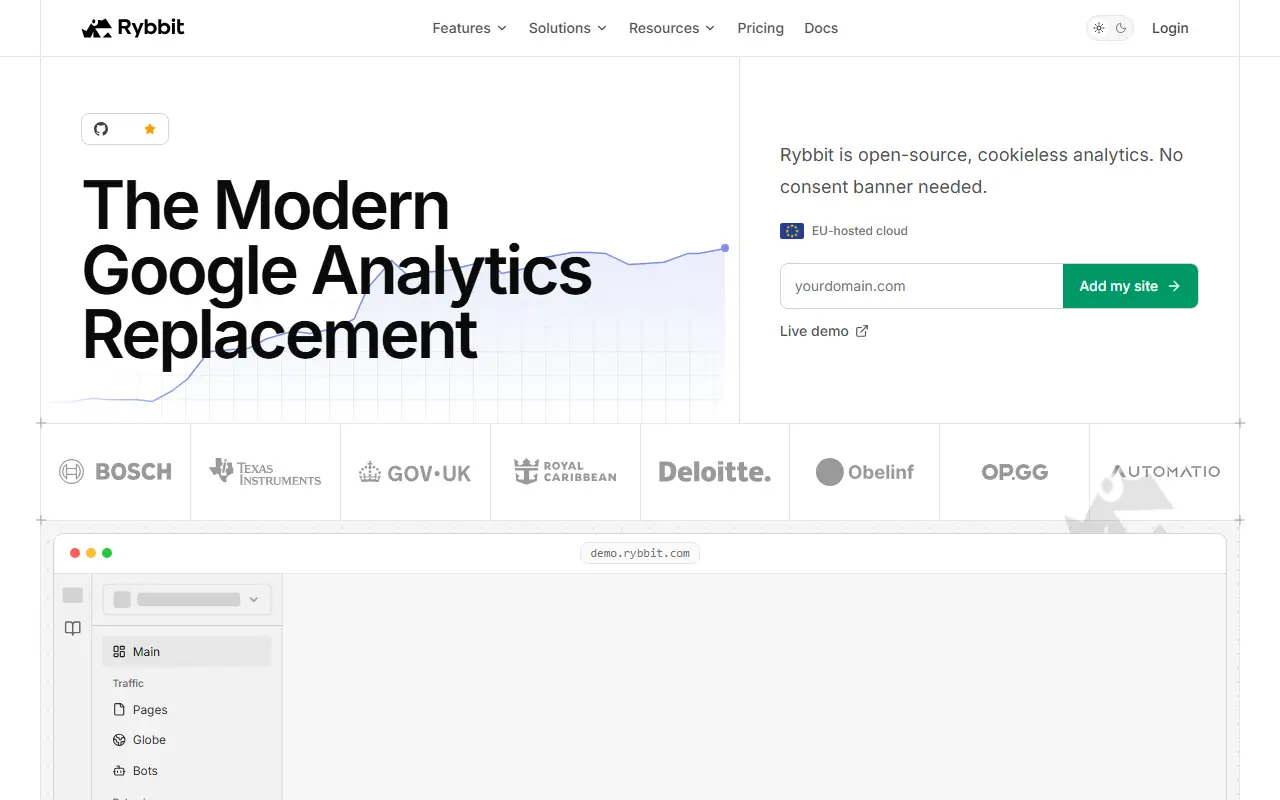
Rybbit is an open-source web and product analytics platform that avoids cookies and aims to be easier to read than traditional analytics suites. It is presented as a privacy-friendly alternative to Google Analytics and can be set up in a couple of minutes with a tracking script added to a site.

It covers the usual web metrics, including sessions, unique users, pageviews, bounce rate and session duration, and goes further with session replays, funnels, retention and user journey dashboards. Data can be filtered across more than fifteen dimensions, custom events carry JSON properties, locations are tracked down to city level with map views, and a real-time dashboard is included. Organizations and an unlimited number of sites are supported.

Rybbit is licensed under AGPL-3.0 and written in TypeScript. You can use the hosted service for the quickest start or deploy it on your own VPS for full control, and a live demo shows it running on a production site. The README compares it with GA4, Plausible and Cloudflare analytics on openness, self-hosting and privacy.

Key features

  • Cookieless, privacy-friendly tracking
  • Sessions, pageviews, bounce rate and duration
  • Session replays of user visits
  • Funnels, retention and user journeys
  • Custom events with JSON properties
  • City-level location tracking with maps
  • Real-time analytics dashboard
  • Multiple organizations and unlimited sites

Pricing: Standard is $13 and Pro $26 per month on annual billing for 100,000 monthly pageviews, rising with traffic. Includes a 7-day free trial; Enterprise is custom.

Read more about RybbitWebsite GitHub

OpenReplay

A self-hosted session replay, cobrowsing and product analytics platform that keeps user session data inside your own infrastructure.

GitHub stars
13k
Last commit
today
Latest release
v1.28.0
Self-hosted
Yes
openreplay.comOpenReplay homepage screenshot

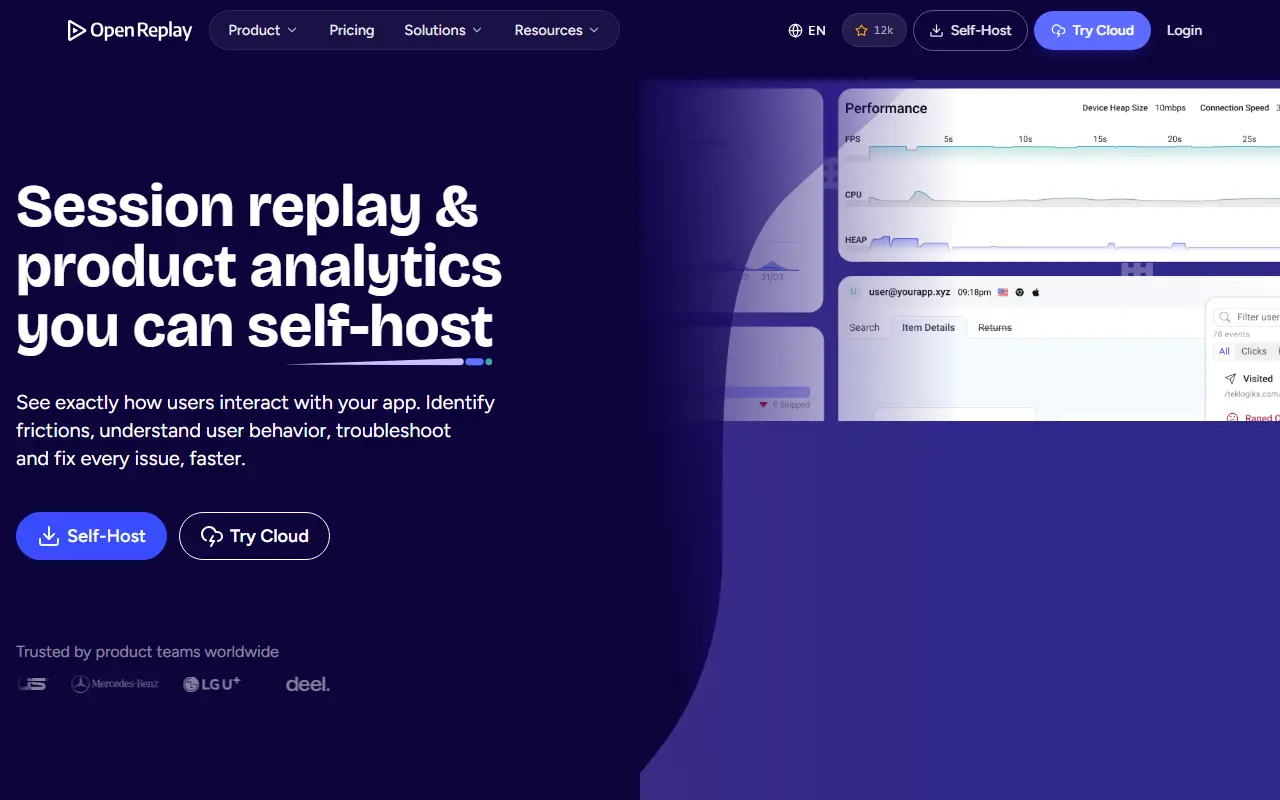
OpenReplay is an open-source experience platform that you host on your own infrastructure. It combines session replay, DevTools-level debugging context, product analytics and live cobrowsing, so teams can see how real users navigate, where they struggle and what errors they hit without sending sessions to a third party.

Because everything stays in your own cloud, it is pitched at teams that cannot hand customer data to an external vendor. Data can be masked, obscured or skipped at capture time before it reaches your servers, and a private mode redacts everything by default. A lightweight tracker sends data asynchronously to limit the impact on page performance, and SDKs cover frameworks such as React, Angular, Vue, Svelte, Next.js and React Native.

The README states it can be self-hosted for free on AWS, GCP, Azure and other platforms. The repository lists its licence as Other and its topics also reference feature flags, web vitals and real-user monitoring, so it spans debugging, product and support use cases.

Key features

  • Session replay with search and filtering
  • DevTools context for debugging sessions
  • Product analytics for usage insights
  • Live cobrowsing with users
  • Masking and private mode at capture time
  • Lightweight asynchronous tracker
  • Web and mobile framework SDKs

Pricing: Self-hosting is free. Managed Dedicated instances start from $199 a month (billed hourly) with a 7-day trial; Serverless is usage-based and Enterprise is custom.

Read more about OpenReplayWebsite GitHub

OpenPanel

An open-source web and product analytics platform positioned as an alternative to Mixpanel, with funnels, session replay, A/B tests, cookieless tracking and self-hosting.

GitHub stars
7.1k
Last commit
2 days ago
Licence
AGPL-3.0
Self-hosted
Yes
Hosted version
Available
openpanel.devOpenPanel homepage screenshot

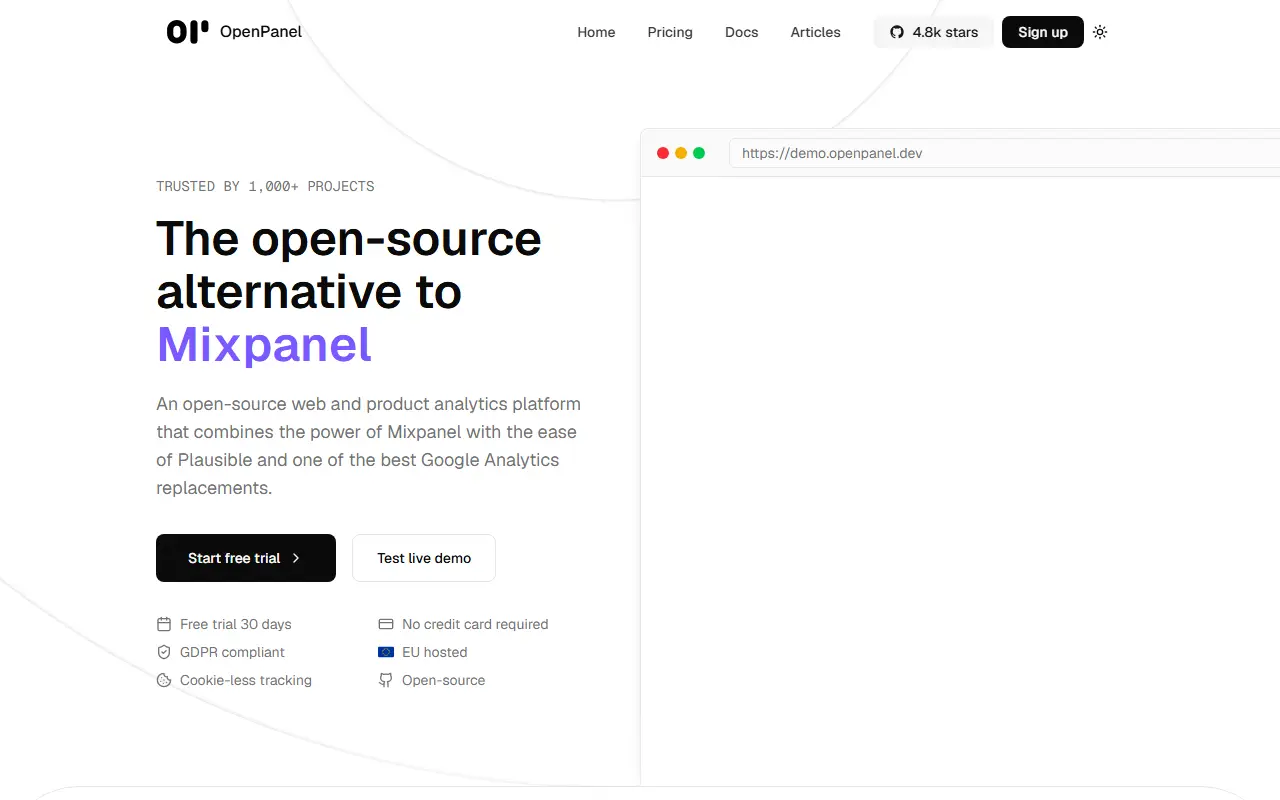
OpenPanel is a web and product analytics platform, released as open source, that sets out to combine the depth of Mixpanel with the simplicity of Plausible. It is presented as an alternative to Mixpanel and Google Analytics, with optional self-hosting and cookieless tracking by default.

Its feature list covers funnels and cohorts, user profiles with session history, session replay that has privacy controls, real-time dashboards, built-in A/B testing, event and funnel alerts, custom dashboards, revenue tracking for purchases, subscriptions and lifetime value, SDKs and an API for web, mobile and server-side tracking, integrations such as Google Search Console, and an MCP server so AI clients can query user data. A comparison table in the README sets it against Mixpanel, GA4 and Plausible.

OpenPanel is written in TypeScript and licensed under AGPL-3.0. It can be self-hosted for full control of data, and a hosted version with sign-in is also available. The project emphasizes transparent pricing with no hidden costs or usage limits. It suits product teams that want privacy-friendly analytics with product-level depth.

Key features

  • Funnels, cohorts and user profiles
  • Session replay with privacy controls
  • Real-time dashboards and custom charts
  • Built-in A/B testing
  • Cookieless, GDPR-friendly tracking
  • Web, mobile and server-side SDKs
  • MCP server for AI clients

Pricing: Self-hosting is free. Cloud is priced by monthly event volume, from $2.50 for 5K events up to $900.00 for 50M, with unlimited users and a 30-day free trial.

Read more about OpenPanelWebsite GitHub

Countly

Countly is a privacy-focused product analytics and customer engagement platform for web, mobile, desktop and IoT apps that you can run on-premises.

GitHub stars
5.9k
Last commit
yesterday
Latest release
25.03.53-LTS
Self-hosted
Yes
Hosted version
Available
countly.comCountly homepage screenshot

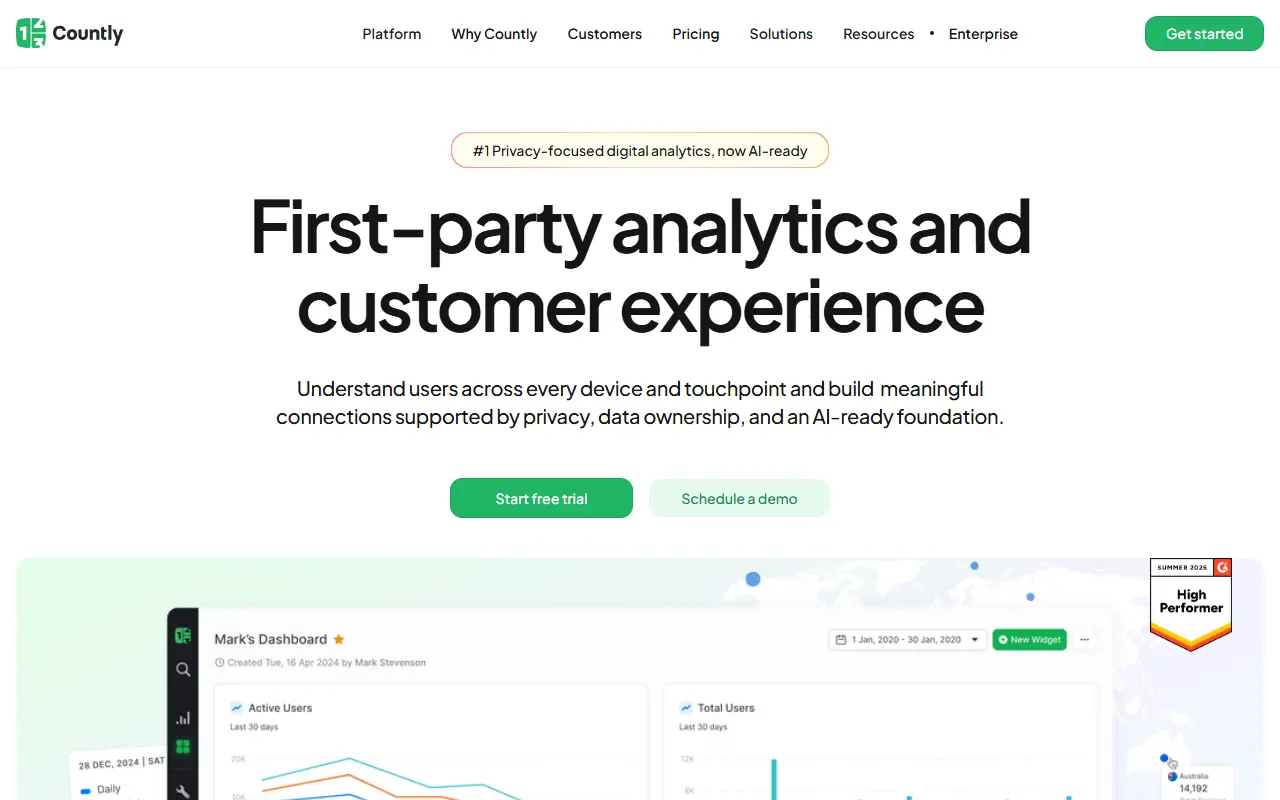
Countly is a product analytics and customer engagement system for organizations that insist on owning their data. Teams use it to see how people behave in mobile, web, desktop and connected products, to improve product experiences, and to automate and personalize how they engage with customers.

The repository topics reflect a broad toolset: web and mobile analytics, crash analytics, push notifications, feature flags, remote configuration, user feedback, dashboards and user journeys. Privacy is a central theme, with references to GDPR, COPPA and HIPAA, and the README stresses that, unlike SaaS-only tools, it can run on your own premises or inside a private cloud. SDKs are provided for many platforms, and the project has a Discord community.

The server code is JavaScript and published under a license that GitHub lists as 'Other', so check the repository for the terms that apply to the edition you use. Countly also offers hosted and enterprise options through the vendor. It suits product and marketing teams that need analytics without sending data to a third party.

Key features

  • Cross-platform product and user analytics
  • Crash reporting for mobile apps
  • Push notifications and engagement tools
  • Feature flags and remote configuration
  • User feedback collection
  • On-premises or private cloud deployment

Pricing: Free self-hosted Lite edition. Flex starts at $175 per month on a managed private cloud with usage-based pricing and a 14-day trial; Enterprise is custom.

Read more about CountlyWebsite GitHub

Microsoft Clarity

Open-source behavioral analytics library that records DOM changes and interactions to produce session replay and heatmap insights.

GitHub stars
2.7k
Last commit
yesterday
Licence
MIT
Hosted version
Available
clarity.microsoft.comMicrosoft Clarity homepage screenshot

Clarity is a behavioral analytics library written in TypeScript with two main goals: privacy and performance. It watches DOM mutations and user interactions in the browser to generate aggregated insights about how visitors view and use a website, across modern devices and browsers. It is released under the MIT license.

The data it captures supports session replay and heatmaps, which help product and design teams see where features succeed or fail. The README says the same code powers Microsoft's hosted behavioral analytics service at clarity.microsoft.com, where a live demo is also available, so the repository represents the client-side collection library rather than a full self-contained analytics backend.

The community is invited to help build a privacy-first, high-performance behavioral analytics library. It suits web teams who want to understand user behavior, improve conversion and retention, and review the code that runs on their pages before adding it to a site.

Key features

  • Session replay from DOM mutations
  • Heatmaps of user interaction
  • Aggregated behavioral insights
  • Privacy and performance focus
  • Works across modern browsers and devices
  • Same code as Microsoft's hosted service

Pricing: The library is open source under the MIT license; the hosted Clarity service is run by Microsoft.

Swetrix

A cookieless, privacy-first web analytics platform with error tracking, performance monitoring and session replays, available self-hosted or as a cloud service.

GitHub stars
1.2k
Last commit
2 days ago
Latest release
tracker-node@3.5.0
Licence
AGPL-3.0
Self-hosted
Yes
Hosted version
Available
swetrix.comSwetrix homepage screenshot

Swetrix is an open-source web analytics platform presented as a privacy-respecting alternative to Google Analytics. It is cookieless and designed to comply with GDPR without consent banners, with anonymized data and no cross-device tracking, and it has been developed in the open since 2021.

Beyond traffic statistics such as top pages, locations, devices, traffic sources and UTM campaigns, it offers custom events and properties, sessions and user flows, funnels, real-user performance metrics, client-side error tracking and session replays. The README says some features, such as network intelligence and session replays, are available on the cloud service. A lightweight tracking script feeds a real-time dashboard.

Swetrix is built with TypeScript, NestJS, Redis, MySQL and ClickHouse and is licensed under AGPL-3.0. You can try it on Swetrix Cloud, which is free to start, or self-host it with Docker. A live demo and documentation are available. It suits website owners and product teams who want analytics, error tracking and performance data in one privacy-focused tool.

Key features

  • Cookieless, GDPR-friendly analytics
  • Real-time dashboard with traffic stats
  • Custom events and funnels
  • Error tracking for client-side issues
  • Performance monitoring metrics
  • Session replays on the cloud service

Pricing: The self-hosted Community Edition is free; the cloud has no free plan but offers a 14-day trial. Standard starts at $19 and Plus at $39 per month, scaling with event volume; Enterprise is custom.

Read more about SwetrixWebsite GitHub

Yandex Metrica alternatives: questions

What is the best open-source alternative to Yandex Metrica?
PostHog is the top-ranked open-source alternative to Yandex Metrica on Enlisted: An open-source product platform combining analytics, session replay, feature flags, experiments, surveys and error tracking, with AI that turns signals into reports. Other strong options are Umami, Plausible, Matomo and Rybbit.
Are these Yandex Metrica alternatives free?
All 10 are open source, so the code is free to use under its licence, and all of them can be self-hosted on your own server or computer. 9 also offer a paid or managed cloud version if you'd rather not host it yourself.
How is this list of Yandex Metrica alternatives ranked?
By a score built from GitHub stars, star growth over the last 30 days and how recently the code changed. 10 of these projects shipped code in the last 30 days. Data is refreshed daily, and nobody can pay to move up.

People also look for alternatives to…

View all