7,363 open-source and SaaS tools, with GitHub stats refreshed every day.

5 alternatives ranked by real activity

Open-source Clicky alternatives

A curated, ranked list of the 5 best open-source alternatives to Clicky.

The best open-source alternative to Clicky is Umami. If that doesn't suit you, other good options are Plausible, Matomo, Open Web Analytics and Vince.

Clicky alternatives are mainly analytics tools. 4 of them shipped code in the last 30 days, 5 can be self-hosted, and 1 uses a permissive licence.

Last updated October 2, 2026 · ranked by GitHub stars, growth and recent commits

Umami

A privacy-first web analytics platform covering traffic, campaigns, behavior, conversions and revenue without cookies, available self-hosted or in the cloud.

GitHub stars
39k
Last commit
yesterday
Latest release
v3.4.0
Licence
MIT
Self-hosted
Yes
Hosted version
Available
umami.isUmami homepage screenshot

Umami is a privacy-focused web analytics platform and a common open-source alternative to Google Analytics. It brings traffic, campaign performance, user behavior, conversions and revenue into one dashboard, and it does so without cookies and without cross-site surveillance of visitors.

Topics show it also supports audience segmentation, cohort analysis and user journey views alongside standard statistics and charts. The app is built with TypeScript and runs on Node.js 18.18 or newer with a PostgreSQL database of version 12.14 or newer. Optional settings let you change the API base URL, enable two-factor authentication by providing an encryption key, and switch on an MCP endpoint, which is disabled by default.

Umami is MIT licensed and can be installed from source or run on your own infrastructure; the project also offers a hosted cloud version for teams that do not want to maintain servers. A detailed getting-started guide lives at umami.is/docs. It suits site owners and product teams who want clean, compliant analytics they control.

Key features

  • Cookie-free web analytics
  • Traffic, campaign and conversion tracking
  • Revenue and conversion tracking
  • Cohort analysis and audience segmentation
  • User journey views
  • Optional two-factor authentication and MCP endpoint

Pricing: Free and open source under the MIT license; a hosted cloud version is also available.

Plausible

A lightweight, cookie-free, privacy-first web analytics tool and Google Analytics alternative, available as a managed cloud or a self-hosted community edition.

GitHub stars
29k
Last commit
today
Latest release
v3.2.1
Licence
AGPL-3.0
Self-hosted
Yes
Hosted version
Available
plausible.ioPlausible homepage screenshot

Plausible Analytics is an open-source web analytics tool built around privacy. It is a lightweight, cookie-free alternative to Google Analytics that measures traffic rather than individuals: it keeps no personal data or IP addresses and uses no persistent identifiers, and the project states compliance with GDPR, CCPA and PECR. The company is made and hosted in the EU.

The dashboard is deliberately simple, with the key insights on a single page and no layers of menus or custom reports to build. The tracking script is tiny, which helps pages load faster, and you can also send custom events to measure goals. The stack uses Elixir with Phoenix, PostgreSQL and ClickHouse, with Tailwind CSS for the interface.

Plausible is AGPL-3.0 licensed and comes in two forms: a managed cloud service run by the company, which is paid, and a self-hosted community edition you operate yourself. A live demo and documentation let you try the dashboard first. It suits site owners and marketers who want straightforward, compliant analytics without cookie banners.

Key features

  • Cookie-free, privacy-first tracking
  • Single-page, clutter-free dashboard
  • Lightweight tracking script
  • Custom event and goal tracking
  • GDPR, CCPA and PECR compliance
  • Managed cloud or self-hosted edition

Pricing: Plans are priced by monthly pageviews: for up to 10k pageviews Starter is $9, Growth $14 and Business $19 per month. Enterprise is custom; there is a 30-day free trial.

Matomo

A full-featured open-source web analytics platform in PHP and MySQL that you run on your own server, built as a privacy-conscious alternative to Google Analytics.

GitHub stars
22k
Last commit
today
Latest release
5.14.0
Licence
GPL-3.0
Self-hosted
Yes
Hosted version
Available
matomo.orgMatomo homepage screenshot

Matomo, formerly known as Piwik, is an open web analytics platform written in PHP with MySQL storage. You download and install it on your own web server, and after a short installation you receive a JavaScript tracking tag to paste into the sites you want to measure, then see reports in real time. It positions itself as a free-software substitute for Google Analytics.

Privacy is built in, and its mission statement stresses giving every user full control of their data. According to the README it is used on more than 1,400,000 websites. Requirements are PHP 8.1 or newer, MySQL 8.0 or newer or MariaDB 10.6 or newer, and the PDO MySQL or MySQLi extension, and it is independent of operating system and web server. Topics also reference marketing and mobile analytics.

Matomo is released under the GPL-3.0 (or later) license. Self-hosting keeps data on your own servers, and the organization also offers Matomo Cloud as a managed option, with a marketplace of plugins. It suits organizations with data-protection requirements, such as public bodies and companies in privacy-regulated markets, that need dependable analytics they control.

Key features

  • Real-time web analytics reports
  • Self-hosted PHP and MySQL application
  • JavaScript tracking tag installation
  • Privacy-focused data ownership
  • Mobile and intranet analytics topics
  • Matomo Cloud as a managed option

Pricing: The self-hosted Community edition is free. Matomo Cloud starts at $26 a month for 50,000 hits and scales with traffic; a free trial is offered and Enterprise is quoted on request.

Open Web Analytics

Self-hosted PHP web analytics platform and JavaScript tracker offered as an open-source alternative to Google Analytics, tracking multiple sites from one server.

GitHub stars
2.7k
Last commit
today
Latest release
1.14.0
Licence
GPL-2.0
Self-hosted
Yes
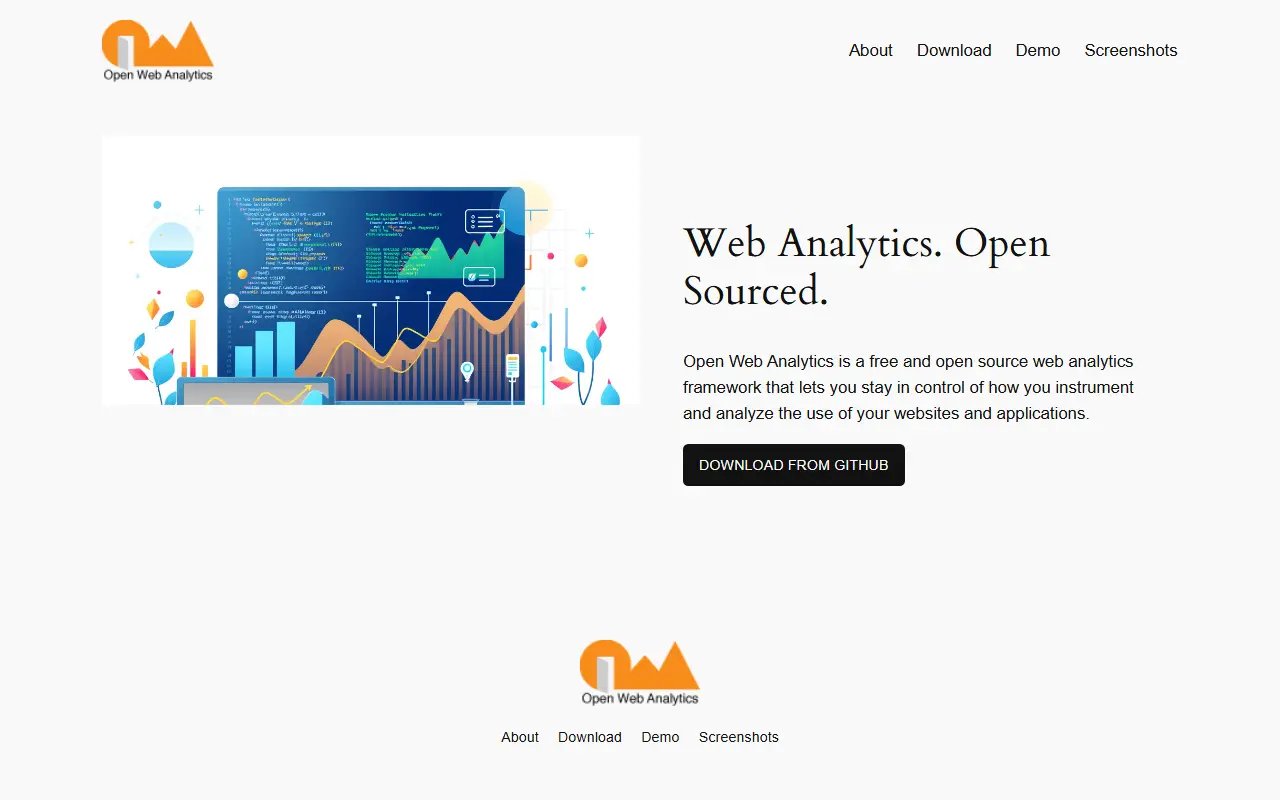
openwebanalytics.comOpen Web Analytics homepage screenshot

Open Web Analytics is an open-source alternative to commercial web analytics tools such as Google Analytics. It lets you collect and keep data about the visitors to your own websites and applications on your own server, so you stay in control of that data. It is written in PHP and released under the GPL-2.0 license.

The repository installs the OWA server and a first-party JavaScript tracking client that can be added to any web page. It tracks visitors, pageviews, e-commerce transactions, and configurable actions, and a single server instance can track an unlimited number of sites. A reporting dashboard provides views of the collected data, with options to customize reports.

For WordPress there is an integration plugin, and for other PHP applications there is an OWA PHP SDK. The project asks for sponsorship to support its development. It suits site owners and developers who want privacy-conscious analytics on infrastructure they manage, instead of sending traffic data to an advertising company.

Key features

  • Visitor and pageview tracking
  • E-commerce transaction and custom action tracking
  • Unlimited websites per server instance
  • First-party JavaScript tracker
  • Reporting dashboard
  • WordPress plugin and PHP SDK

Pricing: Free and open source under the GPL-2.0 license.

Vince

Vince is a free, AGPL-licensed, self-hosted web analytics tool positioned as an alternative to Google Analytics and a drop-in replacement for Plausible Analytics scripts.

GitHub stars
2k
Last commit
1 yr ago
Latest release
v1.11.8
Licence
AGPL-3.0
Self-hosted
Yes
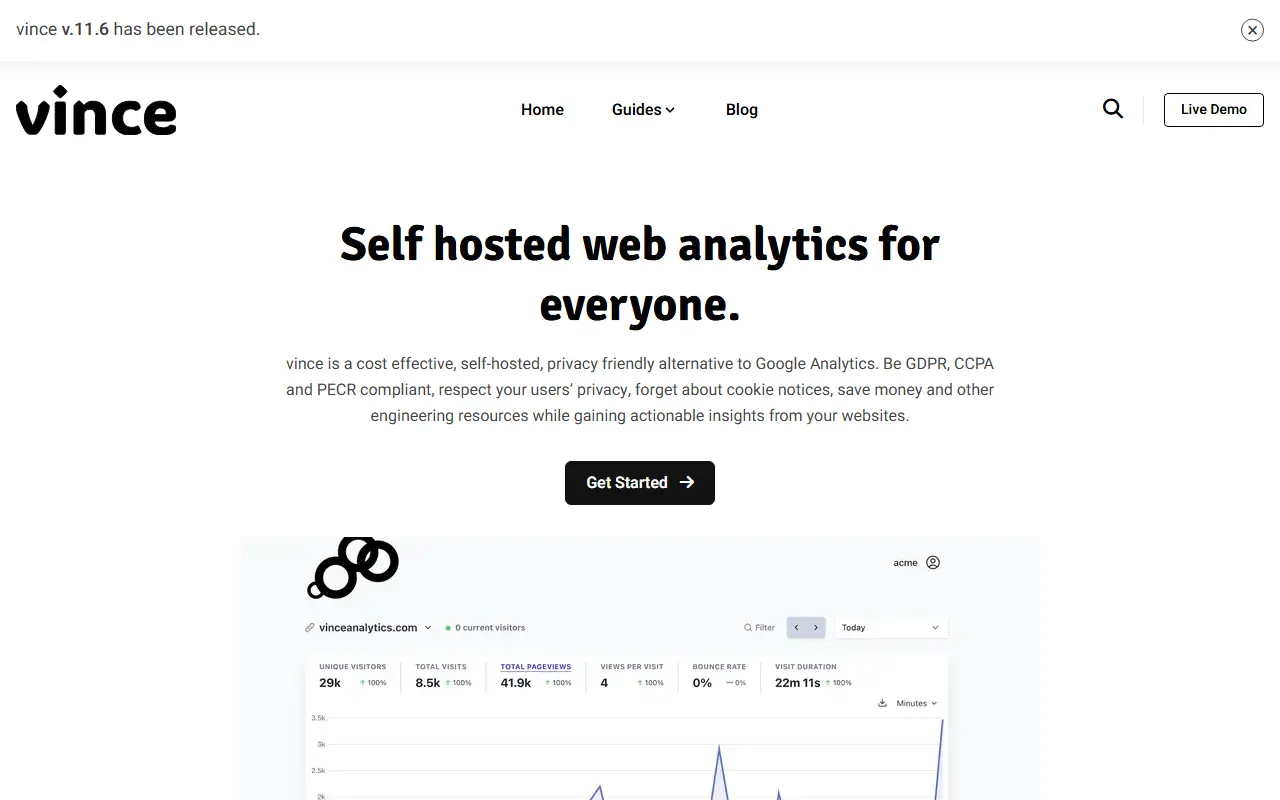
vinceanalytics.comVince homepage screenshot

Vince is a self-hosted web analytics platform built as an alternative to Google Analytics. It is aimed at site owners who want privacy-friendly, cookie-free analytics they control themselves, and it is designed to be a drop-in replacement for existing Plausible Analytics tracking scripts, which can simply be pointed at a Vince instance instead.

Features include outbound link tracking, file download tracking, 404 page tracking, custom event tracking, time-period comparisons, public dashboards that anyone can view, and unique shareable dashboard links that can optionally be password protected. Automatic TLS support for Let's Encrypt is built in. The README is explicit that Vince focuses on the needs of a single entity self-hosting its own analytics and does not aim for full feature parity with Plausible, for example lacking multi-tenant support, funnels and a hosted offering.

Vince ships as a single zero-dependency binary, supports unlimited sites and events limited only by available resources, and can be installed on macOS, Linux, via Docker or Helm. It is written in Go and released under the AGPL-3.0 license, with documentation, an API reference and a live demo available.

Key features

  • Self-hosted, privacy-friendly web analytics
  • Drop-in replacement for Plausible scripts
  • Outbound link and file download tracking
  • Public and password-protected dashboards
  • Automatic Let's Encrypt TLS
  • Zero-dependency single binary

Pricing: Free and open source under the AGPL-3.0 license.

Clicky alternatives: questions

What is the best open-source alternative to Clicky?
Umami is the top-ranked open-source alternative to Clicky on Enlisted: A privacy-first web analytics platform covering traffic, campaigns, behavior, conversions and revenue without cookies, available self-hosted or in the cloud. Other strong options are Plausible, Matomo, Open Web Analytics and Vince.
Are these Clicky alternatives free?
All 5 are open source, so the code is free to use under its licence, and all of them can be self-hosted on your own server or computer. 3 also offer a paid or managed cloud version if you'd rather not host it yourself.
How is this list of Clicky alternatives ranked?
By a score built from GitHub stars, star growth over the last 30 days and how recently the code changed. 4 of these projects shipped code in the last 30 days. Data is refreshed daily, and nobody can pay to move up.

People also look for alternatives to…

View all