
About XGo
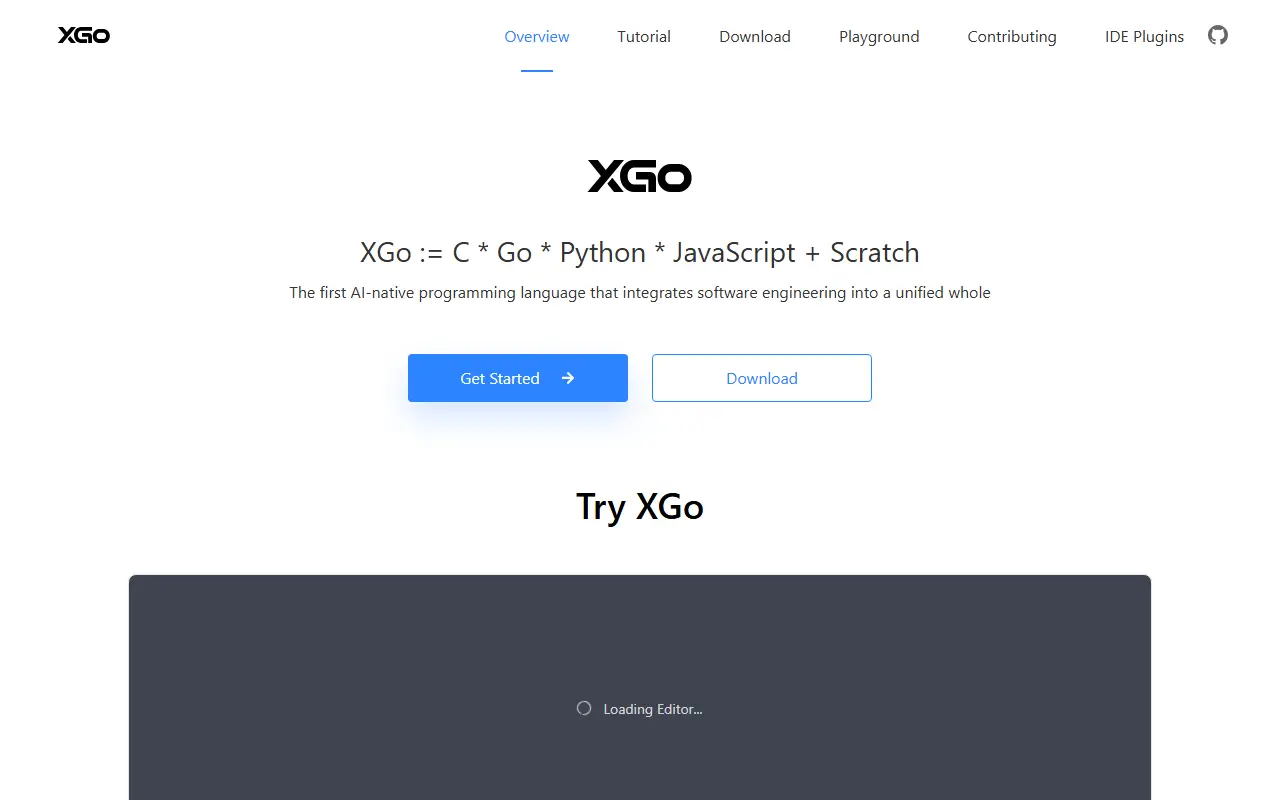
XGo, formerly known as Go+, is a programming language derived from Go that aims to read close to natural language. It targets engineering work, STEM teaching and data science, with a smaller syntax than Go or Python, so that beginners and non-specialists can use the same language engineers use.
It remains fully compatible with Go, so Go and XGo code can be mixed in the same package, and it can integrate C and C++ libraries as well as Python and JavaScript through its C ecosystem work. It deliberately avoids domain-specific languages in favor of domain friendliness through classfiles and text literals. Resources include documentation, tutorials, a playground, an interactive REPL called iXGo and comparisons with Go.
The compiler and tooling are written in Go and licensed under Apache-2.0, and the project was created in 2015. Because it compiles to Go, it can use Go's ecosystem and engineering foundation. The authors describe a vision of enabling everyone to become a builder.
Key features
- Plain-English style syntax
- Full compatibility with Go packages
- Mixed Go and XGo code in one package
- Integration with C/C++ and Python
- Online playground and REPL
- Aimed at STEM education and data science
Good fit for
- →Teaching programming to beginners
- →Data science scripts that engineers can maintain
- →Writing Go-compatible tools with simpler syntax
- Built with
- Go
- Tags
- programming-language
- golang
- stem-education
- data-science
- compiler
- low-code
- go-plus
- repl
XGo: questions and answers
- What is XGo used for?
- XGo is a Go-compatible programming language designed to read like plain English, with easy interop with C/C++, Go, Python and JavaScript libraries. It is a good fit for teaching programming to beginners, data science scripts that engineers can maintain and writing Go-compatible tools with simpler syntax.
- Is XGo open source?
- Yes. XGo is open source under the Apache-2.0 licence. Its source code is on GitHub at goplus/xgo and is written mainly in Go.
- Is XGo free?
- Yes. XGo is open source, so the software itself is free to use.
- What are some alternatives to XGo?
- Similar open-source tools in the Developer Tools category include Marimo, Wave Terminal and golangci-lint. SaaS products in the same category include DataSpell, GoLand and PyCharm.
- Is XGo actively maintained?
- Yes. The most recent commit to XGo was on 1 October 2026, and the latest release is v1.7.5, published on 22 July 2026. The project has 9.5k stars on GitHub.
Open-source alternatives to XGo
See all
Marimo
Developer Tools
A reactive notebook for Python — run reproducible experiments, query with SQL, execute as
Apache-2.0vs Hex★ 23k
Wave Terminal
Developer Tools
An open-source, AI-integrated, cross-platform terminal for seamless workflows
Apache-2.0vs Warp★ 22k
golangci-lint
Developer Tools
Fast linters runner for Go
GPL-3.0★ 19k
JupyterLab
Developer Tools
JupyterLab computational environment.
BSD-3-Clausevs MATLAB★ 15k
Jupyter Notebook
Developer Tools
Jupyter Interactive Notebook
BSD-3-Clausevs MATLAB★ 13k
Spyder
Developer Tools
Official repository for Spyder - The Scientific Python Development Environment
MITvs MATLAB★ 9.4k
SaaS alternatives to XGo
See all
DataSpell
Developer Tools
JetBrains IDE for data science with notebook and Python support
SaaS
GoLand
Developer Tools
JetBrains IDE for Go development
SaaS
PyCharm
Developer Tools
JetBrains IDE for Python with debugging, testing and data science tooling
SaaS
1DevTool
Developer Tools
Desktop workspace for running several AI coding agents side by side across multiple projects
SaaS
3 Pixel Grid
Developer Tools
Library of tiny animated 3x3 grid indicators with copyable configs for use in your own project
SaaS
act101
Developer Tools
Codebase quality and refactoring toolkit for coding agents, with code porting and verification
SaaS