 TrackMedia
 TrackRev

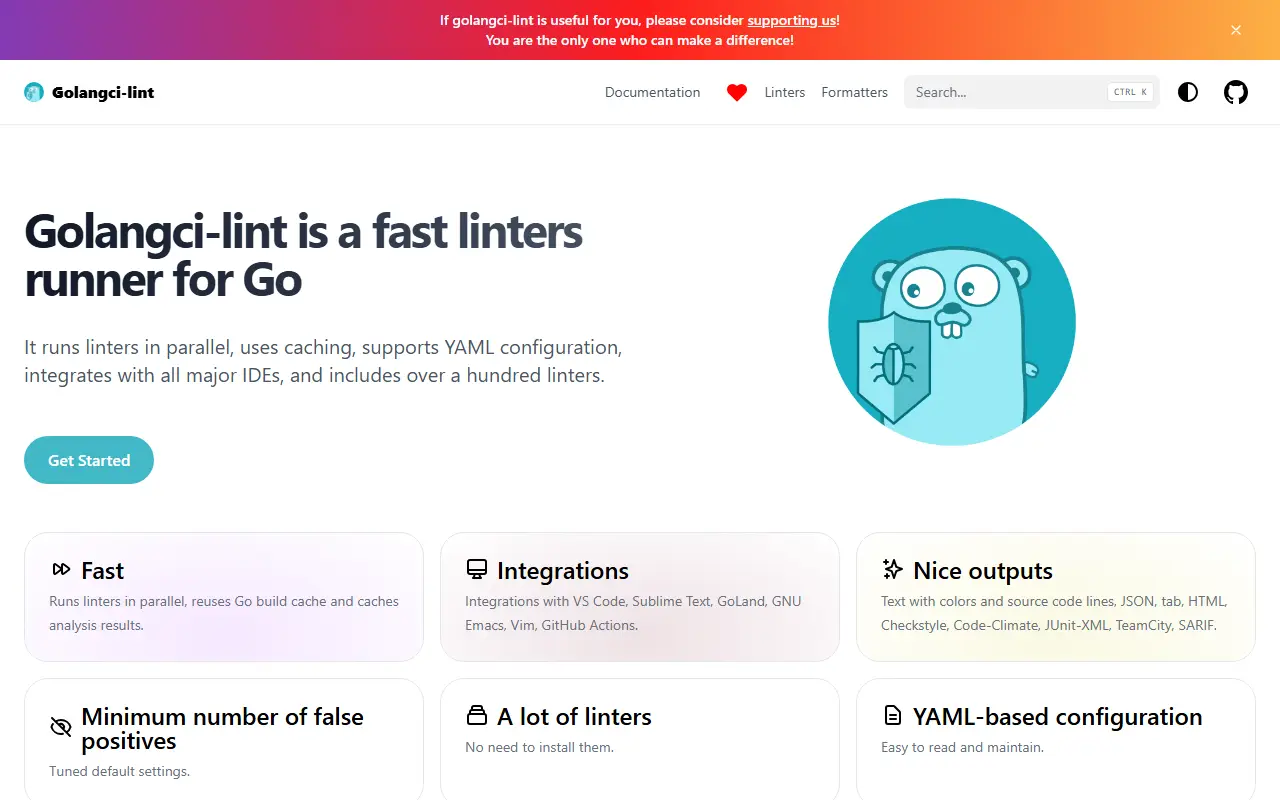
About golangci-lint
golangci-lint is a tool that runs many Go linters together and reports their findings in one place. Instead of installing and invoking each linter on its own, you configure golangci-lint once and let it do the work, which keeps code review focused on logic rather than style and common mistakes.
It runs linters in parallel, caches results to speed up repeated runs, and reads configuration from YAML files. It plugs into the major IDEs and bundles more than a hundred linters, so teams can choose which checks to enable. Documentation covers installation on a developer machine and on CI/CD systems, and the project's site hosts configuration references and linter lists.
golangci-lint is written in Go and licensed under GPL-3.0. It is built by volunteers and funded through sponsors and donations. It runs wherever Go does, locally or inside build pipelines, so there is no hosted service. It is a common quality gate in Go projects of all sizes.
Key features
- Runs many linters in parallel
- Result caching for fast repeat runs
- Configuration through YAML files
- Integrations with major IDEs
- Over a hundred bundled linters
- CI/CD installation guidance
Good fit for
- Enforcing code quality in Go repositories
- Pre-merge checks in CI pipelines
- Consistent linting across a team
golangci-lint: questions and answers
- What is golangci-lint used for?
- golangci-lint is a fast Go linters runner that executes many linters in parallel with caching, YAML configuration and IDE integration, for local use and CI pipelines. It is a good fit for enforcing code quality in Go repositories, pre-merge checks in CI pipelines and consistent linting across a team.
- Is golangci-lint open source?
- Yes. golangci-lint is open source under the GPL-3.0 licence. Its source code is on GitHub at golangci/golangci-lint and is written mainly in Go.
- Is golangci-lint free?
- Yes. golangci-lint is open source, so the software itself is free to use.
- What is golangci-lint an alternative to?
- golangci-lint is an open-source alternative to SonarQube Cloud. Other open-source alternatives to SonarQube Cloud include SonarQube, Semgrep and ESLint.
- Is golangci-lint actively maintained?
- Yes. The most recent commit to golangci-lint was on 12 November 2026, and the latest release is v2.15.0, published on 16 October 2026. The project has 20k stars on GitHub, with 93 added in the last 30 days.
Open-source alternatives to golangci-lint
See all
SonarQube
Developer Tools
Continuous Inspection
LGPL-3.0vs Codacy★ 11k
Semgrep
Security
Lightweight static analysis for many languages. Find bug variants with patterns that look
LGPL-2.1vs Snyk★ 18k
ESLint
Open source
Find and fix problems in your JavaScript code.
MITvs SonarQube Cloud★ 28k
GitLab Community Edition
CI/CD & DevOps
Open-core GitLab edition you install yourself, with Git hosting, CI/CD and issue tracking
MITvs GitHub★ 25k
Revive
Developer Tools
🔥 Fast, strict, configurable, extensible, and beautiful linter for Go
MITvs DeepSource★ 5.6k
PhpMetrics
Developer Tools
Beautiful and understandable static analysis tool for PHP
MIT★ 2.6k
SaaS alternatives to golangci-lint
See all
SonarQube Cloud
Developer Tools
Hosted code quality and security analysis for pull requests, from Sonar
SaaS
Codacy
Developer Tools
Automated code quality and security analysis for pull requests
SaaS
Debtdrone
Developer Tools
Scans codebases for technical debt and opens AI-generated pull requests to fix it
SaaS
DeepSource
Developer Tools
Static analysis and code health platform with auto-fix suggestions
SaaS
VibeFix
Developer Tools
Scans a URL for patterns left by AI coding tools, scores code quality and generates a fix roadmap with patches
SaaS
Code Climate
Developer Tools
Automated code review and engineering analytics tools
SaaS