
About Marimo
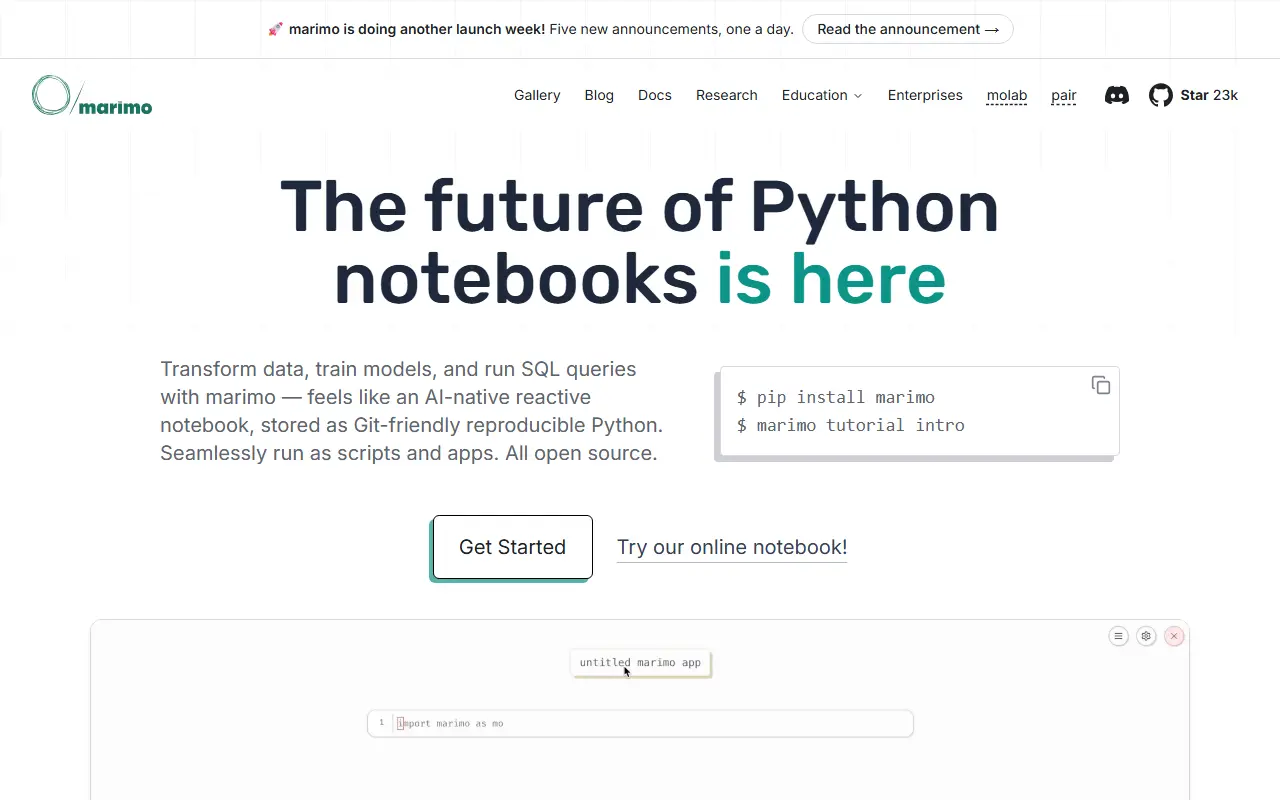
marimo is a reactive Python notebook. Running a cell, or changing a UI element, makes it automatically re-run dependent cells or mark them as stale, so code and outputs stay consistent. Notebooks are saved as pure Python with first-class SQL support, which makes them friendly to git, executable as scripts and deployable as apps. It is released under the Apache-2.0 license.
The project presents itself as a replacement for tools like Jupyter, Streamlit, Jupytext, ipywidgets and Papermill. Highlights include binding sliders, tables and plots to Python without callbacks, querying dataframes, databases and warehouses with SQL, reproducibility with no hidden state and built-in package management, parameterized script execution, sharing as web apps or slides that can run in the browser via WASM, importing functions between notebooks and running pytest on notebooks. The editor has AI assistants and vim keybindings, and works alongside VS Code, Cursor, PyCharm and other editors. A free online notebook is available.
Key features
- Reactive cell execution with dependency tracking
- Notebooks stored as pure Python files
- First-class SQL querying support
- Run as a script or deploy as an app
- Interactive UI elements without callbacks
- Built-in AI features and package management
Good fit for
- →Reproducible data analysis in Python
- →Turning notebooks into shareable apps
- Built with
- Python
- Tags
- notebook
- python
- reactive
- data-science
- sql
- jupyter-alternative
- apps
- reproducible
Marimo: questions and answers
- What is Marimo used for?
- marimo is a reactive Python notebook stored as plain .py files that runs as a script or deploys as an interactive app. It is a good fit for reproducible data analysis in Python and turning notebooks into shareable apps.
- Is Marimo open source?
- Yes. Marimo is open source under the Apache-2.0 licence. Its source code is on GitHub at marimo-team/marimo and is written mainly in Python.
- Is Marimo free?
- Yes. Marimo is open source, so the software itself is free to use. A managed cloud version is also available.
- What is Marimo an alternative to?
- Marimo is an open-source alternative to Hex and DataSpell. Other open-source alternatives to Hex include Jupyter Notebook and JupyterLab.
- Is Marimo actively maintained?
- Yes. The most recent commit to Marimo was on 2 October 2026, and the latest release is 0.25.1, published on 1 October 2026. The project has 23k stars on GitHub.
Open-source alternatives to Marimo
See all
Jupyter Notebook
Developer Tools
Jupyter Interactive Notebook
BSD-3-Clausevs MATLAB★ 13k
JupyterLab
Developer Tools
JupyterLab computational environment.
BSD-3-Clausevs MATLAB★ 15k
Spyder
Developer Tools
Official repository for Spyder - The Scientific Python Development Environment
MITvs MATLAB★ 9.4k
RStudio
Developer Tools
RStudio is an integrated development environment (IDE) for R
OSSvs IBM SPSS Statistics★ 5.1k
Visual Studio Code
Developer Tools
Visual Studio Code
MITvs Sublime Text★ 193k
VSCodium
Developer Tools
binary releases of VS Code without MS branding/telemetry/licensing
MITvs Sublime Text★ 33k
SaaS alternatives to Marimo
See all
Hex
BI & Dashboards
Collaborative notebooks combining SQL, Python and dashboards for data teams
SaaS
DataSpell
Developer Tools
JetBrains IDE for data science with notebook and Python support
SaaS
PyCharm
Developer Tools
JetBrains IDE for Python with debugging, testing and data science tooling
SaaS
1DevTool
Developer Tools
Desktop workspace for running several AI coding agents side by side across multiple projects
SaaS
3 Pixel Grid
Developer Tools
Library of tiny animated 3x3 grid indicators with copyable configs for use in your own project
SaaS
act101
Developer Tools
Codebase quality and refactoring toolkit for coding agents, with code porting and verification
SaaS