 TrackMedia
 TrackRev

 Signal
 AWS Wickr
 LINE WORKS
 KakaoTalk
 TeamSpeak
 FaceTime
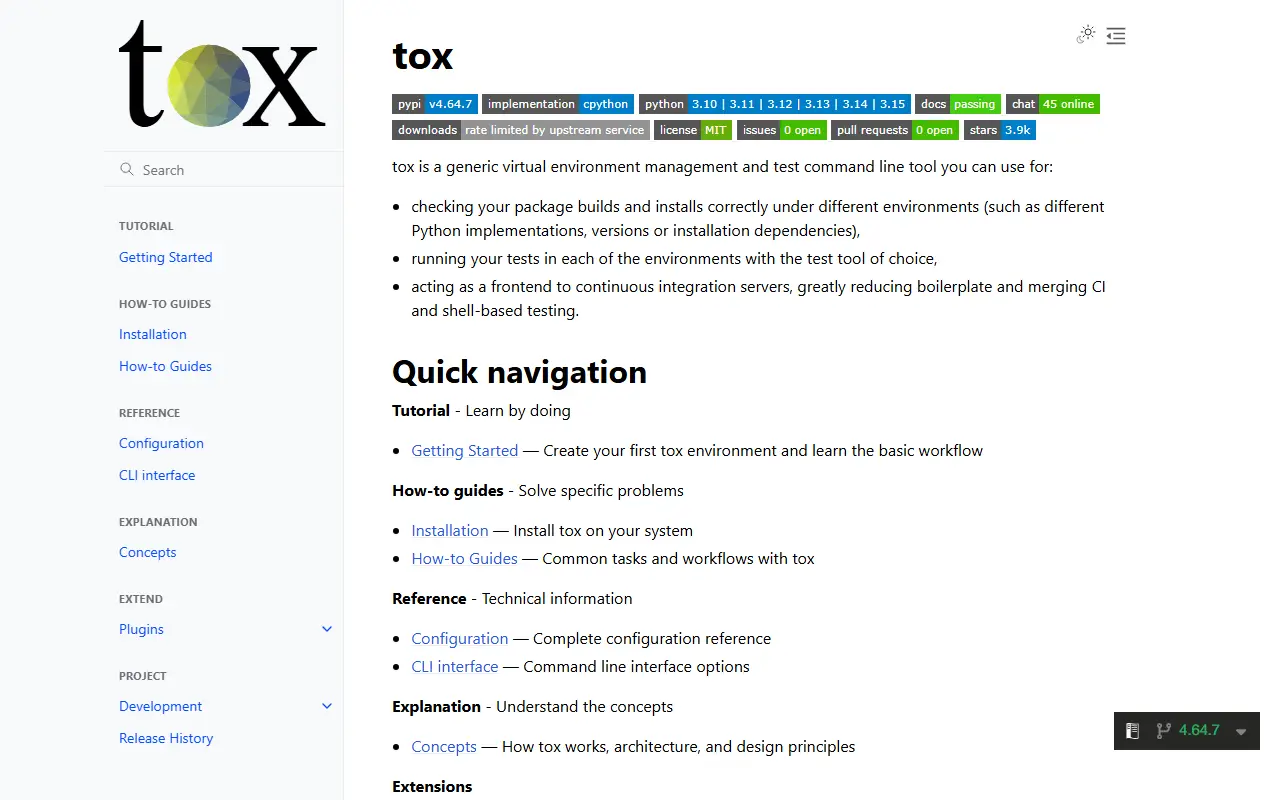
About Tox
tox is built to automate and standardize how Python code is tested. It is a general-purpose command-line tool for managing virtual environments and running tests, creating isolated environments, installs your package into each one and runs your tests there, making it a staple of Python project workflows. It belongs to a broader effort to simplify packaging, testing and releasing Python software, together with pytest and devpi.
Typical uses are checking that a package builds and installs correctly under different Python implementations, versions or dependency sets, running tests in every environment with the test tool of your choice, and acting as a front end for continuous integration servers so that CI configuration and local shell commands stay in sync with much less boilerplate. Topics reference virtualenv, venv and GitHub Actions.
tox is written in Python and licensed under MIT. It runs on developer machines and in CI pipelines, so nothing needs hosting. It suits maintainers of Python libraries and applications who need a repeatable way to test across versions.
Key features
- Isolated virtual environments per test run
- Tests across Python versions and implementations
- Package build and install verification
- Works with any test runner
- Front end for CI servers
- Single configuration for local and CI runs
Good fit for
- Testing a library across Python versions
- Keeping CI and local test commands consistent
Tox: questions and answers
- What is Tox used for?
- tox is a command-line tool that automates Python testing across multiple environments and acts as a front end to CI servers. It is a good fit for testing a library across Python versions, and keeping CI and local test commands consistent.
- Is Tox open source?
- Yes. Tox is open source under the MIT licence. Its source code is on GitHub at tox-dev/tox and is written mainly in Python.
- Is Tox free?
- Yes. Tox is open source, so the software itself is free to use.
- What is Tox an alternative to?
- Tox is an open-source alternative to Zoom, Messenger, WeChat and LINE. Other open-source alternatives to Zoom include Element, Wire and Rocket.Chat.
- Is Tox actively maintained?
- Yes. The most recent commit to Tox was on 13 November 2026, and the latest release is 4.67.13, published on 6 November 2026. The project has 4k stars on GitHub, with 36 added in the last 30 days.
Open-source alternatives to Tox
See all
Element
Team Chat
A glossy Matrix collaboration client for the web.
AGPL-3.0vs Slack★ 14k
Wire
Team Chat
🇪🇺 Wire back-end services
AGPL-3.0vs Slack★ 2.8k
Rocket.Chat
Team Chat
The Secure CommsOS™ for mission-critical operations
OSSvs Slack★ 46k
Mattermost
Team Chat
Mattermost is an open source platform for secure collaboration across the entire software
OSSvs Slack★ 40k
Zulip
Team Chat
Zulip server and web application. Open-source team chat that helps teams stay productive a
Apache-2.0vs Slack★ 26k
Briarproject
Open source
Mirror of https://code.briarproject.org/briar/briar
OSSvs Messenger★ 720
SaaS alternatives to Tox
See all
Zoom
Video Conferencing
Zoom is a communications platform for video meetings, team chat, phone, webinars, whiteboards and events, with apps for desktop and mobile.
SaaS
Messenger
Team Chat
Meta's chat and video calling service for Facebook contacts
SaaS
WeChat
Team Chat
Tencent's messaging and mobile payments app
SaaS
LINE
Team Chat
Messenger and super-app popular in Japan, Taiwan and Thailand
SaaS
Telegram
Team Chat
Cloud-based messenger with large groups, channels and bots
SaaS
Spike
Email Clients & Servers
Email-based team chat that turns inbox threads into conversations
SaaS