7,363 open-source and SaaS tools, with GitHub stats refreshed every day.

5 alternatives ranked by real activity

Open-source TeamSpeak alternatives

A curated, ranked list of the 5 best open-source alternatives to TeamSpeak.

The best open-source alternative to TeamSpeak is Mumble. If that doesn't suit you, other good options are Stoat, Chatto, Sharkord and Haven.

TeamSpeak alternatives are mainly team chat tools. 5 of them shipped code in the last 30 days, 5 can be self-hosted, and 1 uses a permissive licence.

Last updated October 3, 2026 · ranked by GitHub stars, growth and recent commits

Mumble

Mumble is an open-source, low-latency voice chat program with a client and server built on Qt and Opus, popular with gaming groups and communities.

GitHub stars
8.3k
Last commit
today
Latest release
v1.5.915
Self-hosted
Yes
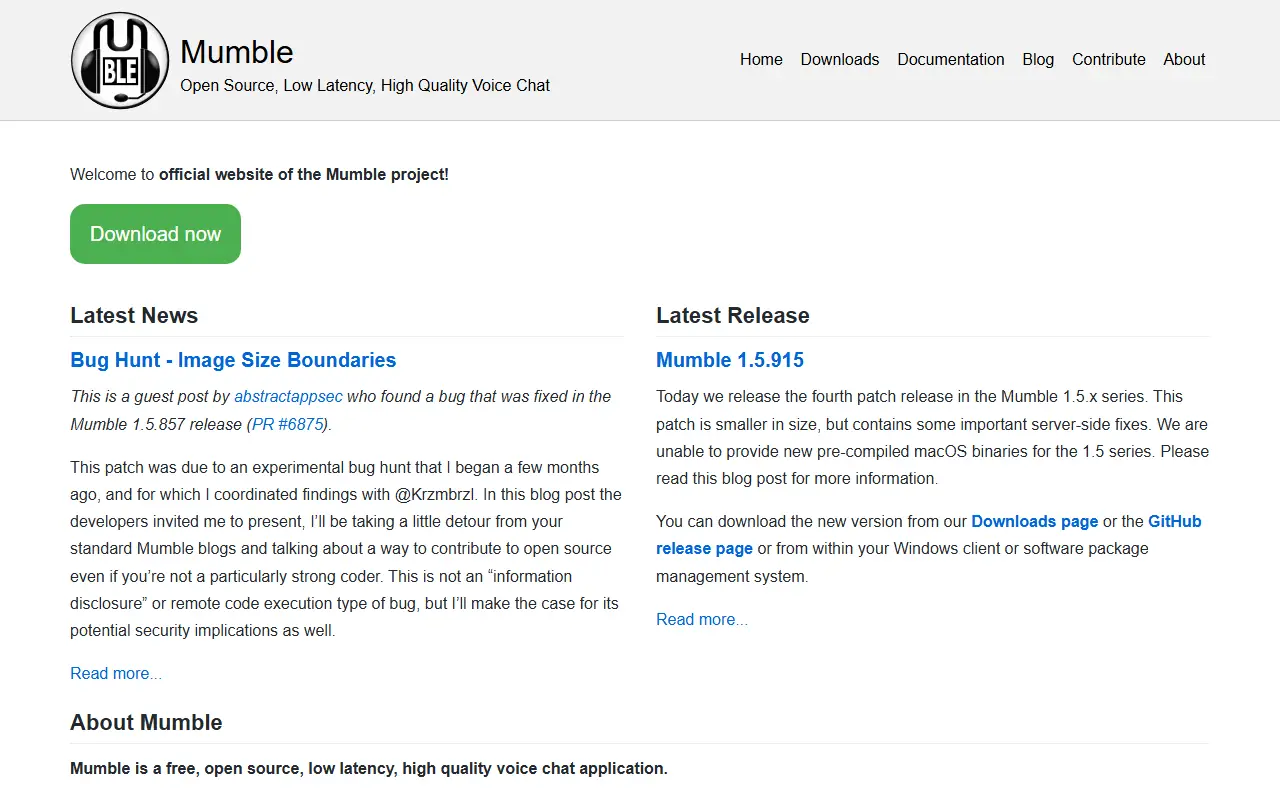
mumble.infoMumble homepage screenshot

Mumble is an open-source voice chat program designed for low latency and high audio quality. It is written on top of Qt and Opus and is used by groups, including gaming communities, that want to talk in real time on a server they control.

The software has two parts: the client, called mumble, and the server, called mumble-server, which was formerly known as murmur. The client is available for Windows, Linux, FreeBSD, OpenBSD and macOS, and the server is expected to run anywhere Qt can be installed. General-purpose plugins can add functionality that is not built into the main application, and the interface is translated through the Weblate platform.

Mumble is written in C++, and its licence is listed as non-standard on GitHub, so check the repository for details. Documentation lives on the project website, and the README gives build instructions that vary by branch, with the master branch holding unstable code for a future release.

Key features

  • Low-latency voice chat
  • Opus audio codec
  • Separate client and server programs
  • Clients for Windows, Linux, macOS and BSD
  • Plugin support
  • Community translations via Weblate
Stoat

Developers is the Rust backend codebase behind Stoat, formerly Revolt, an open-source chat service built on MongoDB and Redis.

GitHub stars
3.4k
Last commit
yesterday
Latest release
v0.15.7
Hosted version
Available

This repository contains the services and libraries that power the Stoat chat service, whose earlier name Revolt still appears in the project's topics. It is a backend codebase written in Rust, using MongoDB for storage and Redis alongside it. The linked developer site documents the public API for people building on the platform.

The code is organized into core crates and server crates. The core crates cover configuration, the database implementation, file handling with S3 storage and encryption, API models, permission logic, user presence, shared result and error types, and a request coalescing service. On top of these sit a REST API server called delta and a WebSocket events server called bonfire.

Key features

  • REST API server for the chat service
  • WebSocket events server for real-time updates
  • Permission logic as a separate crate
  • S3 file storage with encryption helpers
  • User presence tracking
Read more about StoatWebsite GitHub

Chatto

Self-hostable team and community chat application with channels, voice and video calls, and screen sharing, built with a privacy-first approach.

GitHub stars
2.8k
Last commit
yesterday
Latest release
v0.4.24
Licence
AGPL-3.0
Self-hosted
Yes
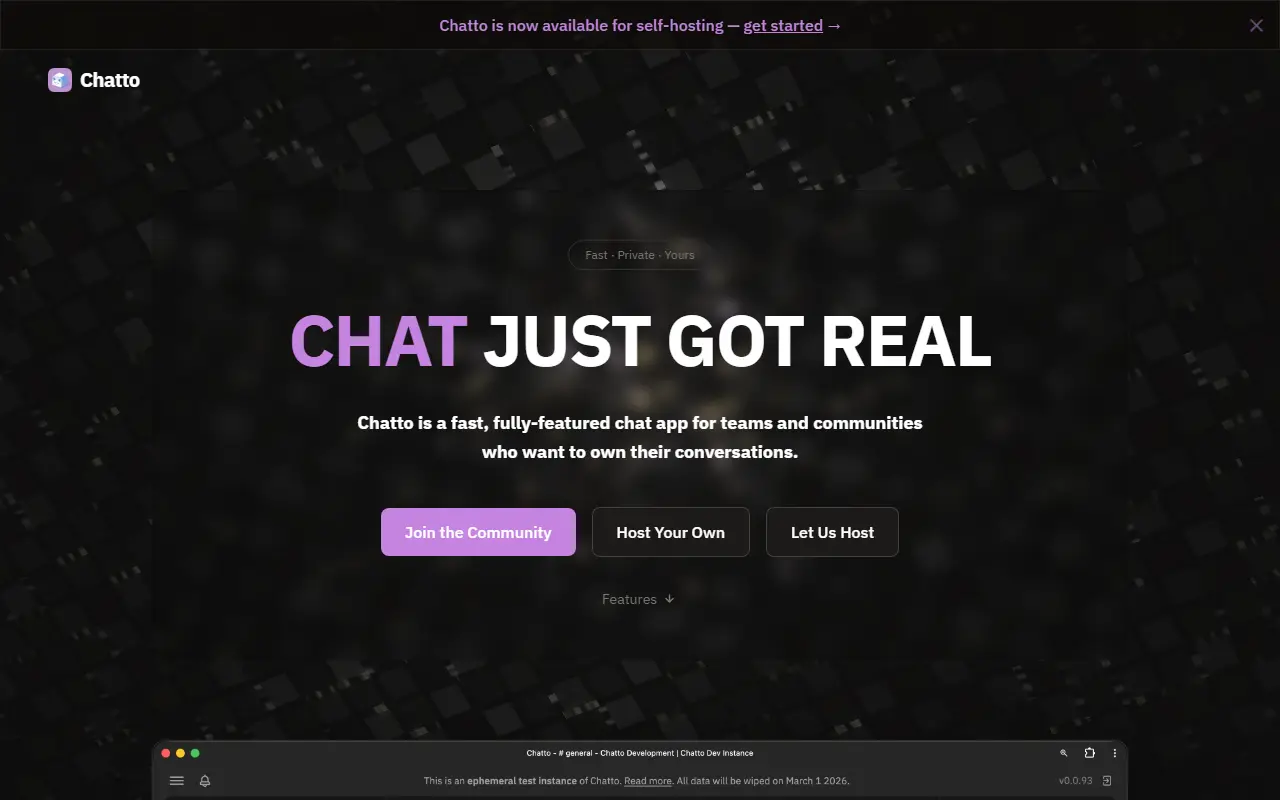
chatto.runChatto homepage screenshot

Chatto is an open-source chat application for teams and communities that is meant to be free and easy to self-host. The repository contains the chat server, a command-line tool, and a bundled web front end, and the project describes itself as fully featured. It is released under the AGPL-3.0 license.

The topics describe a privacy-first design that is GDPR-compliant, and the application includes voice calls, video calls, and screen sharing in addition to text chat. The repository also hosts related components, including Runling, an independent workflow and agent orchestrator published on npm, and Authling, an identity provider that is expected to move to its own repository.

The README says cloud hosting will be available soon, so self-hosting is the supported route today, with a documentation site and releases for installation. The authors note that Chatto is built with the help of coding agents. It is a young project created in 2026 and suits teams that want an alternative to hosted workplace chat tools.

Key features

  • Team and community text chat
  • Voice and video calls
  • Screen sharing
  • Bundled web front end and CLI
  • Privacy-first, GDPR-oriented design
  • Self-hosting documentation and releases

Pricing: Free and open source under the AGPL-3.0 license; the project says cloud hosting is coming.

Sharkord

A lightweight self-hosted chat server with text, voice, video and screen sharing for small groups, shipped as a single binary and currently in alpha.

GitHub stars
1.5k
Last commit
21 days ago
Latest release
v0.0.25
Licence
MIT
Self-hosted
Yes
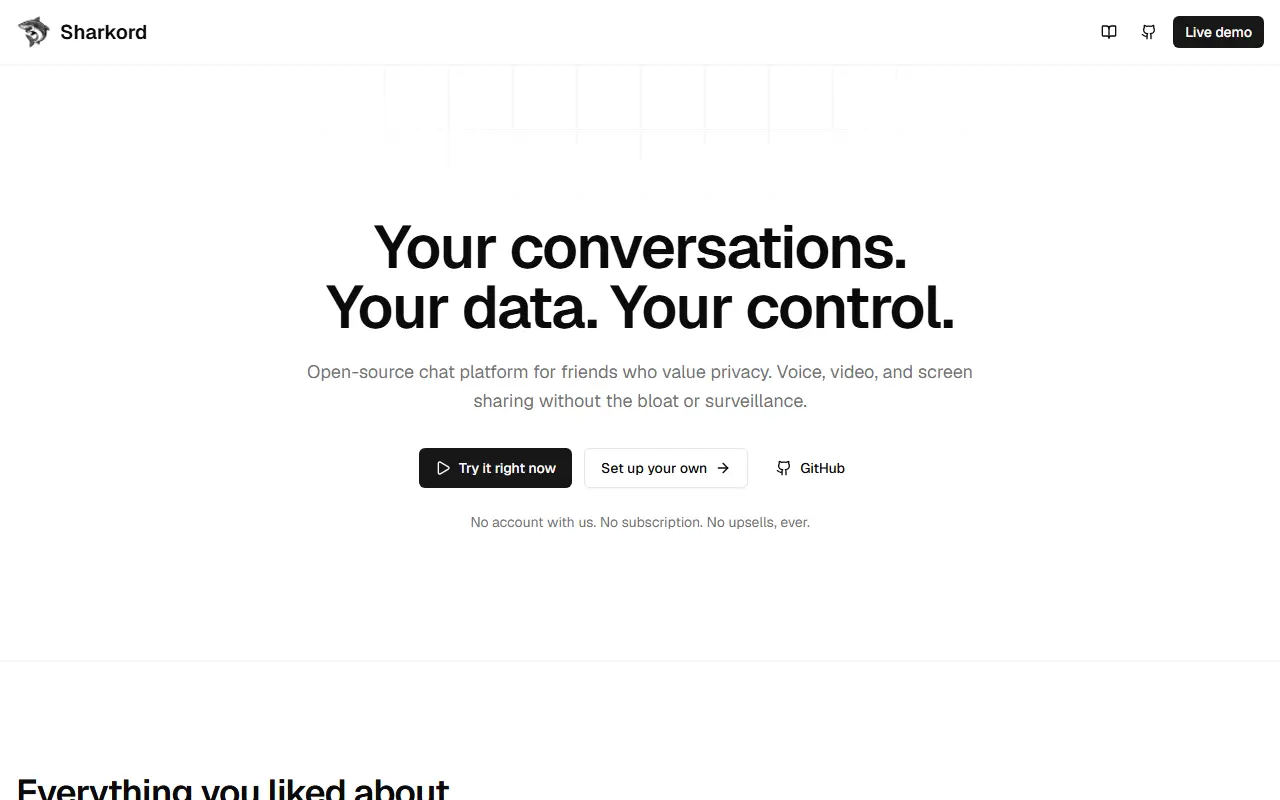
sharkord.comSharkord homepage screenshot

Sharkord is a self-hosted communication platform that brings the most important Discord-style features to your own infrastructure. It is aimed at small groups who want voice, video, text and screen sharing with privacy, simplicity and full control over their data, and the project notes it is in an alpha stage.

Voice channels use a built-in mediasoup SFU for video and screen sharing, while text channels can be grouped into categories and include threads, replies, reactions, pins and search. Other features include direct messages, roles with per-channel permission overrides, custom emoji, mentions, invites with usage limits, file uploads with storage quotas, and a plugin SDK that extends both server and client.

Sharkord is written in TypeScript on Bun and licensed under MIT. It is distributed as a standalone binary that bundles server and client for Windows, macOS and Linux, and it can also run in Docker. On first launch it prints a secret token that grants owner access and must be kept safe. A live demo is available, and breaking changes are expected during alpha.

Key features

  • Voice channels with video and screen sharing
  • Text channels with threads and reactions
  • Direct messages between members
  • Roles with per-channel permissions
  • Invites with usage limits
  • Plugin SDK for server and client

Pricing: Free and open source under the MIT licence.

Haven

Haven is a self-hosted private chat and voice server pitched as a Discord alternative, with desktop, Android and browser clients and no cloud or telemetry.

GitHub stars
580
Last commit
yesterday
Latest release
v4.16.0
Licence
AGPL-3.0
Self-hosted
Yes
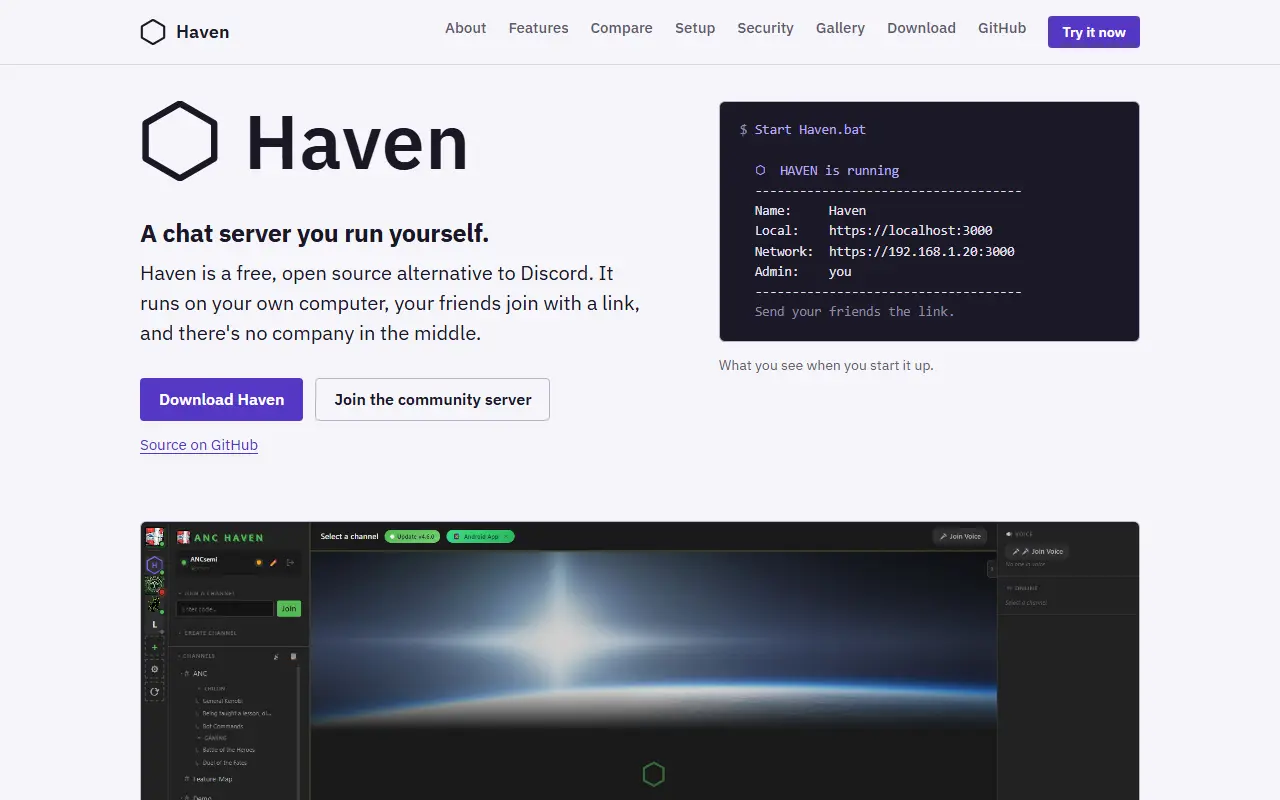
haven-app.comHaven homepage screenshot

Haven is a private chat platform that runs on your own machine and is positioned as an alternative to Discord. The project says there is no cloud, no company account, no telemetry and no paid tier. One person runs the server and everyone else joins with a code, so messages, files and voice never touch anyone else's infrastructure.

Setup takes about a minute: run it in Docker, unzip and start it on Windows with a batch file that installs Node.js if needed, or run a start script on Linux or macOS, then open the HTTPS address on port 3000, register as admin, create a channel and share the invite code. Clients include a desktop app for Windows and Linux with per-app audio sharing, device switching mid-call and the option to run the server itself, a native Android app on Google Play, an iOS app in TestFlight testing, and any browser including on phones. Topics mention voice chat, streaming and mediasoup.

Haven is written in JavaScript on Node.js and licensed under AGPL-3.0. One-click deployments on Zeabur and RepoCloud are offered, and a volunteer-hosted community server is open for anyone who wants to look around first.

Key features

  • Self-hosted text, voice and file chat
  • Join with invite codes, no email needed
  • Desktop apps for Windows and Linux
  • Native Android app
  • Browser access on any device
  • Docker and script-based install

Pricing: Free and open source under the AGPL-3.0 license, with no paid tier according to the project.

Read more about HavenWebsite GitHub

TeamSpeak alternatives: questions

What is the best open-source alternative to TeamSpeak?
Mumble is the top-ranked open-source alternative to TeamSpeak on Enlisted: Mumble is an open-source, low-latency voice chat program with a client and server built on Qt and Opus, popular with gaming groups and communities. Other strong options are Stoat, Chatto, Sharkord and Haven.
Are these TeamSpeak alternatives free?
All 5 are open source, so the code is free to use under its licence, and all of them can be self-hosted on your own server or computer. 1 also offers a paid or managed cloud version if you'd rather not host it yourself.
How is this list of TeamSpeak alternatives ranked?
By a score built from GitHub stars, star growth over the last 30 days and how recently the code changed. 5 of these projects shipped code in the last 30 days. Data is refreshed daily, and nobody can pay to move up.

People also look for alternatives to…

View all