7,363 open-source and SaaS tools, with GitHub stats refreshed every day.

9 alternatives ranked by real activity

Open-source FaceTime alternatives

A curated, ranked list of the 9 best open-source alternatives to FaceTime.

The best open-source alternative to FaceTime is Jitsi Meet. If that doesn't suit you, other good options are Signal Android, SimpleX Chat, Element and Signal iOS.

FaceTime alternatives are mainly team chat tools, but some are also video conferencing tools. 8 of them shipped code in the last 30 days, 8 can be self-hosted, and 1 uses a permissive licence.

Last updated October 2, 2026 · ranked by GitHub stars, growth and recent commits

Jitsi Meet

An open-source video conferencing platform that runs in the browser and mobile apps, usable as a standalone service or embedded in your own web application.

GitHub stars
30k
Last commit
yesterday
Latest release
stable/jitsi-meet_11248
Licence
Apache-2.0
Self-hosted
Yes
Hosted version
Available
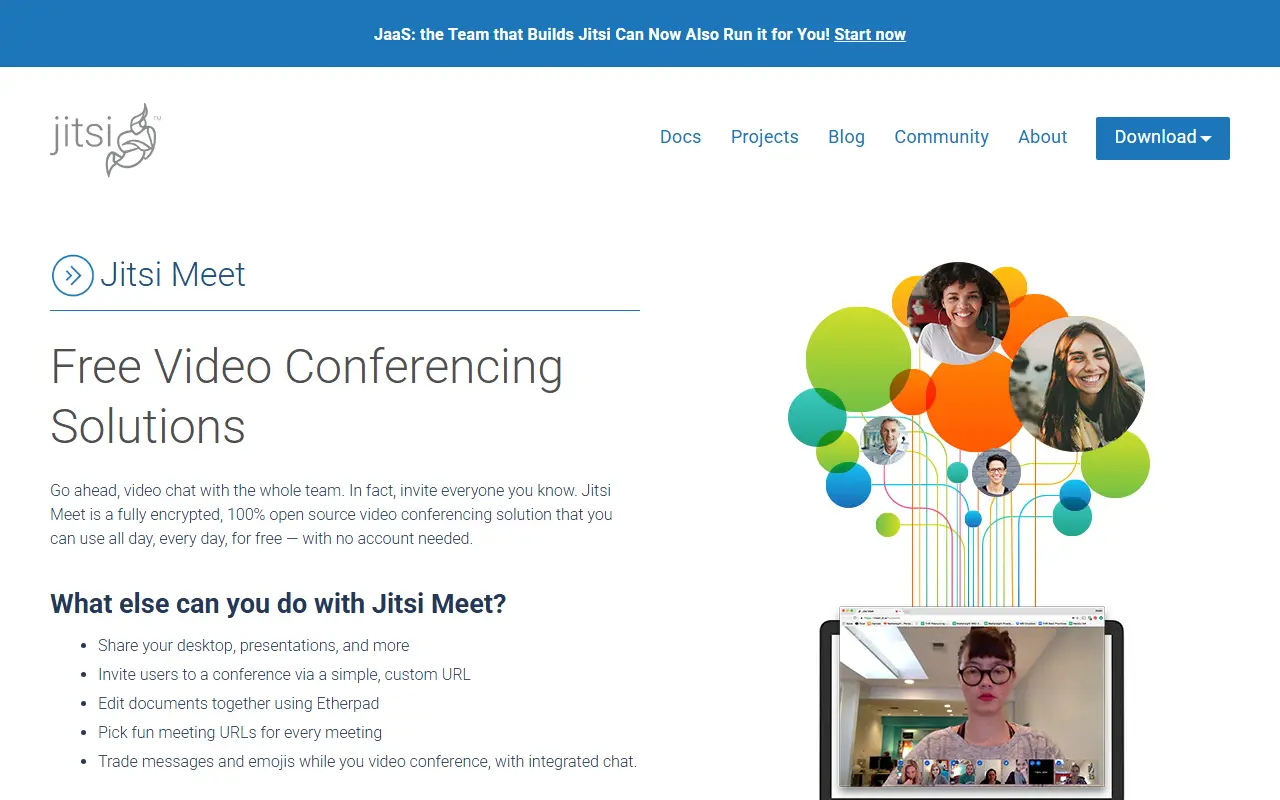
jitsi.orgJitsi Meet homepage screenshot

Jitsi Meet is a collection of open-source projects for hosting video conferences. It works in all current browsers and has Android and iOS apps, and it can be used as a ready-made service or embedded into other web applications through web and native SDKs. It is built on WebRTC with a selective forwarding unit to scale to larger meetings.

Meetings offer HD audio and video, content sharing, raised hands and reactions, chat with private conversations, polls and virtual backgrounds. The hosted service at meet.jit.si is free to use, and the README says you can start a meeting after signing in with an account from a major provider. Mobile users can use the browser or the full-featured apps, which are also available from F-Droid, and open beta programs let early adopters test features.

If you prefer control over your data, Jitsi can be deployed on your own infrastructure, with documentation for running your own instance. Jitsi Meet is Apache-2.0 licensed and written in TypeScript. It suits organizations, schools and communities that want an alternative to proprietary meeting software.

Key features

  • Browser-based meetings with no install
  • Android and iOS apps
  • Screen and content sharing
  • Chat, polls, reactions and raised hands
  • Virtual background support
  • Web and native SDKs for embedding

Pricing: Free and open source under Apache-2.0; the public meet.jit.si service is free to use.

Signal Android

Signal Android is the open-source Android client of the Signal private messenger, offering encrypted messages and voice or video calls.

GitHub stars
29k
Last commit
today
Latest release
v8.28.4
Licence
AGPL-3.0
Self-hosted
No
Hosted version
Available
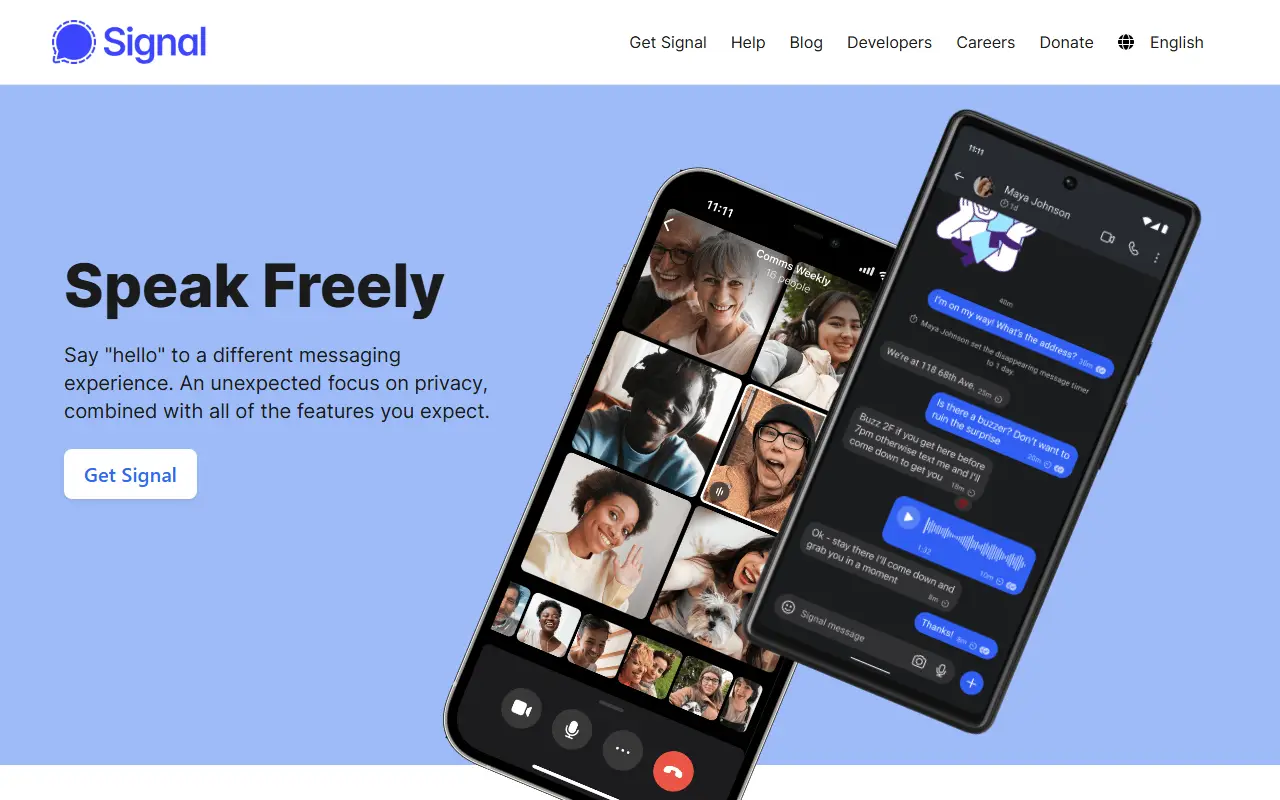
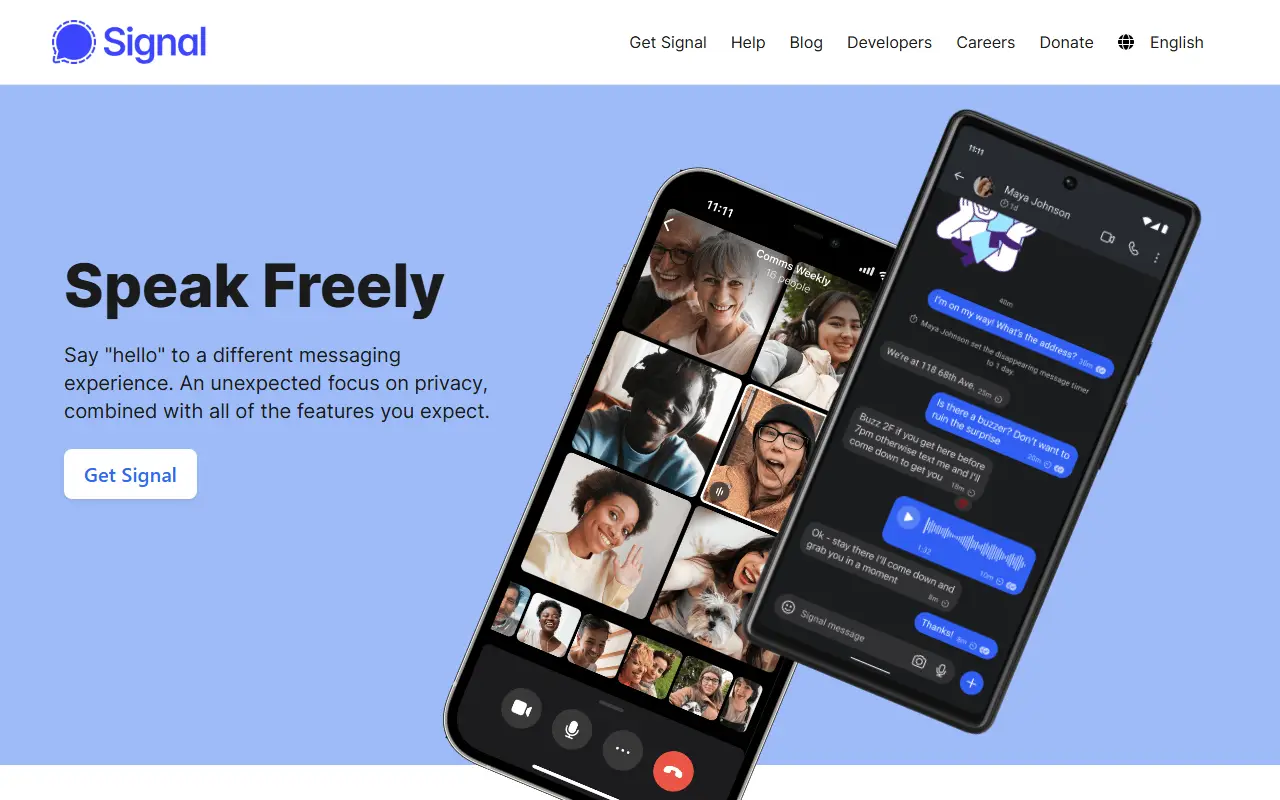
signal.orgSignal Android homepage screenshot

Signal Android is the source code of the Signal private messenger for Android. Signal describes itself as a simple and secure messenger that sends messages and places voice and video calls over WiFi or a mobile data connection, with privacy protections always switched on. The app is written in Kotlin and released under the AGPL-3.0 license, and it is free to use.

The app is available from the Play Store and signal.org, with versions for iOS and desktop as well. The repository explains how to report bugs on GitHub, join the beta channel on Google Play, contribute translations through the community forum, and submit code. New contributors are encouraged to start with small bug fixes, and larger ideas should be discussed on the community forum first. The client depends on Signal's own hosted service, so there is no self-hosted server option here.

Key features

  • Encrypted one-to-one and group messaging
  • Voice and video calls
  • Privacy features that are always enabled
  • Android app distributed via Play Store and signal.org
  • Open Kotlin source under AGPL-3.0
  • Beta program and translation contributions

Pricing: Free to use; the README describes Signal as free of charge.

SimpleX Chat

A private messenger and protocol that works without any user identifiers, with end-to-end encryption, mobile apps and a terminal client.

GitHub stars
20k
Last commit
yesterday
Latest release
v7.0.3
Licence
AGPL-3.0
Self-hosted
Yes
simplex.chatSimpleX Chat homepage screenshot

SimpleX is a messaging network built around the idea that it should not assign identifiers of any kind to its users, not even random IDs, which the project says makes it private by design. The goal is to protect not just message content but also metadata, meaning who talks to whom and when.

Messages use double-ratchet end-to-end encryption with an additional encryption layer. Apps are available for Android and iOS, with an iOS TestFlight preview that gets new features a week or two earlier but is limited in the number of users, and a terminal client runs on Linux, macOS and Windows. The README invites readers to install the app, connect to the team and user groups, make a private connection with a friend, help with translations and donate. The core is written in Haskell.

SimpleX Chat is licensed under AGPL-3.0, and its protocol and server software are open so that others can host relays. It is aimed at people who need stronger privacy guarantees than mainstream messengers provide, such as journalists, activists and privacy-conscious individuals.

Key features

  • No user identifiers of any kind
  • Protects message metadata
  • Double ratchet end-to-end encryption
  • Android and iOS apps
  • Terminal client for Linux, macOS and Windows
  • Open protocol and server software

Pricing: Free and open source under the AGPL-3.0 license.

Element

Web and desktop client for the Matrix network, offering encrypted chat, rooms and collaboration built on the Matrix JS SDK.

GitHub stars
14k
Last commit
today
Latest release
v1.12.30
Licence
AGPL-3.0
Self-hosted
Yes
Hosted version
Available
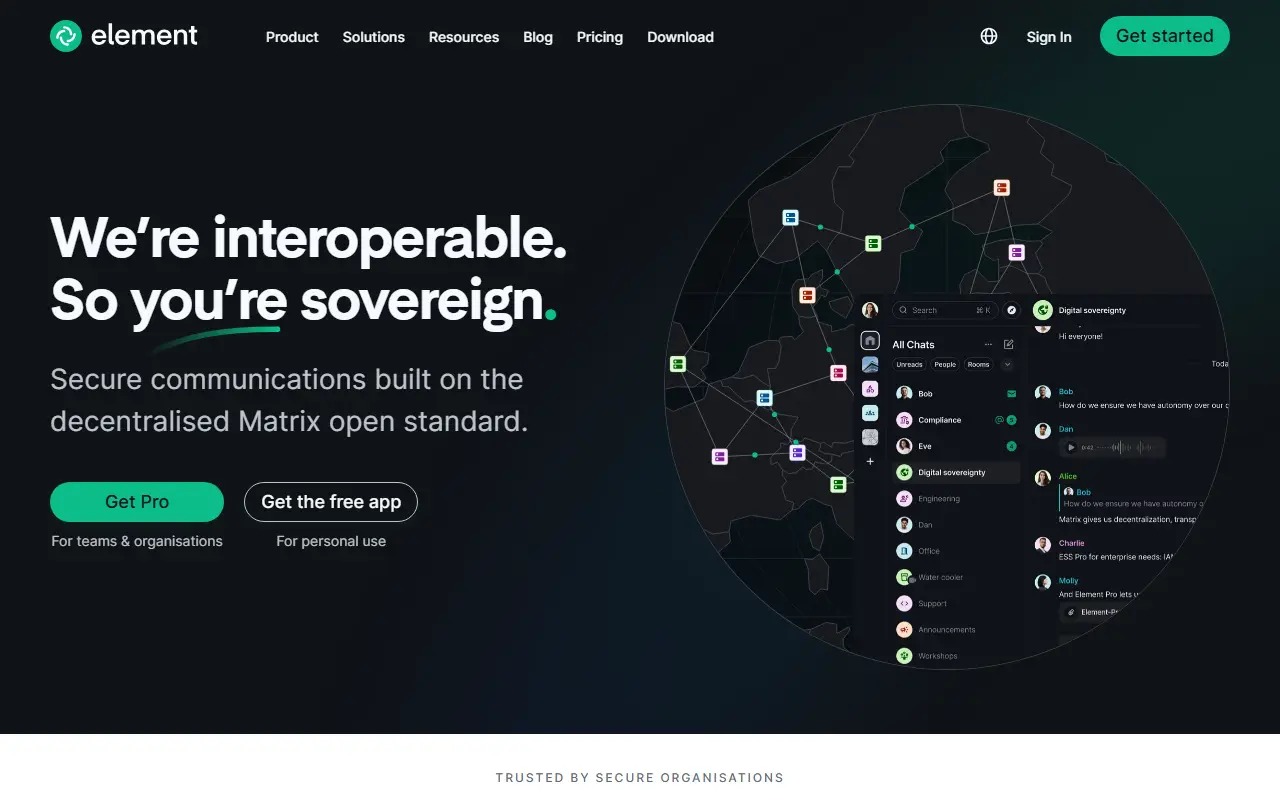
element.ioElement homepage screenshot

Element Web is a client for Matrix, the open protocol for decentralized messaging. It is the web and desktop application formerly known as Vector and Riot, and it lets people join rooms, chat in teams and communities, and collaborate across Matrix servers rather than inside a single vendor's network.

The client is built with TypeScript on top of the Matrix JS SDK. The README defines support tiers for browsers, covering recent versions of Chrome, Firefox, Edge and Safari on desktop, best-effort handling for ESR and extended-stable releases, and community support for mobile web. For phones and tablets the maintainers recommend the native Element X apps for Android and iOS.

It is released under the AGPL-3.0 license and is typically served from your own web host or used through the hosted app from the vendor, Element. Related products such as Element Call and the Enterprise Server Suite are mentioned as part of the wider Element offering. Changes are tracked on GitHub with regular release cycles.

Key features

  • Matrix web client for rooms and chat
  • Desktop app built from the same code
  • Built on the Matrix JS SDK
  • Documented browser support tiers
  • Works alongside Element X mobile apps

Pricing: Element Enterprise is priced per seat per month and Sovereign per deployment, but no prices are published; buyers are directed to talk to an expert.

Signal iOS

Free, open-source Signal messaging app for iPhone and iPad, built for private communication with friends and without analytics.

GitHub stars
12k
Last commit
yesterday
Latest release
8.30.0.1882
Licence
AGPL-3.0
Hosted version
Available
signal.orgSignal iOS homepage screenshot

Signal iOS is the iPhone and iPad client of Signal, a free and open-source messaging app made for simple, private communication with friends. The same service is also available on Android and as a desktop application, so conversations are not tied to a single platform.

The app is written in Swift. The maintainers state that it collects no analytics or telemetry, which is why they rely on bug reports sent through the Support Center to troubleshoot problems. Developers can follow BUILDING.md to set up a build environment and read the contribution guidelines, while ideas and discussion go through the community forum run for Signal Foundation projects.

The repository is released under the AGPL-3.0 license. Because the software includes cryptographic functionality, the README carries a cryptography notice reminding users to check their country's rules on encryption software and documents its export classification. Signal itself operates as a hosted messaging service rather than something you run on your own server.

Key features

  • Private messaging for iPhone and iPad
  • No analytics or telemetry collection
  • Open Swift source code
  • Companion apps for Android and desktop
  • Build instructions in BUILDING.md

Pricing: Free to use; the app is open source under the AGPL-3.0 license.

Chitchatter

Serverless peer-to-peer chat and video app that is end-to-end encrypted and ephemeral, with no accounts and no message storage.

GitHub stars
2.3k
Last commit
3 days ago
Licence
GPL-2.0
Self-hosted
Yes
Hosted version
Available
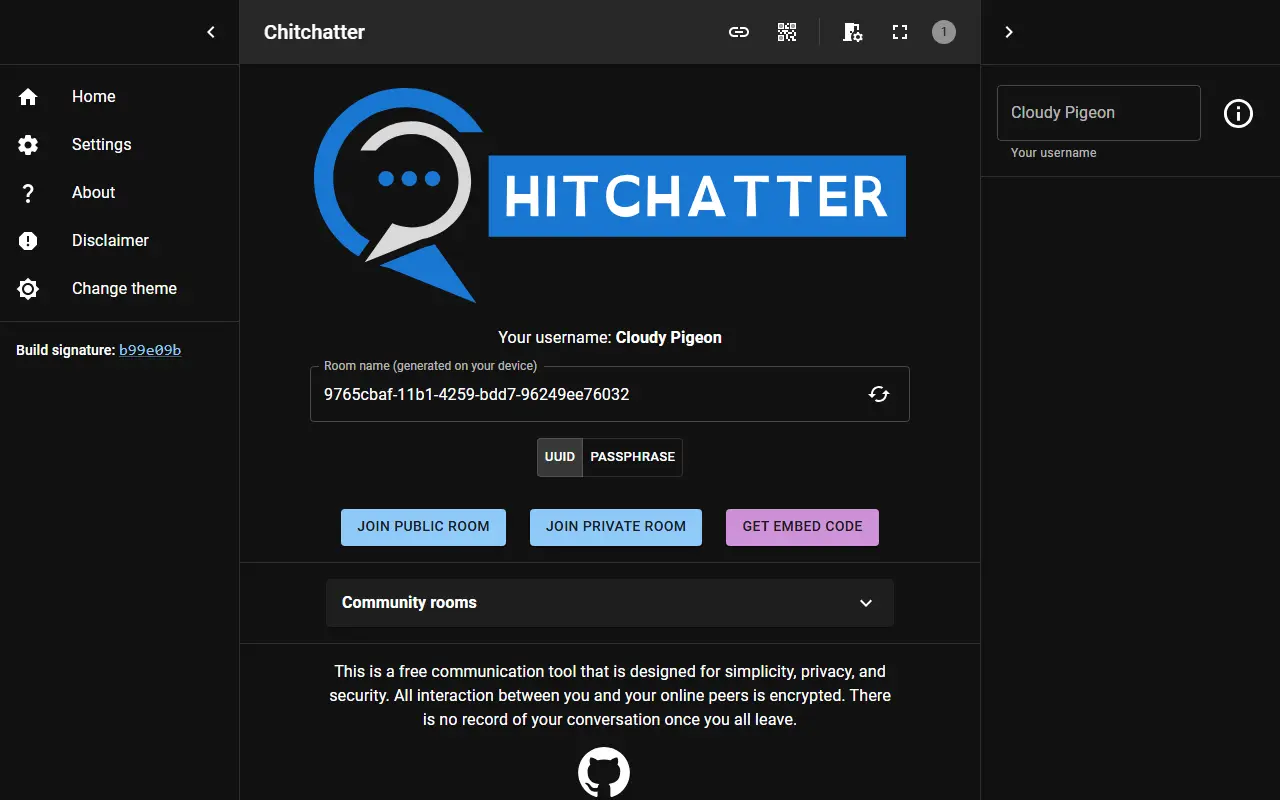
chitchatter.imChitchatter homepage screenshot

Chitchatter is a free communication tool that aims to be the simplest way to connect with others privately and securely. It is peer-to-peer, using a TURN server only when a direct connection is not possible, and end-to-end encrypted through WebRTC. It is fully open source under the GPL v2 license.

Messages are ephemeral: content is never written to disk on either the client or a server. The tool is also decentralized, working without an API server, with only GitHub for static assets and public WebTorrent and TURN relay servers needed to establish connections. Its topics list video conferencing and the Trystero library.

A public instance runs at chitchatter.im, and since it is a static web app it can also be hosted elsewhere. Chitchatter suits people who want a quick private room for text, video, or file exchange without creating accounts, and developers interested in serverless WebRTC applications.

Key features

  • Peer-to-peer WebRTC connections
  • End-to-end encryption
  • Ephemeral messages never stored to disk
  • No account or API server required
  • Text chat and video conferencing
  • TURN fallback for reliable connections

Pricing: Free and open source under the GPL v2 license; a public instance runs at chitchatter.im.

Linphone

Open-source SIP softphone for voice calls, video calls and instant messaging on Windows, macOS and Linux desktops.

GitHub stars
507
Last commit
2 days ago
Licence
GPL-3.0
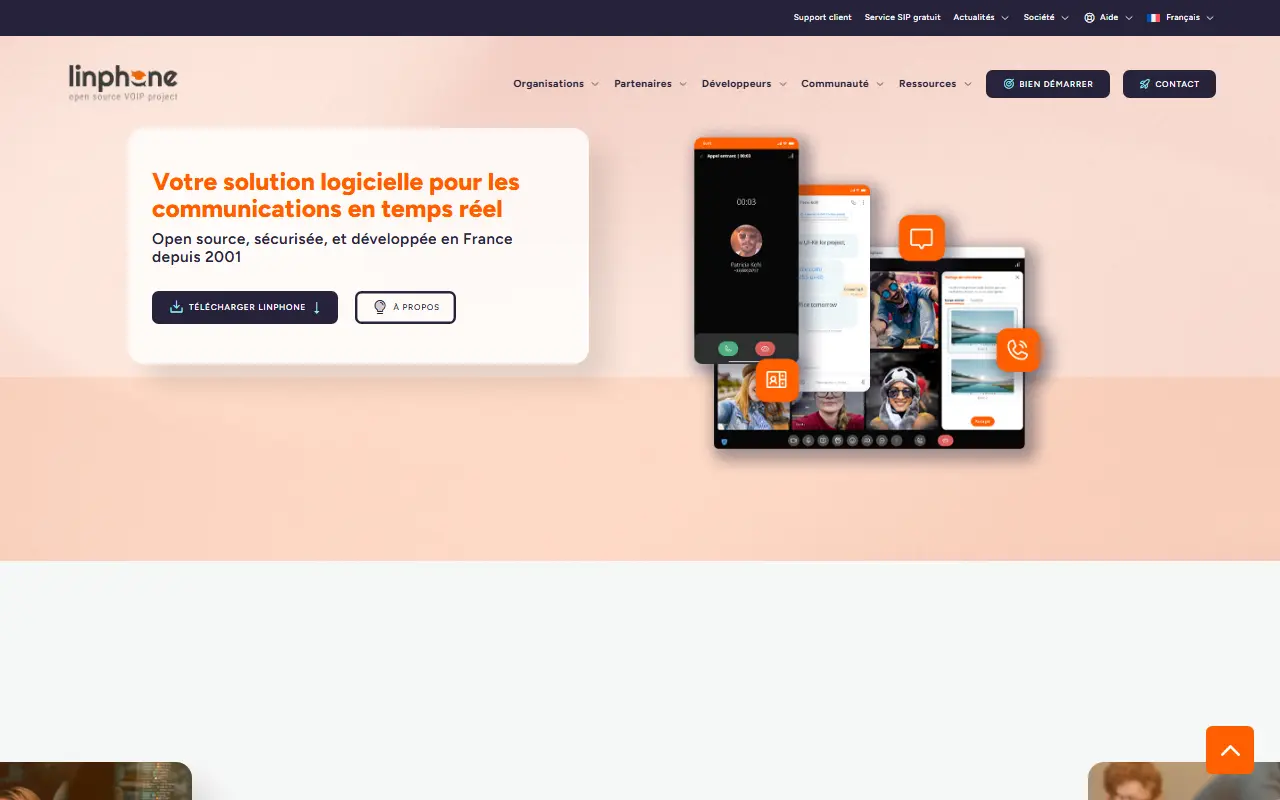
linphone.orgLinphone homepage screenshot

Linphone Desktop is an open-source softphone for voice and video calling and instant messaging over IP. It is based entirely on the SIP protocol and handles calling, presence and messaging features. The project is developed by Belledonne Communications, and this GitHub repository mirrors the official git repository.

Topics on the repository include conferencing, chat and messaging. The app is built with Qt 6, requires a C++17 compiler, and depends on the Linphone SDK, so building from source means installing the SDK dependencies and setting up the Qt environment. Supported features and RFCs are listed in the project documentation and wiki.

Linphone is dual licensed. It is free under GPL-3.0 for open-source use, and Belledonne Communications also sells a proprietary license for a fee to companies that want to use it in closed-source applications.

Key features

  • Voice and video calls over SIP
  • Instant messaging and presence
  • Conference calls
  • Built with Qt 6 for desktop
  • Based on the Linphone SDK

Pricing: Free under GPL-3.0; a paid proprietary license is available for closed-source applications.

MiroTalk C2C

Self-hosted WebRTC tool for private one-to-one video calls with screen sharing, which you can embed in a website through an iframe.

GitHub stars
513
Last commit
yesterday
Licence
AGPL-3.0
Self-hosted
Yes
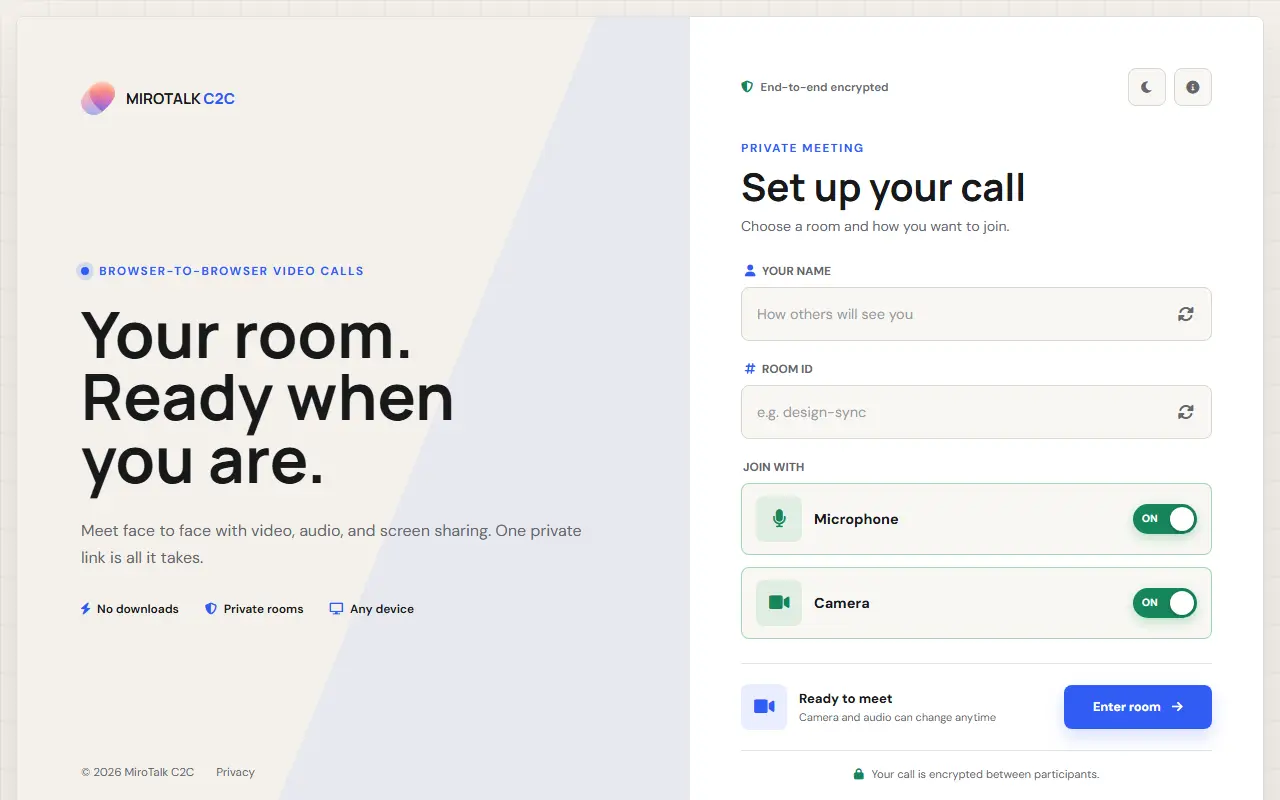
c2c.mirotalk.comMiroTalk C2C homepage screenshot

MiroTalk C2C is an open-source WebRTC application for private one-to-one video calls between two browsers. It uses direct peer-to-peer connections and supports screen sharing, and the project describes the calls as end-to-end encrypted.

It is aimed at consultations, coaching, customer support, telehealth and other situations where two people need a private browser-based call. The interface can be embedded into any website via an iframe. Settings include camera background options of off, blur or a custom image, processed locally in the browser, although the effects load MediaPipe files from external hosts.

You can start it with a few commands or run it with Docker and Docker Compose, then open it on localhost port 8080. A live demo, documentation and a Discord community are linked from the repository. The project is licensed under AGPL-3.0 and is written in JavaScript.

Key features

  • Peer-to-peer WebRTC one-to-one video calls
  • Screen sharing
  • Embeddable in websites via iframe
  • Camera background blur and image options
  • Docker and Docker Compose deployment
  • End-to-end encrypted calls

Pricing: Free and open source under the AGPL-3.0 licence.

Briefing

Browser-based, privacy-focused group video chat built on WebRTC, available as a free hosted service or a self-hostable, embeddable app.

GitHub stars
1.6k
Last commit
10 mo ago
Latest release
v3.1.12
Licence
AGPL-3.0
Self-hosted
Yes
Hosted version
Available
brie.fiBriefing homepage screenshot

Briefing, running at Brie.fi/ng, is a secure group video chat that works directly in the browser using open technologies such as WebRTC. No extra software is needed, and a conversation can start immediately for free. A free iOS app also exists. Features include desktop sharing, text chat and simple invitation links, and the code can be extended with JavaScript and Vue knowledge.

Briefing is self-contained: it bundles the user interface, signaling and STUN components that a WebRTC video chat needs. There are several ways to use it in your own project. You can create a room on Brie.fi/ng and link it from your site, embed it in a frame with a configurator, run it on your own server through Docker or a cloud platform such as fly.io, Render, Google Cloud, AWS or Azure, or customize the source code.

The public license is AGPL-3.0 or later, and the author also offers a commercial license, particularly for white-labeling applications. Sponsorship through GitHub is also welcome. The project is written in TypeScript with Vue, and topics highlight end-to-end encryption and WebRTC signaling.

Key features

  • Group video chat in the browser using WebRTC
  • Desktop sharing and text chat
  • Simple invitation links
  • Embeddable in your own website
  • Bundled signaling and STUN components
  • Docker self-hosting

Pricing: Free to use at Brie.fi/ng and under AGPL-3.0 when self-hosted. A commercial license is available, especially for white-labeling.

FaceTime alternatives: questions

What is the best open-source alternative to FaceTime?
Jitsi Meet is the top-ranked open-source alternative to FaceTime on Enlisted: An open-source video conferencing platform that runs in the browser and mobile apps, usable as a standalone service or embedded in your own web application. Other strong options are Signal Android, SimpleX Chat, Element and Signal iOS.
Are these FaceTime alternatives free?
All 9 are open source, so the code is free to use under its licence, and 8 of them can be self-hosted on your own server or computer. 6 also offer a paid or managed cloud version if you'd rather not host it yourself.
How is this list of FaceTime alternatives ranked?
By a score built from GitHub stars, star growth over the last 30 days and how recently the code changed. 8 of these projects shipped code in the last 30 days. Data is refreshed daily, and nobody can pay to move up.

People also look for alternatives to…

View all