
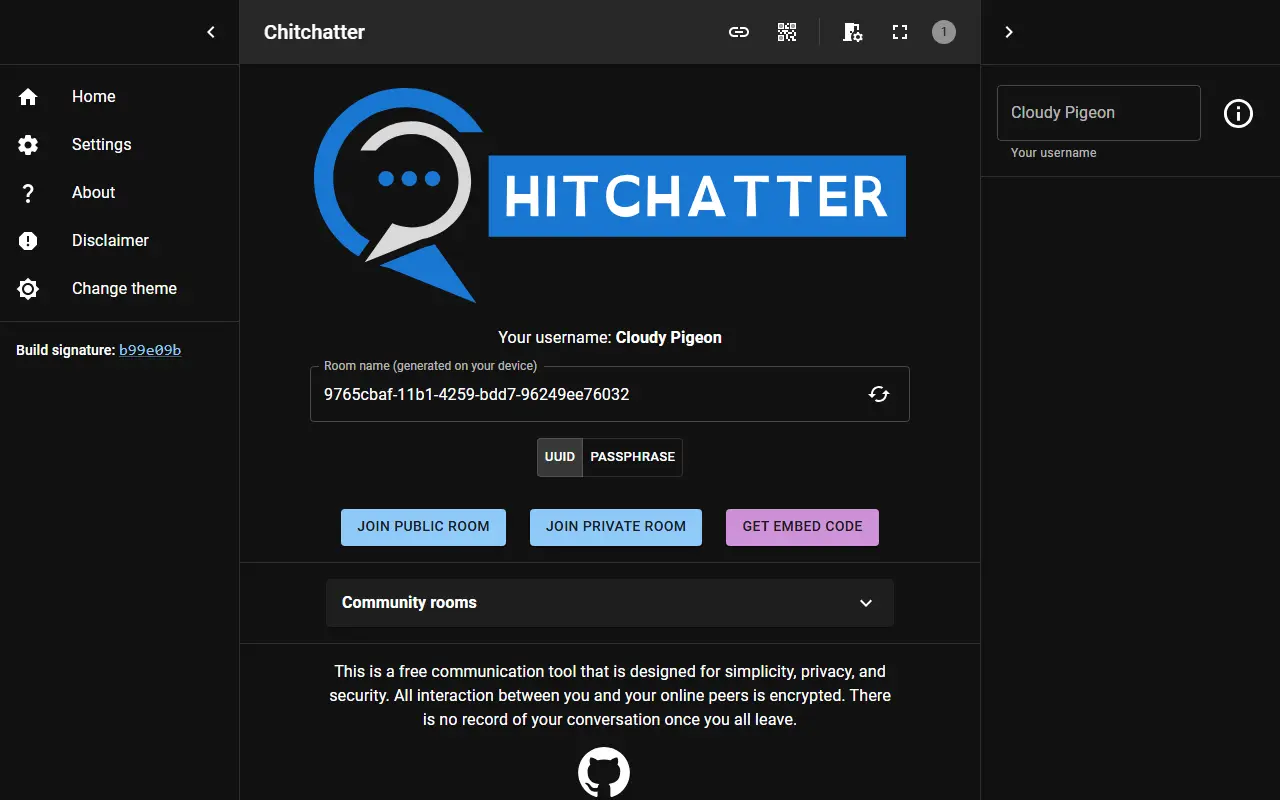
About Chitchatter
Chitchatter is a free communication tool that aims to be the simplest way to connect with others privately and securely. It is peer-to-peer, using a TURN server only when a direct connection is not possible, and end-to-end encrypted through WebRTC. It is fully open source under the GPL v2 license.
Messages are ephemeral: content is never written to disk on either the client or a server. The tool is also decentralized, working without an API server, with only GitHub for static assets and public WebTorrent and TURN relay servers needed to establish connections. Its topics list video conferencing and the Trystero library.
A public instance runs at chitchatter.im, and since it is a static web app it can also be hosted elsewhere. Chitchatter suits people who want a quick private room for text, video, or file exchange without creating accounts, and developers interested in serverless WebRTC applications.
Key features
- Peer-to-peer WebRTC connections
- End-to-end encryption
- Ephemeral messages never stored to disk
- No account or API server required
- Text chat and video conferencing
- TURN fallback for reliable connections
Good fit for
- →Private one-off chat rooms without accounts
- →Learning serverless WebRTC app design
- Tags
- p2p
- webrtc
- chat
- end-to-end-encryption
- video-conferencing
- privacy
- serverless
- ephemeral
Chitchatter: questions and answers
- What is Chitchatter used for?
- Chitchatter is a serverless peer-to-peer chat and video app that is end-to-end encrypted and ephemeral, with no accounts and no message storage. It is a good fit for private one-off chat rooms without accounts and learning serverless WebRTC app design.
- Is Chitchatter open source?
- Yes. Chitchatter is open source under the GPL-2.0 licence. Its source code is on GitHub at jeremyckahn/chitchatter and is written mainly in TypeScript.
- Is Chitchatter free?
- Yes. Chitchatter is open source, so the software itself is free to use. A managed cloud version is also available.
- Can I self-host Chitchatter?
- Yes. Chitchatter can be self-hosted on your own server or infrastructure.
- What is Chitchatter an alternative to?
- Chitchatter is an open-source alternative to Whereby, Google Meet, GoTo Meeting and FaceTime. Other open-source alternatives to Whereby include Jitsi Meet, Briefing and MiroTalk.
- Is Chitchatter actively maintained?
- Yes. The most recent commit to Chitchatter was on 29 September 2026. The project has 2.3k stars on GitHub.
Open-source alternatives to Chitchatter
See all
Jitsi Meet
Video Conferencing
Jitsi Meet - Secure, Simple and Scalable Video Conferences that you use as a standalone ap
Apache-2.0vs Zoom★ 30k
Briefing
Video Conferencing
🔮 Secure direct video group chat
AGPL-3.0vs Whereby★ 1.6k
MiroTalk
Video Conferencing
🚀 Open-source, self-hosted P2P WebRTC video conferencing for fast, private real-time comm
AGPL-3.0vs Zoom★ 4.8kGalène
Video Conferencing
The Galène videoconference server
MITvs Zoom★ 1.4k
edumeet
Video Conferencing
edumeet - multiparty web-meetings using mediasoup and WebRTC
MITvs Zoom★ 1.3k
MiroTalk SFU
Video Conferencing
🏆 Self-hosted, open-source WebRTC video conferencing platform for real-time communication
AGPL-3.0vs Zoom★ 3.1k
SaaS alternatives to Chitchatter
See all
Whereby
Video Conferencing
Browser-based video meetings with persistent rooms and no downloads
SaaS
Google Meet
Video Conferencing
Google Meet is Google's video meeting service, used through browsers and mobile apps and integrated with Google Calendar and Workspace.
SaaS
GoTo Meeting
Video Conferencing
Online meeting software with screen sharing and dial-in numbers
SaaS
FaceTime
Video Conferencing
Apple's video and audio calling app for iPhone, iPad and Mac
SaaS
Webex
Video Conferencing
Cisco's meetings, messaging and calling platform for enterprises
SaaS
Microsoft Teams
Team Chat
Microsoft Teams is Microsoft's workspace for chat, video meetings and file collaboration, closely tied to Microsoft 365.
SaaS