#1
An open-source video conferencing platform that runs in the browser and mobile apps, usable as a standalone service or embedded in your own web application.
- GitHub stars
- 30k
- Last commit
- today
- Latest release
- stable/jitsi-meet_11248
- Licence
- Apache-2.0
- Self-hosted
- Yes
- Hosted version
- Available
jitsi.org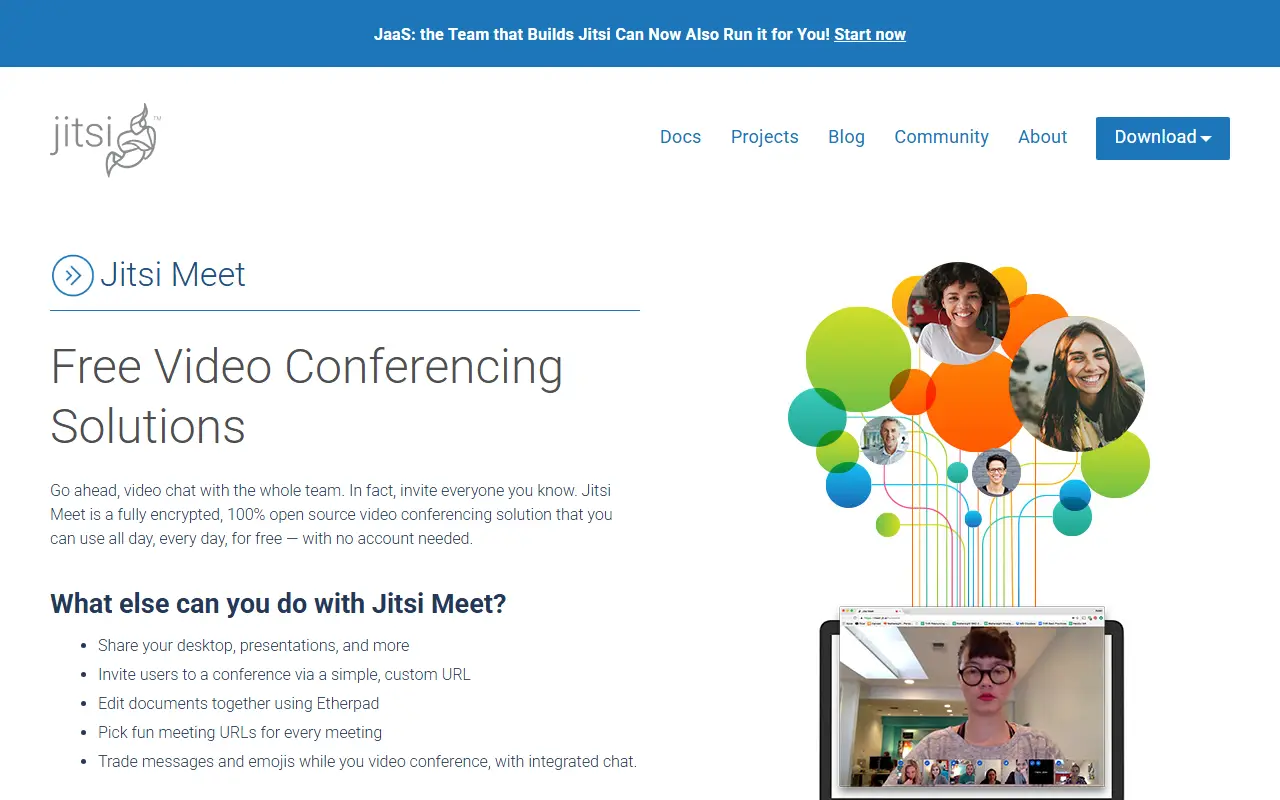
Jitsi Meet is a collection of open-source projects for hosting video conferences. It works in all current browsers and has Android and iOS apps, and it can be used as a ready-made service or embedded into other web applications through web and native SDKs. It is built on WebRTC with a selective forwarding unit to scale to larger meetings.
Meetings offer HD audio and video, content sharing, raised hands and reactions, chat with private conversations, polls and virtual backgrounds. The hosted service at meet.jit.si is free to use, and the README says you can start a meeting after signing in with an account from a major provider. Mobile users can use the browser or the full-featured apps, which are also available from F-Droid, and open beta programs let early adopters test features.
If you prefer control over your data, Jitsi can be deployed on your own infrastructure, with documentation for running your own instance. Jitsi Meet is Apache-2.0 licensed and written in TypeScript. It suits organizations, schools and communities that want an alternative to proprietary meeting software.
Key features
- Browser-based meetings with no install
- Android and iOS apps
- Screen and content sharing
- Chat, polls, reactions and raised hands
- Virtual background support
- Web and native SDKs for embedding
Pricing: Free and open source under Apache-2.0; the public meet.jit.si service is free to use.
#2
An open-source virtual classroom and web conferencing system with real-time audio, video, slides, whiteboard, chat, polling and breakout rooms for online teaching.
- GitHub stars
- 9.3k
- Last commit
- today
- Latest release
- v4.0.2
- Licence
- LGPL-3.0
- Self-hosted
- Yes
bigbluebutton.org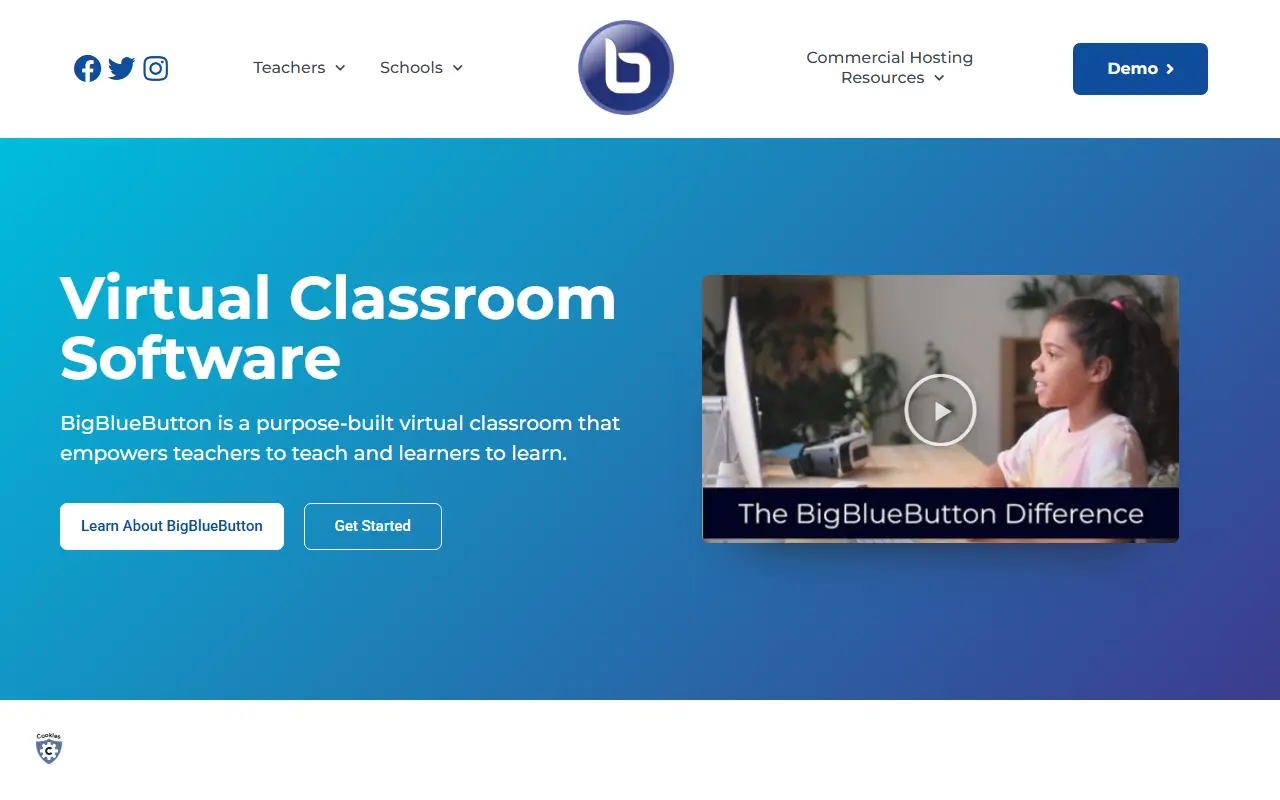
BigBlueButton is an open-source web conferencing system designed for online learning, intended to help teachers teach and learners learn. Participants can share audio, video, slides (with whiteboard annotations), chat messages and their screen in real time, and can also be used for many other meeting types beyond education.
To keep remote students involved, instructors can use polls, emoji reactions, whiteboards that several people can draw on, shared notes and breakout rooms. During a session it generates analytics shown to moderators on a Learning Analytics Dashboard, and presenters can record sessions for later playback and sharing. The README lists online tutoring, flipped classrooms, group collaboration and online classes as the educational scenarios it was built for. Its topics reference WebRTC.
The current major release is BigBlueButton 3.0, which can be installed on Ubuntu 22.04 with the bbb-install.sh script, and full documentation covers architecture, features, the API and GreenLight, the default front end. The software is licensed under LGPL-3.0, while the name and logo are trademarks of BigBlueButton Inc. It suits schools, universities and training providers that want to host their own conferencing.
Key features
- Real-time audio, video and screen sharing
- Slides with whiteboard annotations
- Polling, emojis and breakout rooms
- Multi-user whiteboard and shared notes
- Learning Analytics Dashboard
- Session recording and playback
- GreenLight default front end
Pricing: Free and open source under the LGPL-3.0 licence.
#3
MiroTalk P2P is a self-hosted, open-source WebRTC video conferencing app with browser-based rooms, screen sharing, chat, whiteboard and recording.
- GitHub stars
- 4.8k
- Last commit
- yesterday
- Licence
- AGPL-3.0
- Self-hosted
- Yes
p2p.mirotalk.com
MiroTalk P2P is an open-source video conferencing platform that uses direct peer-to-peer WebRTC connections between participants. You host it on your own server, and people join meeting rooms from a browser with no downloads and no time limits. It is meant for teams and communities that want private real-time communication they control.
Features include unlimited rooms, screen sharing, text chat, a collaborative whiteboard, recording and general collaboration tools. It works across common browsers and platforms, can be deployed with a Docker image in minutes, and has a live demo, documentation and a Discord community. The software is JavaScript based.
MiroTalk P2P is licensed under AGPL-3.0. Because media flows peer to peer, it keeps traffic off a central media server, which suits small groups. It fits small teams, schools and communities who want a self-hosted alternative to commercial meeting tools.
Key features
- Peer-to-peer WebRTC video calls
- Browser-based rooms without downloads
- Screen sharing and text chat
- Shared collaborative whiteboard
- Recording of meetings
- Docker image for quick deployment
Pricing: Free and open source under AGPL-3.0.
#4
La Suite Meet is an open source video conferencing app built on LiveKit with Django and React, joinable from the browser and self-hostable.
- GitHub stars
- 2.5k
- Last commit
- today
- Latest release
- v1.37.0
- Licence
- MIT
- Self-hosted
- Yes
La Suite Meet is a video conferencing application developed by DINUM, the French interministerial digital directorate, and published under the MIT licence. The backend is Django and the frontend is React, and the media layer is provided by LiveKit.
People join calls directly from a browser without installing anything. The feature list covers stability in large meetings of over a hundred participants, several simultaneous screen-sharing streams, non-persistent chat, meeting recording, telephony integration and customisable frontend styling. Transcription and summaries are marked as beta, and end-to-end encryption is listed as coming soon.
It can be self-hosted. The maintainers run Kubernetes for their production instance and also support Docker Compose, while the community has contributed Nix and YunoHost methods. The README notes that documentation for advanced features such as recording and transcription is still thin and points to LiveKit's own documentation meanwhile.
Key features
- Stable in large meetings of 100+ people
- Multiple simultaneous screen sharing streams
- Non-persistent chat
- Meeting recording
- Telephony integration
- Customisable frontend style
- Join from the browser without installing

Self-hosted WebRTC video conferencing platform built on a mediasoup SFU, offered as an alternative to Zoom, Google Meet, Jitsi Meet, and Microsoft Teams.
- GitHub stars
- 3.2k
- Last commit
- yesterday
- Licence
- AGPL-3.0
- Self-hosted
- Yes
sfu.mirotalk.com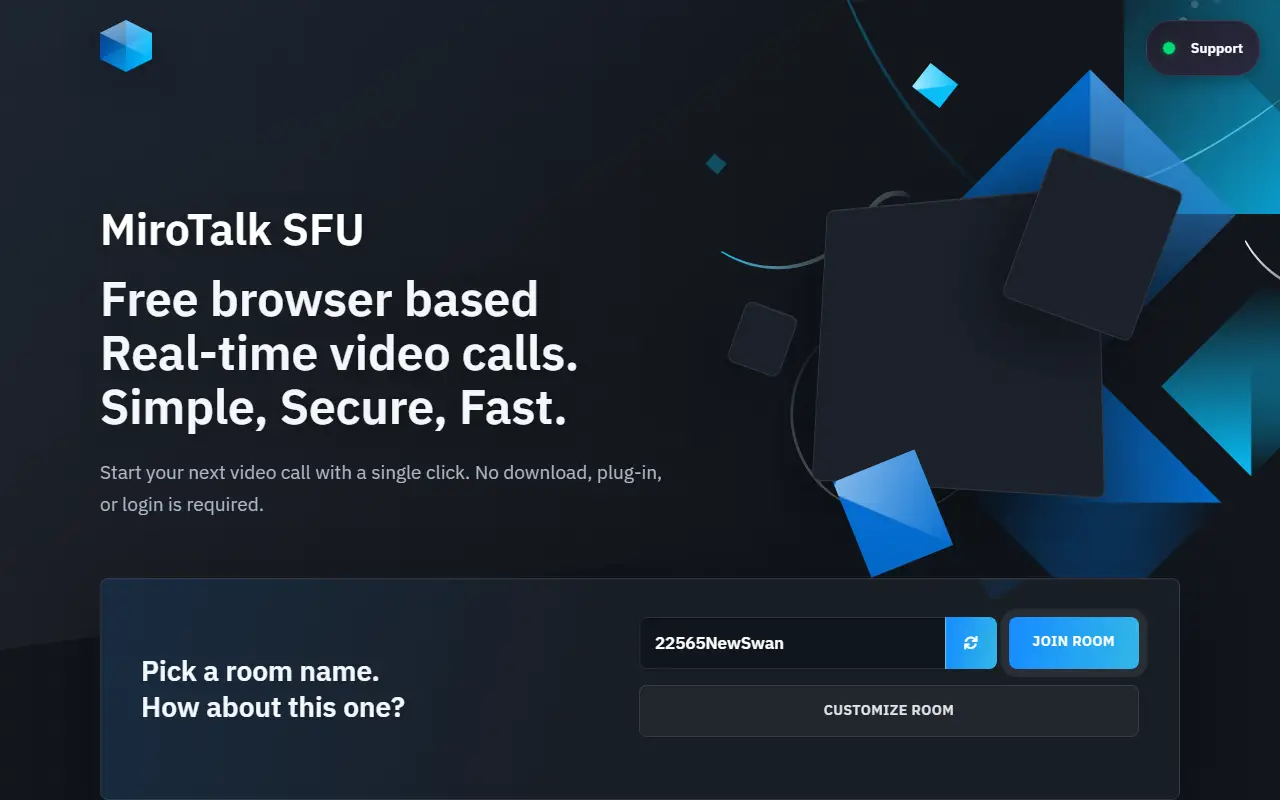
MiroTalk SFU is an open-source video conferencing platform that you deploy on your own server. It uses a mediasoup selective forwarding unit to scale real-time audio and video, and is offered as an alternative to Zoom, Google Meet, Jitsi Meet, and Microsoft Teams. It is released under the AGPL-3.0 license, and one-time commercial license fees are also available.
The platform supports video chat, screen sharing, file sharing, live streaming through RTMP, and webinar-style use cases, with real-time communication over WebRTC and WebSocket. Compared with the hosted services it replaces, the README highlights unlimited meeting duration and rooms, and full control of data and infrastructure with no vendor lock-in.
It is built on Node.js and is distributed with Docker support, so you can run it on a VPS or internal server. It suits organizations, communities, and developers who want private meetings and need to embed or customize video calls, and who are comfortable operating the media server themselves.
Key features
- WebRTC video conferencing on a mediasoup SFU
- Screen sharing and file sharing
- RTMP live streaming
- Unlimited rooms and meeting duration
- Docker deployment on your own server
- Self-hosted with full data control
Pricing: Free and open source under the AGPL-3.0 license; one-time commercial license fees are available.
#6
Serverless peer-to-peer chat and video app that is end-to-end encrypted and ephemeral, with no accounts and no message storage.
- GitHub stars
- 2.3k
- Last commit
- yesterday
- Licence
- GPL-2.0
- Self-hosted
- Yes
- Hosted version
- Available
chitchatter.im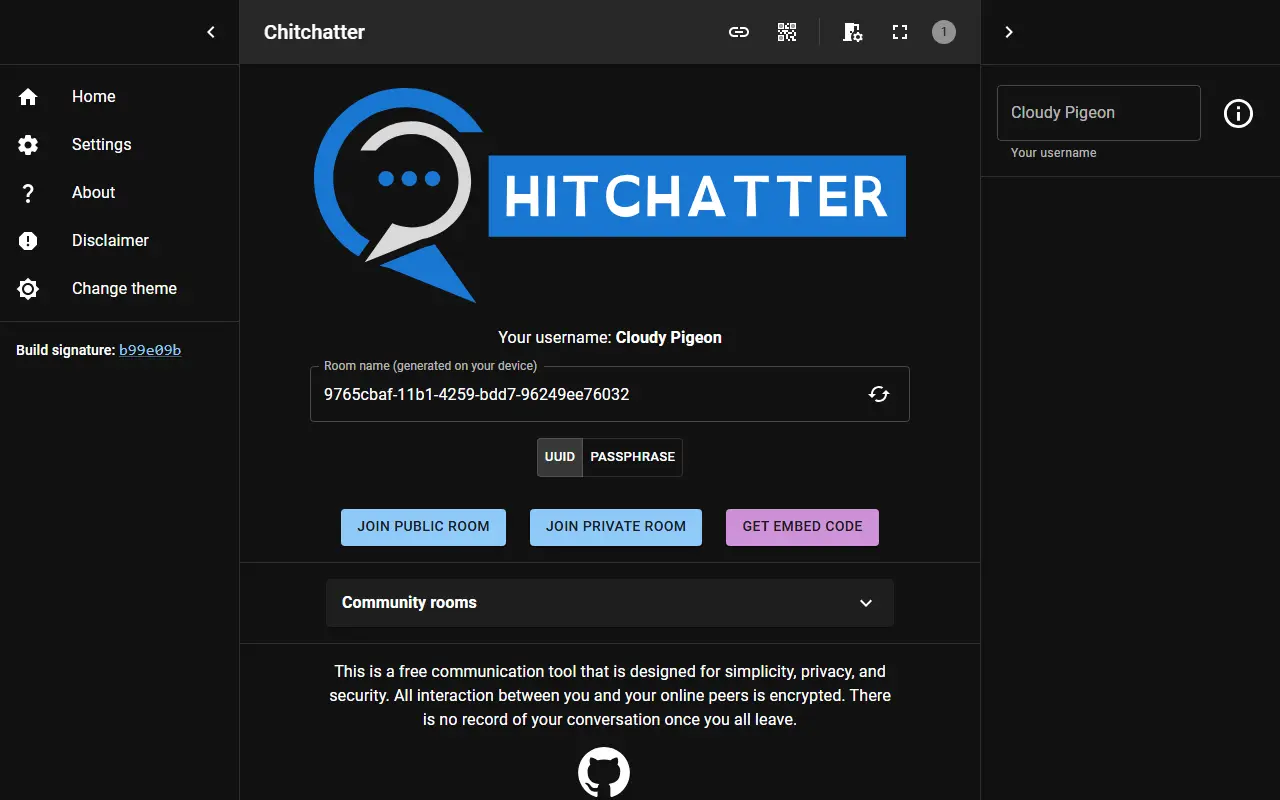
Chitchatter is a free communication tool that aims to be the simplest way to connect with others privately and securely. It is peer-to-peer, using a TURN server only when a direct connection is not possible, and end-to-end encrypted through WebRTC. It is fully open source under the GPL v2 license.
Messages are ephemeral: content is never written to disk on either the client or a server. The tool is also decentralized, working without an API server, with only GitHub for static assets and public WebTorrent and TURN relay servers needed to establish connections. Its topics list video conferencing and the Trystero library.
A public instance runs at chitchatter.im, and since it is a static web app it can also be hosted elsewhere. Chitchatter suits people who want a quick private room for text, video, or file exchange without creating accounts, and developers interested in serverless WebRTC applications.
Key features
- Peer-to-peer WebRTC connections
- End-to-end encryption
- Ephemeral messages never stored to disk
- No account or API server required
- Text chat and video conferencing
- TURN fallback for reliable connections
Pricing: Free and open source under the GPL v2 license; a public instance runs at chitchatter.im.
Galene is a low-resource videoconference server and web client, written to be easy to host, with recording, text chat and a built-in TURN server.
- GitHub stars
- 1.4k
- Last commit
- 3 days ago
- Licence
- MIT
- Self-hosted
- Yes
galene.org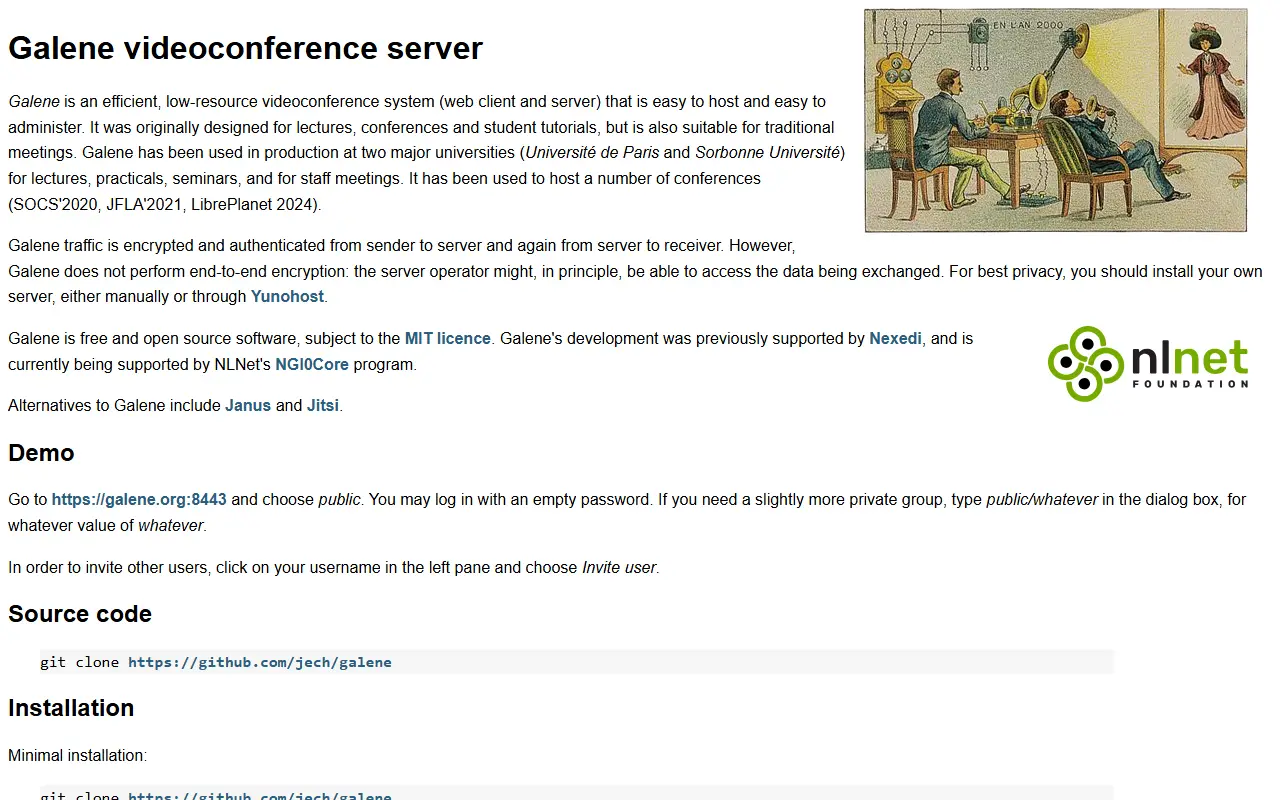
Galene is a videoconference system, with a web client and a server, designed to be efficient, low in resource use, easy to host and easy to administer. It was first made for lectures, conferences and student tutorials, but also suits traditional meetings.
The server supports text chat, recording to disk, simulcast, Scalable Video Coding for VP8 and VP9, a built-in TURN server, an administrative HTTP API and WHIP. Authorisation can be password-based or token-based. The web client works on desktop and mobile browsers and can share screens and windows.
Traffic is encrypted between sender and server and again to the receiver, but not end-to-end, so the server operator could in principle access it. The sources suggest installing your own server for privacy. It is MIT licensed, and the site says it has been used at two universities and several conferences.
Key features
- Efficient, low-resource conferencing server and web client
- Encrypted traffic from sender to server to receiver
- Works in desktop and mobile browsers
- Choice of audio and video codecs
- Password or token based authorisation

Browser-based, privacy-focused group video chat built on WebRTC, available as a free hosted service or a self-hostable, embeddable app.
- GitHub stars
- 1.6k
- Last commit
- 11 days ago
- Latest release
- v3.1.12
- Licence
- AGPL-3.0
- Self-hosted
- Yes
- Hosted version
- Available
brie.fi
Briefing, running at Brie.fi/ng, is a secure group video chat that works directly in the browser using open technologies such as WebRTC. No extra software is needed, and a conversation can start immediately for free. A free iOS app also exists. Features include desktop sharing, text chat and simple invitation links, and the code can be extended with JavaScript and Vue knowledge.
Briefing is self-contained: it bundles the user interface, signaling and STUN components that a WebRTC video chat needs. There are several ways to use it in your own project. You can create a room on Brie.fi/ng and link it from your site, embed it in a frame with a configurator, run it on your own server through Docker or a cloud platform such as fly.io, Render, Google Cloud, AWS or Azure, or customize the source code.
The public license is AGPL-3.0 or later, and the author also offers a commercial license, particularly for white-labeling applications. Sponsorship through GitHub is also welcome. The project is written in TypeScript with Vue, and topics highlight end-to-end encryption and WebRTC signaling.
Key features
- Group video chat in the browser using WebRTC
- Desktop sharing and text chat
- Simple invitation links
- Embeddable in your own website
- Bundled signaling and STUN components
- Docker self-hosting
Pricing: Free to use at Brie.fi/ng and under AGPL-3.0 when self-hosted. A commercial license is available, especially for white-labeling.
#9
edumeet is a self-hosted WebRTC web meeting service built on mediasoup, offering video, screen sharing, file sharing and chat.
- GitHub stars
- 1.4k
- Last commit
- today
- Latest release
- 4.0.0
- Licence
- MIT
- Self-hosted
- Yes
- Hosted version
- Available
letsmeet.no
edumeet is a multiparty web meeting service built with mediasoup and WebRTC, with a React front end. People join meetings in the browser, sharing microphone, camera and an additional video stream, and the system is aimed at education and organizations that want to host their own conferencing.
Main features include audio and video streaming, screen sharing, file sharing using a torrent-based approach, text chat and optional local recording that is disabled by default. Authentication supports OIDC, SAML and a local database. The release is delivered as Docker images for the client, room server, media node and management server, with an installation script that sets up domains, certificates and services.
Hosting it needs Docker and docker-compose, curl, a public IP address and two domain names, one for the service and one for the TURN server, with ports 80 and 443 open. edumeet is licensed under MIT and the project offers a public instance for trying it online and a Discord community. It suits universities, research networks and other institutions that prefer self-hosted video meetings.
Key features
- Browser-based audio and video meetings
- Screen sharing
- File sharing between participants
- Text chat
- OIDC, SAML, and local authentication
- Docker-based installation script
Pricing: Free and open source under the MIT licence.
#10
Plug-N-Meet is a self-hosted, LiveKit-based web conferencing system with whiteboard, breakout rooms, SIP dial-in and an AI meeting agent.
- GitHub stars
- 577
- Last commit
- yesterday
- Latest release
- v2.5.7
- Licence
- MIT
- Self-hosted
- Yes
plugnmeet.org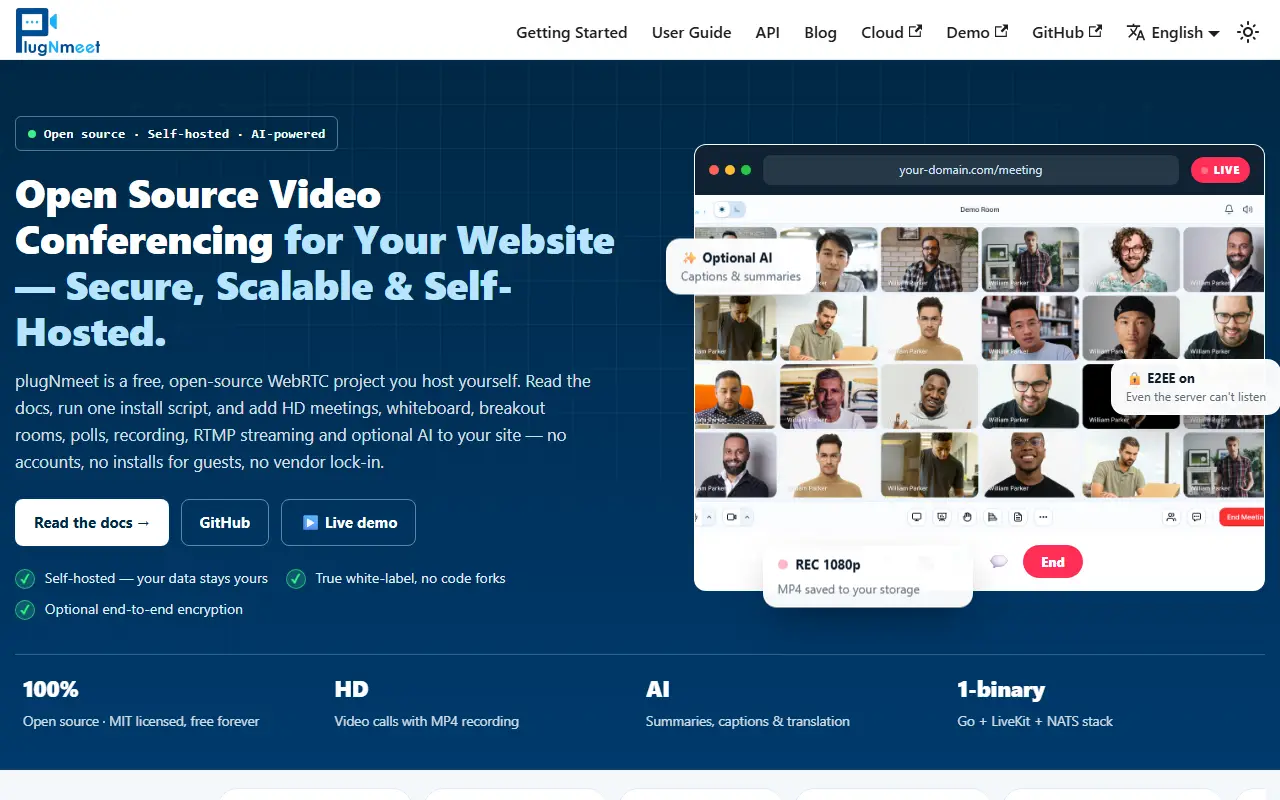
Plug-N-Meet is an open-source web conferencing system built on the WebRTC infrastructure of LiveKit, written in Go. It is designed to be scalable and easy to customize so that a self-hosted video conferencing experience can be integrated into any existing website, application or system.
Collaboration tools include HD audio and video, screen sharing, virtual backgrounds, a collaborative whiteboard with office file support for PDF, DOCX and PPTX, a shared notepad, polls and breakout rooms. Adaptive streaming uses simulcast and dynacast with H264, VP8, VP9 and AV1 codecs to keep calls stable on poor networks. WebRTC encryption is on by default, with optional end-to-end encryption for media and data channels, and a SIP gateway lets participants join the audio by phone. An AI agent adds live spoken translation, real-time transcription and automated summaries with action items, available through an Artifacts API.
Integration is done through an API and SDKs, including one for PHP, and webhooks. Plug-N-Meet is licensed under MIT and has a developer community on Discord.
Key features
- LiveKit-based video conferencing
- Whiteboard with office file support
- Breakout rooms and polls
- Optional end-to-end encryption
- SIP telephone dial-in
- AI transcription, translation and summaries
Pricing: Free and open source under the MIT license.
Commercial GoTo Meeting alternatives
Hosted, closed-source products that compete with GoTo Meeting. Showing 12 of 25.
- View tool
Cisco's meetings, messaging and calling platform for enterprises
SaaS
- View tool

Google Meet
Video Conferencing
Google Meet is Google's video meeting service, used through browsers and mobile apps and integrated with Google Calendar and Workspace.
SaaS
- View tool

Zoho Meeting
Video Conferencing
Online meetings and webinars with screen sharing and recording
SaaS
- View tool
Zoom is a communications platform for video meetings, team chat, phone, webinars, whiteboards and events, with apps for desktop and mobile.
SaaS
- View tool

Tencent Meeting
Video Conferencing
Tencent video conferencing app, also offered internationally as VooV Meeting
SaaS
- View tool

Adobe Connect
Video Conferencing
Web conferencing and virtual classroom software with persistent rooms
SaaS
- View tool

FaceTime
Video Conferencing
Apple's video and audio calling app for iPhone, iPad and Mac
SaaS
- View tool
Enterprise video conferencing that interoperates with Teams, Meet and Zoom
SaaS
- View tool

Digital Samba
Video Conferencing
European video conferencing platform and API with privacy-focused hosting
SaaS
- View tool

Zoom Rooms
Video Conferencing
Conference room software for Zoom meetings with room controls and scheduling
SaaS
- View tool
Microsoft Teams is Microsoft's workspace for chat, video meetings and file collaboration, closely tied to Microsoft 365.
SaaS
- View tool

Livestorm
Video Conferencing
Browser-based webinar and virtual event platform with analytics
SaaS
See every GoTo Meeting alternative on its tool page
GoTo Meeting alternatives: questions
- What is the best open-source alternative to GoTo Meeting?
- Jitsi Meet is the top-ranked open-source alternative to GoTo Meeting on Enlisted: An open-source video conferencing platform that runs in the browser and mobile apps, usable as a standalone service or embedded in your own web application. Other strong options are BigBlueButton, MiroTalk, La Suite Meet and MiroTalk SFU.
- What are the best commercial alternatives to GoTo Meeting?
- Webex, Google Meet, Zoho Meeting, Zoom and Tencent Meeting are among the hosted, closed-source alternatives to GoTo Meeting listed on Enlisted, which lists 25 in total. Compare their pricing and features on each tool page.
- Are these GoTo Meeting alternatives free?
- All 10 are open source, so the code is free to use under its licence, and all of them can be self-hosted on your own server or computer. 4 also offer a paid or managed cloud version if you'd rather not host it yourself.
- How is this list of GoTo Meeting alternatives ranked?
- By a score built from GitHub stars, star growth over the last 30 days and how recently the code changed. 10 of these projects shipped code in the last 30 days. Data is refreshed daily, and nobody can pay to move up.
 TrackMedia
 TrackRev





