 TrackMedia
 TrackRev

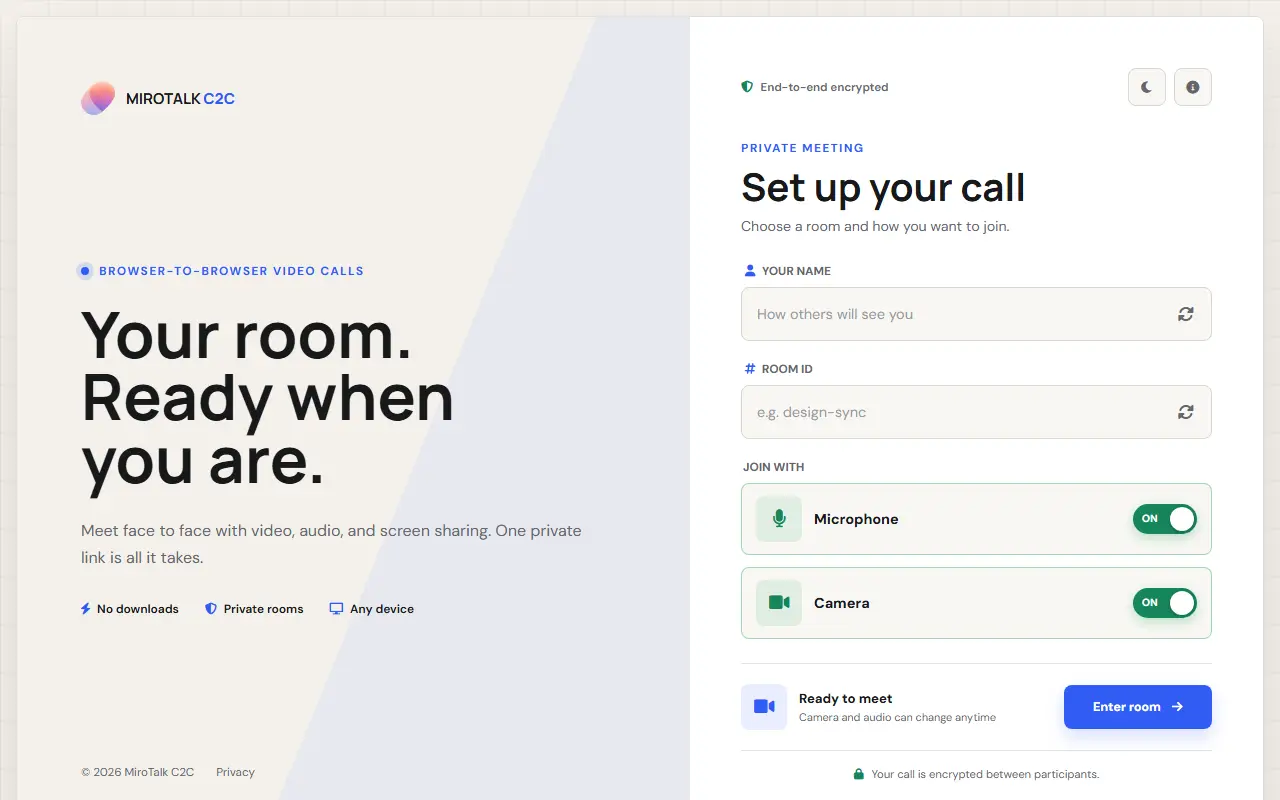
About MiroTalk C2C
MiroTalk C2C is an open-source WebRTC application for private one-to-one video calls between two browsers. It uses direct peer-to-peer connections and supports screen sharing, and the project describes the calls as end-to-end encrypted.
It is aimed at consultations, coaching, customer support, telehealth and other situations where two people need a private browser-based call. The interface can be embedded into any website via an iframe. Settings include camera background options of off, blur or a custom image, processed locally in the browser, although the effects load MediaPipe files from external hosts.
You can start it with a few commands or run it with Docker and Docker Compose, then open it on localhost port 8080. A live demo, documentation and a Discord community are linked from the repository. The project is licensed under AGPL-3.0 and is written in JavaScript.
Key features
- Peer-to-peer WebRTC one-to-one video calls
- Screen sharing
- Embeddable in websites via iframe
- Camera background blur and image options
- Docker and Docker Compose deployment
- End-to-end encrypted calls
Good fit for
- Telehealth and online consultations
- Coaching sessions
- Customer support video calls
MiroTalk C2C: questions and answers
- What is MiroTalk C2C used for?
- MiroTalk C2C is a self-hosted WebRTC tool for private one-to-one video calls with screen sharing, which you can embed in a website through an iframe. It is a good fit for telehealth and online consultations, coaching sessions, and customer support video calls.
- Is MiroTalk C2C open source?
- Yes. MiroTalk C2C is open source under the AGPL-3.0 licence. Its source code is on GitHub at miroslavpejic85/mirotalkc2c and is written mainly in JavaScript.
- Is MiroTalk C2C free?
- Yes. MiroTalk C2C is open source, so the software itself is free to use.
- Can I self-host MiroTalk C2C?
- Yes. MiroTalk C2C can be self-hosted on your own server or infrastructure.
- What is MiroTalk C2C an alternative to?
- MiroTalk C2C is an open-source alternative to Zoom, Whereby and FaceTime. Other open-source alternatives to Zoom include Briefing, Jitsi Meet and MiroTalk.
- Is MiroTalk C2C actively maintained?
- Yes. The most recent commit to MiroTalk C2C was on 9 November 2026. The project has 521 stars on GitHub, with 5 added in the last 30 days.
Open-source alternatives to MiroTalk C2C
See all
Briefing
Video Conferencing
🔮 Secure direct video group chat
AGPL-3.0vs Whereby★ 1.6k
Jitsi Meet
Video Conferencing
Jitsi Meet - Secure, Simple and Scalable Video Conferences that you use as a standalone ap
Apache-2.0vs Zoom★ 30k
MiroTalk
Video Conferencing
🚀 Open-source, self-hosted P2P WebRTC video conferencing for fast, private real-time comm
AGPL-3.0vs Zoom★ 4.8kGalène
Video Conferencing
The Galène videoconference server
MITvs Zoom★ 1.4k
Chitchatter
Team Chat
Secure peer-to-peer chat that is serverless, decentralized, and ephemeral
GPL-2.0vs Whereby★ 2.3k
Linphone
Team Chat
Linphone is a free VoIP and video softphone based on the SIP protocol. Mirror of git://git
GPL-3.0vs RingCentral★ 516
SaaS alternatives to MiroTalk C2C
See all
Zoom
Video Conferencing
Zoom is a communications platform for video meetings, team chat, phone, webinars, whiteboards and events, with apps for desktop and mobile.
SaaS
Whereby
Video Conferencing
Browser-based video meetings with persistent rooms and no downloads
SaaS
FaceTime
Video Conferencing
Apple's video and audio calling app for iPhone, iPad and Mac
SaaS
Tencent Meeting
Video Conferencing
Tencent video conferencing app, also offered internationally as VooV Meeting
SaaS
Tuple
Video Conferencing
Low-latency screen sharing built for remote pair programming
SaaS
Zoho Meeting
Video Conferencing
Online meetings and webinars with screen sharing and recording
SaaS