
About Solarscope
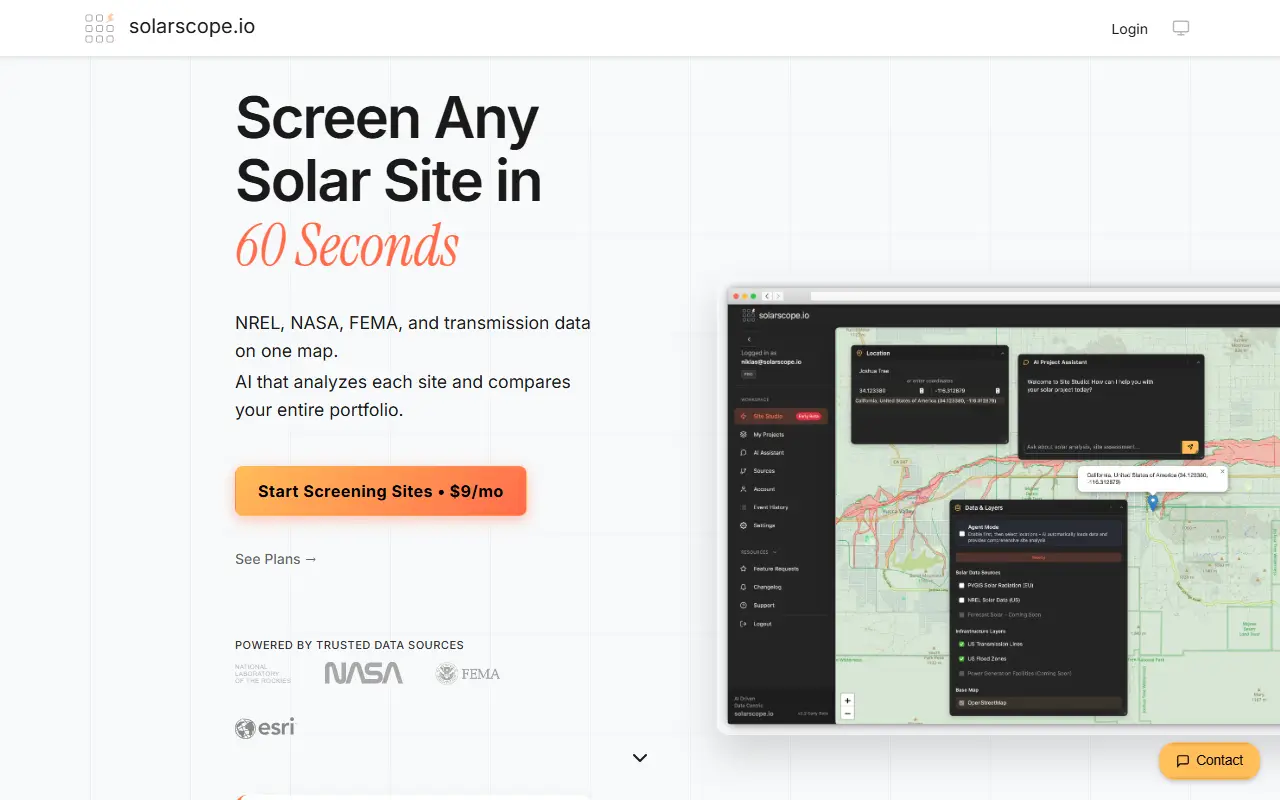
SolarScope is a browser-based tool for commercial solar developers who need to judge whether a location is worth pursuing. Instead of gathering separate datasets, the user opens a map-first workspace called Site Studio and sees solar potential, transmission lines, flood zones and other site constraints in one place. The homepage says the product is still in development and is recruiting beta testers.
A typical session starts by pinning a project area by address or coordinates, then switching on data layers such as PVGIS and NREL solar radiation, transmission infrastructure and flood zones. An AI project assistant answers questions about the selected site using irradiance, terrain, constraints and financial inputs, while a pipeline analysis feature compares a whole portfolio, ranks sites by opportunity and points out where data is missing. Source data is credited to HIFLD, NASA POWER and the EU Joint Research Centre.
Key features
- Interactive map workspace for solar site screening
- Toggle PVGIS and NREL solar radiation layers
- Transmission line, flood zone and infrastructure overlays
- AI assistant that answers questions about a site
- Portfolio pipeline analysis that ranks sites by opportunity
- Pin project locations by address or coordinates
Good fit for
- Screening candidate sites for a commercial solar project
- Ranking a pipeline of sites to decide where to focus
- Early feasibility checks before detailed engineering
Solarscope: questions and answers
- What is Solarscope used for?
- Solarscope is a web platform that lets commercial solar developers screen sites on an interactive map, with AI assistance for single-site analysis and portfolio ranking. It is a good fit for screening candidate sites for a commercial solar project, ranking a pipeline of sites to decide where to focus and early feasibility checks before detailed engineering.
- How much does Solarscope cost?
- Paid plans for Solarscope start at $9 per month, and there is no free plan.
- Is Solarscope open source?
- No. Solarscope is proprietary (closed-source) software and can't be self-hosted. In the Maps & Navigation category, open-source options include OpenStreetMap, Organic Maps and Dawarich.
- What are some alternatives to Solarscope?
- Other SaaS products in the Maps & Navigation category include Cesium, Felt and HuntScout.
Open-source alternatives to Solarscope
See all
OpenStreetMap
Maps & Navigation
The Rails application that powers OpenStreetMap
GPL-2.0vs Google Maps★ 2.8k
Organic Maps
Maps & Navigation
🍃 Organic Maps is a free Android & iOS offline maps app for more than 6M travelers, touri
OSSvs Google Maps★ 16k
Dawarich
Maps & Navigation
The private alternative to Google Timeline. Import your location history, keep it forever.
AGPL-3.0★ 11k
OsmAnd
Maps & Navigation
OsmAnd
OSSvs Google Maps★ 6.1k
Wanderer
Maps & Navigation
wanderer is a self-hosted trail database. Save your adventures!
AGPL-3.0vs Komoot★ 4k
iD
Maps & Navigation
🆔 The easy-to-use OpenStreetMap editor in JavaScript.
ISC★ 3.9k
SaaS alternatives to Solarscope
See all
Cesium
Maps & Navigation
3D geospatial platform and Cesium ion for streaming 3D tiles and terrain
SaaS
Felt
Maps & Navigation
Collaborative web mapping tool for making and sharing maps
SaaS
HuntScout
Maps & Navigation
Hunting app with land ownership, regulations and hunt zone information plus AI guidance
SaaS
MapGO
Maps & Navigation
Geospatial platform for country boundaries, distances to borders, nearest points and spatial relationships
SaaS
AllTrails
Maps & Navigation
Trail guide and map app for hiking, biking and running
SaaS
Amazon Location Service
Maps & Navigation
AWS service for adding maps, geocoding, routing and tracking to applications
SaaS