
 DigitalOcean Spaces
 Scaleway Object Storage
 Bunny Storage
 Synology C2
 Filebase
 IBM Cloud Object Storage
 Oracle Cloud Object Storage
 Akamai Object Storage
 Amazon EFS
 Azure Files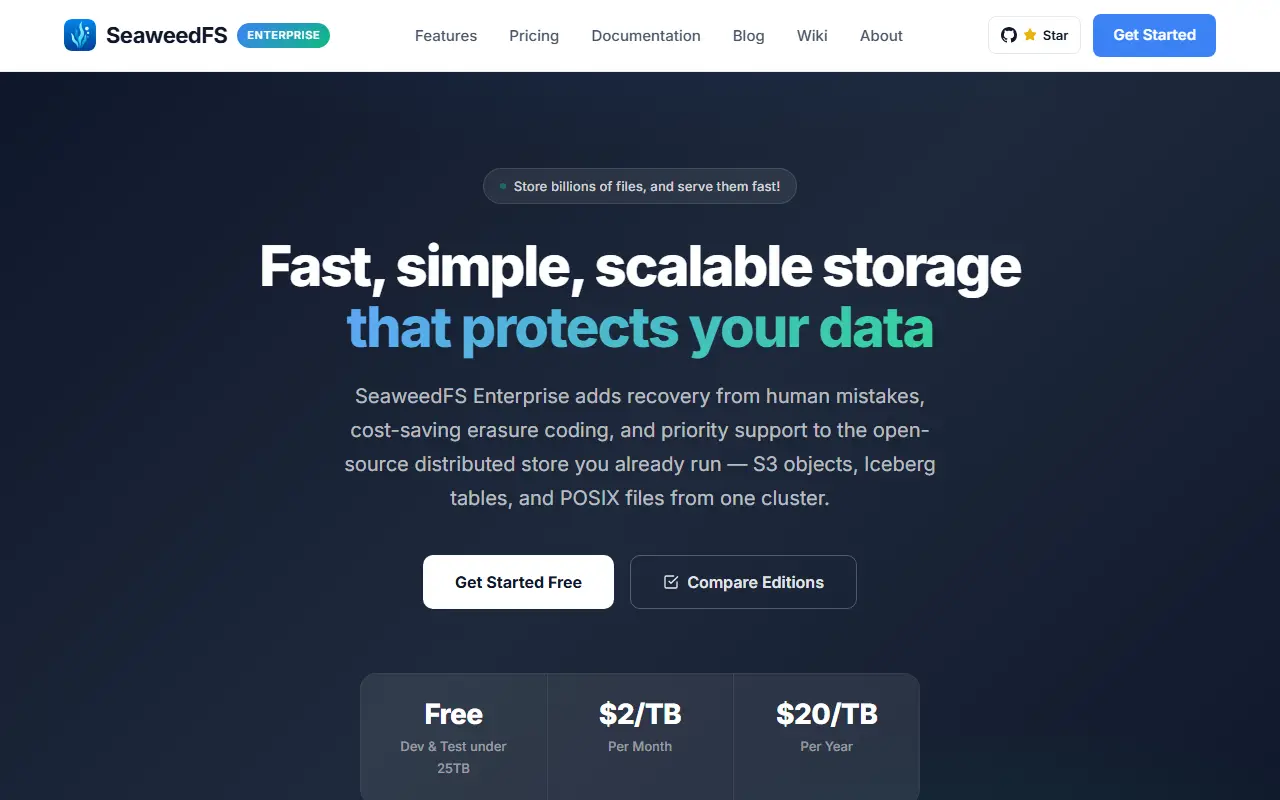
About SeaweedFS
SeaweedFS is a distributed storage system built to store very large numbers of files and serve them quickly. A single weed binary can provide an S3-compatible object store, a POSIX file system and S3 Tables for lakehouse use, all over the same data. The project is written in Go and released under the Apache-2.0 license.
Its design aims for constant-time disk access per file, and capacity grows by starting another volume server. Cloud storage can be cached or tiered transparently, and replication and erasure coding are supported. The same process can also run the master, volume servers, a filer, WebDAV, an Iceberg REST catalog and an Admin UI. You can start with one command, Docker, Docker Compose or Helm on Kubernetes, or build from source. The README includes comparisons with HDFS, Ceph, GlusterFS, MooseFS and MinIO.
Key features
- S3-compatible object storage
- POSIX file system access via FUSE
- Iceberg tables and S3 Tables support
- Tiering and caching for cloud storage
- Replication and erasure coding
- Install with Docker, Helm or one binary
Good fit for
- →Self-hosted S3 storage for applications
- →Storing billions of small files efficiently
- →Data lake storage on your own servers
- Tags
- object-storage
- s3
- distributed-storage
- file-system
- golang
- kubernetes
- erasure-coding
- self-hosted
SeaweedFS: questions and answers
- What is SeaweedFS used for?
- SeaweedFS is a distributed storage system that serves an S3 object store, a file system and Iceberg tables from one scalable binary. It is a good fit for self-hosted S3 storage for applications, storing billions of small files efficiently and data lake storage on your own servers.
- Is SeaweedFS open source?
- Yes. SeaweedFS is open source under the Apache-2.0 licence. Its source code is on GitHub at seaweedfs/seaweedfs and is written mainly in Go.
- Is SeaweedFS free?
- Yes. SeaweedFS is open source, so the software itself is free to use.
- Can I self-host SeaweedFS?
- Yes. SeaweedFS can be self-hosted on your own server or infrastructure.
- What is SeaweedFS an alternative to?
- SeaweedFS is an open-source alternative to Amazon S3, Google Cloud Storage, Azure Blob Storage and Backblaze B2. Other open-source alternatives to Amazon S3 include Ceph and RustFS.
- Is SeaweedFS actively maintained?
- Yes. The most recent commit to SeaweedFS was on 2 October 2026, and the latest release is 4.48, published on 28 September 2026. The project has 35k stars on GitHub.
Open-source alternatives to SeaweedFS
See all
Ceph
Infrastructure & Containers
Ceph is a distributed object, block, and file storage platform
OSSvs Amazon S3★ 17k
RustFS
File Storage & Sharing
RustFS is an open-source, S3-compatible high-performance object storage system supporting
Apache-2.0vs Amazon S3★ 34k
JuiceFS
Infrastructure & Containers
JuiceFS is a distributed POSIX file system built on top of Redis and S3.
Apache-2.0vs Amazon EFS★ 14k
restic
File Storage & Sharing
Fast, secure, efficient backup program
BSD-2-Clausevs CrashPlan★ 36kBackrest
File Storage & Sharing
Backrest is a web UI and orchestrator for restic backup.
GPL-3.0vs Backblaze Computer Backup★ 7.4k
Duplicati
File Storage & Sharing
Store securely encrypted backups in the cloud!
OSSvs Backblaze Computer Backup★ 15k
SaaS alternatives to SeaweedFS
See all
Amazon S3
File Storage & Sharing
Amazon S3 is AWS's cloud object storage service for data lakes, backup and restore, archival, mobile apps and analytics workloads.
SaaS
Google Cloud Storage
File Storage & Sharing
Google Cloud object storage with multiple storage classes and global availability
SaaS
Azure Blob Storage
File Storage & Sharing
Microsoft Azure object storage for unstructured data, backups and data lakes
SaaS
Backblaze B2
File Storage & Sharing
S3-compatible object storage priced per terabyte, used for backups and media
SaaS
Wasabi
File Storage & Sharing
S3-compatible hot cloud storage with flat per-terabyte pricing and no egress fees
SaaS
Cloudflare R2
File Storage & Sharing
S3-compatible object storage with no egress fees, integrated with Cloudflare Workers
SaaS