
 DigitalOcean Spaces
 Scaleway Object Storage
 Bunny Storage
 Synology C2
 Filebase
 IBM Cloud Object Storage
 Oracle Cloud Object Storage
 Akamai Object Storage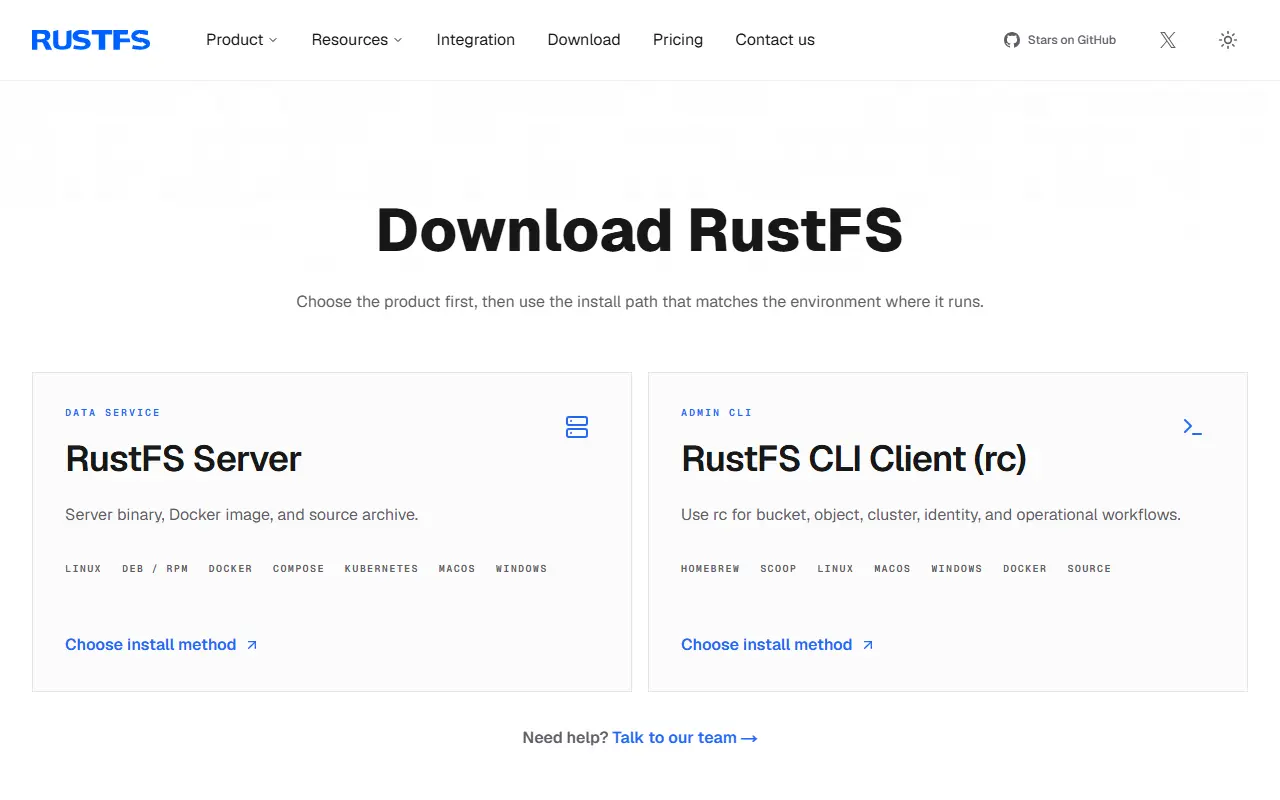
About RustFS
RustFS is a distributed object storage system built in Rust. It offers S3 API compatibility for supported features, and is meant to coexist with, or take over from, platforms like MinIO and Ceph that also speak the S3 API. The project is open source under the Apache 2.0 license and highlights that this avoids the restrictions of AGPL-licensed alternatives.
The feature list includes a scalable, fault-tolerant distributed architecture, an S3 compatibility matrix that tracks current coverage, and native support for the OpenStack Swift API and Keystone authentication. It is tuned for data lakes, AI and big data workloads, and the README says it was designed for easy deployment and management. A status legend marks features as available, preview or planned, so check the documentation for the current state of each capability before relying on it.
Key features
- S3 API compatibility with published matrix
- Distributed, fault-tolerant architecture
- OpenStack Swift API support
- Keystone authentication integration
- Aimed at data lake and AI workloads
- Written in Rust under Apache 2.0
Good fit for
- →Self-hosted S3 storage for big data pipelines
- →Migrating from MinIO or Ceph
- →Object storage for AI training data
- Built with
- Rust
- Tags
- object-storage
- s3
- rust
- distributed-storage
- minio-alternative
- data-lake
- self-hosted
- cloud-native
RustFS: questions and answers
- What is RustFS used for?
- RustFS is an S3-compatible, distributed object storage system written in Rust and released under the Apache-2.0 license. It is a good fit for self-hosted S3 storage for big data pipelines, migrating from MinIO or Ceph and object storage for AI training data.
- Is RustFS open source?
- Yes. RustFS is open source under the Apache-2.0 licence. Its source code is on GitHub at rustfs/rustfs and is written mainly in Rust.
- Is RustFS free?
- Yes. RustFS is open source, so the software itself is free to use.
- Can I self-host RustFS?
- Yes. RustFS can be self-hosted on your own server or infrastructure.
- What is RustFS an alternative to?
- RustFS is an open-source alternative to Amazon S3, Google Cloud Storage, Azure Blob Storage and Backblaze B2. Other open-source alternatives to Amazon S3 include SeaweedFS and Ceph.
- Is RustFS actively maintained?
- Yes. The most recent commit to RustFS was on 2 October 2026, and the latest release is 1.0.0, published on 16 September 2026. The project has 34k stars on GitHub.
Open-source alternatives to RustFS
See all
SeaweedFS
File Storage & Sharing
SeaweedFS is a distributed storage system for object storage (S3), file systems, and Icebe
Apache-2.0vs Amazon S3★ 35k
Ceph
Infrastructure & Containers
Ceph is a distributed object, block, and file storage platform
OSSvs Amazon S3★ 17k
restic
File Storage & Sharing
Fast, secure, efficient backup program
BSD-2-Clausevs CrashPlan★ 36kBackrest
File Storage & Sharing
Backrest is a web UI and orchestrator for restic backup.
GPL-3.0vs Backblaze Computer Backup★ 7.4k
Duplicati
File Storage & Sharing
Store securely encrypted backups in the cloud!
OSSvs Backblaze Computer Backup★ 15k
Kopia
File Storage & Sharing
Cross-platform backup tool for Windows, macOS & Linux with fast, incremental backups, clie
Apache-2.0vs Backblaze Computer Backup★ 14k
SaaS alternatives to RustFS
See all
Amazon S3
File Storage & Sharing
Amazon S3 is AWS's cloud object storage service for data lakes, backup and restore, archival, mobile apps and analytics workloads.
SaaS
Google Cloud Storage
File Storage & Sharing
Google Cloud object storage with multiple storage classes and global availability
SaaS
Azure Blob Storage
File Storage & Sharing
Microsoft Azure object storage for unstructured data, backups and data lakes
SaaS
Backblaze B2
File Storage & Sharing
S3-compatible object storage priced per terabyte, used for backups and media
SaaS
Wasabi
File Storage & Sharing
S3-compatible hot cloud storage with flat per-terabyte pricing and no egress fees
SaaS
Cloudflare R2
File Storage & Sharing
S3-compatible object storage with no egress fees, integrated with Cloudflare Workers
SaaS