7,363 open-source and SaaS tools, with GitHub stats refreshed every day.

3 alternatives ranked by real activity

Open-source DigitalOcean Spaces alternatives

A curated, ranked list of the 3 best open-source alternatives to DigitalOcean Spaces.

The best open-source alternative to DigitalOcean Spaces is SeaweedFS. If that doesn't suit you, other good options are RustFS and Ceph.

DigitalOcean Spaces alternatives are mainly file storage & sharing tools, but some are also infrastructure & container tools. 3 of them shipped code in the last 30 days, 3 can be self-hosted, and 2 use a permissive licence.

Last updated October 2, 2026 · ranked by GitHub stars, growth and recent commits

SeaweedFS

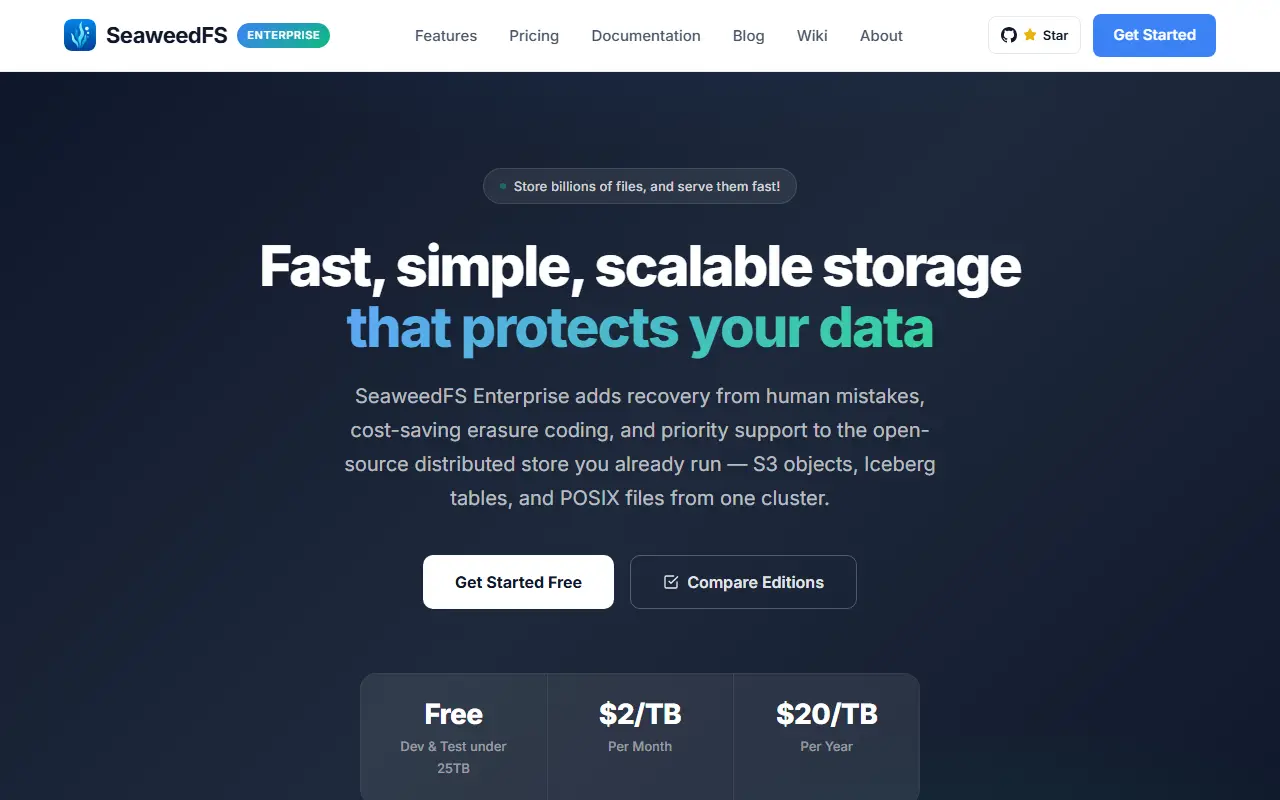
SeaweedFS is a distributed storage system that serves an S3 object store, a file system and Iceberg tables from one scalable binary.

GitHub stars
35k
Last commit
today
Latest release
4.48
Licence
Apache-2.0
Self-hosted
Yes
seaweedfs.comSeaweedFS homepage screenshot

SeaweedFS is a distributed storage system built to store very large numbers of files and serve them quickly. A single weed binary can provide an S3-compatible object store, a POSIX file system and S3 Tables for lakehouse use, all over the same data. The project is written in Go and released under the Apache-2.0 license.

Its design aims for constant-time disk access per file, and capacity grows by starting another volume server. Cloud storage can be cached or tiered transparently, and replication and erasure coding are supported. The same process can also run the master, volume servers, a filer, WebDAV, an Iceberg REST catalog and an Admin UI. You can start with one command, Docker, Docker Compose or Helm on Kubernetes, or build from source. The README includes comparisons with HDFS, Ceph, GlusterFS, MooseFS and MinIO.

Key features

  • S3-compatible object storage
  • POSIX file system access via FUSE
  • Iceberg tables and S3 Tables support
  • Tiering and caching for cloud storage
  • Replication and erasure coding
  • Install with Docker, Helm or one binary

Pricing: Free for dev and test under 25TB. Enterprise is priced per terabyte at $2 per month, or $20 per TB per year.

Read more about SeaweedFSWebsite GitHub

RustFS

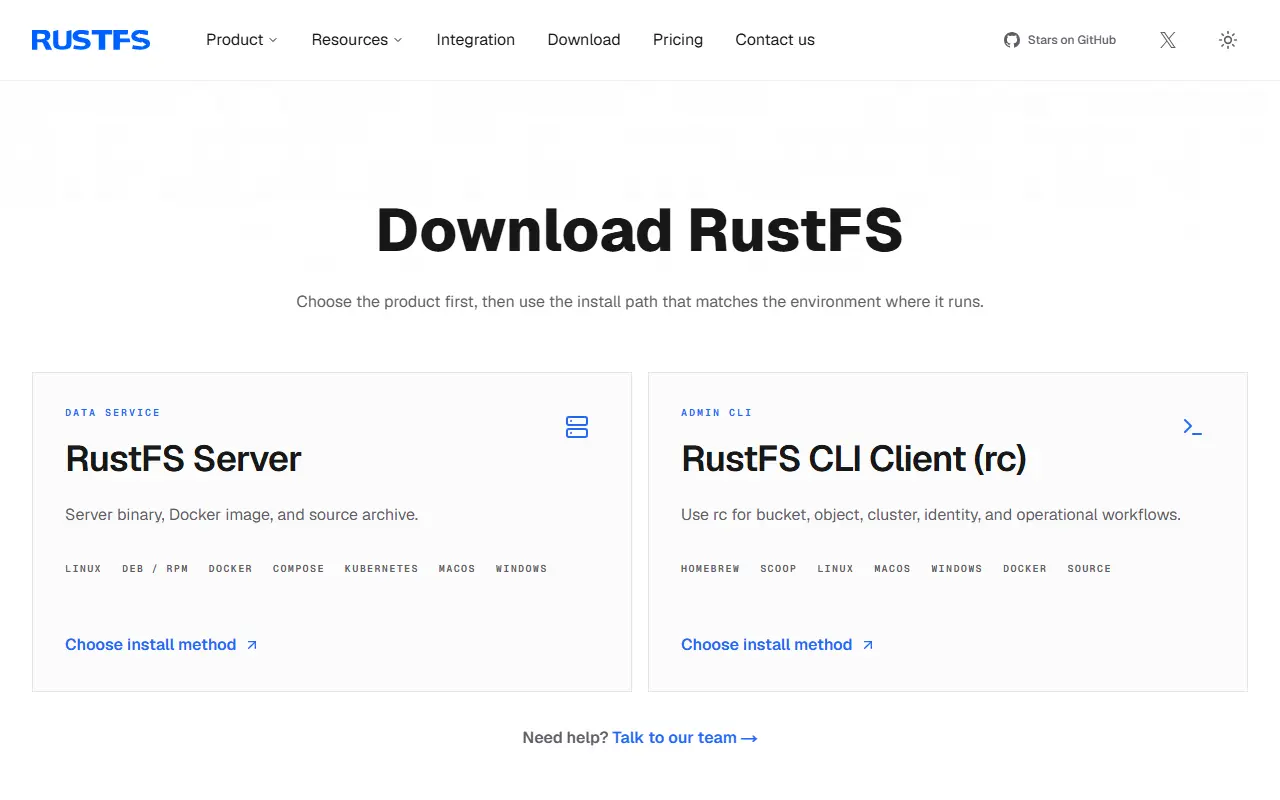
RustFS is an S3-compatible, distributed object storage system written in Rust and released under the Apache-2.0 license.

GitHub stars
34k
Last commit
today
Latest release
1.0.0
Licence
Apache-2.0
Self-hosted
Yes
rustfs.comRustFS homepage screenshot

RustFS is a distributed object storage system built in Rust. It offers S3 API compatibility for supported features, and is meant to coexist with, or take over from, platforms like MinIO and Ceph that also speak the S3 API. The project is open source under the Apache 2.0 license and highlights that this avoids the restrictions of AGPL-licensed alternatives.

The feature list includes a scalable, fault-tolerant distributed architecture, an S3 compatibility matrix that tracks current coverage, and native support for the OpenStack Swift API and Keystone authentication. It is tuned for data lakes, AI and big data workloads, and the README says it was designed for easy deployment and management. A status legend marks features as available, preview or planned, so check the documentation for the current state of each capability before relying on it.

Key features

  • S3 API compatibility with published matrix
  • Distributed, fault-tolerant architecture
  • OpenStack Swift API support
  • Keystone authentication integration
  • Aimed at data lake and AI workloads
  • Written in Rust under Apache 2.0

Pricing: RustFS is free under Apache 2.0 for self-hosted use. Enterprise support and migration planning have no published price; contact the team or request a demo.

Read more about RustFSWebsite GitHub

Ceph

Ceph is a scalable, distributed storage system that provides object, block and file storage from a single software-defined platform.

GitHub stars
17k
Last commit
today
Self-hosted
Yes
ceph.ioCeph homepage screenshot

Ceph is a distributed storage platform that offers object, block and file storage from one software-defined system. It is designed to scale across many servers and provide highly available storage, and it is written mainly in C++.

Repository topics show the range of protocols and features it covers: S3-compatible object storage, block storage, a POSIX distributed file system with FUSE access, protocols such as NFS, SMB, iSCSI and NVMe over Fabrics, and replication and erasure coding for data protection. The topics also mention Kubernetes and HDFS.

Most of Ceph is dual-licensed under the LGPL version 2.1 or 3.0, with some code in the public domain or under BSD-style licenses, which is why the repository lists the license as 'Other'. The documentation uses CC-BY-SA-3.0, and contributions need a Signed-off-by line without copyright assignment. Ceph is deployed on your own hardware or cloud infrastructure.

Key features

  • Unified object, block and file storage
  • S3-compatible object storage
  • POSIX distributed file system
  • Replication and erasure coding
  • NFS, SMB and iSCSI access
  • Scales across many servers

Pricing: Free and open source, mostly dual-licensed under LGPL 2.1 or 3.0.

Read more about CephWebsite GitHub

DigitalOcean Spaces alternatives: questions

What is the best open-source alternative to DigitalOcean Spaces?
SeaweedFS is the top-ranked open-source alternative to DigitalOcean Spaces on Enlisted: SeaweedFS is a distributed storage system that serves an S3 object store, a file system and Iceberg tables from one scalable binary. Other strong options are RustFS and Ceph.
Are these DigitalOcean Spaces alternatives free?
All 3 are open source, so the code is free to use under its licence, and all of them can be self-hosted on your own server or computer.
How is this list of DigitalOcean Spaces alternatives ranked?
By a score built from GitHub stars, star growth over the last 30 days and how recently the code changed. 3 of these projects shipped code in the last 30 days. Data is refreshed daily, and nobody can pay to move up.

People also look for alternatives to…

View all